AIR LAW FLIGHT RULES Airspace classification 1 A


- Slides: 9
AIR LAW – FLIGHT RULES Airspace classification -1 A. Above 20000 ft (FL 200) Instrument (IFR) flights only B Visual (VFR) and Instrument (IFR) flights* C. All controlled airspace below 20000 ft IFR/IFR, IFR/VFR, VFR/IFR separations, VFR/VFR Information only provided (no separation)* D. Visual (VFR) and Instrument (IFR) flights* E. Visual (VFR) and Instrument (IFR) flights* F. Visual (VFR) and Instrument (IFR) flights* G. Uncontrolled Airspace. Visual (VFR) and Instrument (IFR) flights. No separation. Flight Information (only) on request i. e. other aircraft which could affect your flight * Not used in Ireland (Shannon FIR). D, E & F used in N. Ireland (part of Scottish FIR)
AIR LAW – FLIGHT RULES Airspace classification -2 Class A. All Airspace above 20000 ft (FL 200), including Airways Class C. - Shannon and Dublin Control Areas (CTAs) below FL 200 - All Airways in Shannon Flight Information Region (FIR) below FL 200 - Connaught (Galway), Cork, Dublin & Shannon Control Zones (CTRs) - All other CTRs when airports open Class G. All other airspace & Regional Airports when closed
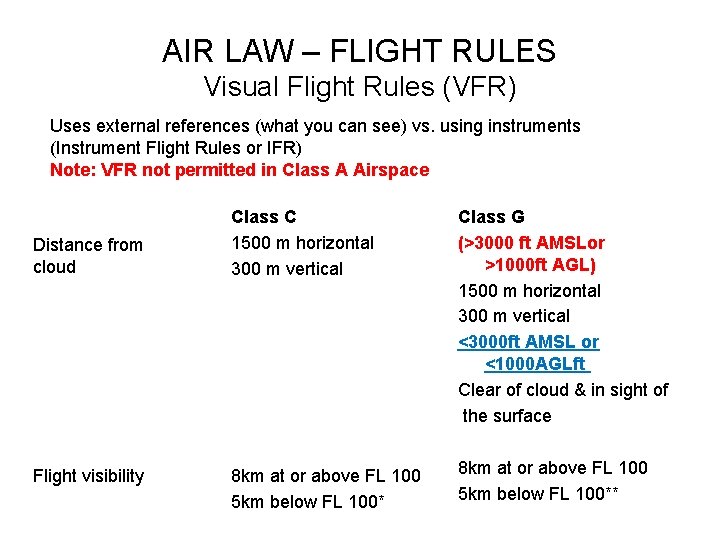
AIR LAW – FLIGHT RULES Visual Flight Rules (VFR) Uses external references (what you can see) vs. using instruments (Instrument Flight Rules or IFR) Note: VFR not permitted in Class A Airspace Distance from cloud Flight visibility Class C 1500 m horizontal 300 m vertical Class G (>3000 ft AMSLor >1000 ft AGL) 1500 m horizontal 300 m vertical <3000 ft AMSL or <1000 AGLft Clear of cloud & in sight of the surface 8 km at or above FL 100 5 km below FL 100**
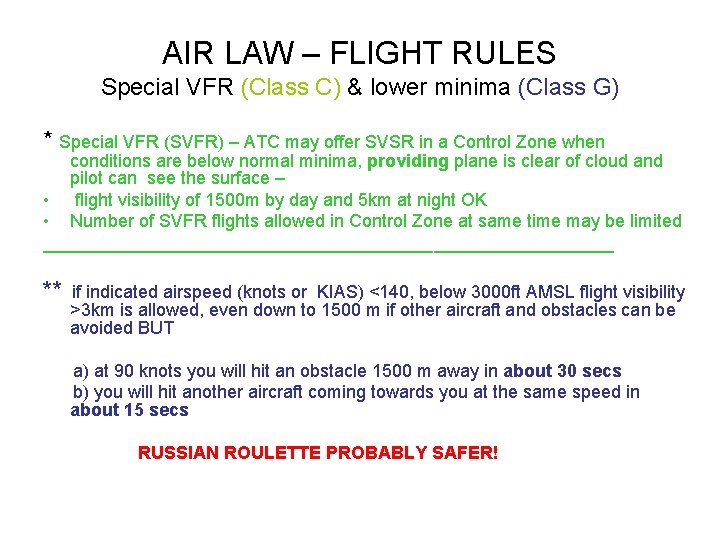
AIR LAW – FLIGHT RULES Special VFR (Class C) & lower minima (Class G) * Special VFR (SVFR) – ATC may offer SVSR in a Control Zone when conditions are below normal minima, providing plane is clear of cloud and pilot can see the surface – • flight visibility of 1500 m by day and 5 km at night OK • Number of SVFR flights allowed in Control Zone at same time may be limited _____________________________ ** if indicated airspeed (knots or KIAS) <140, below 3000 ft AMSL flight visibility >3 km is allowed, even down to 1500 m if other aircraft and obstacles can be avoided BUT a) at 90 knots you will hit an obstacle 1500 m away in about 30 secs b) you will hit another aircraft coming towards you at the same speed in about 15 secs RUSSIAN ROULETTE PROBABLY SAFER!
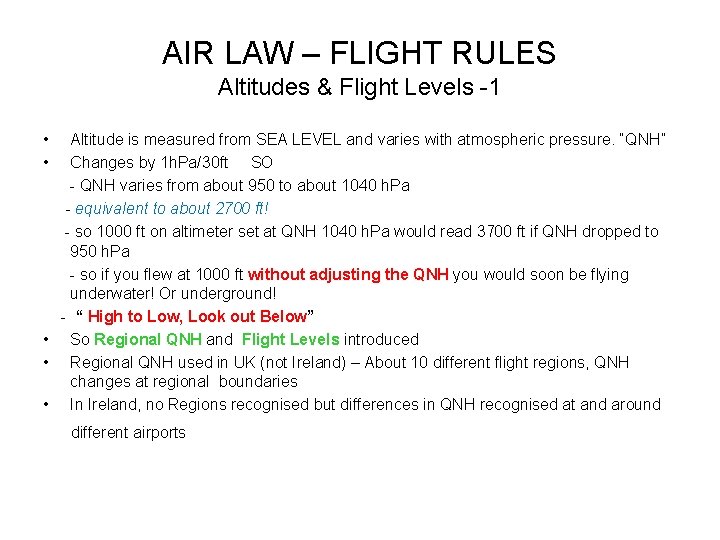
AIR LAW – FLIGHT RULES Altitudes & Flight Levels -1 • • Altitude is measured from SEA LEVEL and varies with atmospheric pressure. “QNH” Changes by 1 h. Pa/30 ft SO - QNH varies from about 950 to about 1040 h. Pa - equivalent to about 2700 ft! - so 1000 ft on altimeter set at QNH 1040 h. Pa would read 3700 ft if QNH dropped to 950 h. Pa - so if you flew at 1000 ft without adjusting the QNH you would soon be flying underwater! Or underground! - “ High to Low, Look out Below” • So Regional QNH and Flight Levels introduced • Regional QNH used in UK (not Ireland) – About 10 different flight regions, QNH changes at regional boundaries • In Ireland, no Regions recognised but differences in QNH recognised at and around different airports
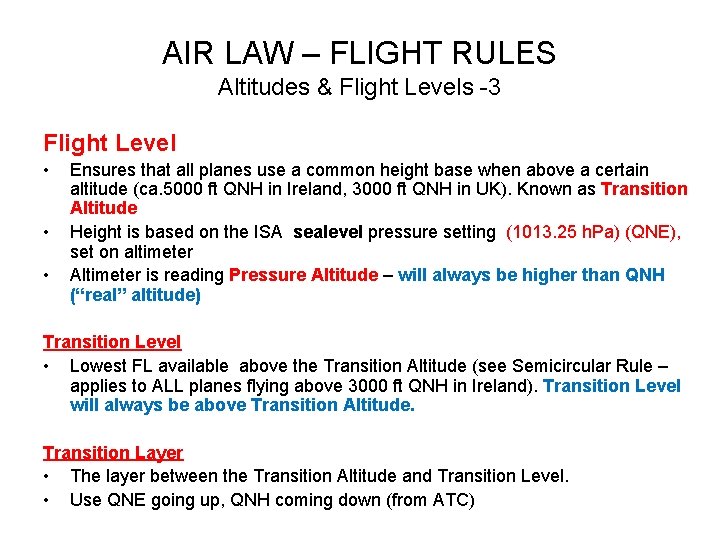
AIR LAW – FLIGHT RULES Altitudes & Flight Levels -3 Flight Level • • • Ensures that all planes use a common height base when above a certain altitude (ca. 5000 ft QNH in Ireland, 3000 ft QNH in UK). Known as Transition Altitude Height is based on the ISA sealevel pressure setting (1013. 25 h. Pa) (QNE), set on altimeter Altimeter is reading Pressure Altitude – will always be higher than QNH (“real” altitude) Transition Level • Lowest FL available above the Transition Altitude (see Semicircular Rule – applies to ALL planes flying above 3000 ft QNH in Ireland). Transition Level will always be above Transition Altitude. Transition Layer • The layer between the Transition Altitude and Transition Level. • Use QNE going up, QNH coming down (from ATC)
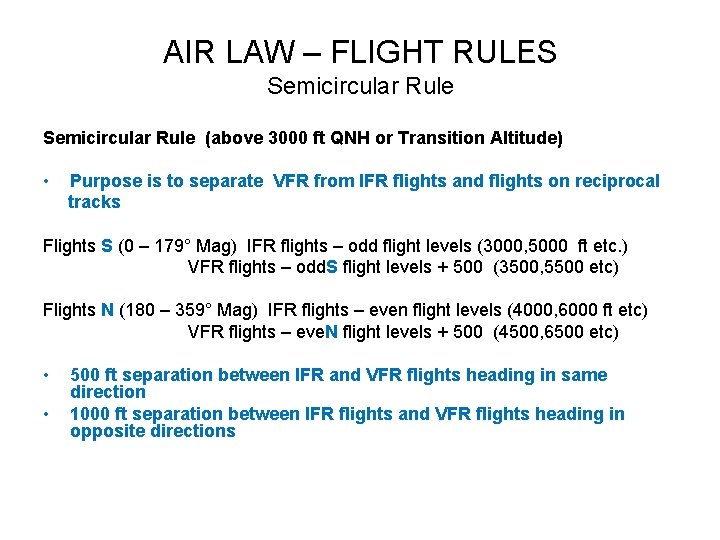
AIR LAW – FLIGHT RULES Semicircular Rule (above 3000 ft QNH or Transition Altitude) • Purpose is to separate VFR from IFR flights and flights on reciprocal tracks Flights S (0 – 179° Mag) IFR flights – odd flight levels (3000, 5000 ft etc. ) VFR flights – odd. S flight levels + 500 (3500, 5500 etc) Flights N (180 – 359° Mag) IFR flights – even flight levels (4000, 6000 ft etc) VFR flights – eve. N flight levels + 500 (4500, 6500 etc) • • 500 ft separation between IFR and VFR flights heading in same direction 1000 ft separation between IFR flights and VFR flights heading in opposite directions
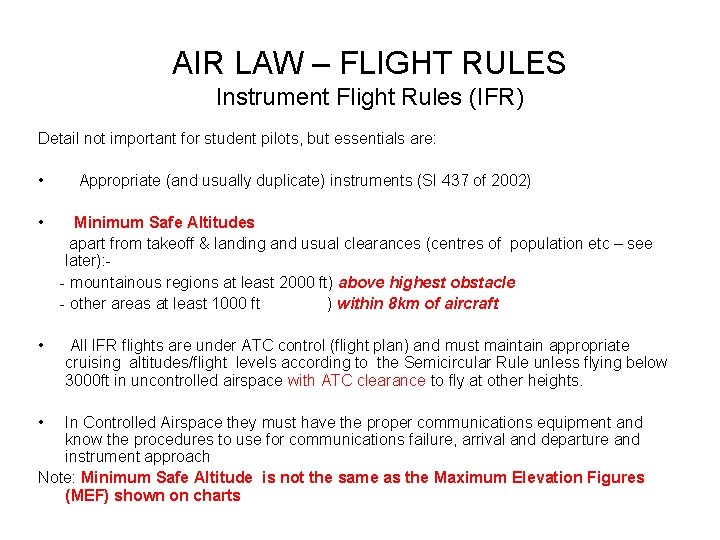
AIR LAW – FLIGHT RULES Instrument Flight Rules (IFR) Detail not important for student pilots, but essentials are: • • Appropriate (and usually duplicate) instruments (SI 437 of 2002) Minimum Safe Altitudes apart from takeoff & landing and usual clearances (centres of population etc – see later): - mountainous regions at least 2000 ft) above highest obstacle - other areas at least 1000 ft ) within 8 km of aircraft All IFR flights are under ATC control (flight plan) and must maintain appropriate cruising altitudes/flight levels according to the Semicircular Rule unless flying below 3000 ft in uncontrolled airspace with ATC clearance to fly at other heights. In Controlled Airspace they must have the proper communications equipment and know the procedures to use for communications failure, arrival and departure and instrument approach Note: Minimum Safe Altitude is not the same as the Maximum Elevation Figures (MEF) shown on charts
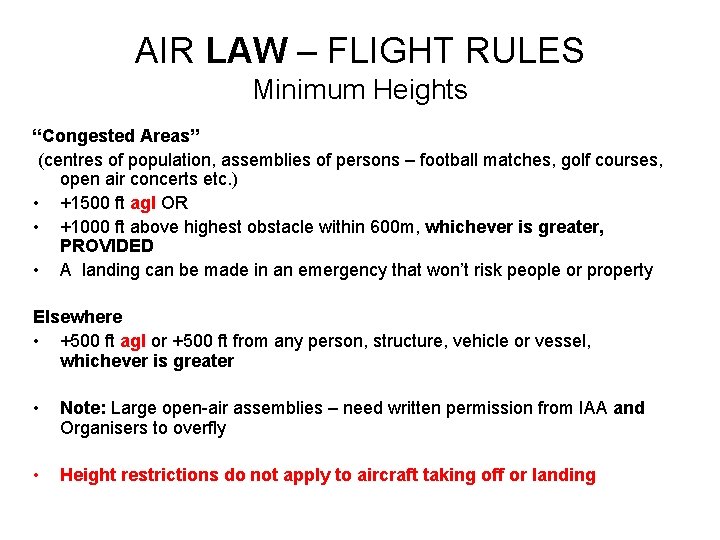
AIR LAW – FLIGHT RULES Minimum Heights “Congested Areas” (centres of population, assemblies of persons – football matches, golf courses, open air concerts etc. ) • +1500 ft agl OR • +1000 ft above highest obstacle within 600 m, whichever is greater, PROVIDED • A landing can be made in an emergency that won’t risk people or property Elsewhere • +500 ft agl or +500 ft from any person, structure, vehicle or vessel, whichever is greater • Note: Large open-air assemblies – need written permission from IAA and Organisers to overfly • Height restrictions do not apply to aircraft taking off or landing