Aim How do we calculate the force acting
- Slides: 12
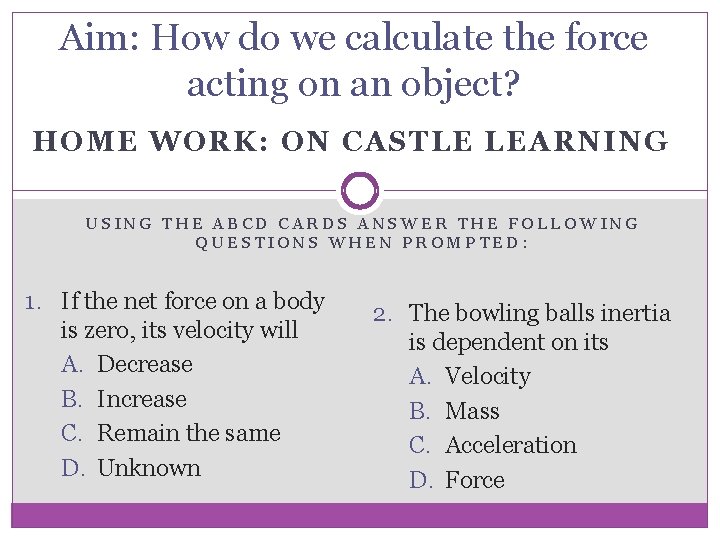
Aim: How do we calculate the force acting on an object? HOME WORK: ON CASTLE LEARNING USING THE ABCD CARDS ANSWER THE FOLLOWING QUESTIONS WHEN PROMPTED: 1. If the net force on a body is zero, its velocity will A. Decrease B. Increase C. Remain the same D. Unknown 2. The bowling balls inertia is dependent on its A. Velocity B. Mass C. Acceleration D. Force
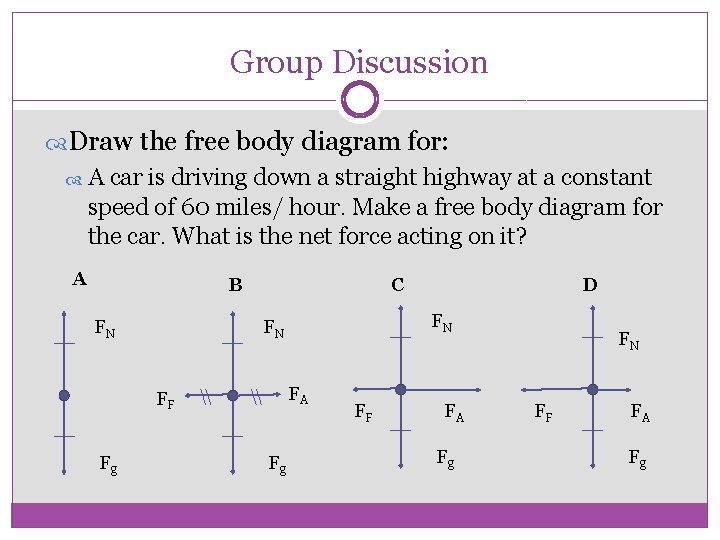
Group Discussion Draw the free body diagram for: A car is driving down a straight highway at a constant speed of 60 miles/ hour. Make a free body diagram for the car. What is the net force acting on it? A B FN C Fg FN FN FA FF Fg D FF FA Fg FN FF FA Fg
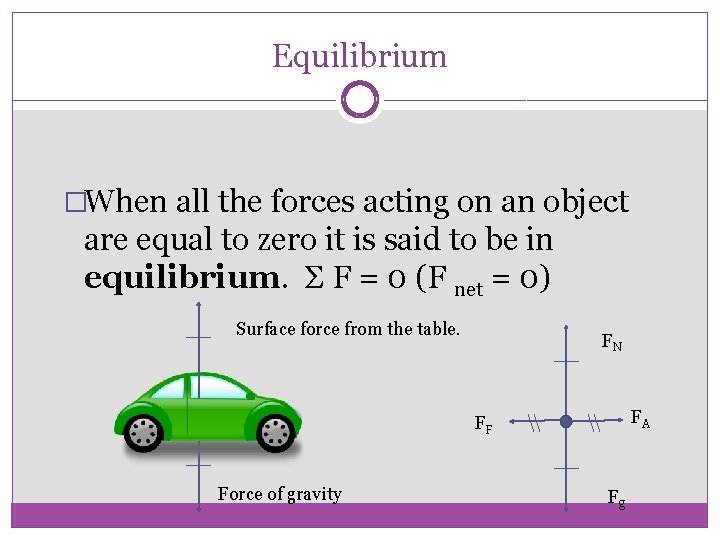
Equilibrium �When all the forces acting on an object are equal to zero it is said to be in equilibrium. Σ F = 0 (F net = 0) Surface force from the table. FN FA FF Force of gravity Fg
Newton’s first law �An object’s motion remains constant unless acted upon by an unbalanced force. �Also known as the law of inertia.
Group Discussion Answer the following questions: Can an object be in equilibrium if only one force acts on the object? What factor can effect acceleration?
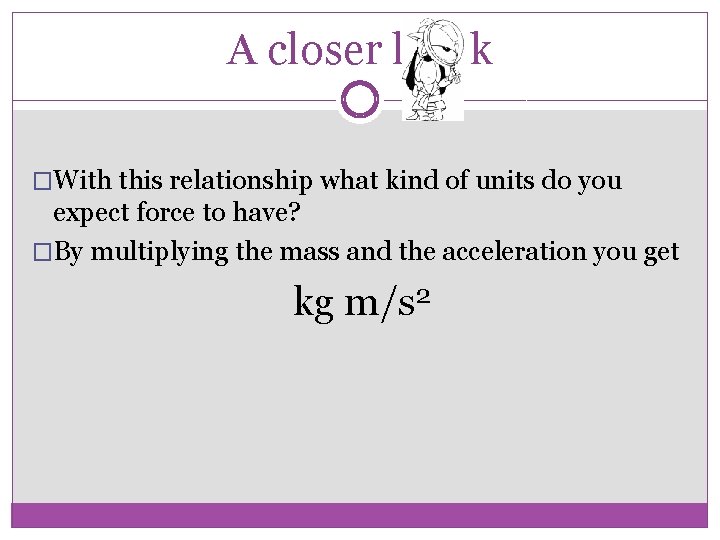
A closer l k �With this relationship what kind of units do you expect force to have? �By multiplying the mass and the acceleration you get kg m/s 2
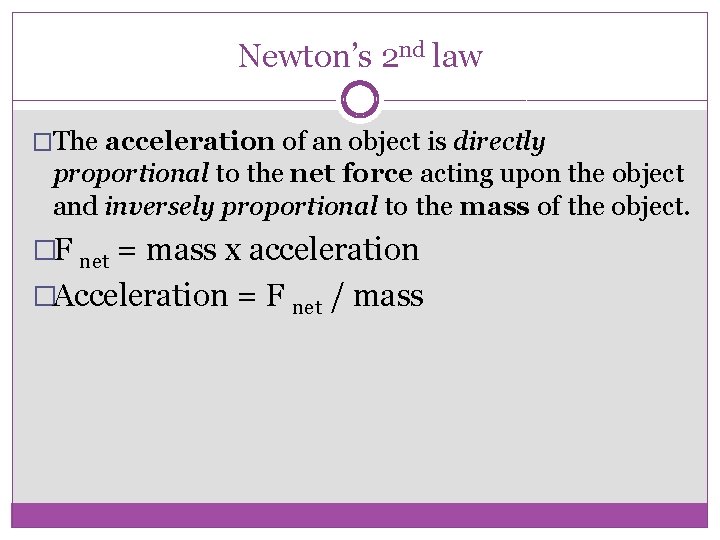
Newton’s 2 nd law �The acceleration of an object is directly proportional to the net force acting upon the object and inversely proportional to the mass of the object. �F net = mass x acceleration �Acceleration = F net / mass
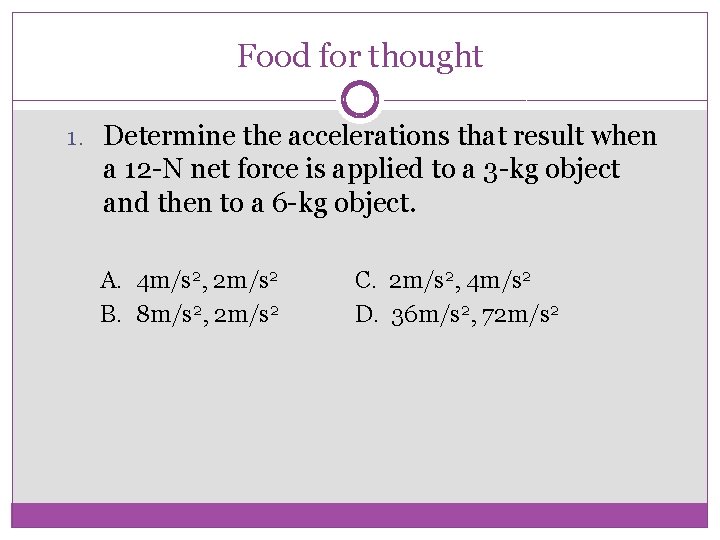
Food for thought 1. Determine the accelerations that result when a 12 -N net force is applied to a 3 -kg object and then to a 6 -kg object. A. 4 m/s 2, 2 m/s 2 B. 8 m/s 2, 2 m/s 2 C. 2 m/s 2, 4 m/s 2 D. 36 m/s 2, 72 m/s 2
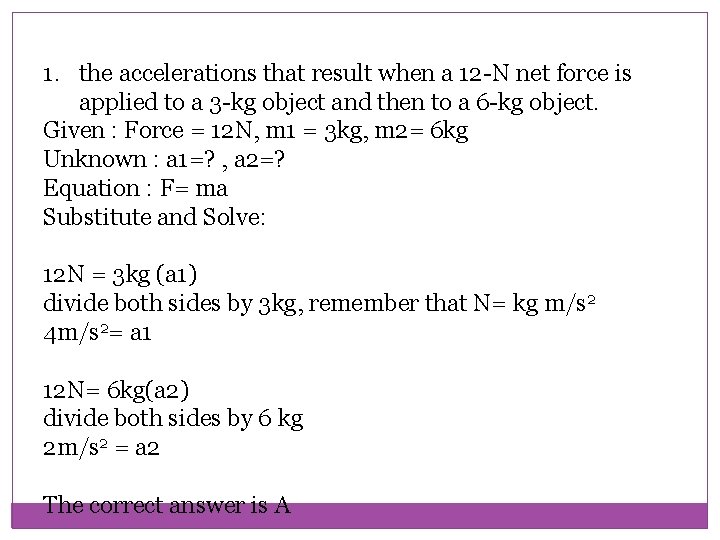
1. the accelerations that result when a 12 -N net force is applied to a 3 -kg object and then to a 6 -kg object. Given : Force = 12 N, m 1 = 3 kg, m 2= 6 kg Unknown : a 1=? , a 2=? Equation : F= ma Substitute and Solve: 12 N = 3 kg (a 1) divide both sides by 3 kg, remember that N= kg m/s 2 4 m/s 2= a 1 12 N= 6 kg(a 2) divide both sides by 6 kg 2 m/s 2 = a 2 The correct answer is A
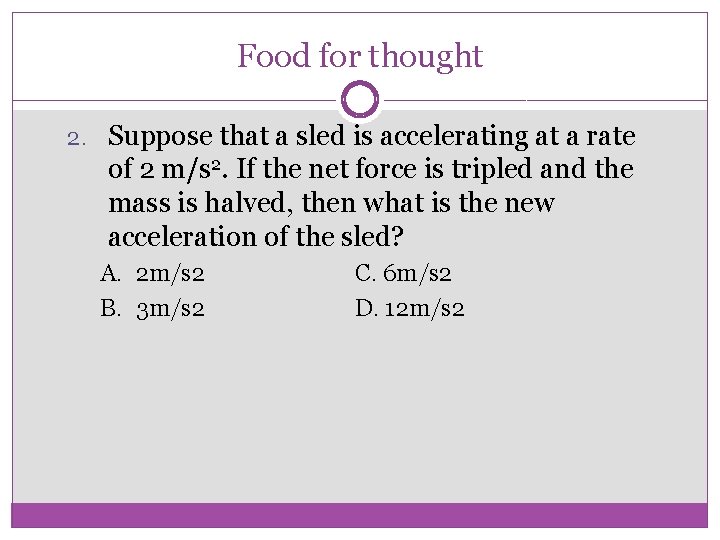
Food for thought 2. Suppose that a sled is accelerating at a rate of 2 m/s 2. If the net force is tripled and the mass is halved, then what is the new acceleration of the sled? A. 2 m/s 2 B. 3 m/s 2 C. 6 m/s 2 D. 12 m/s 2
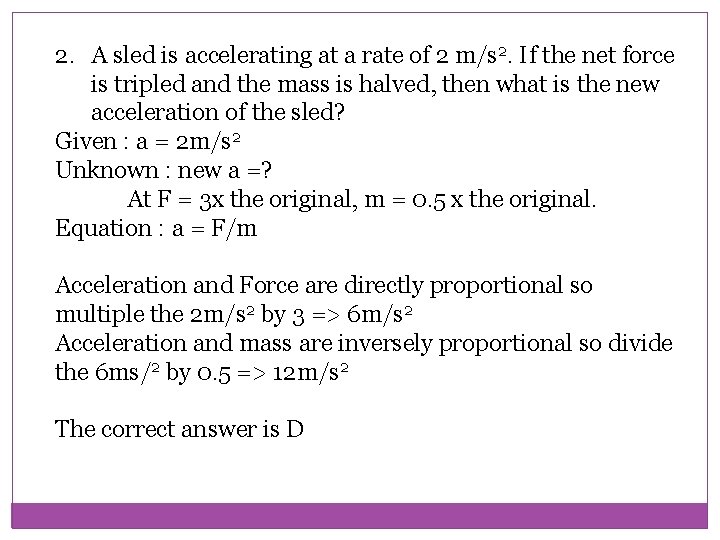
2. A sled is accelerating at a rate of 2 m/s 2. If the net force is tripled and the mass is halved, then what is the new acceleration of the sled? Given : a = 2 m/s 2 Unknown : new a =? At F = 3 x the original, m = 0. 5 x the original. Equation : a = F/m Acceleration and Force are directly proportional so multiple the 2 m/s 2 by 3 => 6 m/s 2 Acceleration and mass are inversely proportional so divide the 6 ms/2 by 0. 5 => 12 m/s 2 The correct answer is D
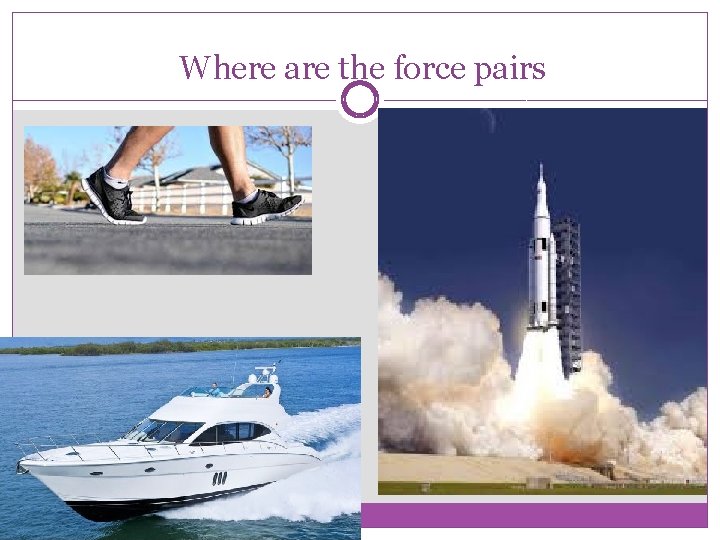
Where are the force pairs