Acute Orofacial Pain Dental Update 2015 Nadine Khawaja
- Slides: 14
Acute Oro-facial Pain Dental Update 2015 Nadine Khawaja, Tara Renton
Contents • Pain Assessment • Diagnosis • Local Anaesthetic • Analgesics • Pain management
Acute Oro-facial Pain • Management of pain is a key part of dental care • Physical and emotional stress to the patient • Very common • 22% of the US adult population had experienced it at least once in the last 6/12
Pain Assessment • History • Pain is a personal experience • Pain assessment tools • Category rating Scale • Visual Analogue Scale • Numerical Rating Scale
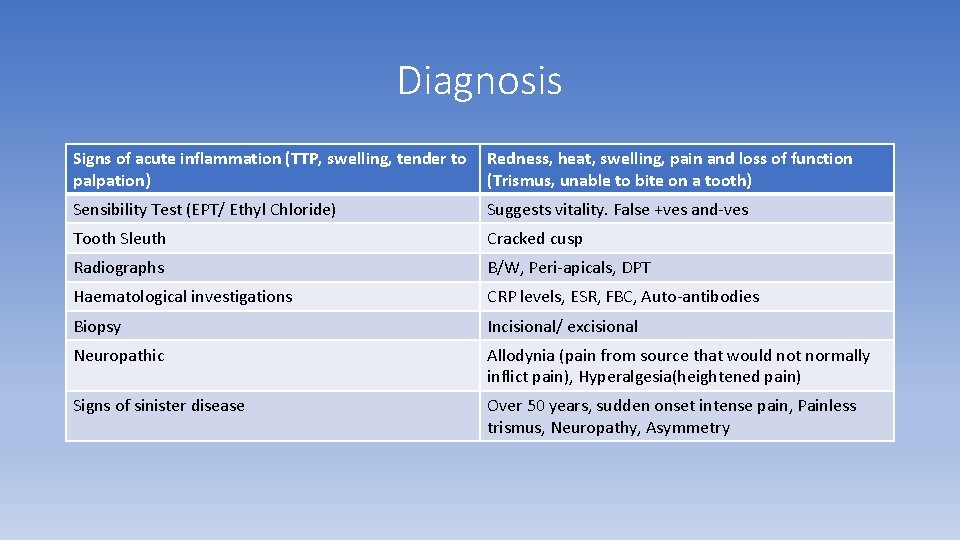
Diagnosis Signs of acute inflammation (TTP, swelling, tender to palpation) Redness, heat, swelling, pain and loss of function (Trismus, unable to bite on a tooth) Sensibility Test (EPT/ Ethyl Chloride) Suggests vitality. False +ves and-ves Tooth Sleuth Cracked cusp Radiographs B/W, Peri-apicals, DPT Haematological investigations CRP levels, ESR, FBC, Auto-antibodies Biopsy Incisional/ excisional Neuropathic Allodynia (pain from source that would not normally inflict pain), Hyperalgesia(heightened pain) Signs of sinister disease Over 50 years, sudden onset intense pain, Painless trismus, Neuropathy, Asymmetry
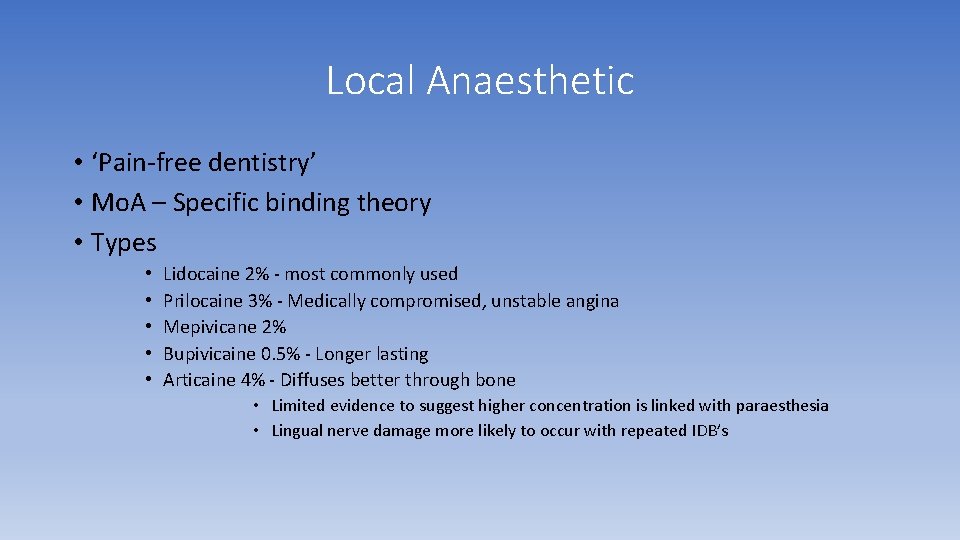
Local Anaesthetic • ‘Pain-free dentistry’ • Mo. A – Specific binding theory • Types • • • Lidocaine 2% - most commonly used Prilocaine 3% - Medically compromised, unstable angina Mepivicane 2% Bupivicaine 0. 5% - Longer lasting Articaine 4% - Diffuses better through bone • Limited evidence to suggest higher concentration is linked with paraesthesia • Lingual nerve damage more likely to occur with repeated IDB’s
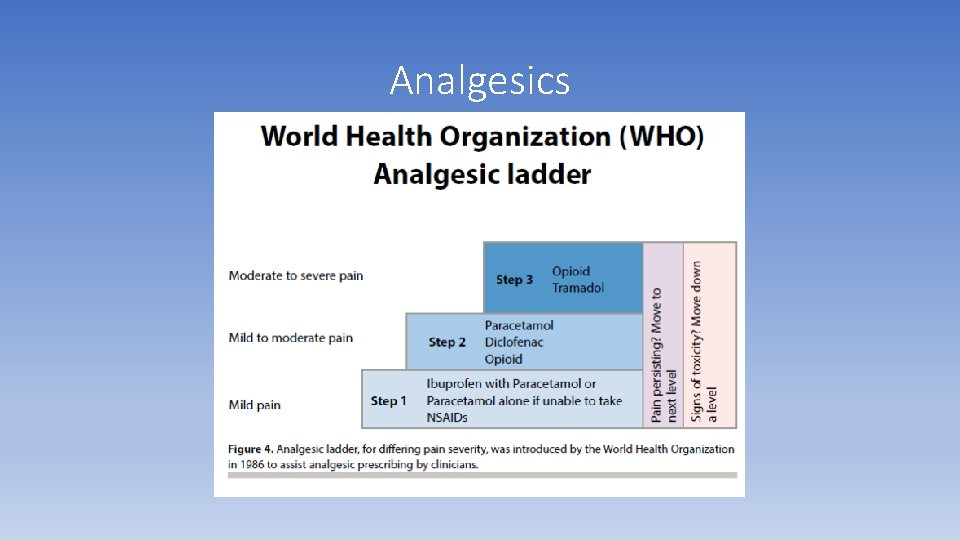
Analgesics
Pre-op Analgesics • Limited studies to show benefit in dentistry
Post Surgical Pain Management • Analgesics • Non-opioid or Opioid (codeine) • OTC non-opioid is most effective for dental pain – Paracetamol and ibuprofen used alternatively is most effective
NSAID – ibuprofen, diclofenac, Aspirin. . • Analgesic, Antipyretic and anti-inflammatory • Mo. A – Acts on COX-2 enzyme (and COX-1) which reduces inflammatory Prostaglandins and reduces inflammation. • Max Dose ibuprofen = 2. 4 g in 24 hrs • Side effects • GI bleeding, prolonged bleeding, nephrotoxicity, allergy • C/I • GI Ulcers, bleeding problems, impaired renal function, known allergy, Under 16’s for aspirin, Pregnancy and breast feeding • Interactions • Warfarin, anti-coagulants, anti-platelets, SSRI’s
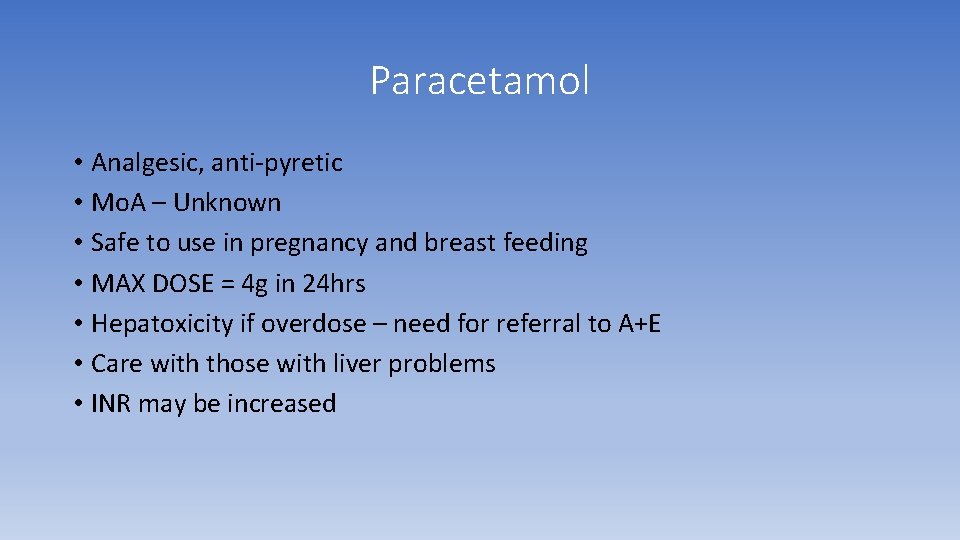
Paracetamol • Analgesic, anti-pyretic • Mo. A – Unknown • Safe to use in pregnancy and breast feeding • MAX DOSE = 4 g in 24 hrs • Hepatoxicity if overdose – need for referral to A+E • Care with those with liver problems • INR may be increased
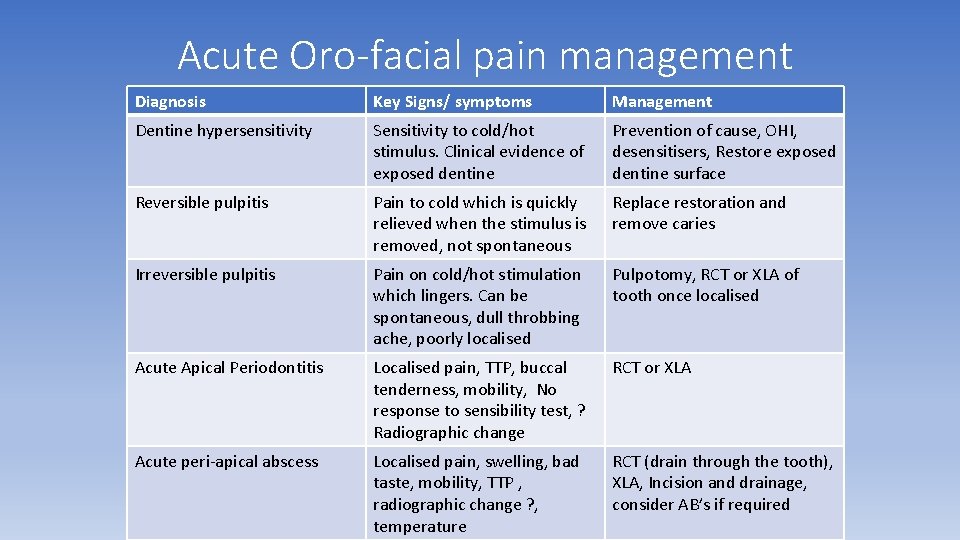
Acute Oro-facial pain management Diagnosis Key Signs/ symptoms Management Dentine hypersensitivity Sensitivity to cold/hot stimulus. Clinical evidence of exposed dentine Prevention of cause, OHI, desensitisers, Restore exposed dentine surface Reversible pulpitis Pain to cold which is quickly relieved when the stimulus is removed, not spontaneous Replace restoration and remove caries Irreversible pulpitis Pain on cold/hot stimulation which lingers. Can be spontaneous, dull throbbing ache, poorly localised Pulpotomy, RCT or XLA of tooth once localised Acute Apical Periodontitis Localised pain, TTP, buccal tenderness, mobility, No response to sensibility test, ? Radiographic change RCT or XLA Acute peri-apical abscess Localised pain, swelling, bad taste, mobility, TTP , radiographic change ? , temperature RCT (drain through the tooth), XLA, Incision and drainage, consider AB’s if required
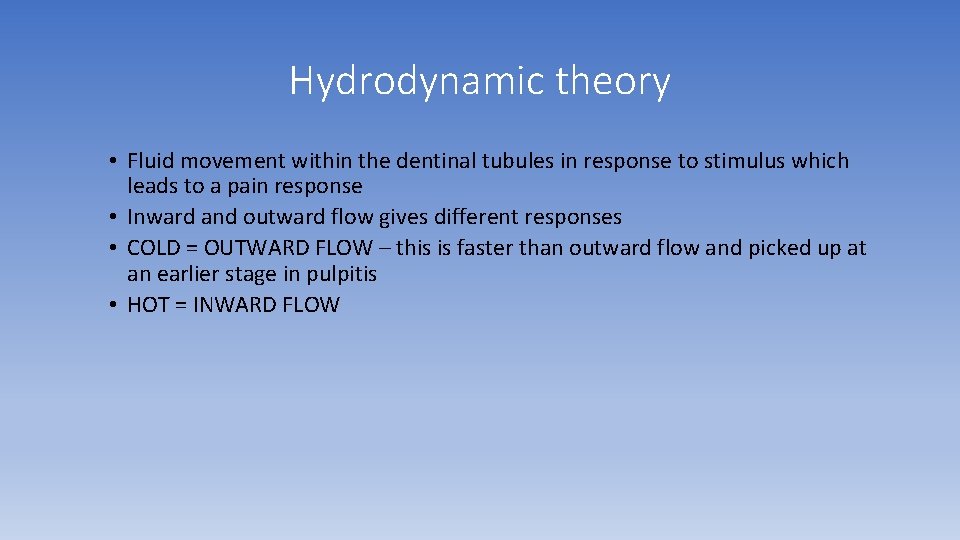
Hydrodynamic theory • Fluid movement within the dentinal tubules in response to stimulus which leads to a pain response • Inward and outward flow gives different responses • COLD = OUTWARD FLOW – this is faster than outward flow and picked up at an earlier stage in pulpitis • HOT = INWARD FLOW
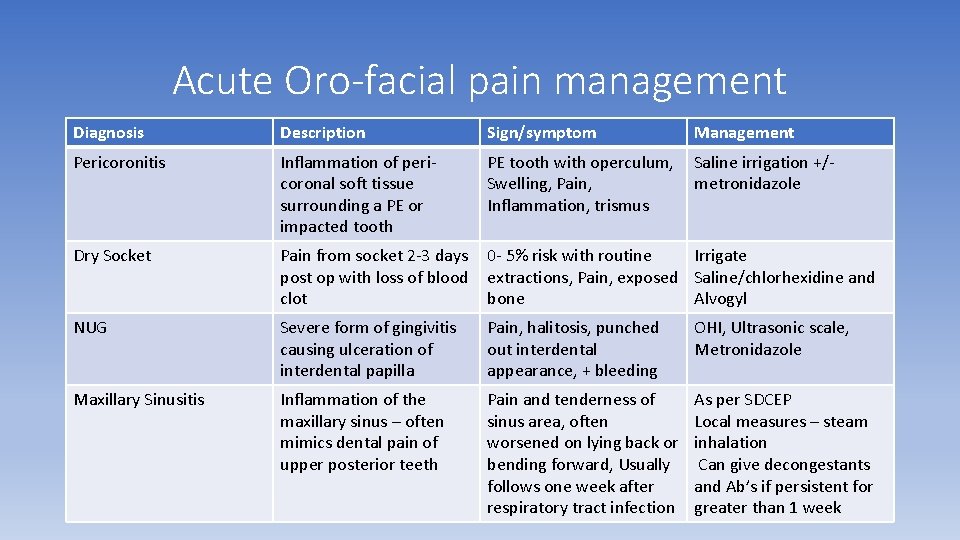
Acute Oro-facial pain management Diagnosis Description Sign/symptom Management Pericoronitis Inflammation of pericoronal soft tissue surrounding a PE or impacted tooth PE tooth with operculum, Swelling, Pain, Inflammation, trismus Saline irrigation +/metronidazole Dry Socket Pain from socket 2 -3 days post op with loss of blood clot 0 - 5% risk with routine Irrigate extractions, Pain, exposed Saline/chlorhexidine and bone Alvogyl NUG Severe form of gingivitis causing ulceration of interdental papilla Pain, halitosis, punched out interdental appearance, + bleeding OHI, Ultrasonic scale, Metronidazole Maxillary Sinusitis Inflammation of the maxillary sinus – often mimics dental pain of upper posterior teeth Pain and tenderness of sinus area, often worsened on lying back or bending forward, Usually follows one week after respiratory tract infection As per SDCEP Local measures – steam inhalation Can give decongestants and Ab’s if persistent for greater than 1 week