3 SLEEPERS 3 6 Precautions for handling of


- Slides: 9
3 SLEEPERS 3. 6 Precautions for handling of PSC sleepers during unloading and laying PERIODS 2
PRECAUTION FOR HANDLING OF PSC SLEEPERS I. Concrete sleeper has been designed for the maximum bending moment under rail seat which is close to anchor zone of pre-stress. Any damage to anchor zone may lead to reduction in pre-stress as well as eccentricity of pre-stress. The concrete sleepers therefore should be handled carefully preferably by mechanical means. II. In case of manual unloading of concrete sleepers become unavoidable, adequate care must be taken to ensure that the ends are not damaged to safe guard anchor zone located towards sleeper ends.
PRECAUTION FOR HANDLING OF PSC SLEEPERS III. While handling these sleepers by mechanical means it shall be ensured that sleepers are not damaged and develop cracks exposing HTS wire and thus may result into their corrosion. IV. While unloading the concrete sleepers should be placed perpendicular to the length of BFR.
PRECAUTION FOR HANDLING OF PSC SLEEPERS V. In unavoidable situation, if concrete sleeper is required to be unloaded manually, it should be done with great precautions to ensure that sleepers are not damaged while unloading the sleeper from wagon. (a) A ramp should be provided with the help of unserviceable steel crossing sleeper/rail pieces; the end fixed rigidly on ground as well as on the wagon. The distance of these two sleepers/rail pieces should be so adjusted that complete length of the sleeper rest on them with minimum projection or around 150 mm on either side.
PRECAUTION FOR HANDLING OF PSC SLEEPERS (b) The sleepers on the ramp should be gently placed with the help of rope provided with hooks which are fixed on the insert of sleepers. The sleepers should be slide down gently bringing rope over the rollers placed on the wagons near the ramp. On reaching the sleepers to the ground, the hooks should be removed and rope pulled up. The sleepers unloaded should be removed away, making room for the next sleeper to be unloaded. The process should be repeated till all the sleepers are unloaded.
Precaution in USE of concrete sleepers • All the PSC sleepers are tested for electrical resistance at the time of manufacture, and sleepers are marked by paint with “FTC” to indicate Fit for Track Circuiting and “NFTC” to indicate not fit for track Circuited location. This shall be noted while using the sleepers at site. On PSC sleepers track, availability of insulated liners upto a minimum level of 97% shall be ensured. • When concrete sleepers are used in yards with fish-plated track/SWR, the sleeper spacing at fish-plated joint shall be kept uniform. In addition, 1 m long fishplates may preferably, be provided at such joints.
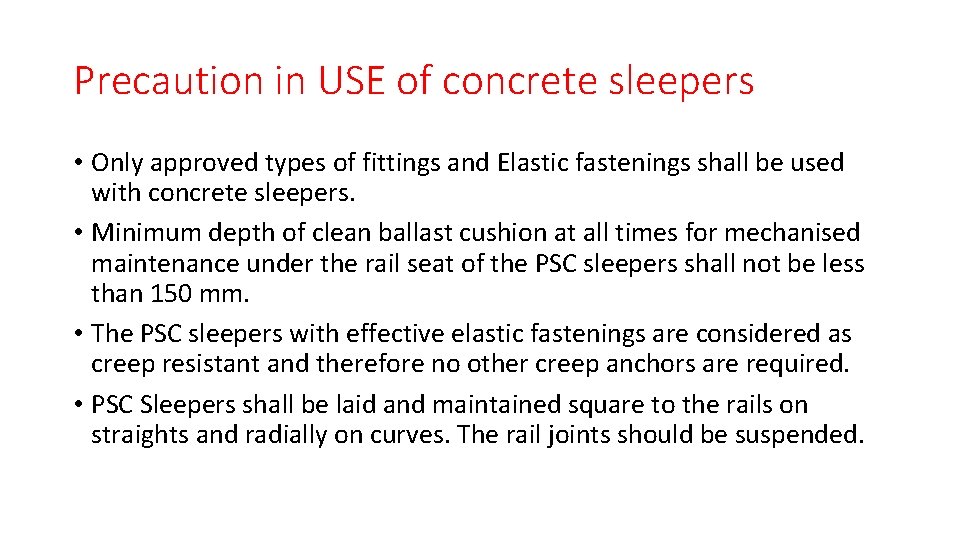
Precaution in USE of concrete sleepers • Only approved types of fittings and Elastic fastenings shall be used with concrete sleepers. • Minimum depth of clean ballast cushion at all times for mechanised maintenance under the rail seat of the PSC sleepers shall not be less than 150 mm. • The PSC sleepers with effective elastic fastenings are considered as creep resistant and therefore no other creep anchors are required. • PSC Sleepers shall be laid and maintained square to the rails on straights and radially on curves. The rail joints should be suspended.
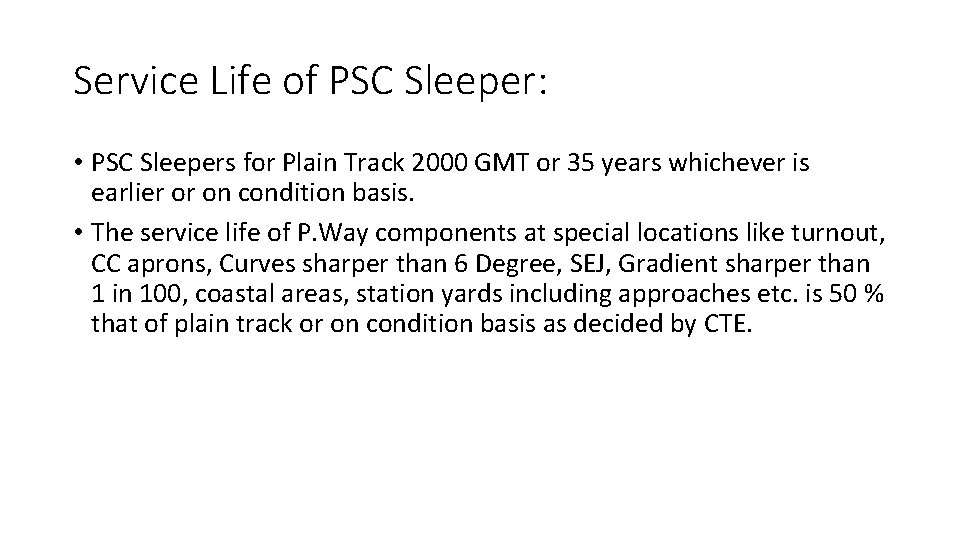
Service Life of PSC Sleeper: • PSC Sleepers for Plain Track 2000 GMT or 35 years whichever is earlier or on condition basis. • The service life of P. Way components at special locations like turnout, CC aprons, Curves sharper than 6 Degree, SEJ, Gradient sharper than 1 in 100, coastal areas, station yards including approaches etc. is 50 % that of plain track or on condition basis as decided by CTE.
THANKS