
Track structure on bridges channel sleepers 1 Introduction
Track structure on bridges & channel sleepers 1
Introduction • Track structure on bridges are different from that on embankment, such as : Ballasted deck bridge – Rails, fittings and sleeper are similar to the track structure on approaches except guard rails are provided to prevent overturning of derailed rolling stock. These type of deck are used over masonry arch bridges, RCC/PSC I girders/slabs and boxes, composite girders, PSC I girders/PSC box girders. On steel girders, ballasted deck is made by providing steel troughs which poses problem for repairs / maintenance to corrosion effected members 2
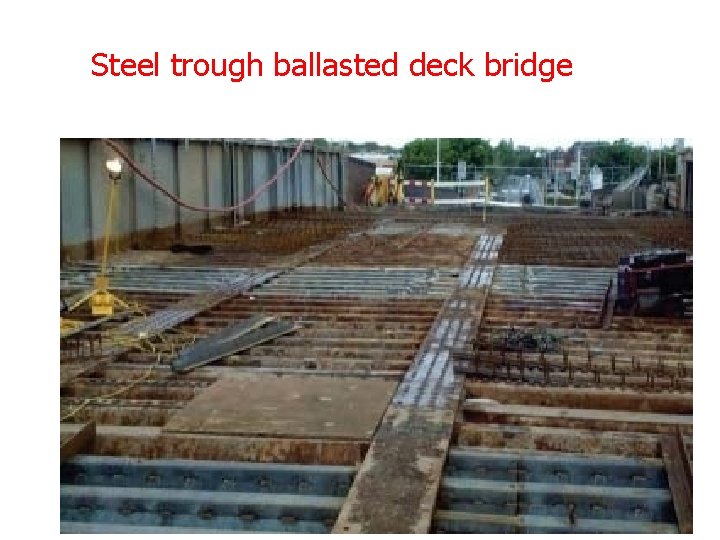
Steel trough ballasted deck bridge 3
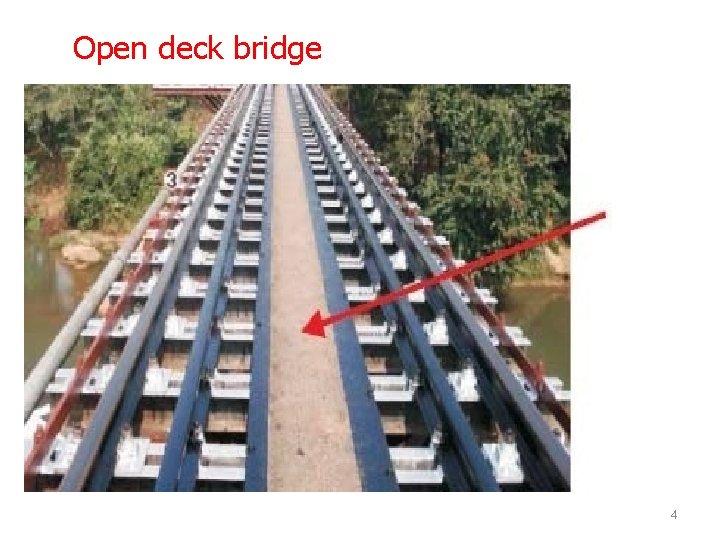
Open deck bridge 4
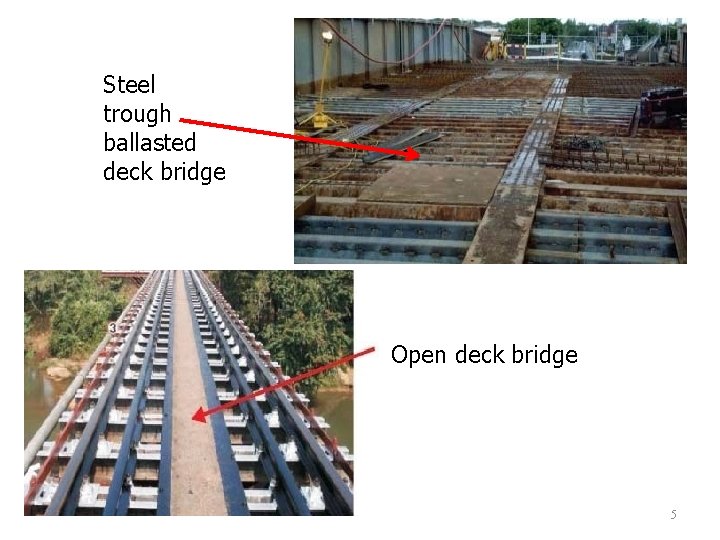
Steel trough ballasted deck bridge Open deck bridge 5
• Open deck bridge – Space between two sleepers is open hence called open deck. • To support rails on steel girders following type of sleepers are being used : • Wooden sleepers – Ø are lighter in weight, Ø easy for handling on bridges, Ø easy in machining for placements, Ø minimum simple fittings to hold the rails as well as in maintenance repairs. • Rail free fastening such as rail screw / dog spikes and canted bearing plates over wooden sleepers provided for independent movement of rail. • Due to scarcity of wood and restriction of use wooden sleepers on Indian Railways, these are not being used now a days. 6
• Steel channel sleepers – Ø Introduced as substitute to bridge timbers during 1992 having drawing No. RDSO / B-1636 and B 1636/1. Ø Subsequently to minimize number of fittings and ease in fabrication and maintenance, revised drawings were issued by RDSO, drawing No. B 1636/R 2 and B-1636/1/R 2 of channel size 150 x 75 mm. Ø To avoid thicker packing plates over top flange plate of plate girders of 12. 2 m, 18. 3 m and 24. 4 m spans additional drawing No. B-1636/2 is also issued with increased height of channel size 175 x 75 mm. 7
Bridge Approaches • Rail joints should be away from abutment by 3 m in case of single rail & 6 m in case of SWR. • Minimum 26 m (2 rail length) in case of single rail & 36 m (3 rail length) in case of SWR should be well anchored. • Spacing of sleepers not more than 60 cm. 8
Bridge Approaches • 100 m approach length should have LWR ballast profile. • Ballast retainers should be provided in one rail length. • If a curvature of 3 degree & more on BG or 5 degree & more on MG exists, check rail should be provided. 9
Bridge proper • Preferred position of rail joints is 1/3 rd of span, to avoid excessive shear force & bending moment. On spans less than 6. 1 m avoid joints. • Rail free fastenings on bridge to allow independent movement of rail & girder. • 26 m long rolled rails may be laid on bridges with 1 m long fish plate & 6 bolts. • Joggled fish plate with clamps or two far end bolts on good AT welds shall be provided on bridges having length of water way as 100 m or more and on approaches up to 100 m length. 10
LWR/CWR ON BRIDGES WITH BALLASTED DECK (WITHOUT BEARING) (4. 5. 6) LWR/CWR can be continued over bridges without bearings, i. e. on slabs, box culverts and arch bridges. BRIDGES WITH/WITHOUT BALLASTED DECK (4. 5. 7) • Bridges on which LWR/CWR is not permitted/ provided shall be isolated by a minimum length of 36 m well anchored track on either sides. • LWR/CWR shall not be continued over bridges with overall length specified in subsequent para for BG (and not more than 20 m for MG). 11
LWR/CWR ON BRIDGES WITH RAIL-FREE FASTENINGS (single span not exceeding 30. 5 m and having sliding bearings on both ends) Para 4. 5. 7. 1(i) • • Overall length as per Table-1. Rail free fastening throughout the length of bridge. The 50 meter approach on both side well anchored. Ballast section of approach track upto 50 m shall be heaped upto foot of rail on the shoulders and well compacted & consolidated condition during extreme summer & winter. 12
LWR/CWR ON BRIDGES • BRIDGES WITH RAIL-FREE FASTENINGS AND PARTLY BOX ANCHORED (single span not exceeding 30. 5 m and having sliding bearings on both ends): Para 4. 5. 7. 1(ii) • • • Overall length as per Table-1. 4 central sleepers on each span box anchored. Bridge timbers - Individual notches for rivet heads. Track on approaches well anchored. Inspection/cleaning of bearing – March & October. Lubrication of bearing – Once in two years. 13
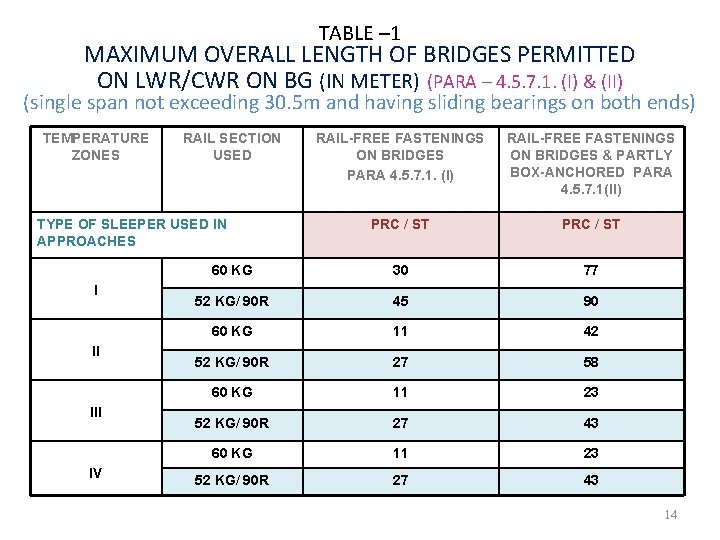
TABLE – 1 MAXIMUM OVERALL LENGTH OF BRIDGES PERMITTED ON LWR/CWR ON BG (IN METER) (PARA – 4. 5. 7. 1. (I) & (II) (single span not exceeding 30. 5 m and having sliding bearings on both ends) TEMPERATURE ZONES RAIL SECTION USED RAIL-FREE FASTENINGS ON BRIDGES PARA 4. 5. 7. 1. (I) RAIL-FREE FASTENINGS ON BRIDGES & PARTLY BOX-ANCHORED PARA 4. 5. 7. 1(II) PRC / ST 60 KG 30 77 52 KG/ 90 R 45 90 60 KG 11 42 52 KG/ 90 R 27 58 60 KG 11 23 52 KG/ 90 R 27 43 TYPE OF SLEEPER USED IN APPROACHES I II IV 14
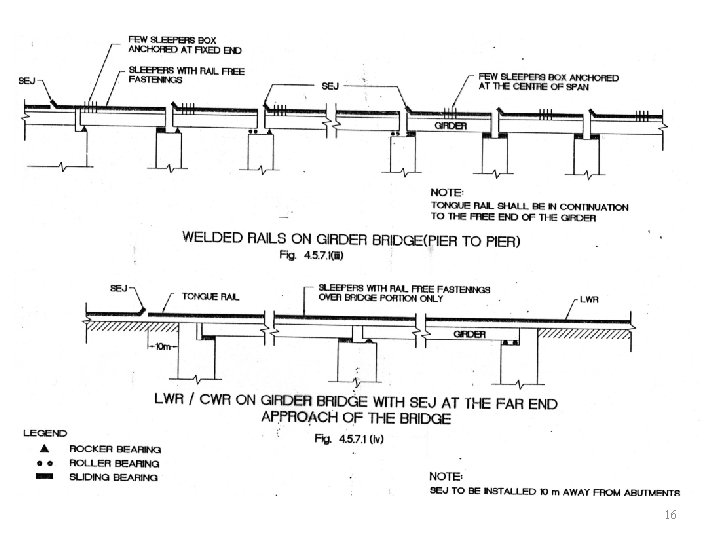
LWR/CWR ON BRIDGES (Para 4. 5. 7. iii) • Welded rails may be provided from pier to pier with rail-free fastenings and with SEJ on each pier. • The rails shall be box-anchored on four sleepers at the fixed end of the girder is supported on rollers on one side and rockers on other side. • In case of girder supported on sliding bearings on both sides, the central portion of the welded rails over each span shall be box-anchored on four sleepers. 15
16
LWR/CWR ON BRIDGES (Para 4. 5. 7. 1 iv) • LWR/CWR may also be continued over a bridge with the provision of SEJ at the far end approach of the bridge using rail-free fastenings over the girder bridge. • The length of the bridge in this case, however, will be restricted by the capacity of the SEJ to absorb expansion, contraction and creep, if any, of the rails. • The length of the bridges with the above arrangement that can be permitted in various rail temperature zones for LWR/CWR with SEJ having maximum movement of 120 mm and 190 mm are as per table 17
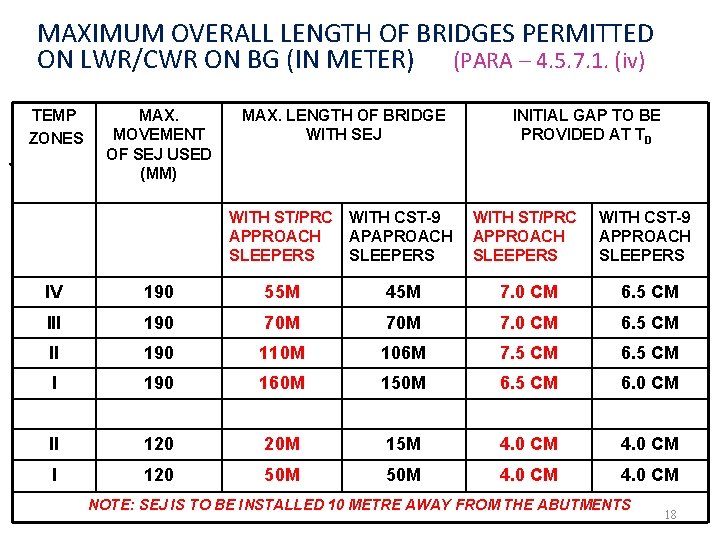
MAXIMUM OVERALL LENGTH OF BRIDGES PERMITTED ON LWR/CWR ON BG (IN METER) (PARA – 4. 5. 7. 1. (iv) . TEMP ZONES MAX. MOVEMENT OF SEJ USED (MM) MAX. LENGTH OF BRIDGE WITH SEJ INITIAL GAP TO BE PROVIDED AT TD WITH ST/PRC APPROACH SLEEPERS WITH CST-9 APAPROACH SLEEPERS WITH ST/PRC APPROACH SLEEPERS WITH CST-9 APPROACH SLEEPERS IV 190 55 M 45 M 7. 0 CM 6. 5 CM III 190 70 M 7. 0 CM 6. 5 CM II 190 110 M 106 M 7. 5 CM 6. 5 CM I 190 160 M 150 M 6. 5 CM 6. 0 CM II 120 20 M 15 M 4. 0 CM I 120 50 M 4. 0 CM NOTE: SEJ IS TO BE INSTALLED 10 METRE AWAY FROM THE ABUTMENTS 18
LWR/CWR ON BRIDGES PARA 4. 5. 7. 1 (V) New Para Added As per CS no. 9 • Welded rails may be provided over a single span bridge with rail free fastenings and SEJs at 30 m away from both abutments. (Span as per table) • The rail shall be box anchored on four sleepers at the fixed end of the bridge if bridge is supported on rollers on one side and rockers on other side. • In case of bridge supported on sliding bearings on both sides, the central portion of the welded rails shall be box anchored on four sleepers. On both side of approaches fully creep anchored fastenings shall be used. 19
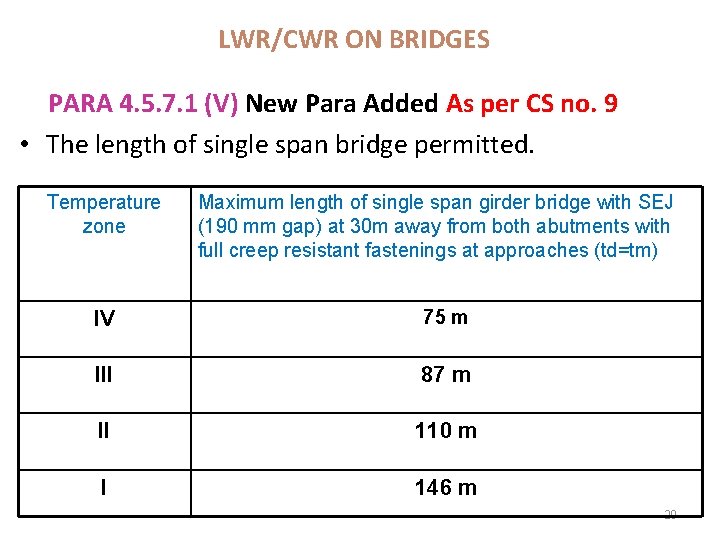
LWR/CWR ON BRIDGES PARA 4. 5. 7. 1 (V) New Para Added As per CS no. 9 • The length of single span bridge permitted. Temperature zone Maximum length of single span girder bridge with SEJ (190 mm gap) at 30 m away from both abutments with full creep resistant fastenings at approaches (td=tm) IV 75 m III 87 m II 110 m I 146 m 20
Longitudinal profile of track • No camber on standard plate girder. • On open web girders having span 30. 5 m & more are provided with Camber. • While re-timbering/ fixing sleepers, it should be ensured that longitudinal level of rails follows the camber of girder. 21
Restrictions for SWR • If SWR is symmetrical to center line of bridge, SWR may be continued on un-ballasted decks up to 13. 3 m. span. • If SWR is laid un-symmetrical to center line of bridge, SWR may be continued on unballasted decks only up to 6. 1 m opening. 22
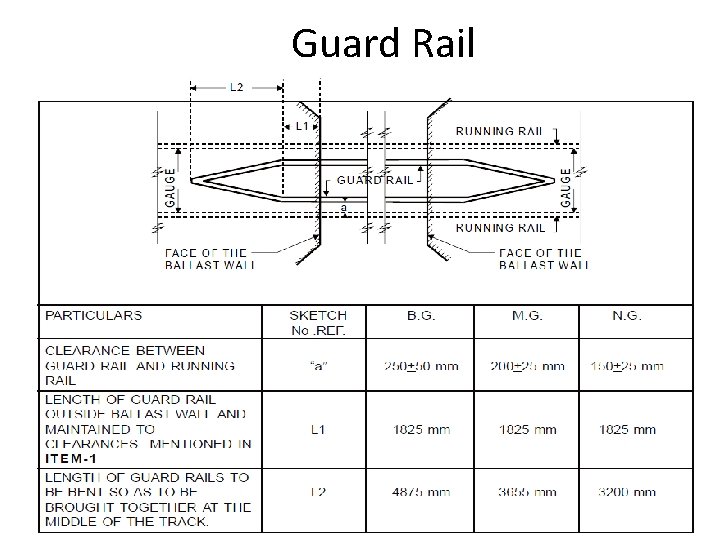
Hook Bolts & Guard Rails • • Hook Bolts Straight lipped – on builtup girders Slopping lipped - on rolled girders. Guard Rails length BG - L 1=1825 mm, L 2=4875 mm, a =250+_50 MG - L 1=1825 mm, L 2=3655 mm, a =200+_25 L 1 - Length of straight Guard Rail Outside Ballast Wall L 2 - Length of Guard Rails to be bent a - Clearance between Guard rail and Running Rail 23
Guard Rail 24
Precautions while fixing guard rails • Top table of guard rail should not be lower than 25 mm from main line. Same section as far as possible. • Guard rail should be notched for spikes at all sleeper locations. • Two spikes towards the centre and one spike on the opposite side • Tie bar runners provided to avoid bunching • Guard rail should form a joint at free end of girder with elongated holes to permit movement of girder. 25
Precautions while fixing guard rails • G/rail should be provided on all girder bridges, whether major or minor. • G/rails should also be provided on all major & important ballasted bridges & on such other minor bridges where derailment may cause serious damages. • Flat top, arch & PSC girder with deck slab where guard rail is not provided, ballast filled up to top of sleeper between parapet walls 26
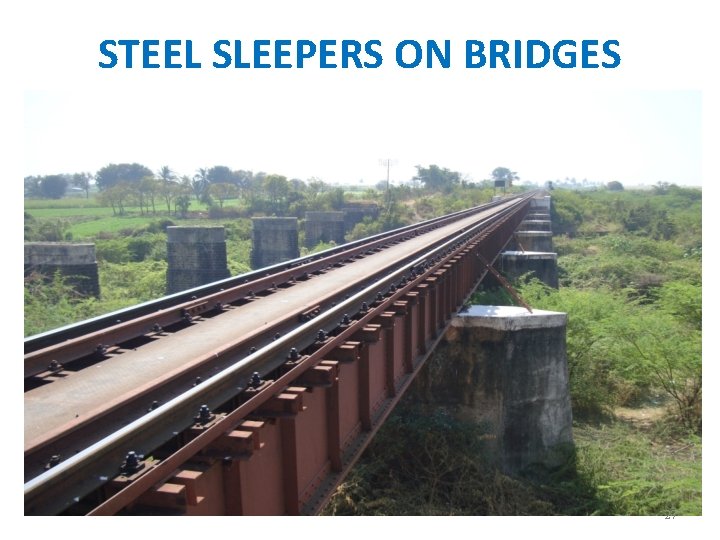
STEEL SLEEPERS ON BRIDGES 27
STEEL SLEEPERS ON BRIDGES IRPWM CS no. 128 • Steel sleepers refer to steel channel sleepers & H-beam sleepers both. • Steel sleepers to be used should be fabricated as per approved drawings. • For girder bridges on curves, steel sleepers should be designed to suit the specific locations. 28
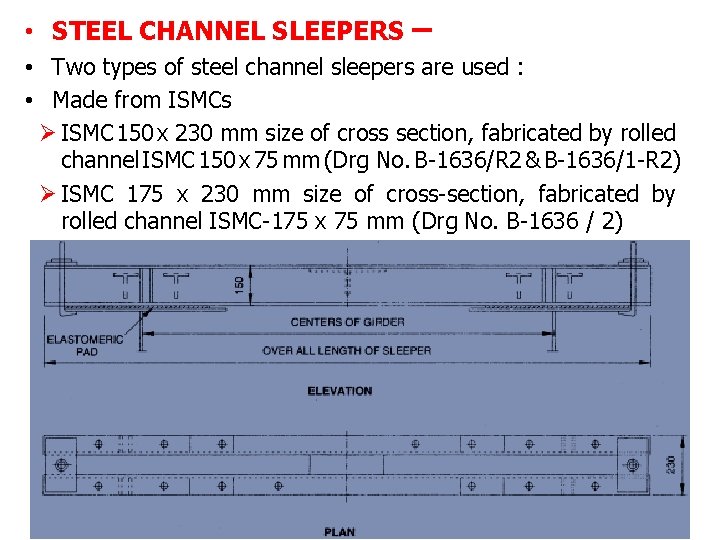
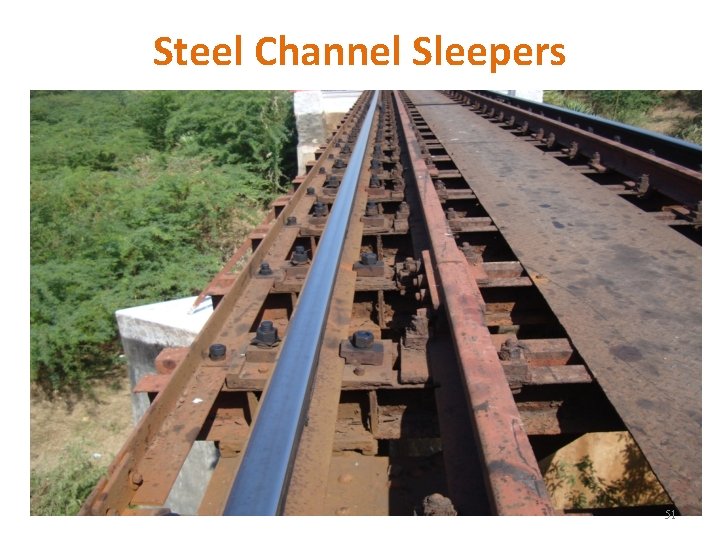
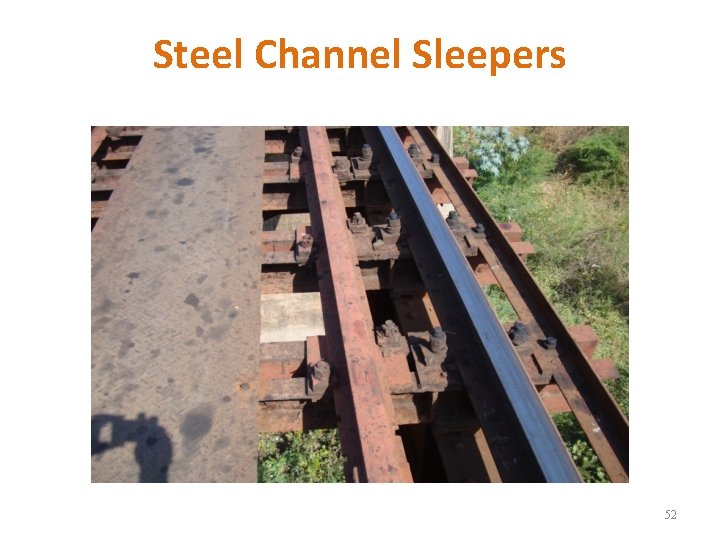
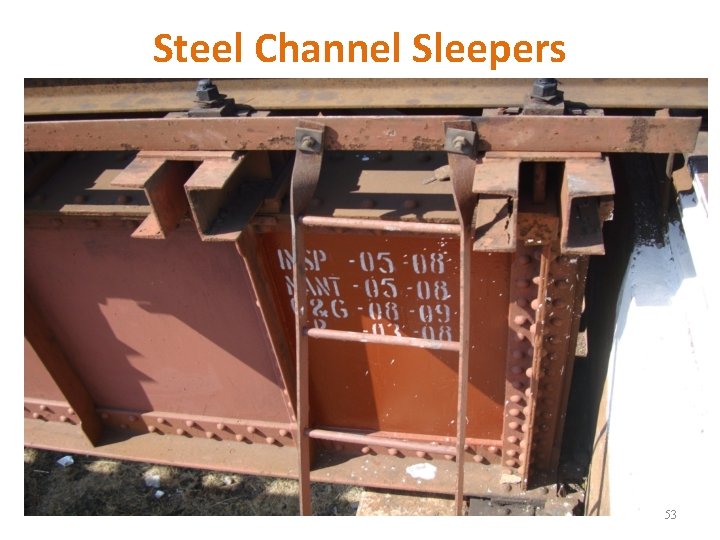
• STEEL CHANNEL SLEEPERS – • Two types of steel channel sleepers are used : • Made from ISMCs Ø ISMC 150 x 230 mm size of cross section, fabricated by rolled channel ISMC 150 x 75 mm (Drg No. B-1636/R 2 & B-1636/1 -R 2) Ø ISMC 175 x 230 mm size of cross-section, fabricated by rolled channel ISMC-175 x 75 mm (Drg No. B-1636 / 2) . 29
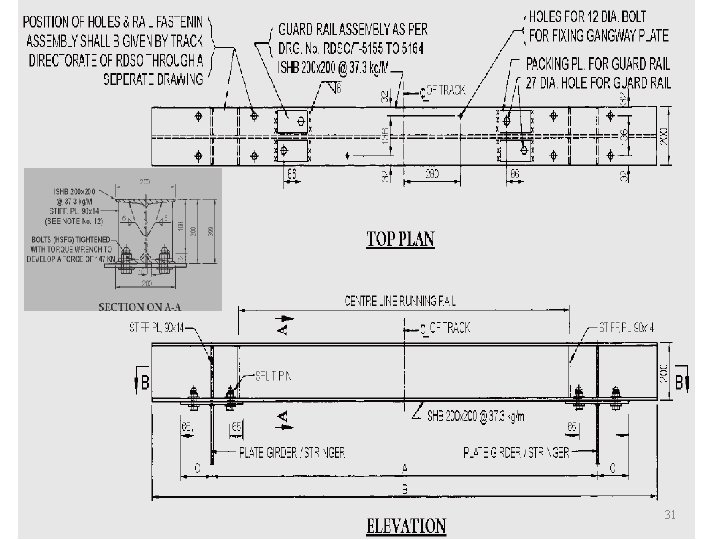
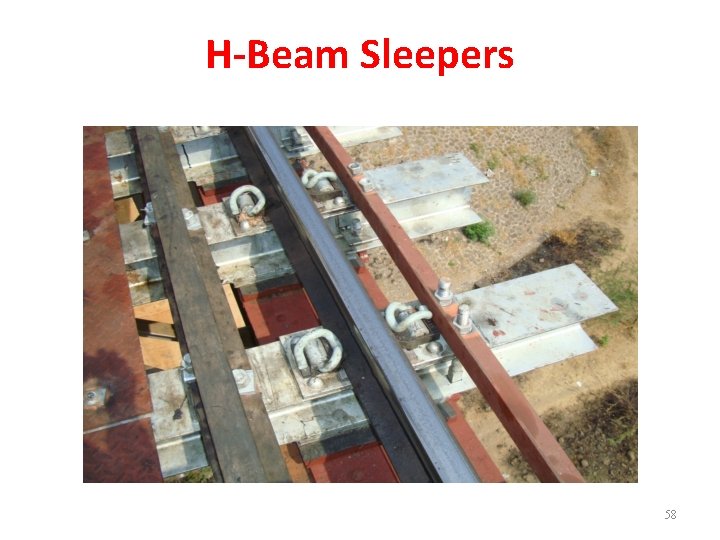
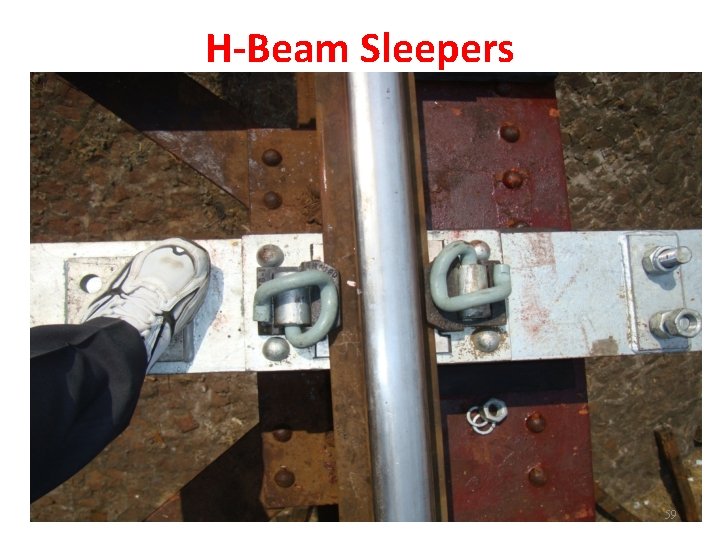
• STEEL H-BEAM SLEEPERS – Ø Made from ISHBs Ø H-Beam is designed using standard ISHB – 200 @ 37. 3 Kg/m as per standard steel. Ø Suitable for Welded Girder Bridges- BG (Drg. RDSO / B-1636/4 & RDSO / B-1636/5 30
31
• Specification of steel for sleepers – Ø Steel channel sleeper is critically loaded dynamic structure which directly supports rails of track on girders hence following steel shall be used: a) Bridges located where service temperature does not fall below 0 C, steel used shall confirm to IS- 2062 grade 'B 0' fully killed. Note: Till such time rolled channel not available of steel to IS - 2062 grade "B 0" steel confirming to IS-2062 'A' fully killed can be used. b) Bridges located in below sub zero temperature areas, steel shall be confirming to IS-2062 grade "C" fully killed. • Note: Steel used for fabrication should be tested one and must have mill test certificate clearly indicating the specification and fully killed. Fabricator should maintain the record of steel used with cast mark for verification if required at later date. Rolled section should be within the rolling tolerances and surface defects prescribed in IS-1852. 32
STEEL SLEEPERS ON BRIDGES IRPWM CS no. 128 Sleeper spacing : • Maximum centre to centre spacing should be 600 mm. • The clear distance between joint sleepers should not be more than 200 mm. Fabrication of steel sleepers & other components: • Fabrication of steel sleepers & its protective coating should be in conformity with BS-45 issued by RDSO. • For girder, location of steel sleepers should be marked & numbered after detailed survey of the girder. • The fabrication of steel sleeper should be location specific considering the girder centre, top flange cover plates, rivets etc. 33
Length – Ø Length of steel channel sleeper depends on the type of steel girder bridges and its span Type of girder Span (m) Length of channel sleeper (mm) MBG Plate Girder Riveted 12. 2 18. 3 24. 4 2440 2550 Welded Plate Girder (A) 12. 2 18. 3 24. 4 2565 2440 Welded Plate Girder (B) 12. 2 18. 3 24. 4 2725 2535 2475 Open Web Steel Girder through span either Riveted / Welded type 30. 5 45. 7 61. 0 76. 2 2440 34
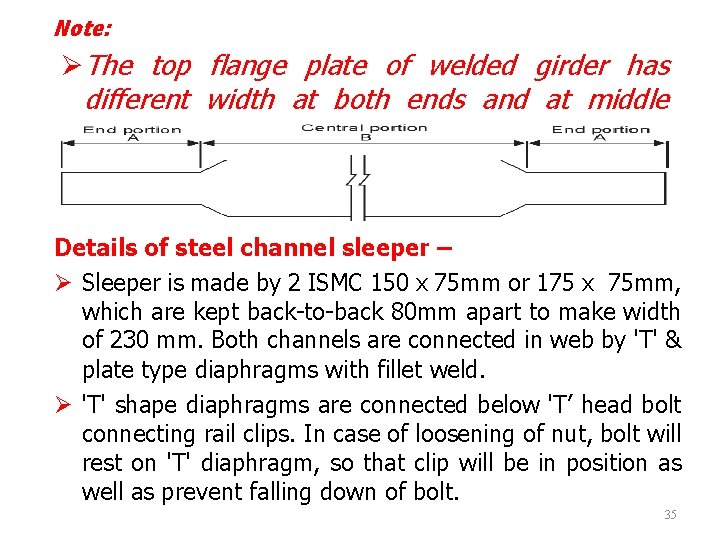
Note: ØThe top flange plate of welded girder has different width at both ends and at middle portion of girder. Therefore, Length of sleepers on A and B location are different. Details of steel channel sleeper – Ø Sleeper is made by 2 ISMC 150 x 75 mm or 175 x 75 mm, which are kept back-to-back 80 mm apart to make width of 230 mm. Both channels are connected in web by 'T' & plate type diaphragms with fillet weld. Ø 'T' shape diaphragms are connected below 'T’ head bolt connecting rail clips. In case of loosening of nut, bolt will rest on 'T' diaphragm, so that clip will be in position as well as prevent falling down of bolt. 35
Ø Canted bearing plates for rail seat are connected to top flange of both channels with rivets. Ø Stiffener plates are provided below the rail seat with fillet weld in web between top and bottom flange of both channels as well as in the middle of sleepers. • Track fittings for steel channel sleepers – Ø Rail fastening arrangement for sleeper is as per Drg No. RDSO/T-5155 to 5164 for BG (60 Kg running rail and 52 Kg guard rail) and as per Drg No. RDSO/T 5197 to 5200 (for 52 Kg running rail and 52 Kg/ 90 R guard rail). Ø Fastening arrangements comprise of a) Bolt- ‘T’ head bolts with spring washers and nuts are used to clamp the clip to canted bearing plate to hold rails. ‘T’ head will facilitate insertion of bolt from top and vice versa removal of the same. 36
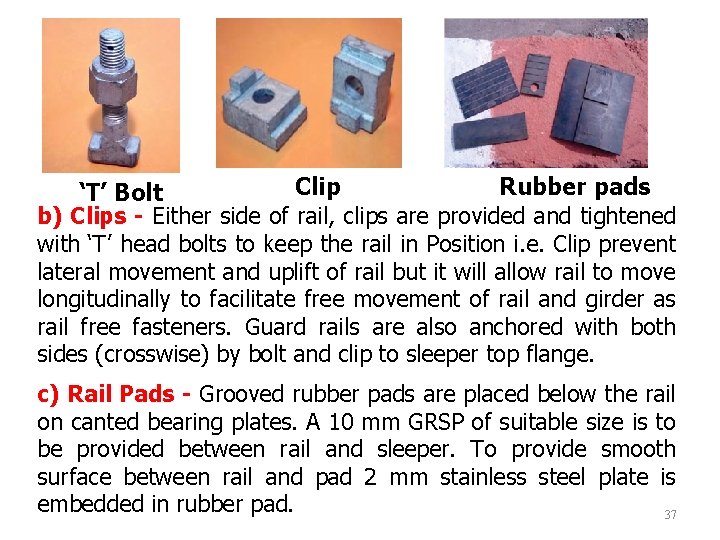
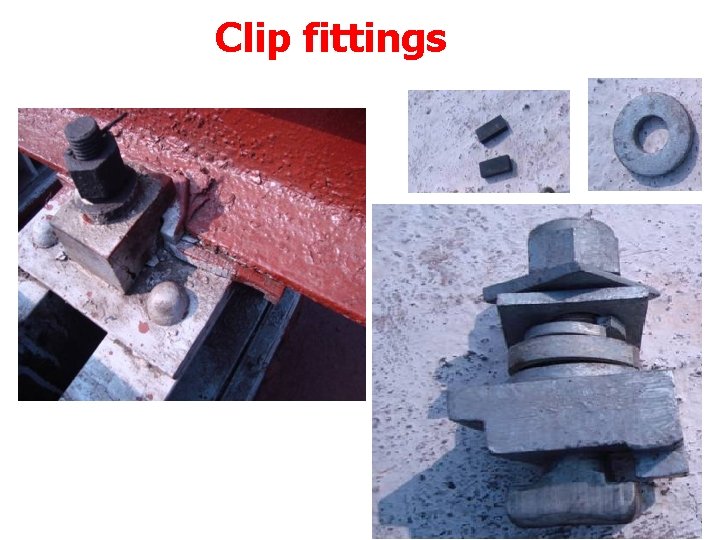
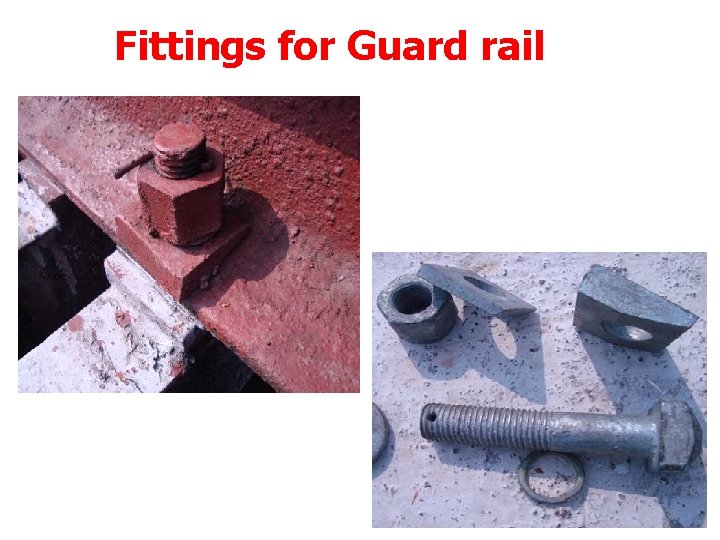
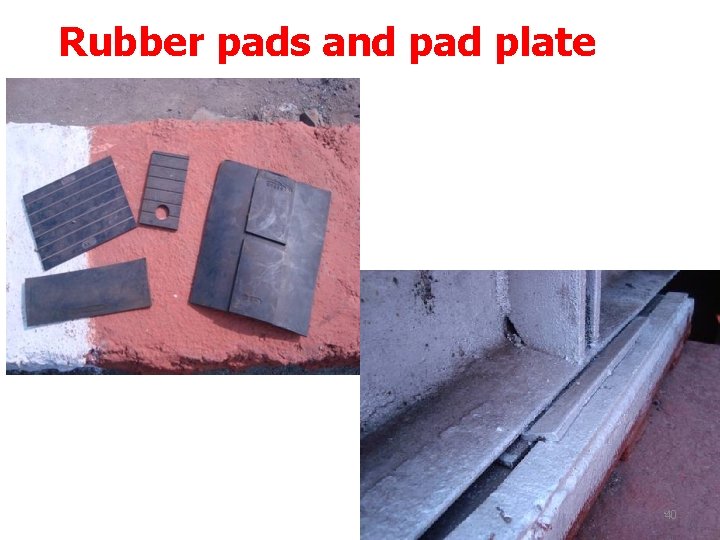
Clip Rubber pads ‘T’ Bolt b) Clips - Either side of rail, clips are provided and tightened with ‘T’ head bolts to keep the rail in Position i. e. Clip prevent lateral movement and uplift of rail but it will allow rail to move longitudinally to facilitate free movement of rail and girder as rail free fasteners. Guard rails are also anchored with both sides (crosswise) by bolt and clip to sleeper top flange. c) Rail Pads - Grooved rubber pads are placed below the rail on canted bearing plates. A 10 mm GRSP of suitable size is to be provided between rail and sleeper. To provide smooth surface between rail and pad 2 mm stainless steel plate is embedded in rubber pad. 37
Clip fittings 38
Fittings for Guard rail 39
Rubber pads and pad plate 40
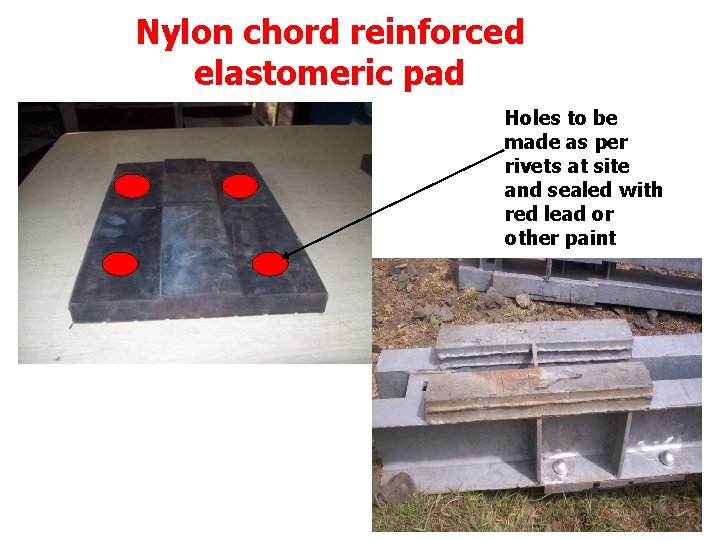
Nylon chord reinforced elastomeric pad Holes to be made as per rivets at site and sealed with red lead or other paint 41

Hook Bolt arrangement: Pad Plates 42
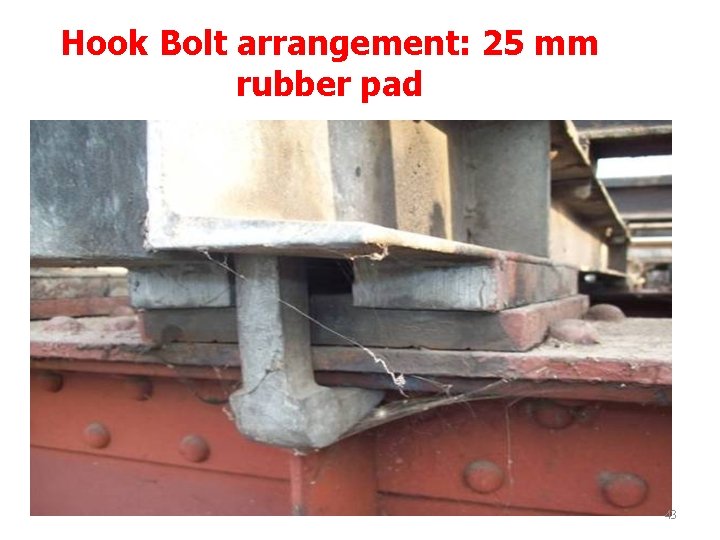
Hook Bolt arrangement: 25 mm rubber pad 43
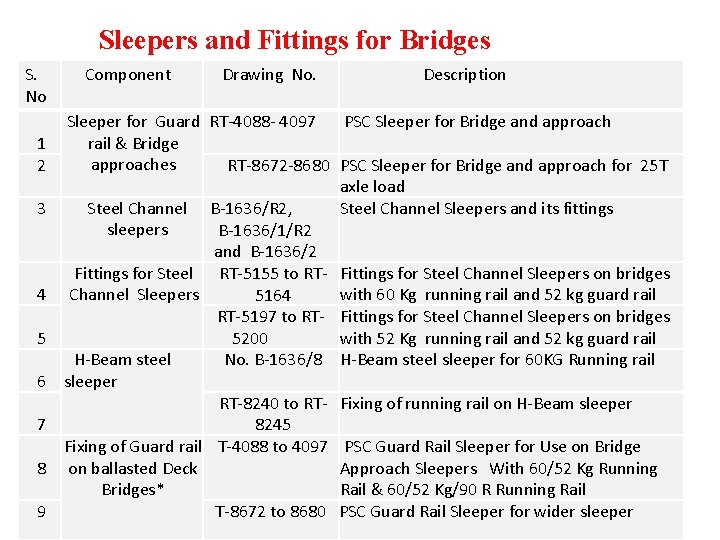
Sleepers and Fittings for Bridges S. No 1 2 3 4 5 6 7 8 9 Component Drawing No. Description Sleeper for Guard RT-4088 - 4097 PSC Sleeper for Bridge and approach rail & Bridge approaches RT-8672 -8680 PSC Sleeper for Bridge and approach for 25 T axle load Steel Channel B-1636/R 2, Steel Channel Sleepers and its fittings sleepers B-1636/1/R 2 and B-1636/2 Fittings for Steel RT-5155 to RT- Fittings for Steel Channel Sleepers on bridges Channel Sleepers with 60 Kg running rail and 52 kg guard rail 5164 RT-5197 to RT- Fittings for Steel Channel Sleepers on bridges 5200 with 52 Kg running rail and 52 kg guard rail H-Beam steel No. B-1636/8 H-Beam steel sleeper for 60 KG Running rail sleeper RT-8240 to RT- Fixing of running rail on H-Beam sleeper 8245 Fixing of Guard rail T-4088 to 4097 PSC Guard Rail Sleeper for Use on Bridge on ballasted Deck Approach Sleepers With 60/52 Kg Running Bridges* Rail & 60/52 Kg/90 R Running Rail T-8672 to 8680 PSC Guard Rail Sleeper for wider sleeper
Laying of steel sleepers on bridges: • In case of bridge on curves, the location of steel sleepers should be marked after taking into account the realigned curve. • In case transition curve lies on bridge fully or partially, the thickness of steel pad plate should take care of cant gradient. • Before laying steel sleepers, creep if any, should be pulled back and rail joints should be so located that after laying sleepers, joints should not become supported joints. 45
Laying of steel sleepers on bridges: • The top flange of girder should be cleaned of paint & repainted as specified. • Existing cross level & misalignment of girder/track should be corrected in advance before steel sleeper laying. • At least JE/II/Pway should supervise the laying work. • Single pad plate below steel sleeper is preferable. • Packing plates can be used along with pad plate to adjust parameters, wherever required. • The pad plates not required where neoprene pad is provided to cover the rivet head. 46
Maintenance • • After laying steel sleepers Tightening of all fittings including hook bolts should be done once in 15 days for initial one month. Thereafter it should be done once a month for next six month & subsequently it should be on need basis as observed by inspecting officials. Guard rail fittings should be tightened once in three month for 1 st six months and thereafter on need basis. The above will be in addition to daily attention by keyman. 47
Maintenance • Replacement of grooved rubber pad & elastomeric pads shall be done on condition basis. • Suitable stock of spare fittings should always be maintained keeping different types of girders in view. • Suitable quantity of the steel sleepers along with fittings should be kept as emergency reserve. • Emergency reserve stock of channel sleepers should be maintained keeping different types of girder in view. • In case galvanized coating gets damaged, it should be repaired as specified. 48
Inspection schedule (only for channel sleepers) • By ADEN and SSE/SE(Pway) Incharge: Once in a year by rotation. • Condition of channel sleeper shall be thoroughly inspected. During intensive inspection, the condition of rivets, distortion or crack in sleepers or any sign of crack in girder flange and tightness of fittings should be looked for. • All loose fittings should be tightened after inspection, if required. • Watch must be kept for few days in the beginning as per need. 49
Inspection schedule (only for channel sleepers) • SSE/SE/Pway and SSE/SE/S&T should jointly inspect insulated steel sleepers, every six month for checking the effectiveness of insulation in track circuited areas. SSE/SE/S&T should coordinate this. 50
Steel Channel Sleepers 51
Steel Channel Sleepers 52
Steel Channel Sleepers 53
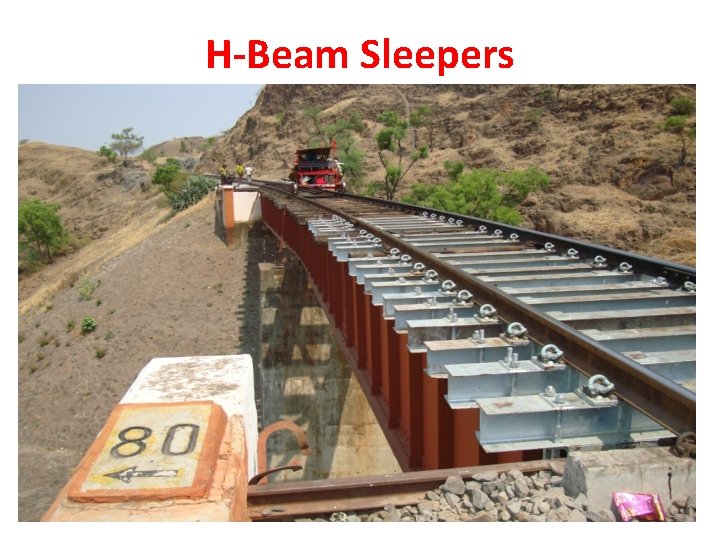
H-Beam Sleepers 54
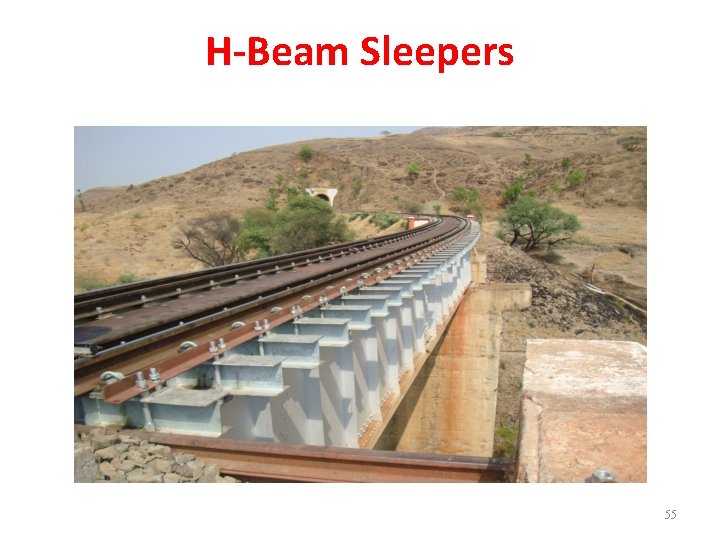
H-Beam Sleepers 55
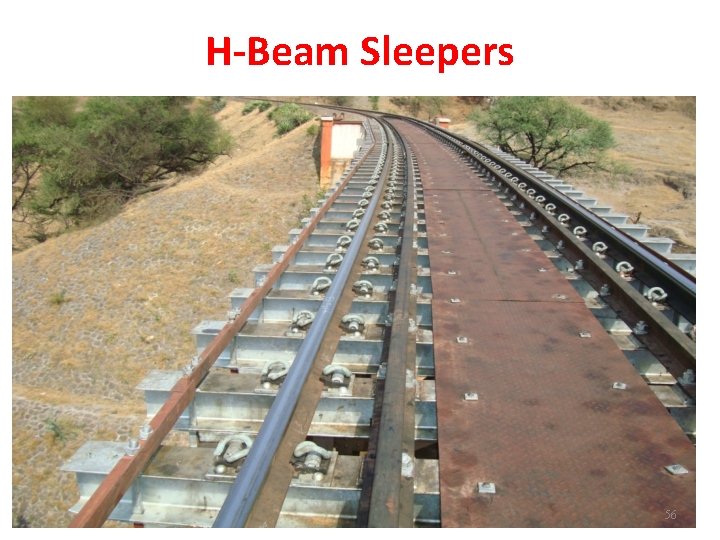
H-Beam Sleepers 56
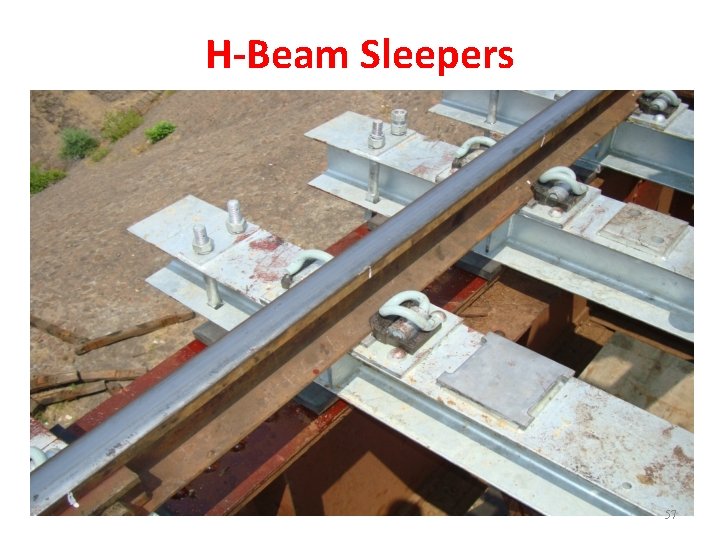
H-Beam Sleepers 57
H-Beam Sleepers 58
H-Beam Sleepers 59
WOODEN SLEEPERS • Wooden sleepers should have permissible fibre stress 140 Kg/cm 2 minimum • Max. clear distance between two consecutive sleepers should not exceed 450 mm in BG & 305 mm in MG. • Minimum depth of sleeper, excluding notches, BG- 150 mm, MG-125 mm • Max clear distance between joint sleepers 200 mm for BG/MG 60
• Minimum length of sleeper BG - 2440 mm or d+305 mm whichever is more. MG - 1675 mm or d+305 mm whichever is more. where “d”= out side to out side of girder flange • Minimum breadth of sleeper BG - 250 mm, MG - 200 mm 61
• End binding done with 6 mm MS wire at a distance of 75 mm from end, to avoid splitting of sleepers. • Notching for rivet head done for accommodating individual rivet. No through notch. 62
Treatment of bridge timbers • Should normally be done in depot, if not , SSE should do it. • One coat of boiling coal tar & a double coat on bottom of sleeper. • With each litre of coal tar 50 gms of quick lime added as an anti pest measure. • Re-tarring done once in 5 to 7 years 63
Dating & branding • Year of laying, number of sleeper & span number should be cut or branded on each sleeper. • Numbering should be done in the direction of traffic on double line & in the direction of increasing KM on single line. 64

THANKS 65
- Slides: 65