15 213 Recitation 7 102102 Outline Program Optimization
- Slides: 17
15 -213 Recitation 7: 10/21/02 Outline • Program Optimization – Machine Independent – Machine Dependent • Loop Unrolling • Blocking Annie Luo e-mail: luluo@cs. cmu. edu Office Hours: Thursday 6: 00 – 7: 00 Wean 8402 Reminder • L 4 due: Thursday 10/24, 11: 59 pm • Submission is *online* http: //www 2. cs. cmu. edu/afs/cs/academic/class/15213 -f 02/www/L 4. html
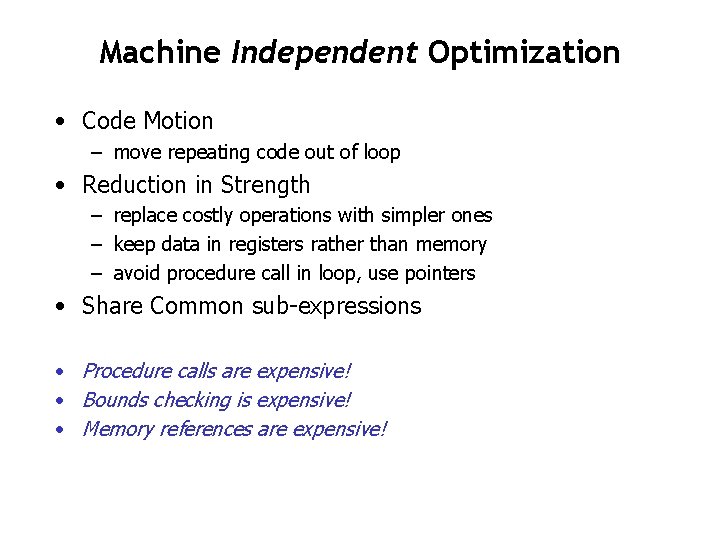
Machine Independent Optimization • Code Motion – move repeating code out of loop • Reduction in Strength – replace costly operations with simpler ones – keep data in registers rather than memory – avoid procedure call in loop, use pointers • Share Common sub-expressions • Procedure calls are expensive! • Bounds checking is expensive! • Memory references are expensive!
Machine Dependent Optimization • Take advantage of system infrastructure • Loop unrolling • Blocking
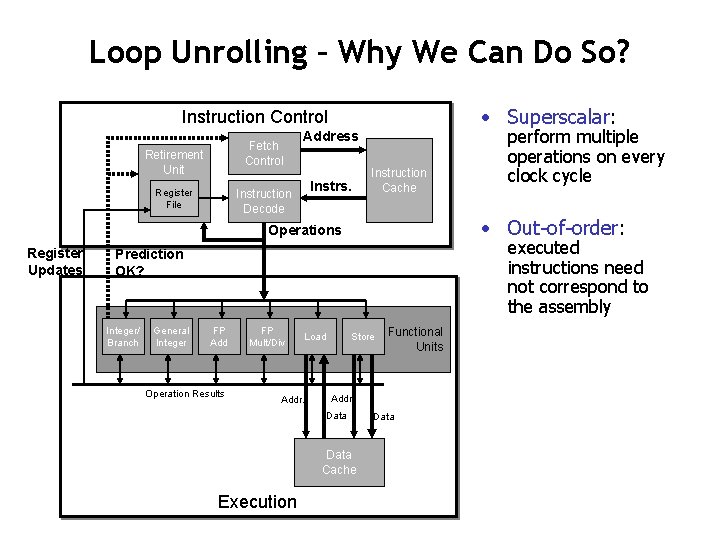
Loop Unrolling – Why We Can Do So? • Superscalar: Instruction Control Fetch Control Retirement Unit Register File Address Instrs. Instruction Decode Instruction Cache • Out-of-order: Operations Register Updates executed instructions need not correspond to the assembly Prediction OK? Integer/ Branch General Integer FP Add Operation Results FP Mult/Div Load Addr. Store Functional Units Addr. Data Cache Execution perform multiple operations on every clock cycle Data
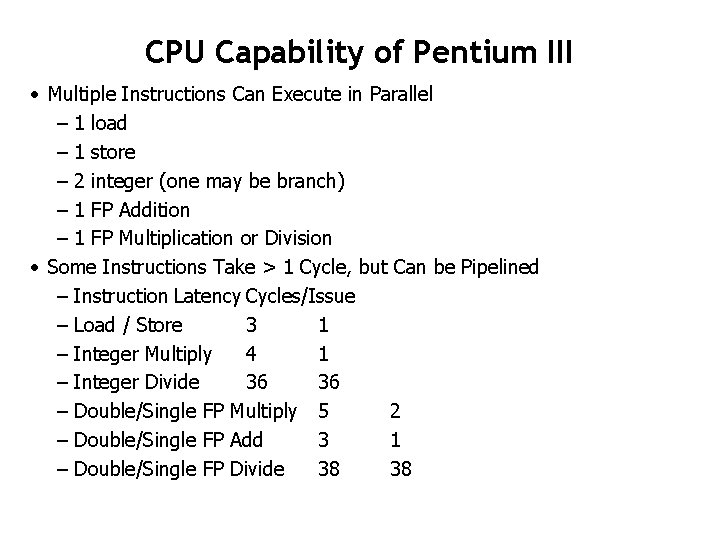
CPU Capability of Pentium III • Multiple Instructions Can Execute in Parallel – 1 load – 1 store – 2 integer (one may be branch) – 1 FP Addition – 1 FP Multiplication or Division • Some Instructions Take > 1 Cycle, but Can be Pipelined – Instruction Latency Cycles/Issue – Load / Store 3 1 – Integer Multiply 4 1 – Integer Divide 36 36 – Double/Single FP Multiply 5 2 – Double/Single FP Add 3 1 – Double/Single FP Divide 38 38
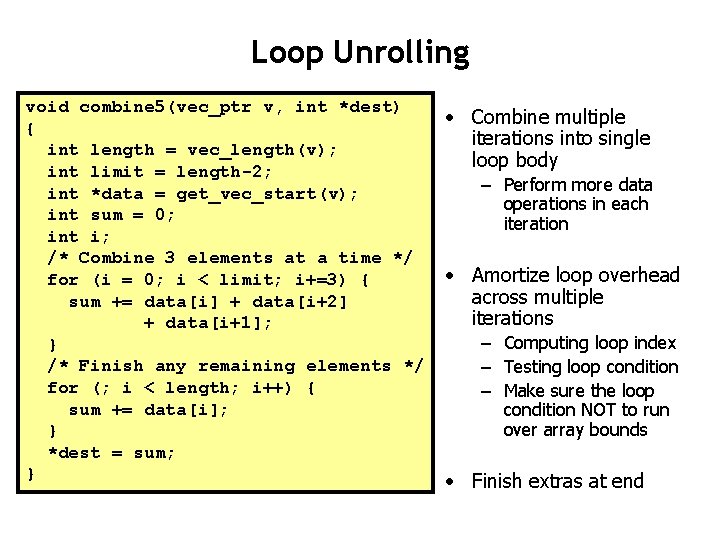
Loop Unrolling void combine 5(vec_ptr v, int *dest) { int length = vec_length(v); int limit = length-2; int *data = get_vec_start(v); int sum = 0; int i; /* Combine 3 elements at a time */ for (i = 0; i < limit; i+=3) { sum += data[i] + data[i+2] + data[i+1]; } /* Finish any remaining elements */ for (; i < length; i++) { sum += data[i]; } *dest = sum; } • Combine multiple iterations into single loop body – Perform more data operations in each iteration • Amortize loop overhead across multiple iterations – Computing loop index – Testing loop condition – Make sure the loop condition NOT to run over array bounds • Finish extras at end
Practice Time • Work on practice problem 5. 12 and 5. 13
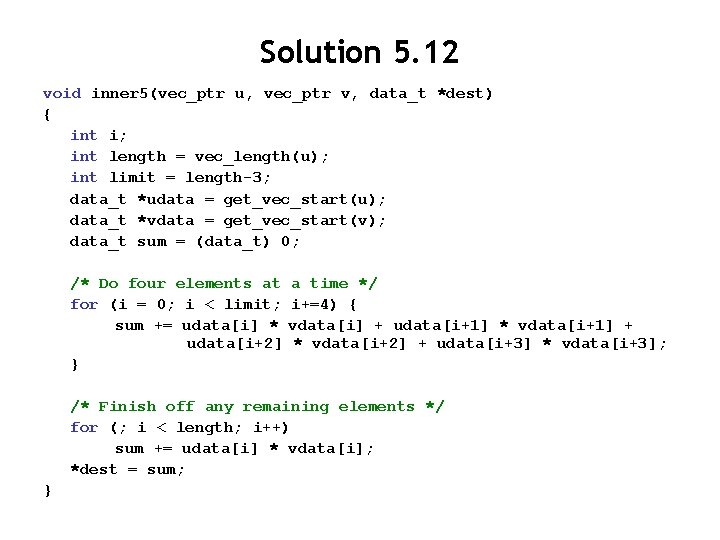
Solution 5. 12 void inner 5(vec_ptr u, vec_ptr v, data_t *dest) { int i; int length = vec_length(u); int limit = length-3; data_t *udata = get_vec_start(u); data_t *vdata = get_vec_start(v); data_t sum = (data_t) 0; /* Do four elements at for (i = 0; i < limit; sum += udata[i] * udata[i+2] } a time */ i+=4) { vdata[i] + udata[i+1] * vdata[i+1] + * vdata[i+2] + udata[i+3] * vdata[i+3]; /* Finish off any remaining elements */ for (; i < length; i++) sum += udata[i] * vdata[i]; *dest = sum; }
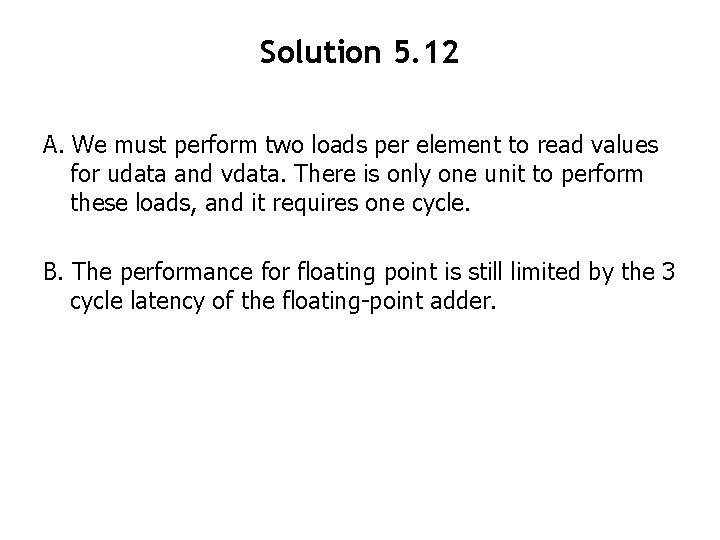
Solution 5. 12 A. We must perform two loads per element to read values for udata and vdata. There is only one unit to perform these loads, and it requires one cycle. B. The performance for floating point is still limited by the 3 cycle latency of the floating-point adder.
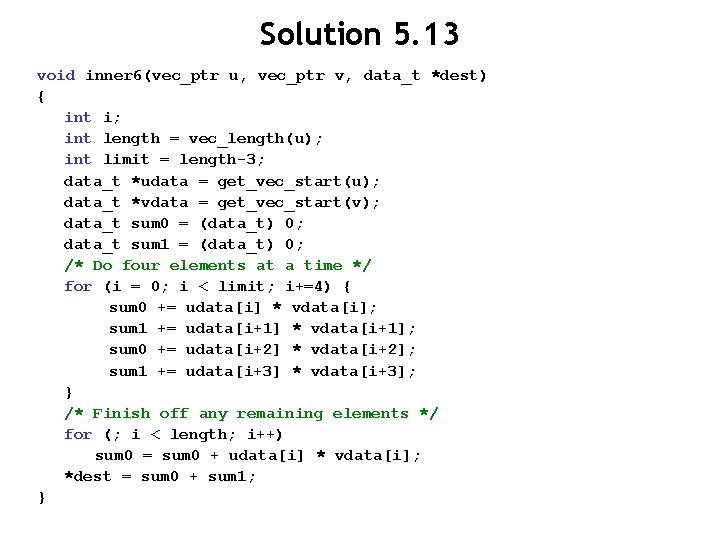
Solution 5. 13 void inner 6(vec_ptr u, vec_ptr v, data_t *dest) { int i; int length = vec_length(u); int limit = length-3; data_t *udata = get_vec_start(u); data_t *vdata = get_vec_start(v); data_t sum 0 = (data_t) 0; data_t sum 1 = (data_t) 0; /* Do four elements at a time */ for (i = 0; i < limit; i+=4) { sum 0 += udata[i] * vdata[i]; sum 1 += udata[i+1] * vdata[i+1]; sum 0 += udata[i+2] * vdata[i+2]; sum 1 += udata[i+3] * vdata[i+3]; } /* Finish off any remaining elements */ for (; i < length; i++) sum 0 = sum 0 + udata[i] * vdata[i]; *dest = sum 0 + sum 1; }
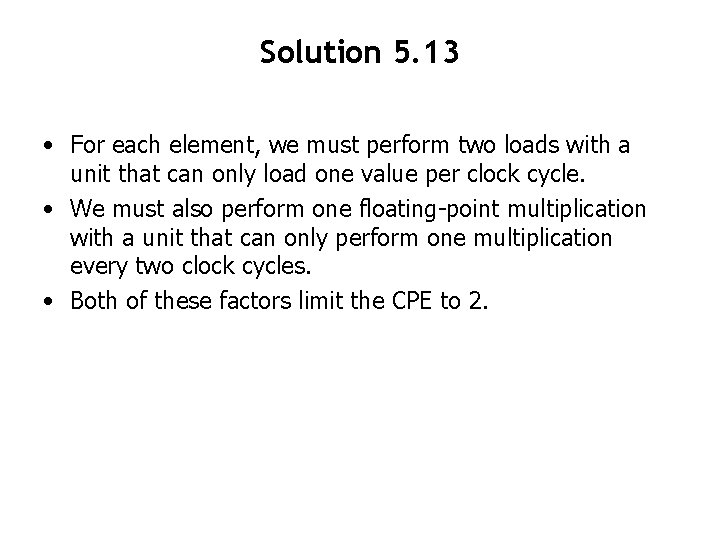
Solution 5. 13 • For each element, we must perform two loads with a unit that can only load one value per clock cycle. • We must also perform one floating-point multiplication with a unit that can only perform one multiplication every two clock cycles. • Both of these factors limit the CPE to 2.
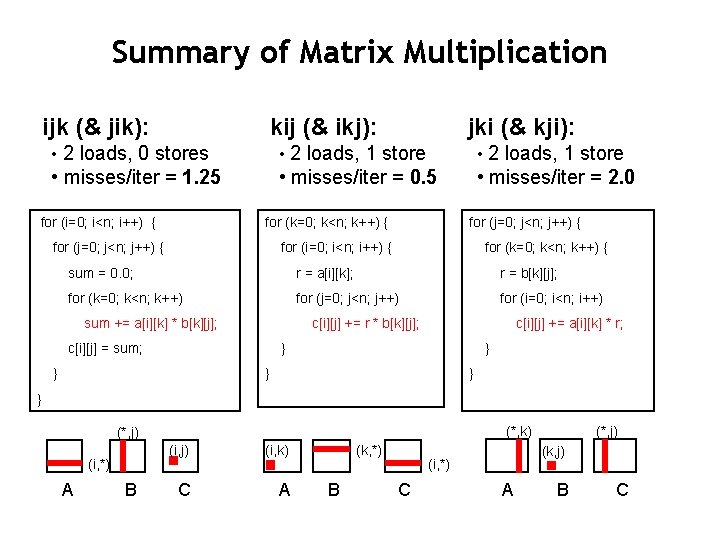
Summary of Matrix Multiplication ijk (& jik): kij (& ikj): jki (& kji): • 2 loads, 0 stores • 2 loads, 1 store • misses/iter = 1. 25 • misses/iter = 0. 5 • misses/iter = 2. 0 for (i=0; i<n; i++) { for (k=0; k<n; k++) { for (j=0; j<n; j++) { for (i=0; i<n; i++) { for (k=0; k<n; k++) { sum = 0. 0; r = a[i][k]; r = b[k][j]; for (k=0; k<n; k++) for (j=0; j<n; j++) for (i=0; i<n; i++) sum += a[i][k] * b[k][j]; c[i][j] += r * b[k][j]; c[i][j] = sum; c[i][j] += a[i][k] * r; } } } (*, k) (*, j) (i, *) A B (i, j) (i, k) C A (k, *) B (k, j) (i, *) C (*, j) A B C
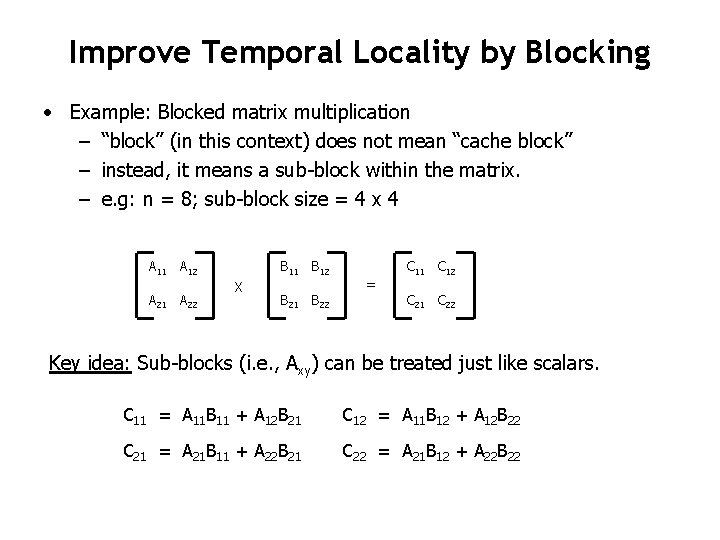
Improve Temporal Locality by Blocking • Example: Blocked matrix multiplication – “block” (in this context) does not mean “cache block” – instead, it means a sub-block within the matrix. – e. g: n = 8; sub-block size = 4 x 4 A 11 A 12 A 21 A 22 B 11 B 12 X B 21 B 22 = C 11 C 12 C 21 C 22 Key idea: Sub-blocks (i. e. , Axy) can be treated just like scalars. C 11 = A 11 B 11 + A 12 B 21 C 12 = A 11 B 12 + A 12 B 22 C 21 = A 21 B 11 + A 22 B 21 C 22 = A 21 B 12 + A 22 B 22
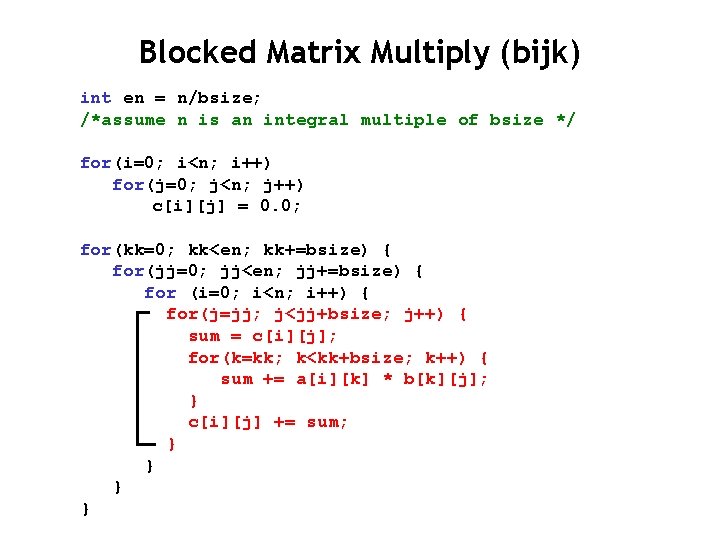
Blocked Matrix Multiply (bijk) int en = n/bsize; /*assume n is an integral multiple of bsize */ for(i=0; i<n; i++) for(j=0; j<n; j++) c[i][j] = 0. 0; for(kk=0; kk<en; kk+=bsize) { for(jj=0; jj<en; jj+=bsize) { for (i=0; i<n; i++) { for(j=jj; j<jj+bsize; j++) { sum = c[i][j]; for(k=kk; k<kk+bsize; k++) { sum += a[i][k] * b[k][j]; } c[i][j] += sum; } }
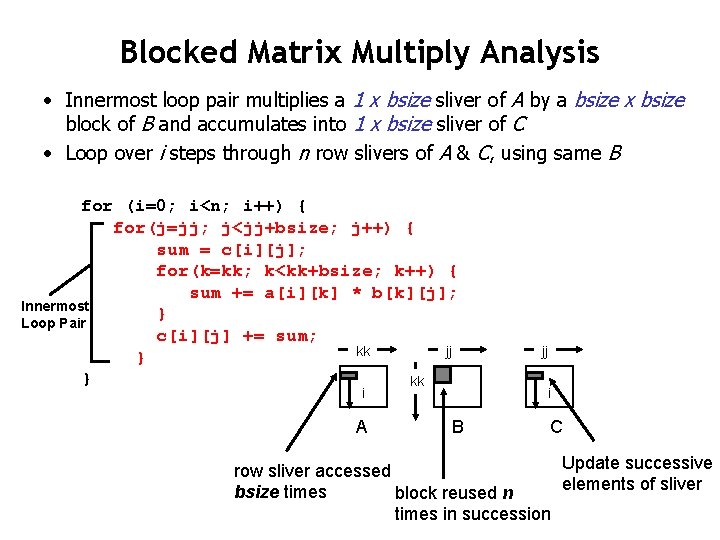
Blocked Matrix Multiply Analysis • Innermost loop pair multiplies a 1 x bsize sliver of A by a bsize x bsize block of B and accumulates into 1 x bsize sliver of C • Loop over i steps through n row slivers of A & C, using same B for (i=0; i<n; i++) { for(j=jj; j<jj+bsize; j++) { sum = c[i][j]; for(k=kk; k<kk+bsize; k++) { sum += a[i][k] * b[k][j]; Innermost } Loop Pair c[i][j] += sum; kk jj } } kk i A B jj i C Update successive row sliver accessed elements of sliver bsize times block reused n times in succession
Pentium Blocked Mat-Mul Performance • Blocking (bijk and bikj) improves performance by a factor of two over unblocked versions (ijk and jik) – relatively insensitive to array size.
Summary • You can improve the performance of your program! – Keep working set reasonably small (temporal locality) – Use small strides (spatial locality) • Mind writing “cache friendly code” – Absolute optimum performance is very platform specific: cache sizes, line sizes, etc.