1 Monopoly Chapter 15 2 What we learn
- Slides: 36
1 Monopoly Chapter 15
2 What we learn in this chapter? • In Ch. 13 we established the cost structure of the firm as the unit of production in a market economy • In Ch. 14 we looked at the equlibrium of the firm and of the market assuming perfect competition • Ch. 15 goes to the other extreme in terms of market competition: a monopoly • Obviously, there is a big contrast between a market with perfect competition on one extreme and full monopoly at the other extreme • We will find out about the behaviour of a monopoly while its sets the profit maximising output level • We will also discuss welfare implications of monopoly and government policy toward it
3 Monopoly • The word monopoly (tekel) comes from the ancient Greek word mono = one, single • It means a single firm controls the market • A firm is considered a monopoly if – it is the sole seller of its product – its products have no close substitutes – it has the means to influence the market price of its products • The fundamental cause of monopoly is barriers to entry that may exist in a market because of – Ownership of key resources – Legal barriers by government – Large economies of scale
4 Monopoly resources • Ownership of a critical natural resource may give monopoly power to its owners • Ownership has to be exclusive and the resource must be very difficult to duplicate • Example: there may exist only one water resource in a community such a small town • By defition its owner will be able to dictate the price on the community if the resource is subject to private ownership • In practise, there almost no monopolies of this kind worth mentioning in large open economies • One often cited exemple is the diamond monopoly held by the South African company De. Beers
5 Government created monopolies • Patent and copywrite laws that protect intellectual property cause government created monopolies • Typical examples would be drugs during the patent period and computer programs • Governments may also restrict entry and directly institute a monopoly by giving a single firm the exclusive right to a sell a particular good or service in certain markets • In Turkey, many such public monopolies were created in the past in order to raise budget revenue • Such as tobacco (Tekel) , broadcasting (TRT), communication (PTT), electricity, gas, etc. • These are now open or opening up to competition
6 Natural monopolies • Natural monopolies are not on natural resources but result from the nature of the economic activity • An industry is a natural monopoly when a single firm can supply a good or service to an entire market at a smaller cost than could two or more firms • Because of economies of scale, the minimum efficient scale of a single firm is bigger than the side of the market, thus leading to natural monopoly • Natural monopolies are often found in service industries which require large capital outlays in order to be operational • Such as city water, cable TV, electricity, gas, toll bridges, airports, etc.
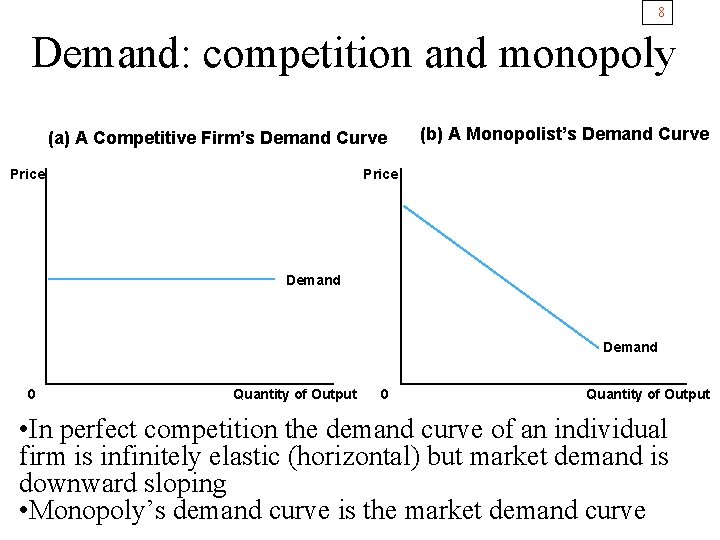
7 Monopoly versus competition • Let us compare the characteristic of monopoly with those of a firm in a perfectly competitive market • Monopoly – is the sole producer – has a downward-sloping demand curve – is a price-maker – must reduce its price to increase sales • Competitive firm – is one of many producers – has a horizontal demand curve – is a price-taker – sells as much or as little it wishes at the same price
8 Demand: competition and monopoly (a) A Competitive Firm’s Demand Curve Price (b) A Monopolist’s Demand Curve Price Demand 0 Quantity of Output • In perfect competition the demand curve of an individual firm is infinitely elastic (horizontal) but market demand is downward sloping • Monopoly’s demand curve is the market demand curve
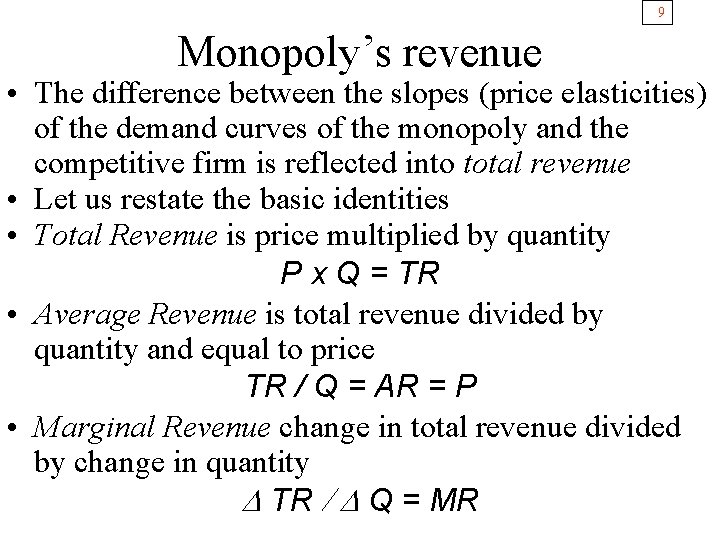
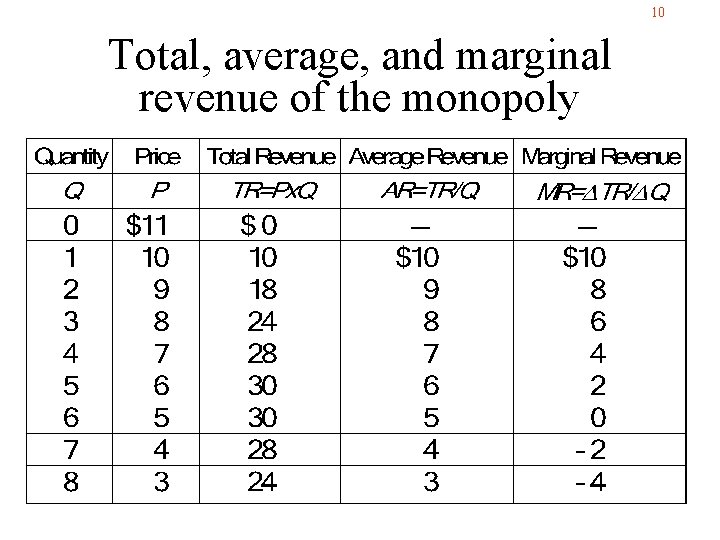
9 Monopoly’s revenue • The difference between the slopes (price elasticities) of the demand curves of the monopoly and the competitive firm is reflected into total revenue • Let us restate the basic identities • Total Revenue is price multiplied by quantity P x Q = TR • Average Revenue is total revenue divided by quantity and equal to price TR / Q = AR = P • Marginal Revenue change in total revenue divided by change in quantity TR Q = MR
10 Total, average, and marginal revenue of the monopoly
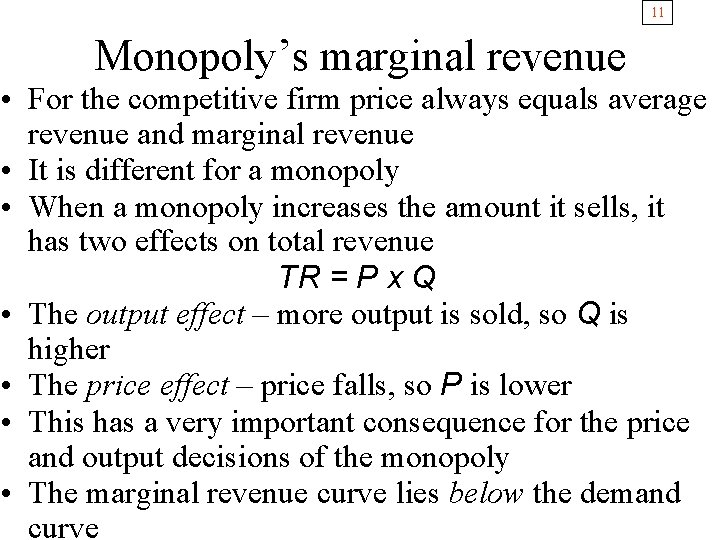
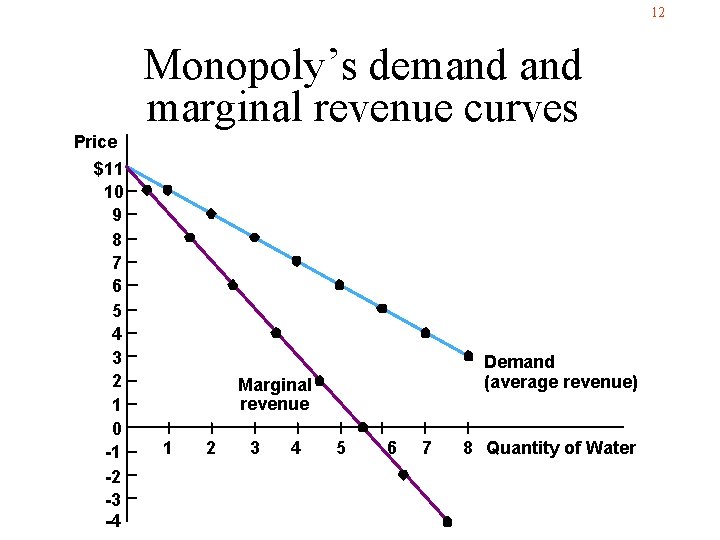
11 Monopoly’s marginal revenue • For the competitive firm price always equals average revenue and marginal revenue • It is different for a monopoly • When a monopoly increases the amount it sells, it has two effects on total revenue TR = P x Q • The output effect – more output is sold, so Q is higher • The price effect – price falls, so P is lower • This has a very important consequence for the price and output decisions of the monopoly • The marginal revenue curve lies below the demand curve
12 Monopoly’s demand marginal revenue curves Price $11 10 9 8 7 6 5 4 3 2 1 0 -1 -2 -3 -4 Demand (average revenue) Marginal revenue 1 2 3 4 5 6 7 8 Quantity of Water
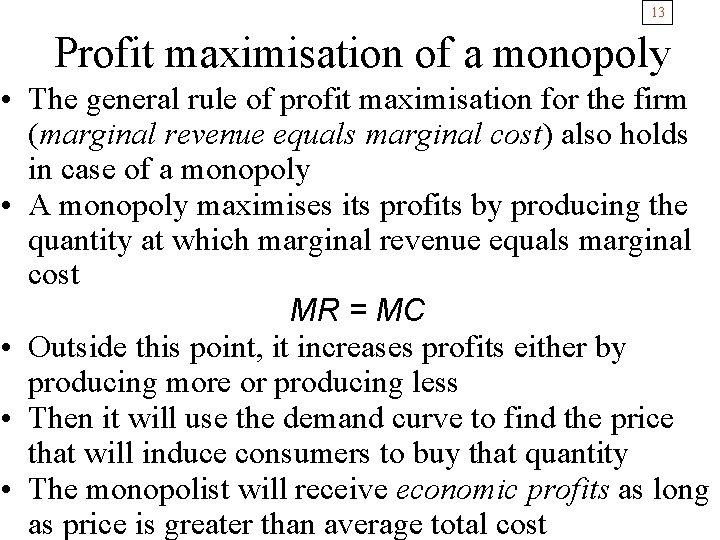
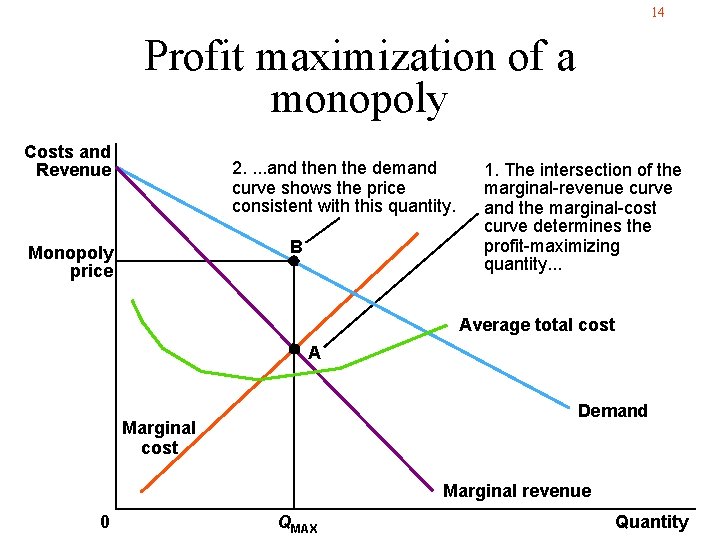
13 Profit maximisation of a monopoly • The general rule of profit maximisation for the firm (marginal revenue equals marginal cost) also holds in case of a monopoly • A monopoly maximises its profits by producing the quantity at which marginal revenue equals marginal cost MR = MC • Outside this point, it increases profits either by producing more or producing less • Then it will use the demand curve to find the price that will induce consumers to buy that quantity • The monopolist will receive economic profits as long as price is greater than average total cost
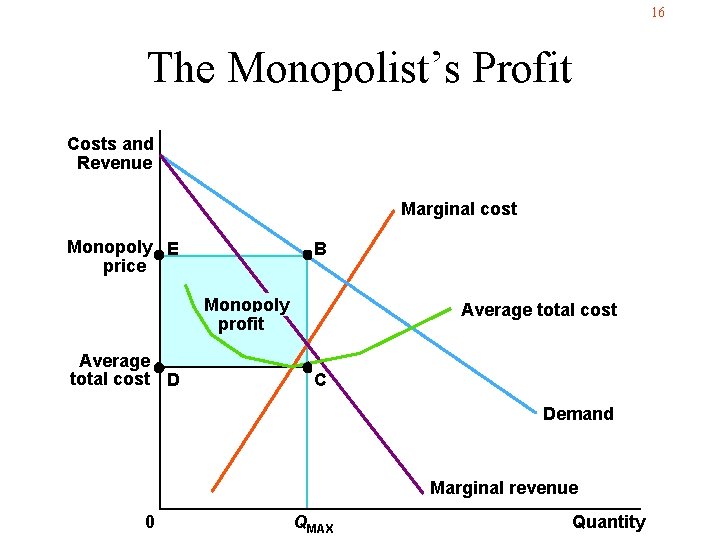
14 Profit maximization of a monopoly Costs and Revenue 2. . and then the demand curve shows the price consistent with this quantity. B Monopoly price 1. The intersection of the marginal-revenue curve and the marginal-cost curve determines the profit-maximizing quantity. . . Average total cost A Demand Marginal cost Marginal revenue 0 QMAX Quantity
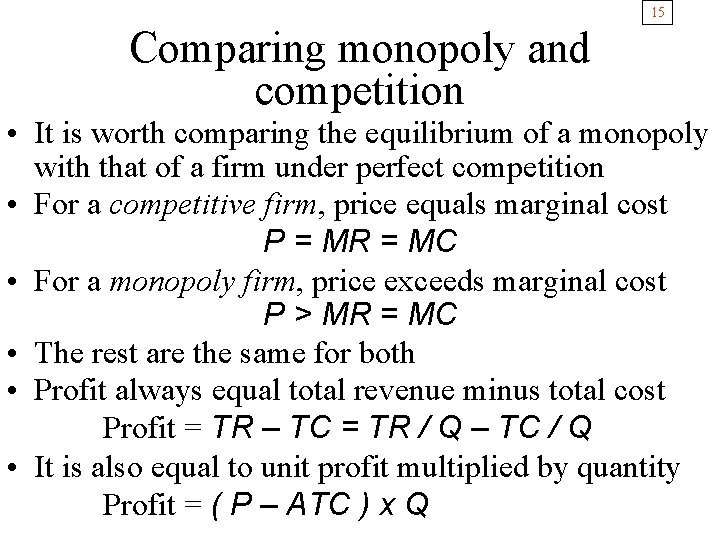
15 Comparing monopoly and competition • It is worth comparing the equilibrium of a monopoly with that of a firm under perfect competition • For a competitive firm, price equals marginal cost P = MR = MC • For a monopoly firm, price exceeds marginal cost P > MR = MC • The rest are the same for both • Profit always equal total revenue minus total cost Profit = TR – TC = TR / Q – TC / Q • It is also equal to unit profit multiplied by quantity Profit = ( P – ATC ) x Q
16 The Monopolist’s Profit Costs and Revenue Marginal cost Monopoly E price B Monopoly profit Average total cost D Average total cost C Demand Marginal revenue 0 QMAX Quantity
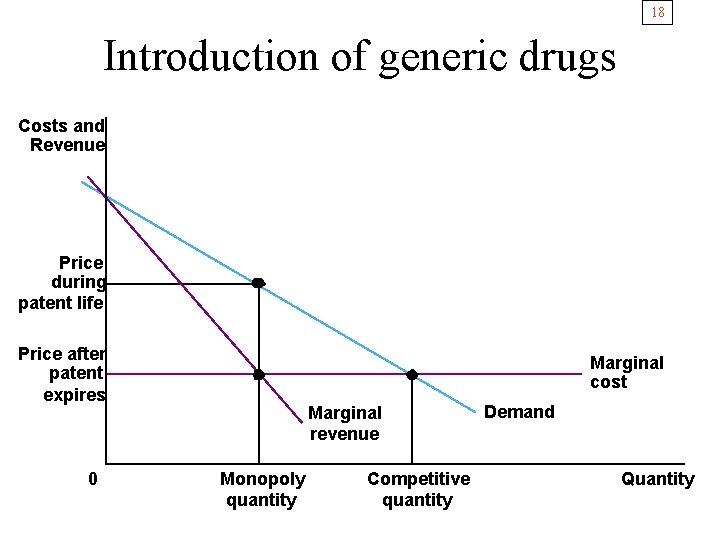
17 Monopoly and generic drugs • The effects of monopoly on price and profits can be better seen through a real world example • When a drug company discovers a new drug, it is protected by patent laws for a certain period • And becomes the sole producer of the drug • It earns high profits during the patent period • Once the patent expires, the same substance becomes a generic drug and other firms also produce it • In line with theory, the price of the drug falls by large amounts compared with the patent period • But the monopolist does not loose all its market and may continue to charge a slightly higher price because customers show loyalty to it
18 Introduction of generic drugs Costs and Revenue Price during patent life Price after patent expires 0 Marginal cost Marginal revenue Monopoly quantity Competitive quantity Demand Quantity
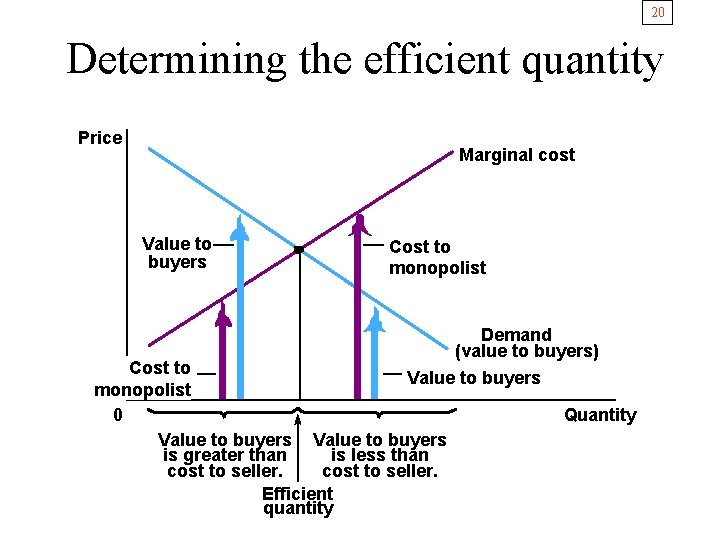
19 The welfare cost of monopoly • A monopoly leads to an inefficient allocation of resources and a failure to maximize total economic well being • Why? Because a monopoly always produces less than the socially efficient quantity of output • As we saw in case of taxation in Ch. 8, the market becomes smaller as a result of monopoly • As the monopolist charges a price above the marginal cost of production, consumers who value the good at more than its marginal cost but less than the monopolist price won’t buy it • In other words monopoly pricing prevents some mutually beneficial trades from taking place
20 Determining the efficient quantity Price Marginal cost Value to buyers Cost to monopolist Demand (value to buyers) Value to buyers Cost to monopolist 0 Value to buyers is greater than is less than cost to seller. Efficient quantity Quantity
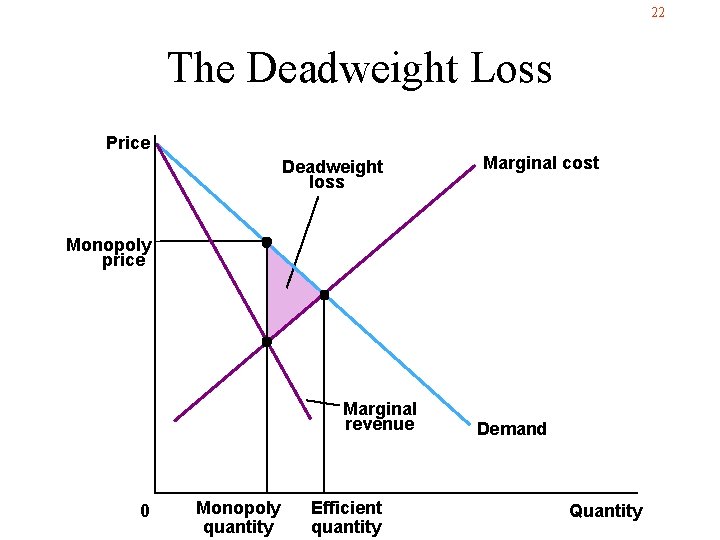
21 Deadweight loss of monopoly • Because a monopoly sets its price above marginal cost, it places a wedge between the consumer’s willingness to pay and the producer’s cost • This wedge causes the quantity sold be fall short of the social optimum • Which means there is a deadweight cost associated with a monopoly • This is similar to the deadweight cost of taxation and of tariffs on imports established in Ch. 8 and Ch. 9 • The monopolist earns extra profit by being the only seller in the market • But the loss to society is bigger than the gains of the monopolist
22 The Deadweight Loss Price Deadweight loss Marginal cost Monopoly price Marginal revenue 0 Monopoly quantity Efficient quantity Demand Quantity
23 Social cost of monopoly’s profit • Many people dislike a monopoly because of the large profits it generates for its owners • Economists disagree with this view • Profits in themselves are not bad a bad thing as long as they represent only a transfer of consumer surplus to the producer • As such, high profits are about the distribution of the social welfare not a loss of social welfare • The case economists construct against monopoly is based on the dead-weight loss it creates for society in terms of lower output and higher price • This is the real loss to the society of the monopoly when compared with perfect competition
24 Public policy toward monopolies • Government responds to the problem of monopoly in one of four ways below • Forcing competition: government intervenes in the market to increase competition through entry of new firms • Regulation: putting limits on the prices they can charge through complicated systems • Nationalisation: turning private monopolies into public enterprises to prevent private monopoly profits • Doing nothing: obviously if any of these are too costly compared with the results, government will not intervene and let the monopoly operate
25 Creating a competitive market • Government may implement and enforce antitrust laws to make the industry more competitive • These came into existence in US in the beginning of 20 th century against large monopolies (called trusts) in sectors such as railways, oil, etc • All developed countries have laws and agencies to prevent the formation of monopolies • “Competition Authority” (Rekabet Kurumu) and the protection of consumer (tüketicinin korunması) are new developments in Turkey • Competitive markets are secured not only by passing laws but proper enforcement of these laws with a competent and clean government
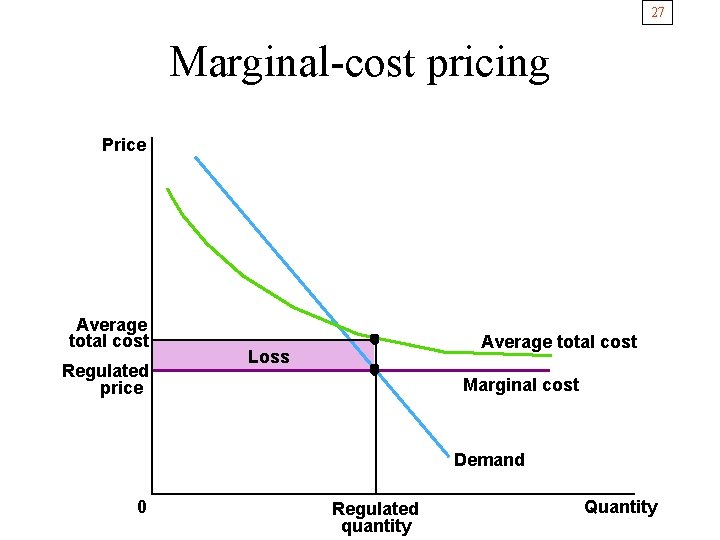
26 Regulation • Government may regulate the prices that the monopoly charges to its customers • Actual systems are complex and complicated • The allocation of resources will be efficient if price is set to equal marginal cost • There are two practical problems with marginal cost pricing – Price may be less than average total cost and the firm will lose money – It gives the monopolist no incentive to reduce costs • Again issues of enforcement and clean government are vital
27 Marginal-cost pricing Price Average total cost Regulated price Average total cost Loss Marginal cost Demand 0 Regulated quantity Quantity
28 Public ownership • Government can turn the monopolist into a government-owned and government-run enterprise • US never took that road but in Europe most utilities (natural monopolies) started life as private companies but were later nationalised • Railroads, telephone, water, electricity and gas are called utilities • In Turkey they were set up as government monopolies from the beginning • In the last decade these companies were privatised and regulated in Europe • Competition was also introduced into these sectors • Turkey is also taking that road
29 Doing nothing • Government may prefer to do nothing at all if the market failure is deemed small compared with the imperfections of public policies • Remember the cost-benefit analysis from Ch. 11 • If the social cost of monopoly is less than the cost of of redressing it society benefits from doing nothing • Like “market failures”, there also “political failures” arising from the imperfections of public interventions into the economy • Typically, wide-scale corruption in government causes many government policies to fail • State administrations are large hierarchies with much waste and often open to corrupt practises
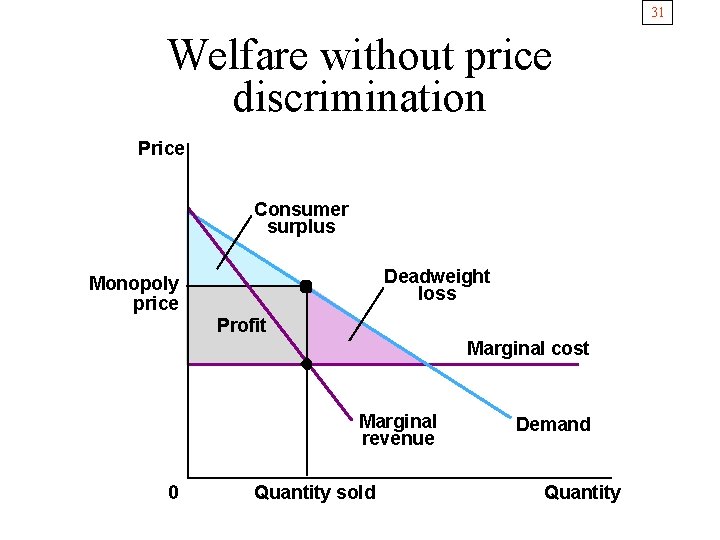
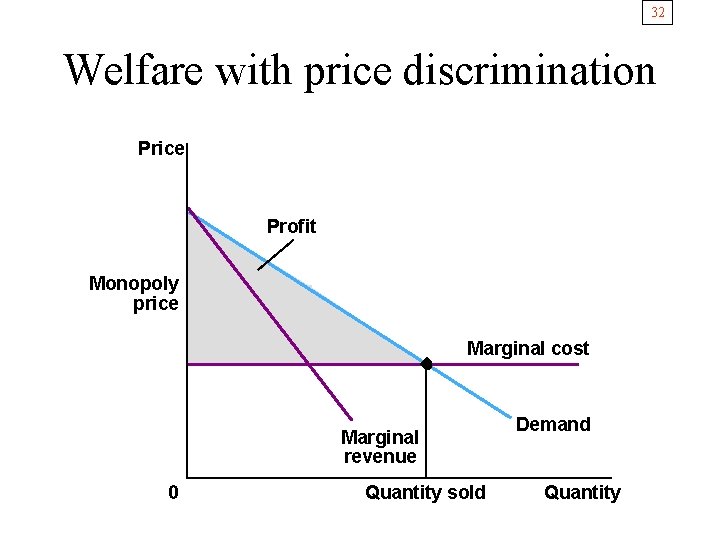
30 Price discrimination • A downward sloping demand curve offers opportunities to a monopolist to increase its profits • Price discrimination is the practise of selling the same good or service at different prices to different customers to capture more of the consumer surplus • The ideal for a monopolist is to charge a price equal to willingness to pay for each individual customer • This is not possible in a competitive market • There are two important and conflicting effects of price discrimination – It increases the profits of monopoly – At the same time it reduces the deadweight loss of the monopoly
31 Welfare without price discrimination Price Consumer surplus Monopoly price Deadweight loss Profit Marginal cost Marginal revenue 0 Quantity sold Demand Quantity
32 Welfare with price discrimination Price Profit Monopoly price Marginal cost Marginal revenue 0 Quantity sold Demand Quantity
33 Exemples of price discrimination • Many examples of price discrimination exist mainly from service industries • Movie tickets: the price of the ticket changes depending on time, on status (student, elderly, etc) even though they watch the same film • Airline tickets: first class, business and economy passangers fly in the same plane at different prices • Discount (and promotion) coupons: only those that participate obtain a lower price • Financial aid (scholarships) from universities allow students to register at a lower price • Quantity discounts: available to those who buy a larger quantity of a good
34 The prevalence of monopoly • How prevalent are the problems of monopolies? • Monopolies in the strict sense are not common in market economies • Because few goods are truly unique, most have substitutes • The exception is public monopolies • But in the sense of a firm having some control over its prices because of differentiated products monopolies are very common • It is more realistic to talk about monopoly power • Monopoly power is a matter of degree in the sense that many firms have it but it is usually a limited power and often encounters with official problems
35 Conclusion • A monopoly is a firm that is the sole seller in its market • It faces a downward sloping demand curve for its products • Like a competitive firm, a monopoly maximises profit by producing the quantity at which marginal cost and marginal revenue are equal • Unlike the competitive firm, its price exceeds its marginal revenue, so its price exceeds marginal cost • A monopolist’s profit-maximising level of output is below the level that maximises the sum of consumer and producer surplus
36 Conclusion • A monopoly causes deadweight losses similar to the deadweight losses caused by taxes • Policymakers can try to remedy the inefficiencies of monopolies with antitrust laws, regulation of prices or by turning a monopoly into a government-run enterprise • If market failure is small, they may do nothing • Monopolists can raise their profits by charging different prices to different buyers based on their willingness to pay • Price discrimination can raise economic welfare and reduce deadweight losses