What Measures are Eau Claire Manufacturing Companies Taking
- Slides: 1
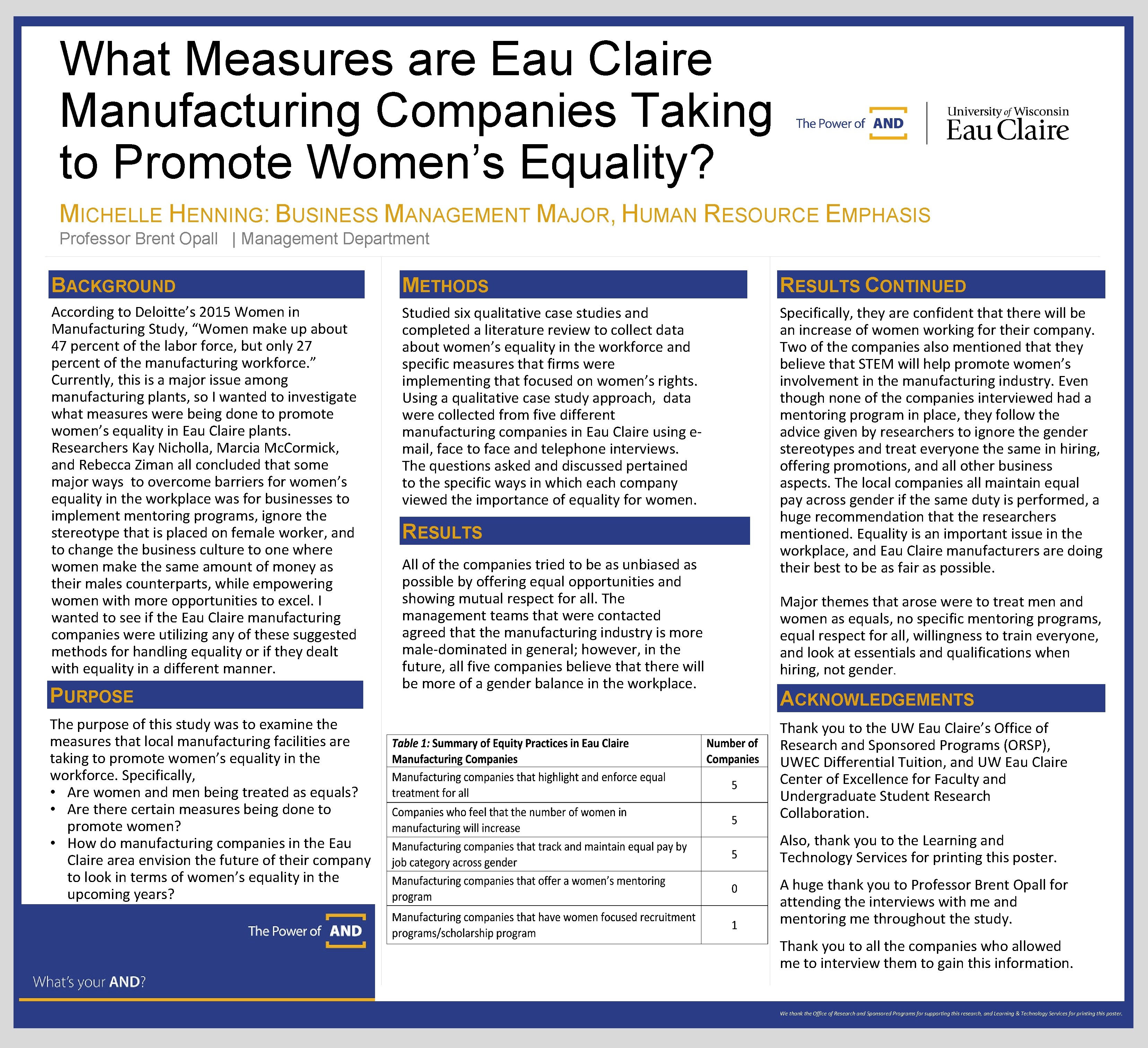
What Measures are Eau Claire Manufacturing Companies Taking to Promote Women’s Equality? MICHELLE HENNING: BUSINESS MANAGEMENT MAJOR, HUMAN RESOURCE EMPHASIS Professor Brent Opall | Management Department BACKGROUND METHODS RESULTS CONTINUED According to Deloitte’s 2015 Women in Manufacturing Study, “Women make up about 47 percent of the labor force, but only 27 percent of the manufacturing workforce. ” Currently, this is a major issue among manufacturing plants, so I wanted to investigate what measures were being done to promote women’s equality in Eau Claire plants. Researchers Kay Nicholla, Marcia Mc. Cormick, and Rebecca Ziman all concluded that some major ways to overcome barriers for women’s equality in the workplace was for businesses to implementoring programs, ignore the stereotype that is placed on female worker, and to change the business culture to one where women make the same amount of money as their males counterparts, while empowering women with more opportunities to excel. I wanted to see if the Eau Claire manufacturing companies were utilizing any of these suggested methods for handling equality or if they dealt with equality in a different manner. Studied six qualitative case studies and completed a literature review to collect data about women’s equality in the workforce and specific measures that firms were implementing that focused on women’s rights. Using a qualitative case study approach, data were collected from five different manufacturing companies in Eau Claire using email, face to face and telephone interviews. The questions asked and discussed pertained to the specific ways in which each company viewed the importance of equality for women. Specifically, they are confident that there will be an increase of women working for their company. Two of the companies also mentioned that they believe that STEM will help promote women’s involvement in the manufacturing industry. Even though none of the companies interviewed had a mentoring program in place, they follow the advice given by researchers to ignore the gender stereotypes and treat everyone the same in hiring, offering promotions, and all other business aspects. The local companies all maintain equal pay across gender if the same duty is performed, a huge recommendation that the researchers mentioned. Equality is an important issue in the workplace, and Eau Claire manufacturers are doing their best to be as fair as possible. PURPOSE The purpose of this study was to examine the measures that local manufacturing facilities are taking to promote women’s equality in the workforce. Specifically, • Are women and men being treated as equals? • Are there certain measures being done to promote women? • How do manufacturing companies in the Eau Claire area envision the future of their company to look in terms of women’s equality in the upcoming years? RESULTS All of the companies tried to be as unbiased as possible by offering equal opportunities and showing mutual respect for all. The management teams that were contacted agreed that the manufacturing industry is more male-dominated in general; however, in the future, all five companies believe that there will be more of a gender balance in the workplace. Major themes that arose were to treat men and women as equals, no specific mentoring programs, equal respect for all, willingness to train everyone, and look at essentials and qualifications when hiring, not gender. ACKNOWLEDGEMENTS Thank you to the UW Eau Claire’s Office of Research and Sponsored Programs (ORSP), UWEC Differential Tuition, and UW Eau Claire Center of Excellence for Faculty and Undergraduate Student Research Collaboration. Also, thank you to the Learning and Technology Services for printing this poster. A huge thank you to Professor Brent Opall for attending the interviews with me and mentoring me throughout the study. Thank you to all the companies who allowed me to interview them to gain this information. We thank the Office of Research and Sponsored Programs for supporting this research, and Learning & Technology Services for printing this poster.