What is poetry Poetry is a form of



- Slides: 8
What is poetry? Poetry is a form of art that uses words to express thoughts and feelings. It has been around for thousands of years and can be found in just about every culture on earth. It differs from "normal writing" (called prose) in several ways. Poems: • look different • sound different • often use figurative language
A little bit about poems. . . • 1. Poems Look Different: Prose (“normal writing”) is written in the form of sentences and paragraphs, using correct grammar and punctuation. Poems, on the other hand, are usually written in lines and stanzas (groups of lines). They may or may not have punctuation and sometimes regular grammar and/or spelling rules are ignored. Two lines are called a couplet and a stanza with four lines is called a quatrain.
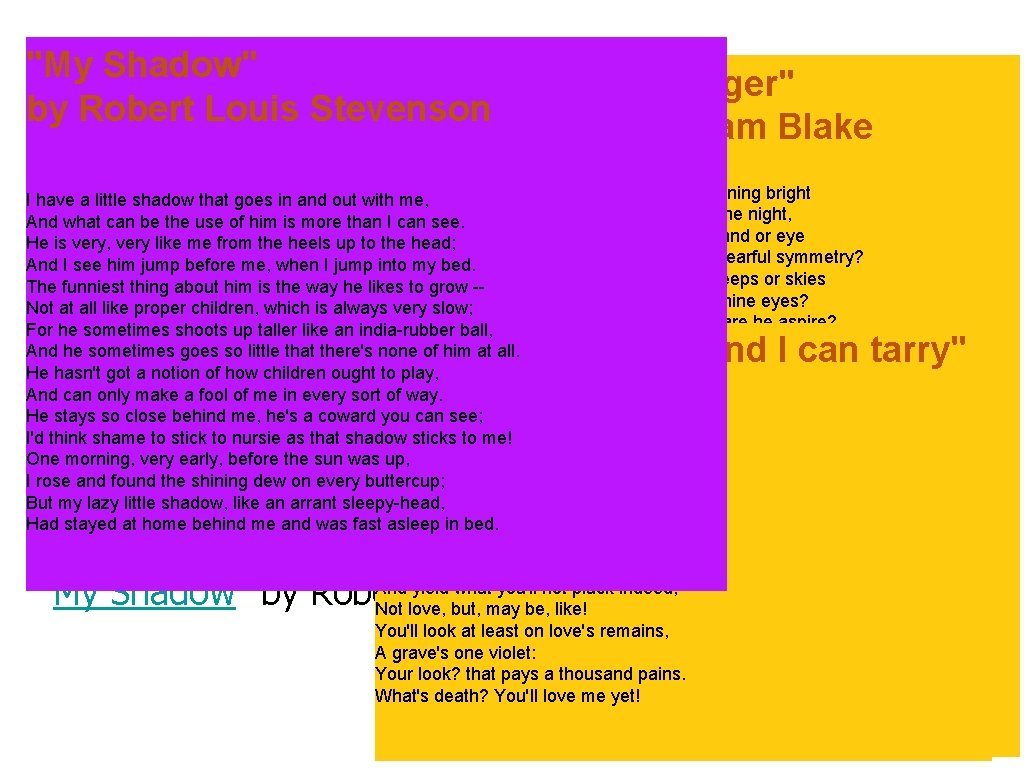
"My Shadow" "Trees" "The Tyger" by Robert Louis Stevenson by Joyce Kilmer 2. Poems Sound Different: by William Blake • The two main features which make a poem sound different than prose are rhyme Tyger! burning bright I think that I shall never see I have a little shadow that goes in and out with me, and rhythm. A rhyme is when two words. A sound same - cat, hat, fat, In the forests of(e. g. the night, poem lovely as a tree. And what can be the use of him is more than I can see. Whathungry immortal handisorprest eye rat, very etc. ). A tree whose mouth He is very, like me from the heels up to the head; Could frame thy fearful Against the sweet earth's flowingsymmetry? breast; And I see him jump before me, when I jump into my bed. In looks what distant [ Read byhim Joyce ] to grow -A tree that at Goddeeps all day, or skies The funniest"Trees" thing about is the. Kilmer way he likes the arms fire oftothine And lifts Burnt her leafy pray; eyes? Not at all like proper children, which is always very slow; We can use letters to indicate the rhyming scheme of awhat poem. The rhyming Onmay dare he aspire? A tree that inwings summer wear For he sometimes shoots up taller like an india-rubber ball, the dareother sieze the fire? robins in hand her hair; "Trees" is: AA BBnone CC of DD FF. A nest Let'sof. What look at some common And he scheme sometimesof goes so little that there's him. EE at all. And what shoulder, and what art. Upon whose bosom snow has lain; He hasn't got a notion of how children ought to play, rhyming schemes: Could twist Who intimately lives the withsinews rain. of thy heart? And can only make a fool of me in every sort of way. Andmade whenbythy heart Poems are fools likebegan me, to beat, He stays. Tyger" so close behind me, he's. Blake a coward you can see; EEFF "The by William - AABB CCDD etc. dread hand? and what dread feet? God can make a tree. I'd think shame to stick to nursie as that shadow sticks to me! But only What "You'll love me yet and I canup, tarry" by Robert Browning - ABAB CDCD EFEF love me yet and I can. What tarry the hammer? what the chain? One morning, very early, before the sun was. You'll In what furnace was thy brain? Your love's protracted growing: I rose and found the shining dew on every buttercup; What the anvil? June reared that bunch of flowers you carrywhat dread grasp But my lazy little shadow, like an arrant sleepy-head, Dare its deadly terrors clasp? seeds of April's sowing. Had stayed at home behind me and was fast. From asleep in bed. I plant a heartful now: some. When seed the stars threw down their spears, At least is sure to strike, And watered heaven with their tears, Did indeed, he smile his work to see? And yield what you'll not pluck Not love, but, may be, like! Did he who made the Lamb make thee? Tyger! burning bright You'll look at least on love's. Tyger! remains, In the forests of the night, A grave's one violet: What immortal Your look? that pays a thousand pains. hand or eye Dare What's death? You'll love me yet!frame thy fearful symmetry? "You'll love me yet and I can tarry" by Robert Browning Activity: Read the following poems with a partner and see if you can figure out the rhyming scheme: "My Shadow" by Robert Louis Stevenson
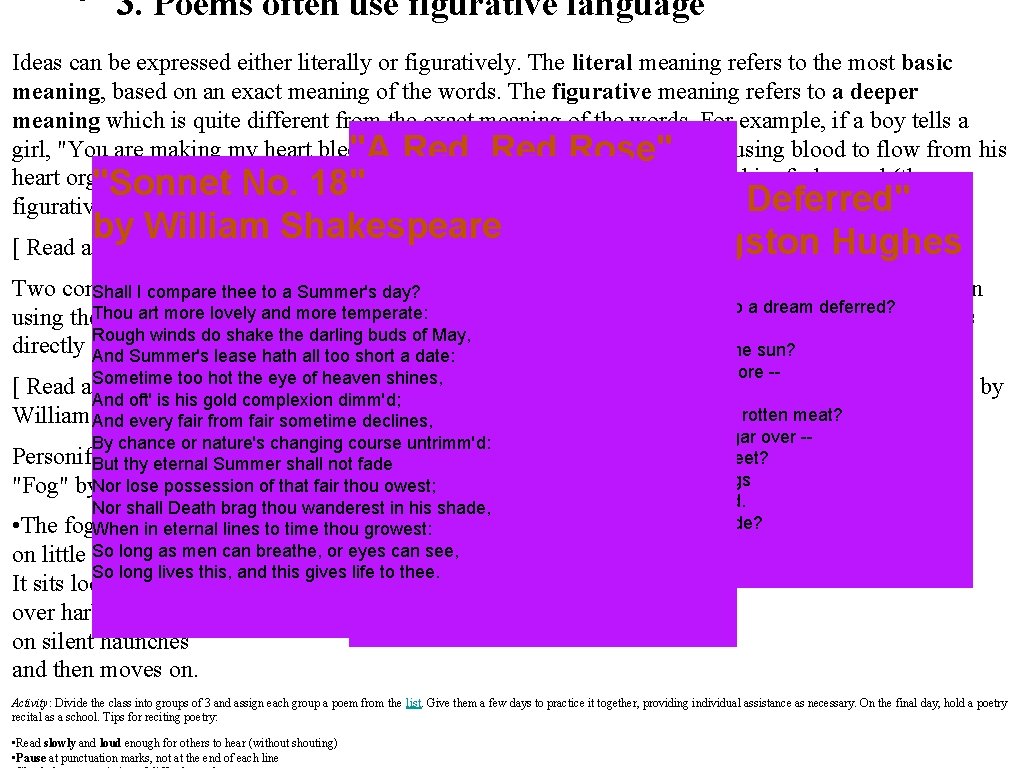
• 3. Poems often use figurative language Ideas can be expressed either literally or figuratively. The literal meaning refers to the most basic meaning, based on an exact meaning of the words. The figurative meaning refers to a deeper meaning which is quite different from the exact meaning of the words. For example, if a boy tells a girl, "You are making my heart bleed", does he actually mean that she is causing blood to flow from his "A Red, Red Rose" heart organ (the literal meaning) or does he simply mean that she is making him feel so sad (the "Sonnet No. 18"by Robert Burns "Dream Deferred" figurative meaning)? by William Shakespeare by Langston Hughes [ Read and discuss "Dream Deferred" by Langston Hughes ] O, my love is like a red, red rose, That is newly sprung in June. Two common ways of using figurative language are similes and metaphors. A simile is a comparison Shall I compare thee to a Summer's day? O, my love is like the melody, What happens to a dream deferred? Thou art more lovely and more temperate: using the words "like" or "as" (as in the poem we just read) whereas a metaphor is when one thing is That is sweetly played in tune. Does it dry up Rough winds do shake the darling of May, Asbuds fair are you, my lovely lass, Like a raisin in the sun? directly compared to another. And Summer's lease hath all too short a date: So deep in love am I, Or fester like a sore -Sometime too hot the eye of heaven shines, And I will love you still, my Dear, And then run? [ Read and discuss "A Red, Red Rose" by Robert Burns for examples of simile and "Sonnet No. 18" by And oft' is his gold complexion dimm'd; Till all the seas go dry. Does it stink like rotten meat? William Shakespeare for examples of metaphors. ] And every fair from fair sometime. Till declines, all the seas go dry, my Dear, Or crust and sugar over -By chance or nature's changing course And theuntrimm'd: rocks melt with the sun! like a syrupy sweet? Personification is when living traits are given to a non-living thing (e. g. - the moon smiled). [ Read But thy eternal Summer shall not. Ofade I will love you still, my Dear, Maybe it just sags Nor lose possession of that fair thou owest; "Fog" by Carl Sandburg ] While the sands of life shall run. like a heavy load. Nor shall Death brag thou wanderest in shade, And farehis you well, my only Love, Or does it explode? • The fog comes When in eternal lines to time thou growest: And fare you well a while! So long as men can breathe, or eyes on little cat feet. And Ican will see, come again, my Love, So long lives this, and this gives Although life to thee. it were ten thousand mile! It sits looking over harbor and city on silent haunches and then moves on. Activity: Divide the class into groups of 3 and assign each group a poem from the list. Give them a few days to practice it together, providing individual assistance as necessary. On the final day, hold a poetry recital as a school. Tips for reciting poetry: • Read slowly and loud enough for others to hear (without shouting) • Pause at punctuation marks, not at the end of each line
Read the following poem. Write answers to the questions on a sheet of paper. Prepare to discuss. This face in the mirror stares at me demanding Who are you? What will you become? And taunting, You don't even know. Chastened, I cringe and agree and then because I'm still young, I stick out my tongue. ~Eve Merriam, "Conversation with Myself", 1964 Write responses to the following, and then discuss with the whole class: 1. Write a one-sentence summary of the poem. 2. How old is the speaker? 3. Why are certain words written in italics? 4. Define taunting, cringe, and chastened. 5. Why would the speaker be chastened, then cringe and agree? 6. What are the problems facing the narrator? How are these common problems? 7. What is the speaker’s final response? What is the significance of this act? 8. What is the poet telling her readers about life?
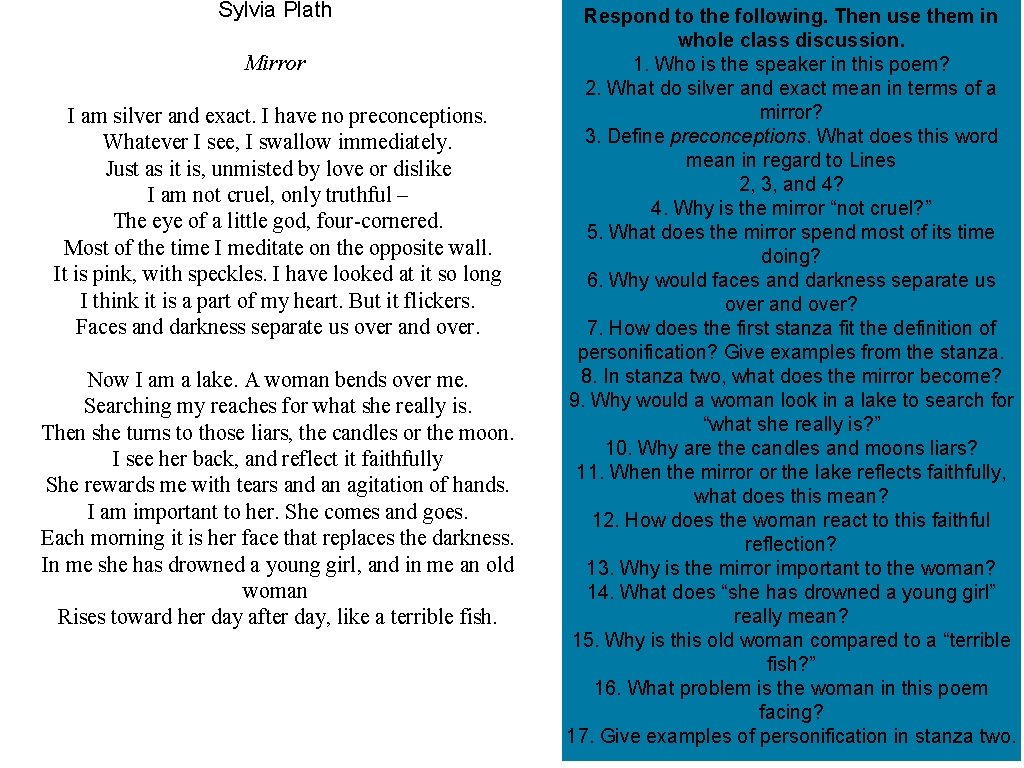
Sylvia Plath Mirror I am silver and exact. I have no preconceptions. Whatever I see, I swallow immediately. Just as it is, unmisted by love or dislike I am not cruel, only truthful – The eye of a little god, four-cornered. Most of the time I meditate on the opposite wall. It is pink, with speckles. I have looked at it so long I think it is a part of my heart. But it flickers. Faces and darkness separate us over and over. Now I am a lake. A woman bends over me. Searching my reaches for what she really is. Then she turns to those liars, the candles or the moon. I see her back, and reflect it faithfully She rewards me with tears and an agitation of hands. I am important to her. She comes and goes. Each morning it is her face that replaces the darkness. In me she has drowned a young girl, and in me an old woman Rises toward her day after day, like a terrible fish. Respond to the following. Then use them in whole class discussion. 1. Who is the speaker in this poem? 2. What do silver and exact mean in terms of a mirror? 3. Define preconceptions. What does this word mean in regard to Lines 2, 3, and 4? 4. Why is the mirror “not cruel? ” 5. What does the mirror spend most of its time doing? 6. Why would faces and darkness separate us over and over? 7. How does the first stanza fit the definition of personification? Give examples from the stanza. 8. In stanza two, what does the mirror become? 9. Why would a woman look in a lake to search for “what she really is? ” 10. Why are the candles and moons liars? 11. When the mirror or the lake reflects faithfully, what does this mean? 12. How does the woman react to this faithful reflection? 13. Why is the mirror important to the woman? 14. What does “she has drowned a young girl” really mean? 15. Why is this old woman compared to a “terrible fish? ” 16. What problem is the woman in this poem facing? 17. Give examples of personification in stanza two.
Writing Samples: 1. In a short answer response of 25 -50 words, answer the following: When you look into a mirror, what do you see and feel? 2. In a short answer response of 25 -50 words, answer the following: Why do others see us differently from the way we see ourselves? 3. An old poem states: There were three girls walked down the road, As down the road walked she saw: The girl she was, The girl they saw, The girl she wanted to be. In an essay of 150 -200 words compare this poem with the other two poems in this lesson. The essay should have a topic sentence. It should use either line by line or block style organization to show similarities in all three works. There should be specific detail from each poem as support.
See the website for the rest of the assignment straffin. weebly. com