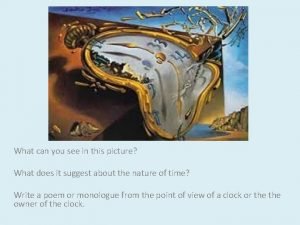
What can you see in this picture Think



- Slides: 18
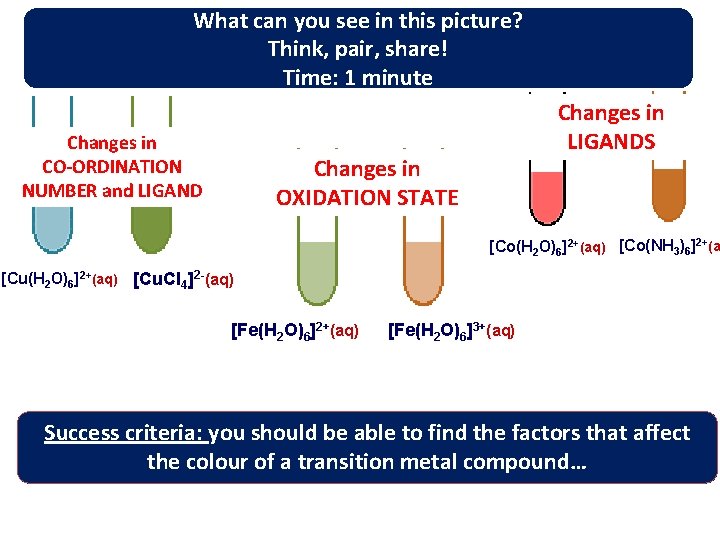
What can you see in this picture? Think, pair, share! Time: 1 minute Changes in CO-ORDINATION NUMBER and LIGAND Changes in LIGANDS Changes in OXIDATION STATE [Co(H 2 O)6]2+(aq) [Co(NH 3)6]2+(a [Cu(H 2 O)6]2+(aq) [Cu. Cl 4]2 -(aq) [Fe(H 2 O)6]2+(aq) [Fe(H 2 O)6]3+(aq) Success criteria: you should be able to find the factors that affect the colour of a transition metal compound…
Lesson Topic : Ligand Substitution Reactions Learning objectives You should be able to: ü understand ligand substitution with similar and dissimilar sized ligands, and possible consequent changes of co-ordination number Ligand Substitution (2 min) https: //www. youtube. com/watch? v=HYUw 8 Yi 9 y. Gk&list=PLW 1 s. Gr 2 p. Zx. Wx. Yt. Hym. Katg. R yn 7 wqy. DQg. D 8 https: //www. youtube. com/watch? v=e. KYs 9 JMp. UTo&index=2&list=PLW 1 s. Gr 2 p. Zx. Wx. Yt. H ym. Katg. Ryn 7 wqy. DQg. D 8
What does “SUBSTITUTION” mean? What do you understand by the term LIGAND? Ligand substitution is a reaction in which one ligand in a complex ion is replaced by another ligand. L. O. : define the term “ligand substitution
Ligand Substitution Reactions (Ligand Exchange) • Ligand exchange results in a colour change and sometimes coordination number. • Sometimes the ligand substitution is partial.
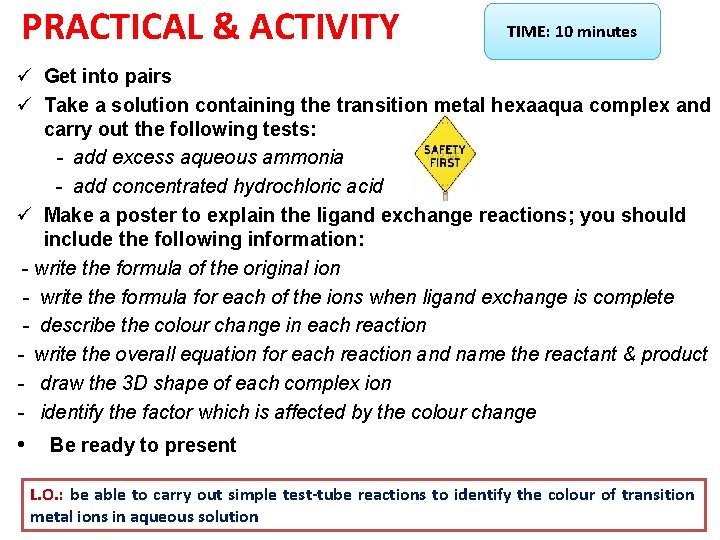
PRACTICAL & ACTIVITY TIME: 10 minutes ü Get into pairs ü Take a solution containing the transition metal hexaaqua complex and carry out the following tests: - add excess aqueous ammonia - add concentrated hydrochloric acid ü Make a poster to explain the ligand exchange reactions; you should include the following information: - write the formula of the original ion - write the formula for each of the ions when ligand exchange is complete - describe the colour change in each reaction - write the overall equation for each reaction and name the reactant & product - draw the 3 D shape of each complex ion - identify the factor which is affected by the colour change • Be ready to present L. O. : be able to carry out simple test-tube reactions to identify the colour of transition metal ions in aqueous solution
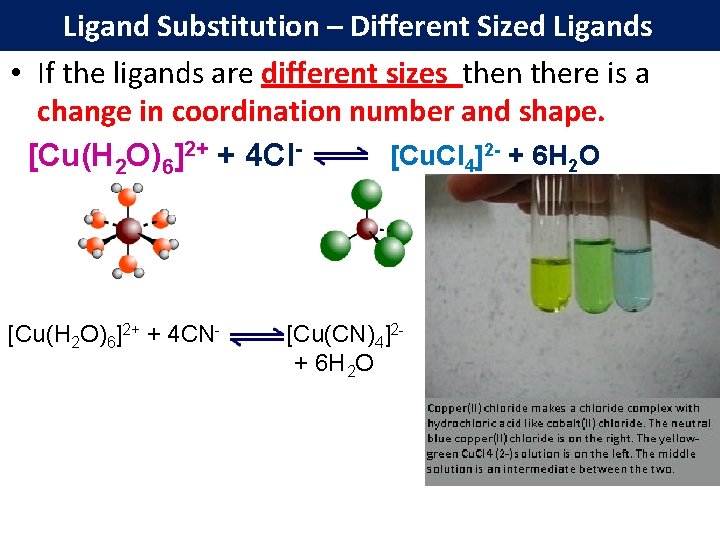
Ligand Substitution – Different Sized Ligands • If the ligands are different sizes then there is a change in coordination number and shape. [Cu. Cl 4]2 - + 6 H 2 O [Cu(H 2 O)6]2+ + 4 Cl- [Cu(H 2 O)6]2+ + 4 CN- [Cu(CN)4]2+ 6 H 2 O
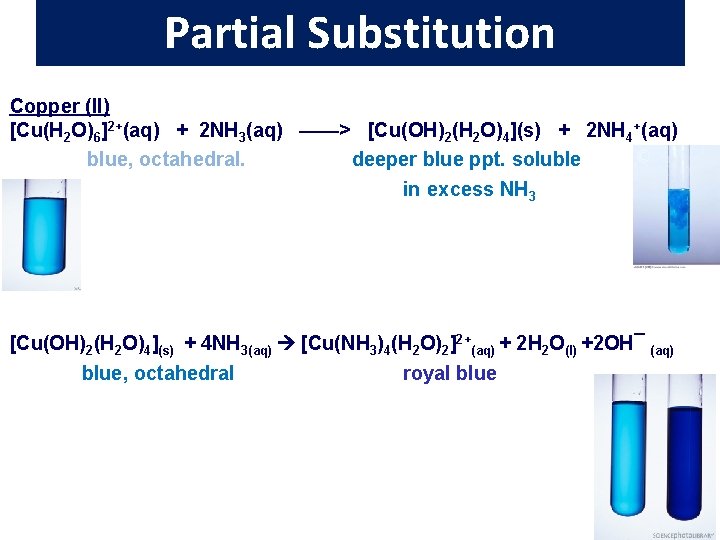
Partial Substitution Copper (II) [Cu(H 2 O)6]2+(aq) + 2 NH 3(aq) ——> [Cu(OH)2(H 2 O)4](s) + 2 NH 4+(aq) blue, octahedral. deeper blue ppt. soluble in excess NH 3 [Cu(OH)2(H 2 O)4](s) + 4 NH 3(aq) [Cu(NH 3)4(H 2 O)2]2+(aq) + 2 H 2 O(l) +2 OH¯ (aq) blue, octahedral royal blue
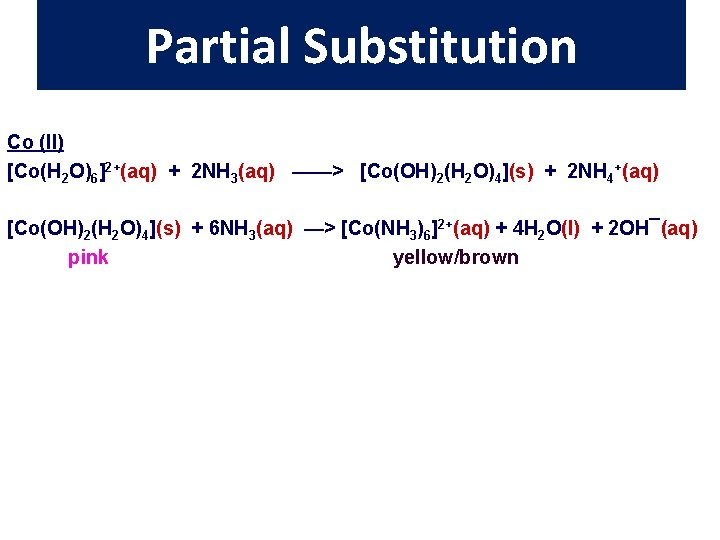
Partial Substitution Co (II) [Co(H 2 O)6]2+(aq) + 2 NH 3(aq) ——> [Co(OH)2(H 2 O)4](s) + 2 NH 4+(aq) [Co(OH)2(H 2 O)4](s) + 6 NH 3(aq) —> [Co(NH 3)6]2+(aq) + 4 H 2 O(l) + 2 OH¯(aq) pink yellow/brown
Partial Substitution CHROMIUM(III) NH 3 [Cr(H 2 O)6]3+(aq) + 3 NH 3(aq) A-B ——> [Cr(OH)3(H 2 O)3](s) + 3 NH 4+(aq) green ppt. soluble in XS NH 3 With EXCESS AMMONIA, the precipitate redissolves [Cr(OH)3(H 2 O)3](s) + 6 NH 3(aq) ——> [Cr(NH 3)6]3+(aq) + 3 H 2 O(l) + 3 OH¯(aq) LS NO Substitution ACID/BASE OH¯ A-B [Cr(H 2 O)6]3+(aq) + 3 OH¯(aq) violet, octahedral [Cr(OH)3(H 2 O)3](s) Green ppt A-B ——> [Cr(OH)3(H 2 O)3](s) + 3 H 2 O(l) green ppt. soluble in XS Na. OH + 3 OH¯(aq) ——> [Cr(OH)6]3 -(aq) + 3 H 2 O(l) green, octahedral Why the difference, because OH- is a MUCH stronger base.
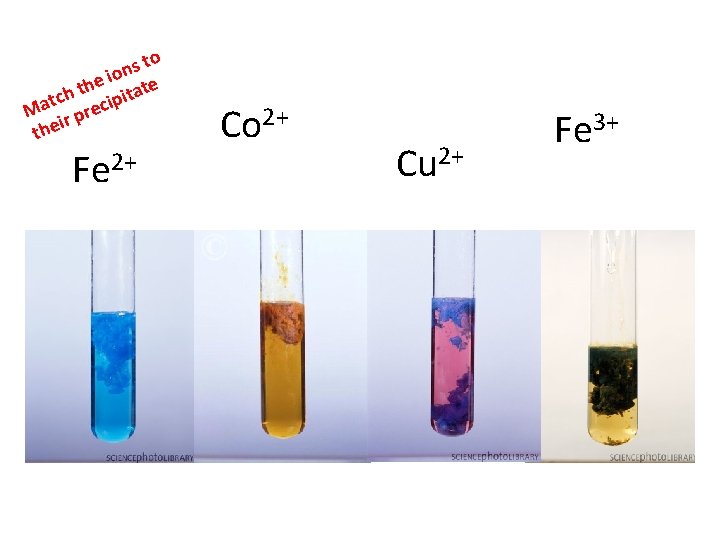
to s n e io ate h t tch ecipit a M r pr i the Fe 2+ Co 2+ Cu 2+ Fe 3+
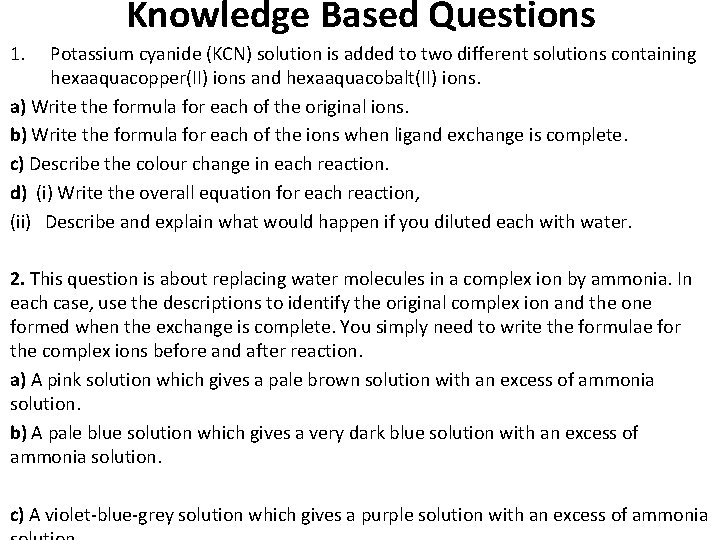
Knowledge Based Questions 1. Potassium cyanide (KCN) solution is added to two different solutions containing hexaaquacopper(II) ions and hexaaquacobalt(II) ions. a) Write the formula for each of the original ions. b) Write the formula for each of the ions when ligand exchange is complete. c) Describe the colour change in each reaction. d) (i) Write the overall equation for each reaction, (ii) Describe and explain what would happen if you diluted each with water. 2. This question is about replacing water molecules in a complex ion by ammonia. In each case, use the descriptions to identify the original complex ion and the one formed when the exchange is complete. You simply need to write the formulae for the complex ions before and after reaction. a) A pink solution which gives a pale brown solution with an excess of ammonia solution. b) A pale blue solution which gives a very dark blue solution with an excess of ammonia solution. c) A violet-blue-grey solution which gives a purple solution with an excess of ammonia
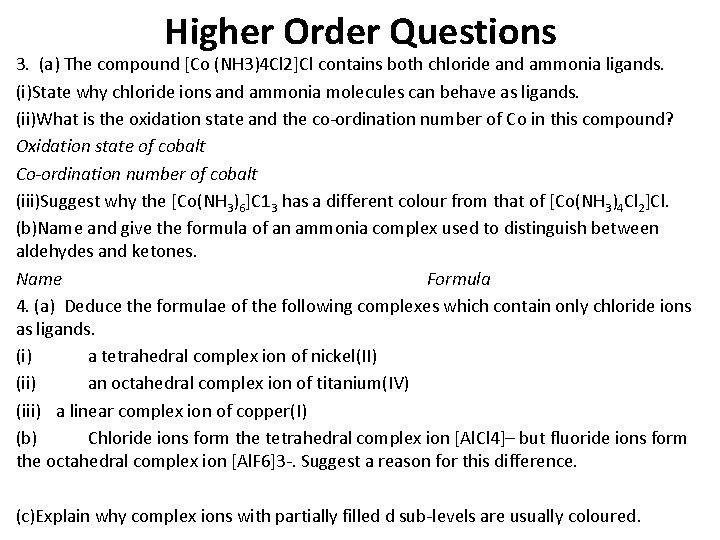
Higher Order Questions 3. (a) The compound [Co (NH 3)4 Cl 2]Cl contains both chloride and ammonia ligands. (i)State why chloride ions and ammonia molecules can behave as ligands. (ii)What is the oxidation state and the co-ordination number of Co in this compound? Oxidation state of cobalt Co-ordination number of cobalt (iii)Suggest why the [Co(NH 3)6]C 13 has a different colour from that of [Co(NH 3)4 Cl 2]Cl. (b)Name and give the formula of an ammonia complex used to distinguish between aldehydes and ketones. Name Formula 4. (a) Deduce the formulae of the following complexes which contain only chloride ions as ligands. (i) a tetrahedral complex ion of nickel(II) (ii) an octahedral complex ion of titanium(IV) (iii) a linear complex ion of copper(I) (b) Chloride ions form the tetrahedral complex ion [Al. Cl 4]– but fluoride ions form the octahedral complex ion [Al. F 6]3 -. Suggest a reason for this difference. (c)Explain why complex ions with partially filled d sub-levels are usually coloured.
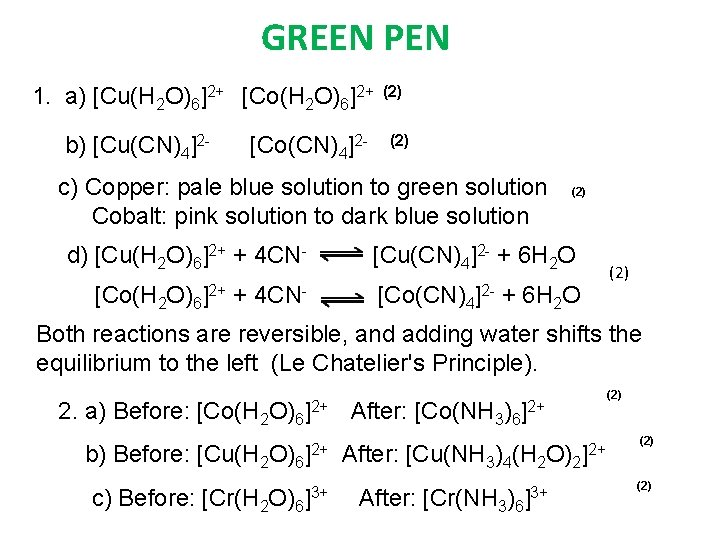
GREEN PEN 1. a) [Cu(H 2 O)6]2+ [Co(H 2 O)6]2+ b) [Cu(СN)4]2 - [Co(CN)4]2 - (2) c) Copper: pale blue solution to green solution Cobalt: pink solution to dark blue solution (2) d) [Cu(H 2 O)6]2+ + 4 CN- [Cu(CN)4]2 - + 6 H 2 O [Co(H 2 O)6]2+ + 4 CN- [Co(CN)4]2 - + 6 H 2 O (2) Both reactions are reversible, and adding water shifts the equilibrium to the left (Le Chatelier's Principle). (2) 2. a) Before: [Co(H 2 O)6]2+ After: [Co(NH 3)6]2+ b) Before: [Cu(H 2 O)6 c) Before: [Cr(H 2 O)6 ]2+ ]3+ After: [Cu(NH 3)4(H 2 O)2 After: [Cr(NH 3)6 ]3+ ]2+ (2)
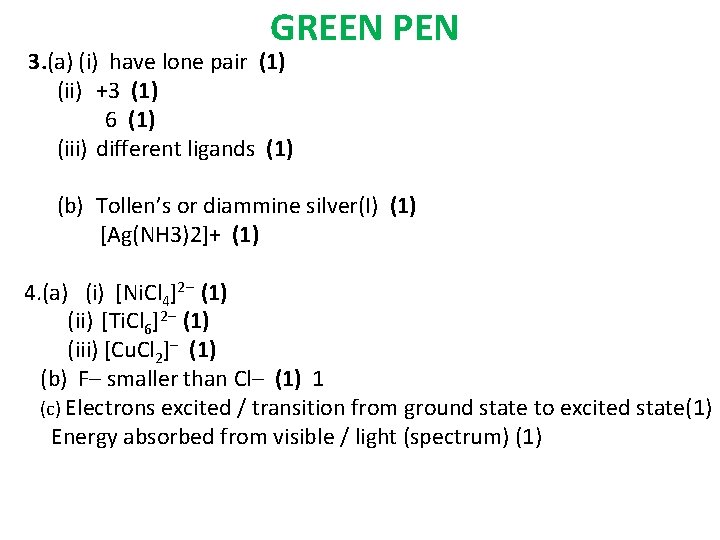
GREEN PEN 3. (a) (i) have lone pair (1) (ii) +3 (1) 6 (1) (iii) different ligands (1) (b) Tollen’s or diammine silver(I) (1) [Ag(NH 3)2]+ (1) 4. (a) (i) [Ni. Cl 4]2– (1) (ii) [Ti. Cl 6]2– (1) (iii) [Cu. Cl 2]– (1) (b) F– smaller than Cl– (1) 1 (c) Electrons excited / transition from ground state to excited state(1) Energy absorbed from visible / light (spectrum) (1)
Lesson Topic : Ligand Substitution Reactions Chelate Effect Learning outcomes You should be able to: ü be able to explain ligand substitutions in terms of complex ion stability ü recognise the existence of bi- and multidentate ligands and understand the chelate effect in terms of entropy and free energy change
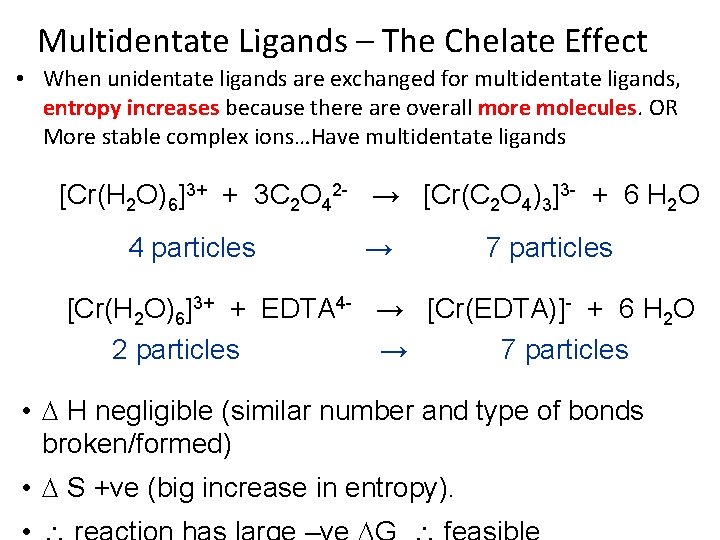
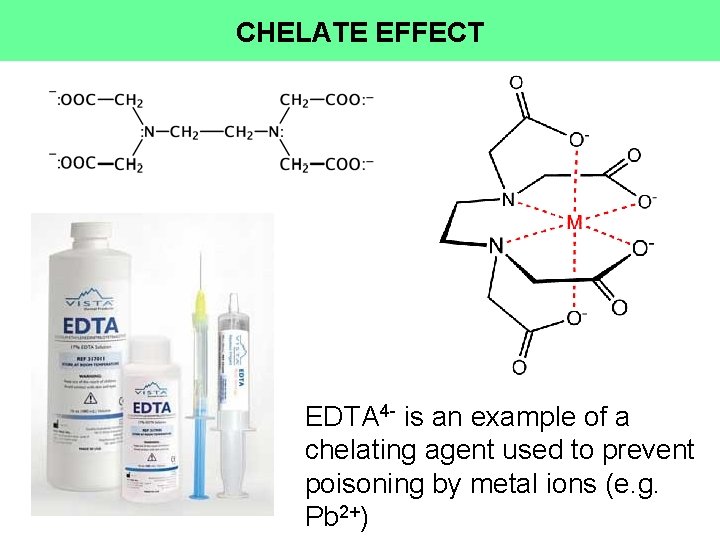
Multidentate Ligands – The Chelate Effect • When unidentate ligands are exchanged for multidentate ligands, entropy increases because there are overall more molecules. OR More stable complex ions…Have multidentate ligands [Cr(H 2 O)6]3+ + 3 C 2 O 42 - → [Cr(C 2 O 4)3]3 - + 6 H 2 O 4 particles → 7 particles [Cr(H 2 O)6]3+ + EDTA 4 - → [Cr(EDTA)]- + 6 H 2 O 2 particles → 7 particles • H negligible (similar number and type of bonds broken/formed) • S +ve (big increase in entropy).
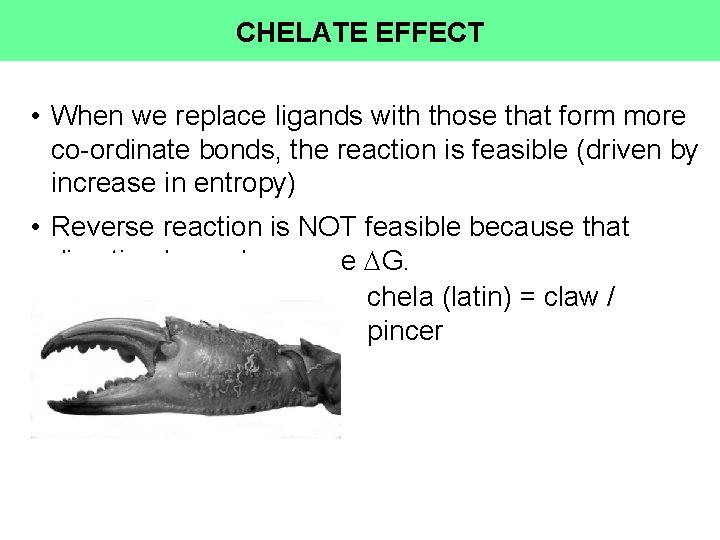
CHELATE EFFECT • When we replace ligands with those that form more co-ordinate bonds, the reaction is feasible (driven by increase in entropy) • Reverse reaction is NOT feasible because that direction has a large +ve G. chela (latin) = claw / pincer
CHELATE EFFECT EDTA 4 - is an example of a chelating agent used to prevent poisoning by metal ions (e. g. Pb 2+)