Wargame Terminology or What did he just say
- Slides: 18
Wargame Terminology or What did he just say?
References • A Compendium of Wargaming Terms (Updated 7 July 2015) Compiled by William L. Simpson Jr – http: //www. mors. org/Communities/Co. PDocument-Search • The Art of Wargaming by Peter Perla
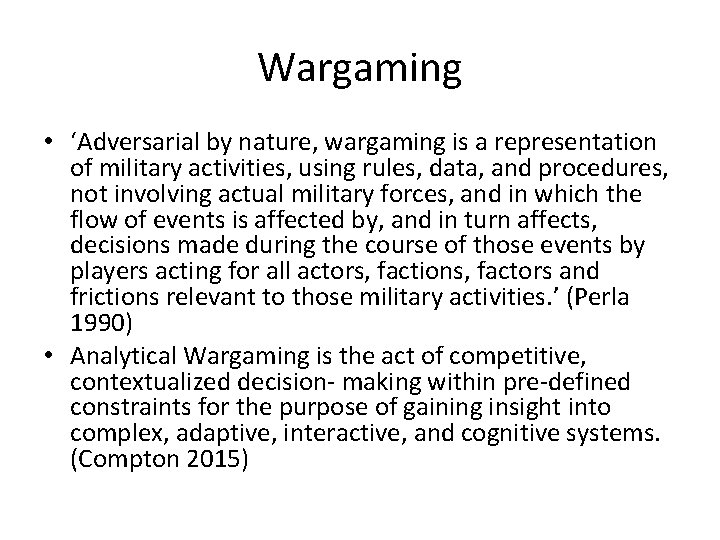
Wargaming • ‘Adversarial by nature, wargaming is a representation of military activities, using rules, data, and procedures, not involving actual military forces, and in which the flow of events is affected by, and in turn affects, decisions made during the course of those events by players acting for all actors, factions, factors and frictions relevant to those military activities. ’ (Perla 1990) • Analytical Wargaming is the act of competitive, contextualized decision- making within pre-defined constraints for the purpose of gaining insight into complex, adaptive, interactive, and cognitive systems. (Compton 2015)
Elements of a Real Wargame • • Competing Teams Human Decision Making Adjudication Consequences
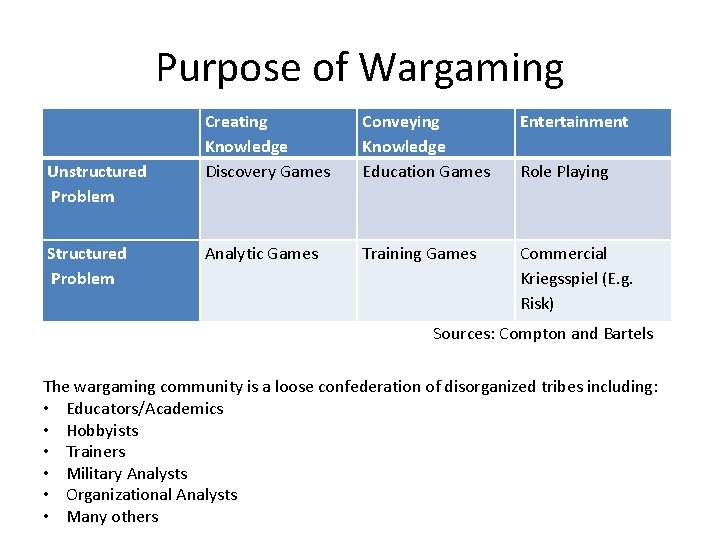
Purpose of Wargaming Unstructured Problem Structured Problem Creating Knowledge Discovery Games Conveying Knowledge Education Games Entertainment Analytic Games Training Games Commercial Kriegsspiel (E. g. Risk) Role Playing Sources: Compton and Bartels The wargaming community is a loose confederation of disorganized tribes including: • Educators/Academics • Hobbyists • Trainers • Military Analysts • Organizational Analysts • Many others
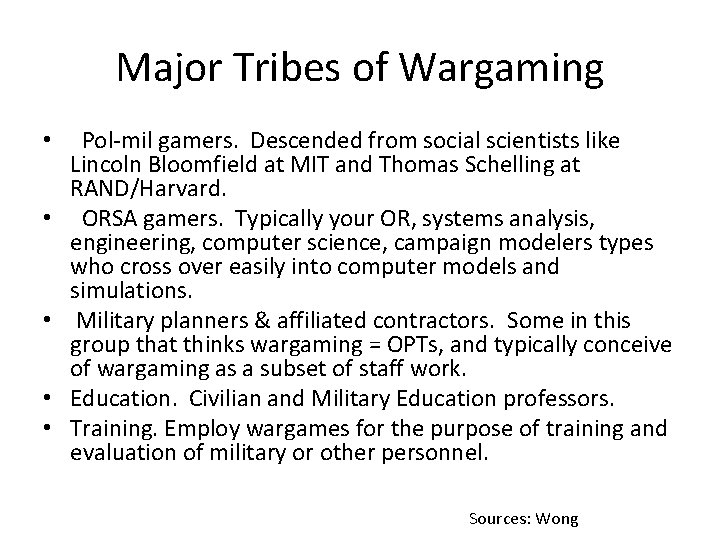
Major Tribes of Wargaming • • • Pol-mil gamers. Descended from social scientists like Lincoln Bloomfield at MIT and Thomas Schelling at RAND/Harvard. ORSA gamers. Typically your OR, systems analysis, engineering, computer science, campaign modelers types who cross over easily into computer models and simulations. Military planners & affiliated contractors. Some in this group that thinks wargaming = OPTs, and typically conceive of wargaming as a subset of staff work. Education. Civilian and Military Education professors. Training. Employ wargames for the purpose of training and evaluation of military or other personnel. Sources: Wong
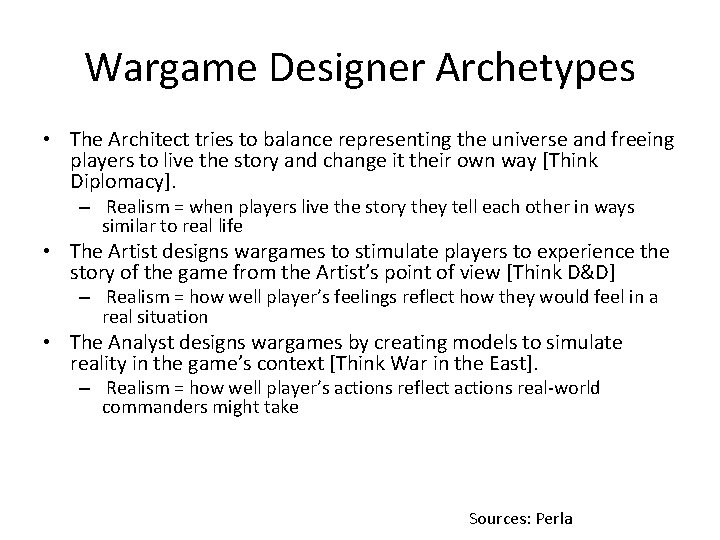
Wargame Designer Archetypes • The Architect tries to balance representing the universe and freeing players to live the story and change it their own way [Think Diplomacy]. – Realism = when players live the story they tell each other in ways similar to real life • The Artist designs wargames to stimulate players to experience the story of the game from the Artist’s point of view [Think D&D] – Realism = how well player’s feelings reflect how they would feel in a real situation • The Analyst designs wargames by creating models to simulate reality in the game’s context [Think War in the East]. – Realism = how well player’s actions reflect actions real-world commanders might take Sources: Perla
Role Playing • The essence of Wargaming is decisions… The player’s ability to assume a meaningful decision-making role. • Players may assume more than one role • Cells – an element of the wargame where decisions are made. May be part of a larger team or is a team. • Team – A side in a conflict often identified with a color. There can be more than one cell/team of a color (e. g. “Blue 2”) • Blue Cell/Team – Usually the United States and/or allies • Green – Usually an ally of the U. S. • Red – Usually the opposition • Orange – Often the ally of the opposition • White/Control – The team or cell tasked with running the game and adjudication • Grey – Sometimes the opposition. Can be the watchers of White. Sources: Simpson
Roles in a Wargame • Sponsor – Who paid for the game – The senior officer or official of the command / organization who has requested the game. Normally the sponsor is the approval authority on major game purpose, objectives, research questions, and design • Game Director – The Wargamer responsible for supervising and executing the wargame – The individual responsible for a war game and its critique. Also known as the controller and in early Naval War College games, as the arbitrator. – The director is responsible for the planning, execution, and critique of the game. Sources: Simpson
Roles in a Wargame (Cont. ) • • • Control Cell: The person or group of persons designated to monitor and direct game execution to meet the game objectives also called game control. The Control Cell is directly responsible to the Game Director / Action Officer or Deputy Director. The Control Cell includes the Moderators, Facilitators and Umpires. (See White Cell and Controller / Observer). Controller: A member of the control cell, usually means a person or persons assisting the Game Director in directing and supervising the game. Capture, Assessment, and Production Plan (CAP Plan): The plan describes the process, by which the desired data from the wargame is identified, captured, assessed, synthesized and published. Capture, Assessment, and Production Team (CAP Team): The team executing the CAP Plan. Rapporteur: – A person appointed by an organization to report on the proceedings of its meetings – A member of the CAP team, who collects and assesses the data and helps prepare the game reports. Sources: Simpson
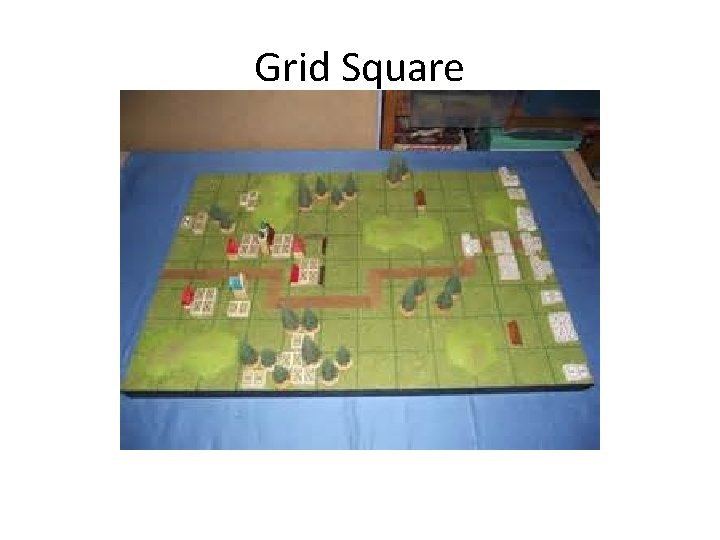
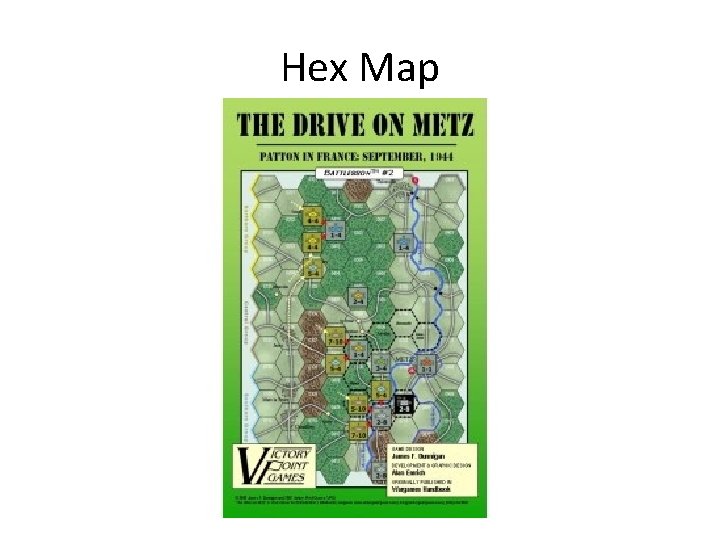
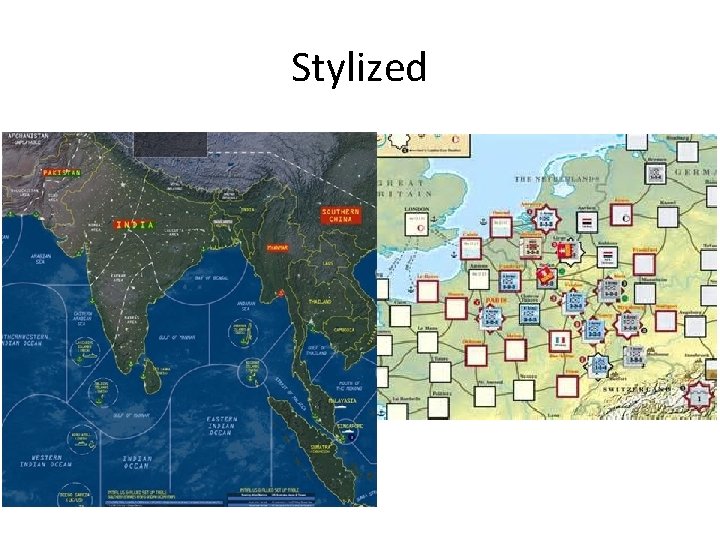
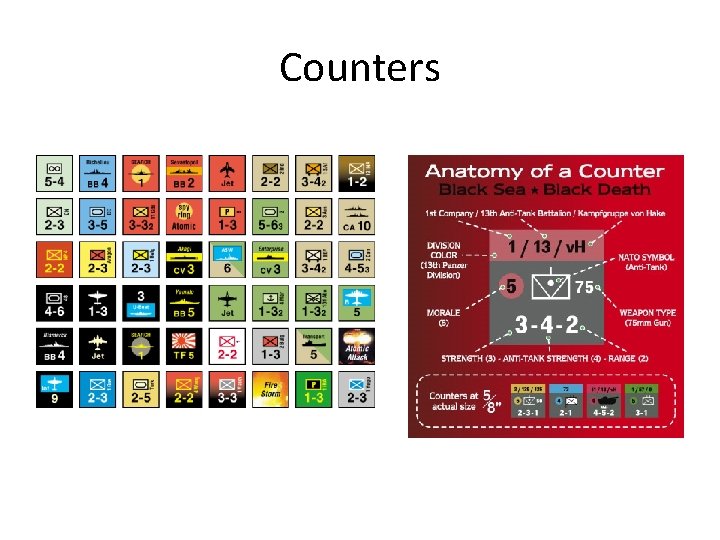
Presentation The Building of a Story • Road to War – Narrative prelude to why there is a conflict • Order of Battle – Forces on opposing sides and their expected capabilities • First Person – Often used for trainers/simulations • Third Person – Maps/Charts • Grids, Hexes, Stylized, Free Space – Actions/Capabilities/Units • Cards, Counters, Figures • Mediums: – Table Top – Sand Table – Computer Screen • Time – Fixed Time Step • Time ratios – Event Driven – Retrospective
Grid Square
Hex Map
Stylized
Counters
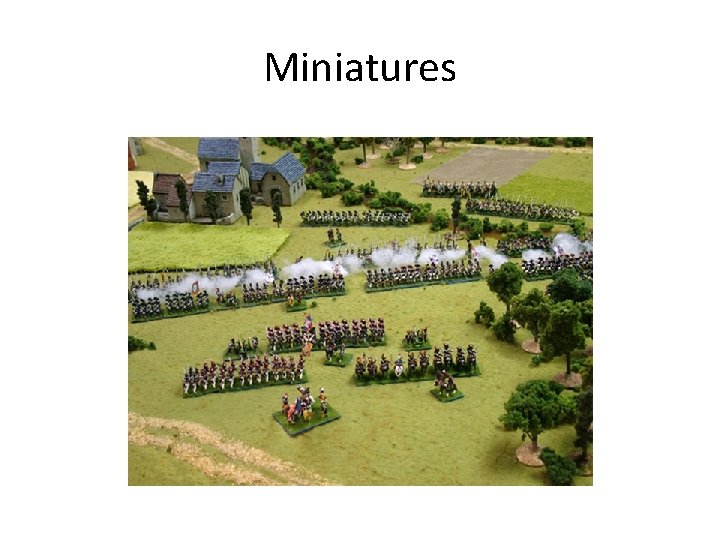
Miniatures
Input • Turn/Move – An input from the players describing their actions • Course of Action (COA) – In staff development one of many potential actions in consideration • Branches – Conditional moves based on potential or expected event in a game • Sequel – Follow on actions in a move based on potential or expected conditions in a game
Adjudication/Assessment • • BOGGSAT Types • – Free Adjudication • Military Judgement – Rigid Adjudication • Combat Resolution Table – Combination • • – Note: In large or complex games, the Game Director and game staff, often conduct a hotwash at the end of each day. Methods – Deterministic – Monte Carlo/Random Tools Hotwash - “the act of reviewing any operations (in particular, a wargame). A hotwash is so named because it occurs as quickly as possible after the conclusion of the move or game (while it’s still “hot”). • Out-Briefs: – The briefs presented by the players that discuss what they did and why during a move or the wargame. – The briefs created and presented by the players at the end of a move or end of game play. – Dice, Cards – Tables – Computer • Final Report: – Report by the wargaming team to the sponsor.