Using Generative Adversarial Networks for Fast Simulation in

- Slides: 18
Using Generative Adversarial Networks for Fast Simulation in ALICE Experiment Tomasz Trzcinski, Kamil Deja, Łukasz Graczykowski for the ALICE Collaboration CHEP 2018 | 10 July 2018 Tomasz Trzciński et al. 1
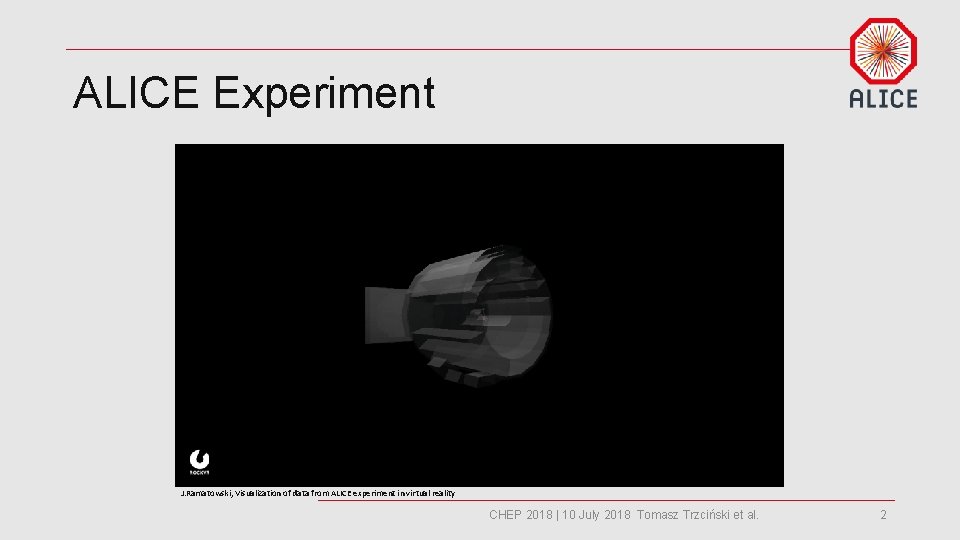
ALICE Experiment J. Ramatowski, Visualization of data from ALICE experiment in virtual reality CHEP 2018 | 10 July 2018 Tomasz Trzciński et al. 2
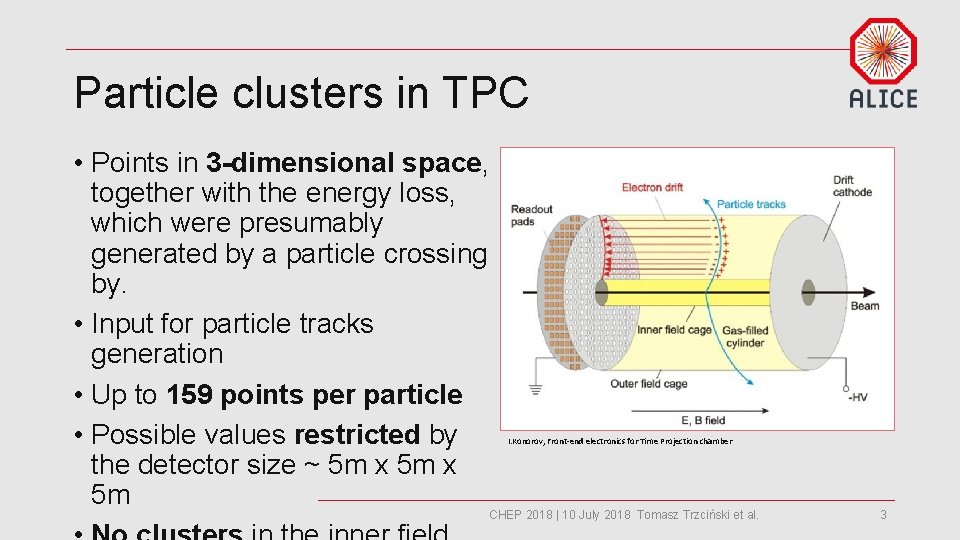
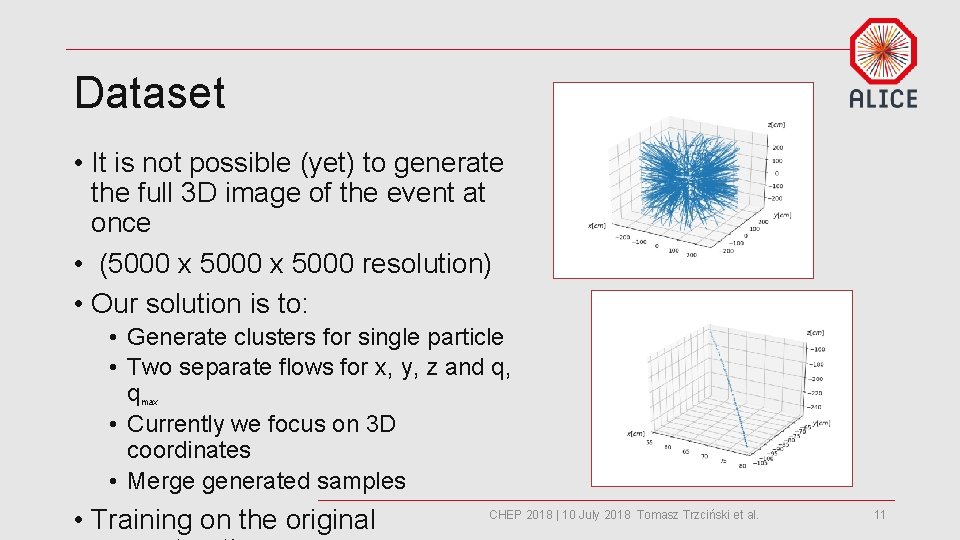
Particle clusters in TPC • Points in 3 -dimensional space, together with the energy loss, which were presumably generated by a particle crossing by. • Input for particle tracks generation • Up to 159 points per particle • Possible values restricted by the detector size ~ 5 m x 5 m I. Konorov, Front-end electronics for Time Projection chamber CHEP 2018 | 10 July 2018 Tomasz Trzciński et al. 3
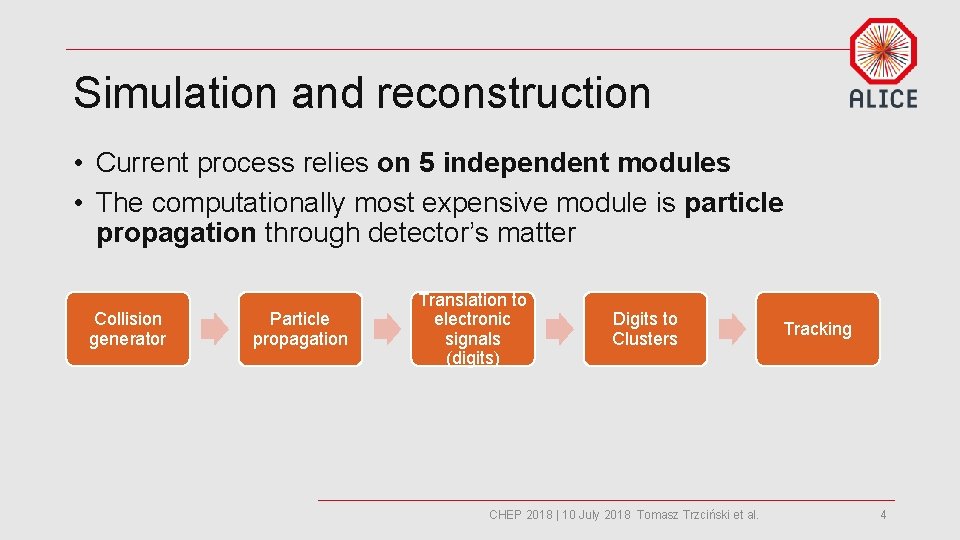
Simulation and reconstruction • Current process relies on 5 independent modules • The computationally most expensive module is particle propagation through detector’s matter Collision generator Particle propagation Translation to electronic signals (digits) Digits to Clusters CHEP 2018 | 10 July 2018 Tomasz Trzciński et al. Tracking 4
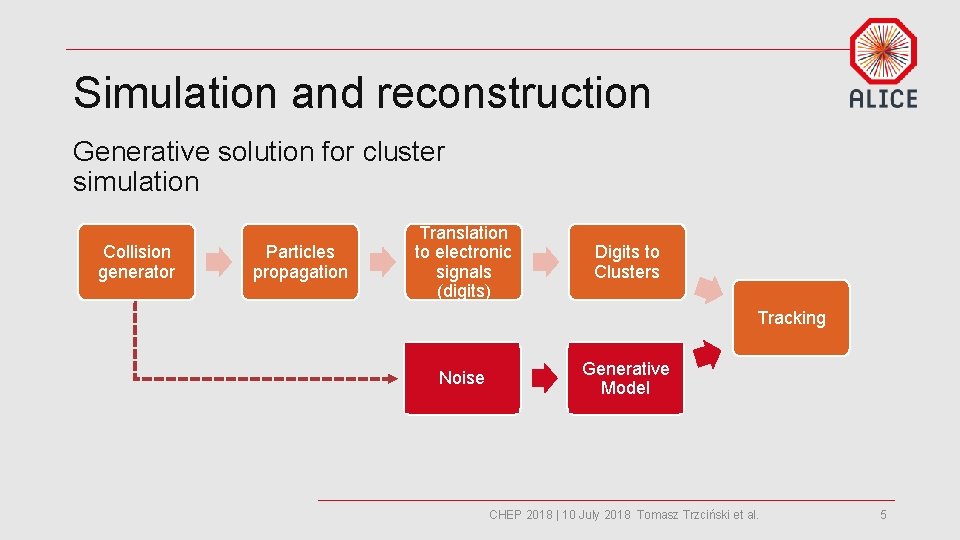
Simulation and reconstruction Generative solution for cluster simulation Collision generator Particles propagation Translation to electronic signals (digits) Digits to Clusters Tracking Noise Generative Model CHEP 2018 | 10 July 2018 Tomasz Trzciński et al. 5
Generative Models CHEP 2018 | 10 July 2018 Tomasz Trzciński et al. 6
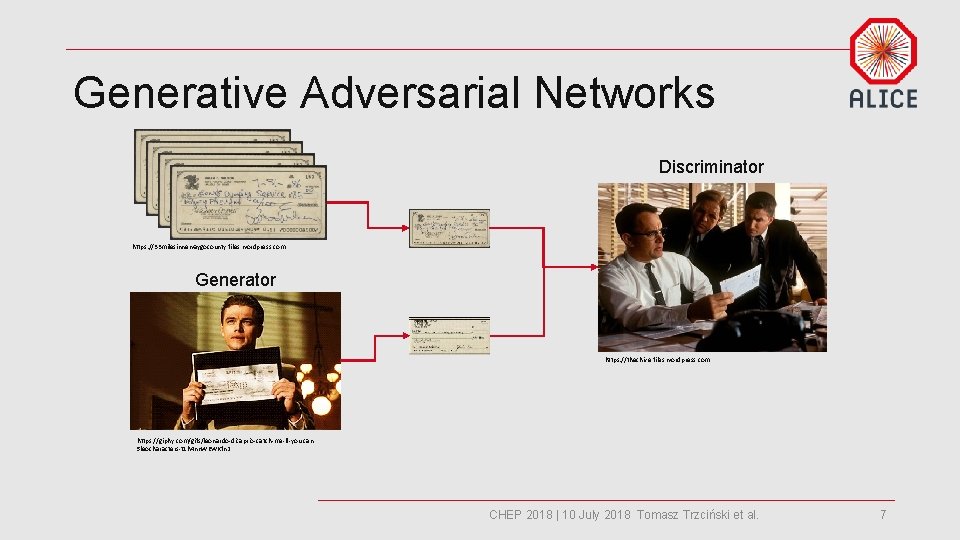
Generative Adversarial Networks Discriminator https: //33 milesinnewaygocounty. files. wordpress. com Generator https: //thechive. files. wordpress. com https: //giphy. com/gifs/leonardo-dicaprio-catch-me-if-you-can 5 leocharacters-t 1 h 4 nn. WEWKfn 2 CHEP 2018 | 10 July 2018 Tomasz Trzciński et al. 7
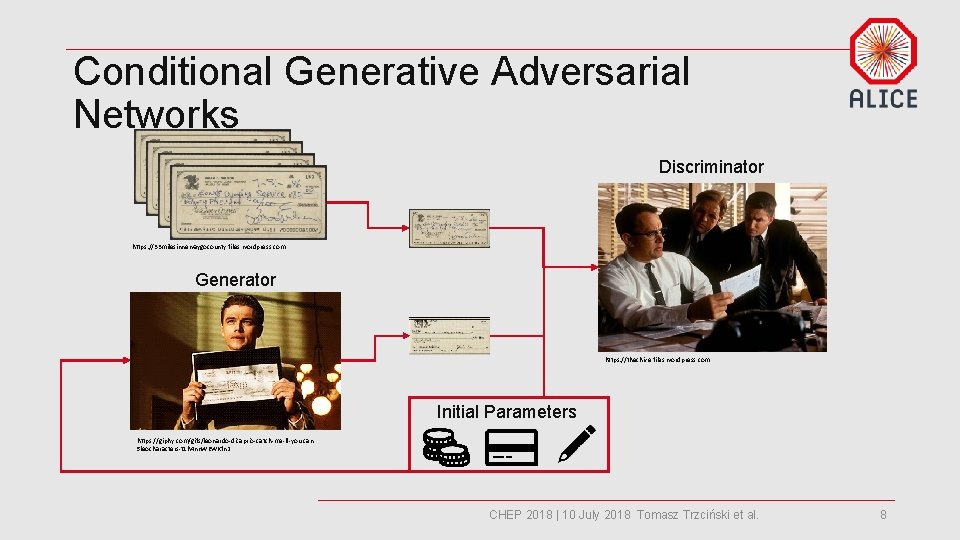
Conditional Generative Adversarial Networks Discriminator https: //33 milesinnewaygocounty. files. wordpress. com Generator https: //thechive. files. wordpress. com Initial Parameters https: //giphy. com/gifs/leonardo-dicaprio-catch-me-if-you-can 5 leocharacters-t 1 h 4 nn. WEWKfn 2 CHEP 2018 | 10 July 2018 Tomasz Trzciński et al. 8
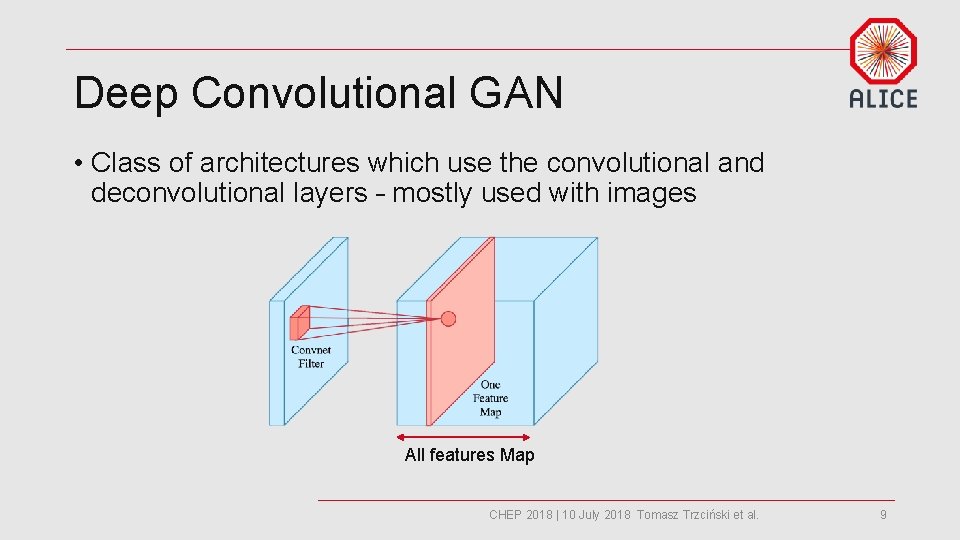
Deep Convolutional GAN • Class of architectures which use the convolutional and deconvolutional layers – mostly used with images All features Map CHEP 2018 | 10 July 2018 Tomasz Trzciński et al. 9
Cluster Simulation with Generative Models CHEP 2018 | 10 July 2018 Tomasz Trzciński et al. 10
Dataset • It is not possible (yet) to generate the full 3 D image of the event at once • (5000 x 5000 resolution) • Our solution is to: • Generate clusters for single particle • Two separate flows for x, y, z and q, q • Currently we focus on 3 D coordinates • Merge generated samples max • Training on the original CHEP 2018 | 10 July 2018 Tomasz Trzciński et al. 11
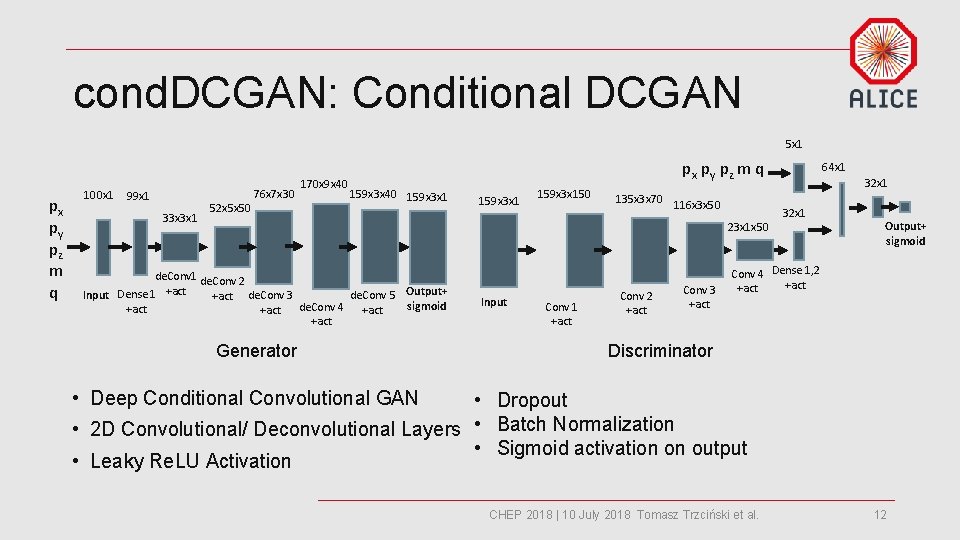
cond. DCGAN: Conditional DCGAN 5 x 1 px py pz m q 100 x 1 99 x 1 33 x 3 x 1 52 x 5 x 50 76 x 7 x 30 170 x 9 x 40 px py pz m q 159 x 3 x 40 159 x 3 x 150 135 x 3 x 70 116 x 3 x 50 23 x 1 x 50 de. Conv 1 de. Conv 2 Input Dense 1 +act de. Conv 5 Output+ +act de. Conv 3 sigmoid +act de. Conv 4 +act Generator Input Conv 1 +act Conv 2 +act Conv 3 +act 64 x 1 32 x 1 Output+ sigmoid Conv 4 Dense 1, 2 +act Discriminator • Deep Conditional Convolutional GAN • Dropout • 2 D Convolutional/ Deconvolutional Layers • Batch Normalization • Sigmoid activation on output • Leaky Re. LU Activation CHEP 2018 | 10 July 2018 Tomasz Trzciński et al. 12
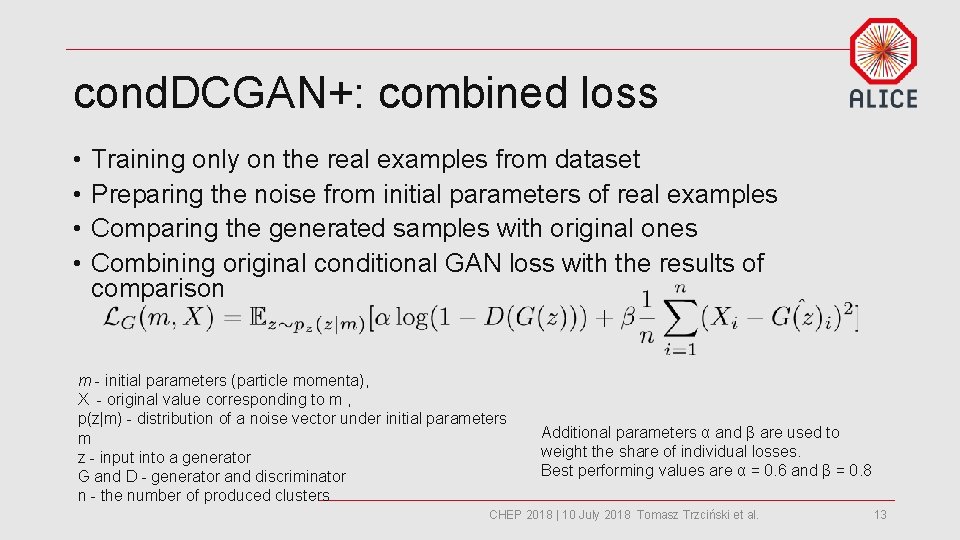
cond. DCGAN+: combined loss • • Training only on the real examples from dataset Preparing the noise from initial parameters of real examples Comparing the generated samples with original ones Combining original conditional GAN loss with the results of comparison m - initial parameters (particle momenta), X - original value corresponding to m , p(z|m) - distribution of a noise vector under initial parameters m z - input into a generator G and D - generator and discriminator n - the number of produced clusters Additional parameters α and β are used to weight the share of individual losses. Best performing values are α = 0. 6 and β = 0. 8 CHEP 2018 | 10 July 2018 Tomasz Trzciński et al. 13
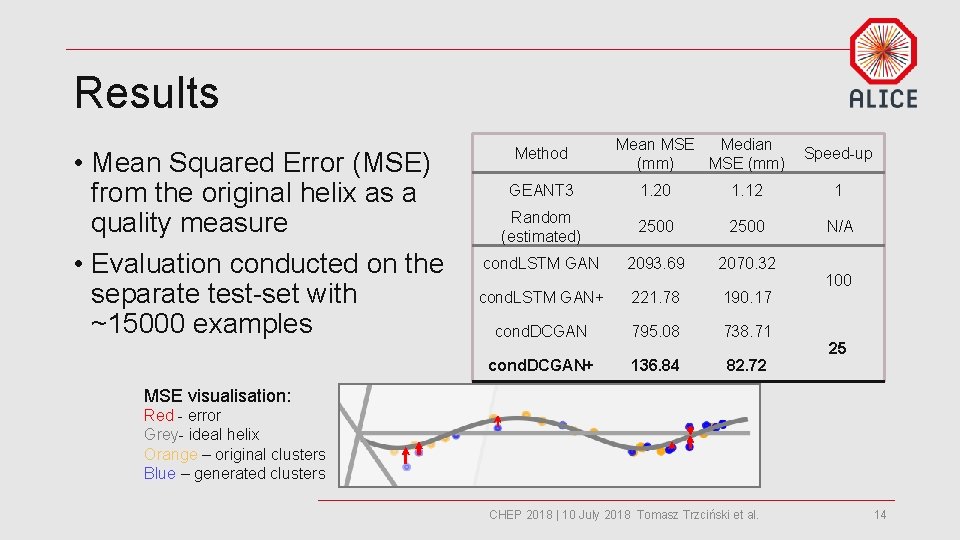
Results • Mean Squared Error (MSE) from the original helix as a quality measure • Evaluation conducted on the separate test-set with ~15000 examples Method Mean MSE Median (mm) MSE (mm) Speed-up GEANT 3 1. 20 1. 12 1 Random (estimated) 2500 N/A cond. LSTM GAN 2093. 69 2070. 32 cond. LSTM GAN+ 221. 78 190. 17 cond. DCGAN 795. 08 738. 71 cond. DCGAN+ 136. 84 82. 72 100 25 MSE visualisation: Red - error Grey- ideal helix Orange – original clusters Blue – generated clusters CHEP 2018 | 10 July 2018 Tomasz Trzciński et al. 14
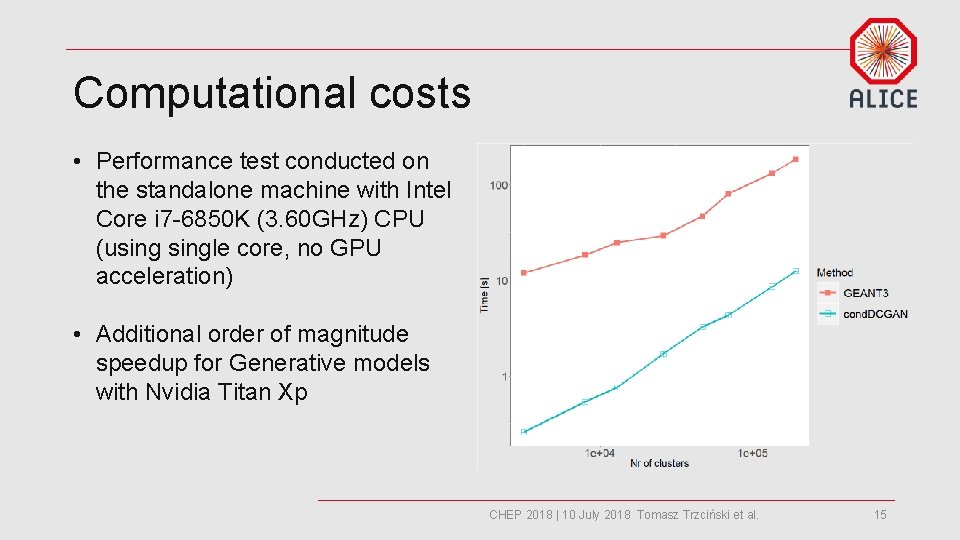
Computational costs • Performance test conducted on the standalone machine with Intel Core i 7 -6850 K (3. 60 GHz) CPU (usingle core, no GPU acceleration) • Additional order of magnitude speedup for Generative models with Nvidia Titan Xp CHEP 2018 | 10 July 2018 Tomasz Trzciński et al. 15
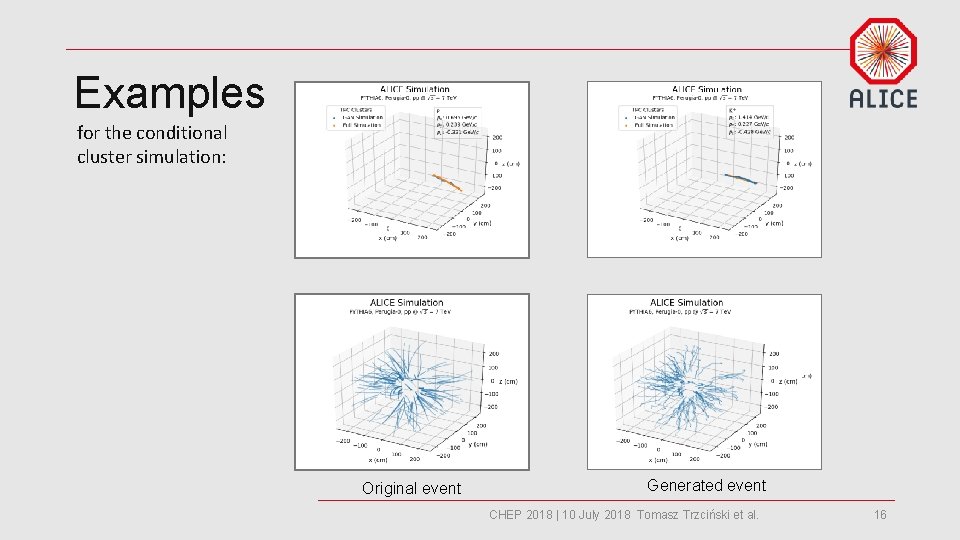
Examples for the conditional cluster simulation: Original event Generated event CHEP 2018 | 10 July 2018 Tomasz Trzciński et al. 16
Summary • Quality not yet equal to this observed with full simulation • Massive speed-up 25 (CPU) or 250 (GPU) comparing to standard simulation methods • First step toward semi-real time anomaly detection tool Limitations: • Multi-track generation • 2 flows for 3 D coordinates and energy • Error estimation based on a helix CHEP 2018 | 10 July 2018 Tomasz Trzciński et al. 17
Acknowledgments • The authors acknowledge the support from the Polish National Science Centre grant no. UMO-2016/21/D/ST 6/01946. • The GPUs used in this work were funded by the grant of the Dean of the Faculty of Electronics and Information Technology at Warsaw University of Technology (project II/2017/GD/1). National Science Centre Poland Faculty of Electronics and Information Technology Warsaw Universtiy of Technology CHEP 2018 | 10 July 2018 Tomasz Trzciński et al. 18