Unit 1 present tenses Its a good idea



- Slides: 10
Unit 1 – present tenses
It’s a good idea to compare and contrast the present simple and continuous to understand them better. Let’s look at: 1. when we use the present simple and continuous. 2. how we make sentences in the present simple. 3. how we make sentences in the present continuous. 4. action and state verbs. When do we use them? Copyright © 2018 by Pearson Education Gold Experience 2 nd Edition B 1
Function: When do we use them? present simple and present continuous I live in Lisbon, but I’m staying with a friend in the countryside at the moment because I’m repainting my apartment. I’m from the UK, so I usually visit my parents in London every three months. Look at what the woman says and match the sentences in bold to the uses. present simple for permanent states I live in Lisbon. Copyright © 2018 by Pearson Education Gold Experience 2 nd Edition B 1 for habits/repeated actions I usually visit my parents in London every three months. present continuous for temporary states I’m staying with a friend in the countryside. for actions happening now or around now I’m repainting my apartment.
Function: When do we use them? present simple and present continuous I live in Lisbon, but I’m staying with a friend in the countryside at the moment because I’m repainting my apartment. I’m from the UK, so I usually visit my parents in London every three months. present simple for permanent states I live in London. present continuous for temporary states I usually visit my parents in London every three months. I’m staying with a friend in the countryside. Now Look at the timelines to help you. for actions happening now or around now for habits/repeated actions three months I visit my parents. Copyright © 2018 by Pearson Education Gold Experience 2 nd Edition B 1 I’m repainting my apartment. Now I’m staying with a friend. I’m repainting my apartment. How do we make sentences in these structures?
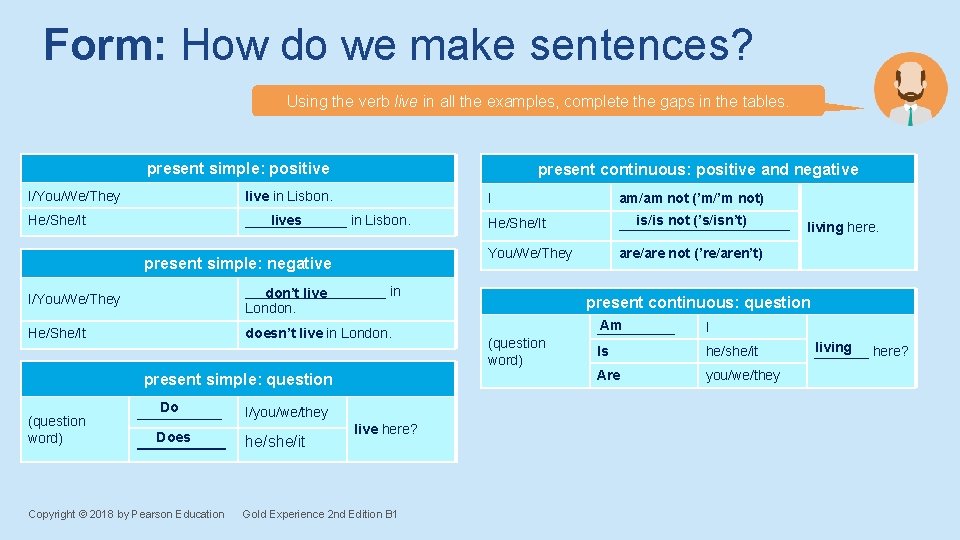
Form: How do we make sentences? Using the verb live in all the examples, complete the gaps in the tables. present simple: positive present continuous: positive and negative I/You/We/They live in Lisbon. I am/am not (’m/’m not) He/She/It lives _______ in Lisbon. He/She/It is/is not (’s/isn’t) ___________ You/We/They are/are not (’re/aren’t) present simple: negative I/You/We/They _________ in don’t live London. He/She/It doesn’t live in London. present simple: question (question word) Do ______ I/you/we/they Does _____ he/she/it live here? Copyright © 2018 by Pearson Education Gold Experience 2 nd Edition B 1 living here. present continuous: question (question word) Am _____ I Is he/she/it Are you/we/they living here? _______
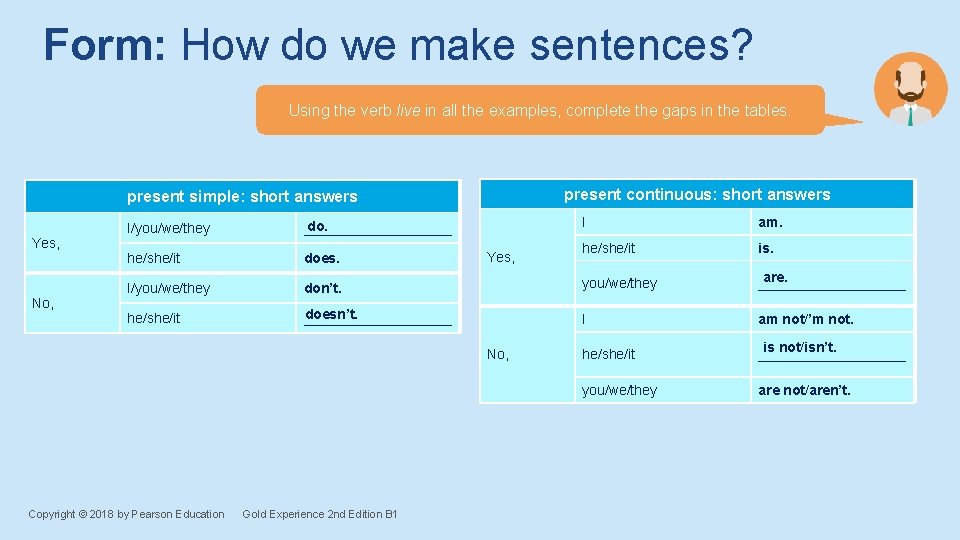
Form: How do we make sentences? Using the verb live in all the examples, complete the gaps in the tables. present continuous: short answers present simple: short answers Yes, No, I am. he/she/it is. don’t. you/we/they are. __________ doesn’t. __________ I am not/’m not. he/she/it is not/isn’t. __________ you/we/they are not/aren’t. I/you/we/they do. __________ he/she/it does. I/you/we/they he/she/it Yes, No, Copyright © 2018 by Pearson Education Gold Experience 2 nd Edition B 1
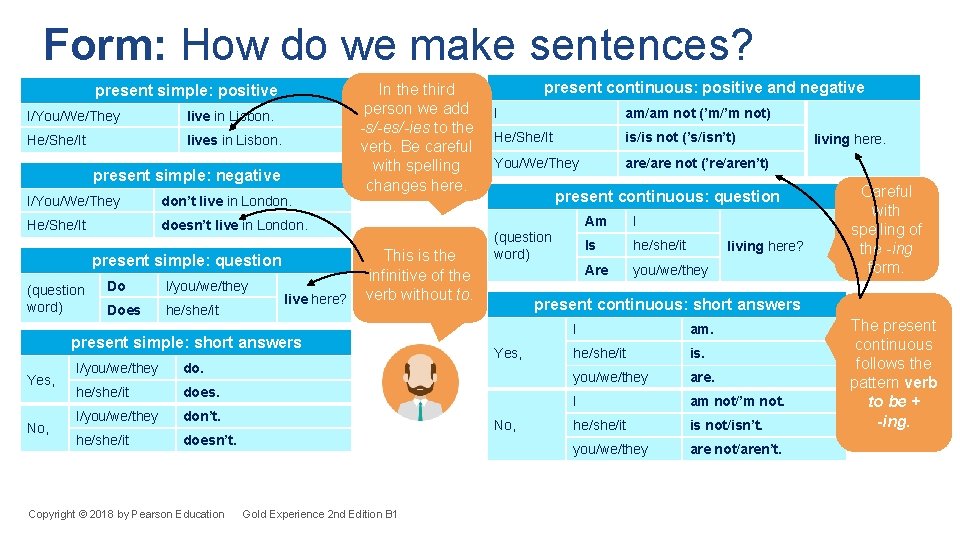
Form: How do we make sentences? present simple: positive I/You/We/They live in Lisbon. He/She/It lives in Lisbon. present simple: negative I/You/We/They don’t live in London. He/She/It doesn’t live in London. present simple: question (question word) Do I/you/we/they Does he/she/it live here? present continuous: positive and negative In the third person we add I am/am not (’m/’m not) -s/-es/-ies to the He/She/It is/is not (’s/isn’t) living here. verb. Be careful You/We/They are/are not (’re/aren’t) with spelling changes here. Careful present continuous: question with Am I spelling of (question Is he/she/it living here? the -ing word) This is the form. Are you/we/they infinitive of the verb without to. present simple: short answers Yes, No, I/you/we/they do. he/she/it does. I/you/we/they don’t. he/she/it doesn’t. Copyright © 2018 by Pearson Education Gold Experience 2 nd Edition B 1 present continuous: short answers Yes, No, I am. he/she/it is. you/we/they are. I am not/’m not. he/she/it is not/isn’t. you/we/they are not/aren’t. The present continuous follows the pattern verb to be + -ing.
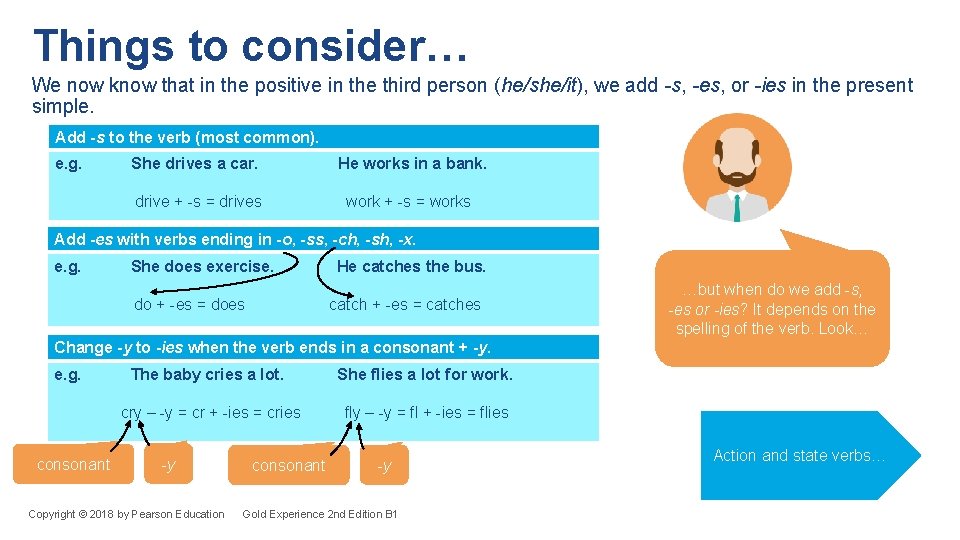
Things to consider… We now know that in the positive in the third person (he/she/it), we add -s, -es, or -ies in the present simple. Add -s to the verb (most common). e. g. She drives a car. He works in a bank. drive + -s = drives work + -s = works Add -es with verbs ending in -o, -ss, -ch, -sh, -x. e. g. She does exercise. He catches the bus. do + -es = does catch + -es = catches …but when do we add -s, -es or -ies? It depends on the spelling of the verb. Look… Change -y to -ies when the verb ends in a consonant + -y. e. g. The baby cries a lot. She flies a lot for work. cry – -y = cr + -ies = cries fly – -y = fl + -ies = flies consonant -y Copyright © 2018 by Pearson Education Gold Experience 2 nd Edition B 1 Action and state verbs…
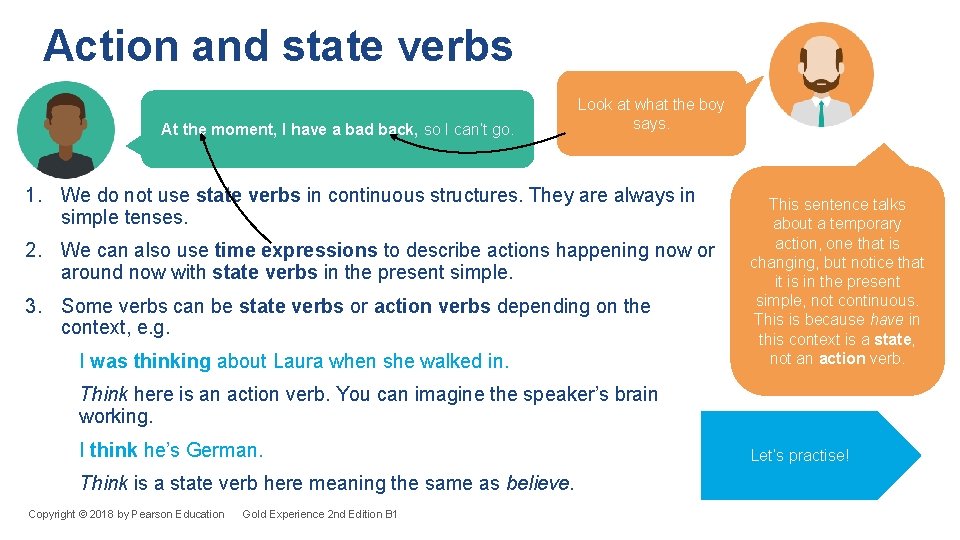
Action and state verbs At the moment, I have a bad back, so I can’t go. Look at what the boy says. 1. We do not use state verbs in continuous structures. They are always in simple tenses. 2. We can also use time expressions to describe actions happening now or around now with state verbs in the present simple. 3. Some verbs can be state verbs or action verbs depending on the context, e. g. I was thinking about Laura when she walked in. This sentence talks about a temporary action, one that is changing, but notice that it is in the present simple, not continuous. This is because have in this context is a state, not an action verb. Think here is an action verb. You can imagine the speaker’s brain working. I think he’s German. Think is a state verb here meaning the same as believe. Copyright © 2018 by Pearson Education Gold Experience 2 nd Edition B 1 Let’s practise!
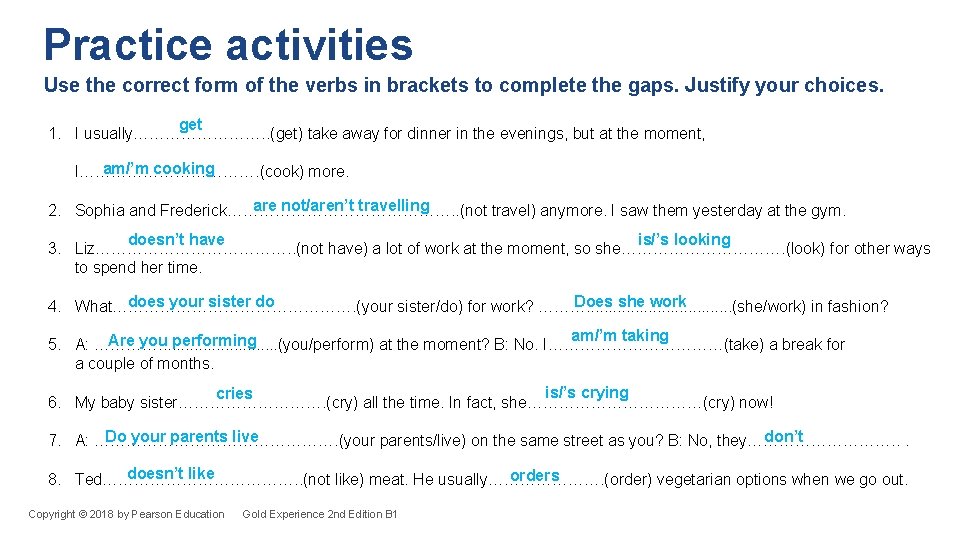
Practice activities Use the correct form of the verbs in brackets to complete the gaps. Justify your choices. get 1. I usually…………. . (get) take away for dinner in the evenings, but at the moment, am/’m cooking I………………. (cook) more. are not/aren’t travelling 2. Sophia and Frederick…………………. . (not travel) anymore. I saw them yesterday at the gym. is/’s looking doesn’t have 3. Liz………………. . (not have) a lot of work at the moment, so she……………. (look) for other ways to spend her time. does your sister do Does she work 4. What……………………. (your sister/do) for work? ………. . . . (she/work) in fashion? am/’m taking Are you performing 5. A: …………. . . . (you/perform) at the moment? B: No. I………………(take) a break for a couple of months. is/’s crying cries 6. My baby sister……………. (cry) all the time. In fact, she………………(cry) now! Do your parents live don’t 7. A: ……………………. (your parents/live) on the same street as you? B: No, they……………. . . doesn’t like orders 8. Ted………………. . (not like) meat. He usually…………………. (order) vegetarian options when we go out. Copyright © 2018 by Pearson Education Gold Experience 2 nd Edition B 1