Transliteracies Project Research in the Technological Social and
- Slides: 28
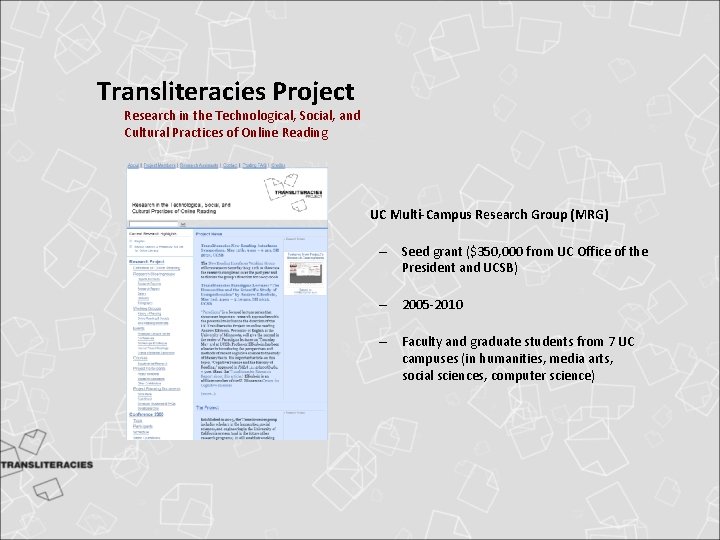
Transliteracies Project Research in the Technological, Social, and Cultural Practices of Online Reading UC Multi-Campus Research Group (MRG) – Seed grant ($350, 000 from UC Office of the President and UCSB) – 2005 -2010 – Faculty and graduate students from 7 UC campuses (in humanities, media arts, social sciences, computer science)
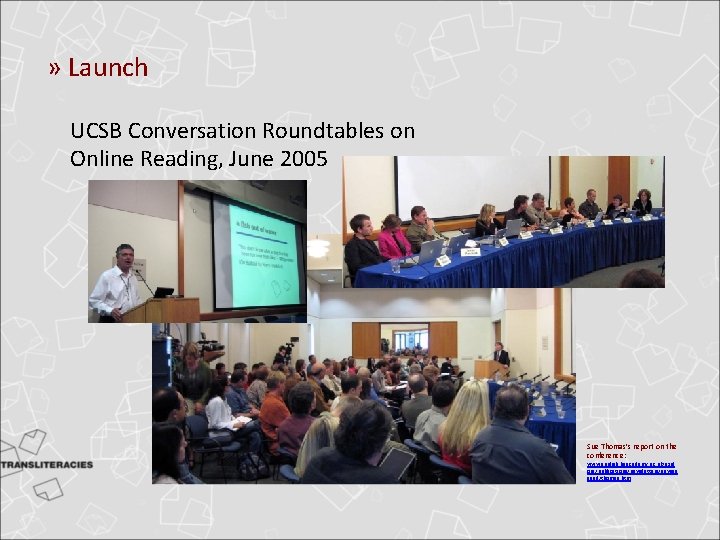
» Launch UCSB Conversation Roundtables on Online Reading, June 2005 Sue Thomas’s report on the conference: www. english. heacademy. ac. uk/expl ore/publications/newsletters/newsis sue 9/thomas. htm
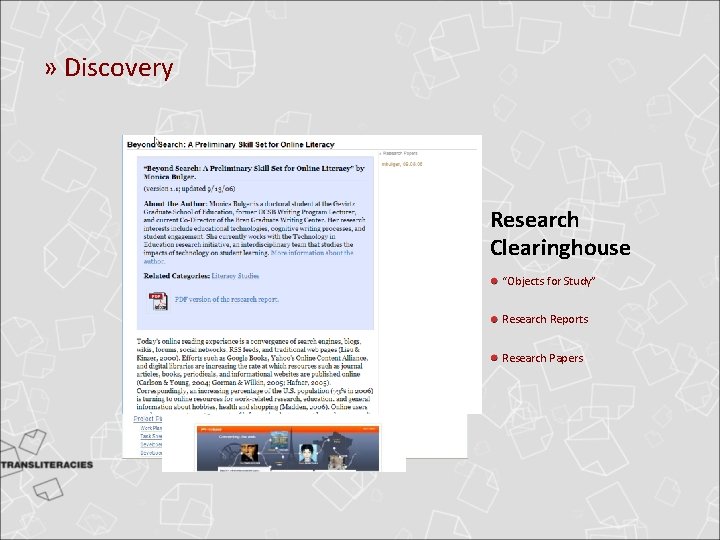
» Discovery Research Clearinghouse “Objects for Study” Research Reports Research Papers
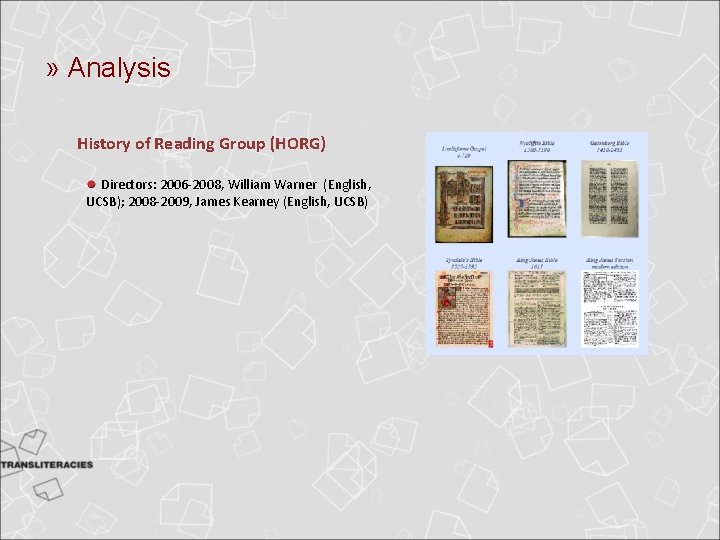
» Analysis History of Reading Group (HORG) Directors: 2006 -2008, William Warner (English, UCSB); 2008 -2009, James Kearney (English, UCSB)
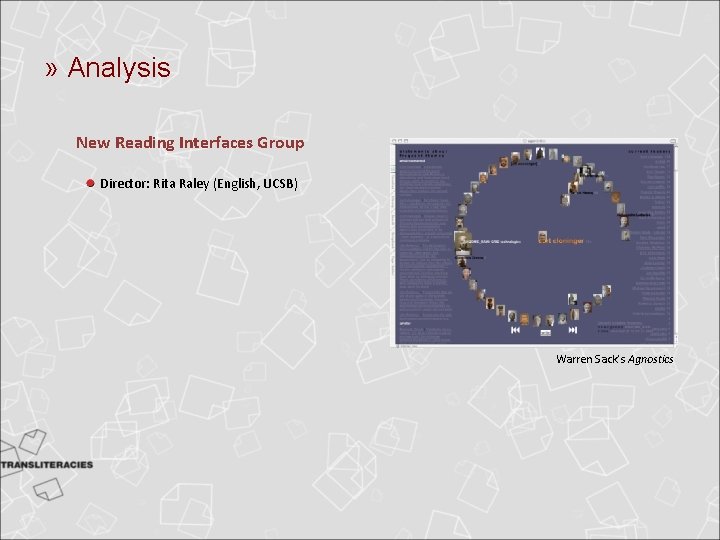
» Analysis New Reading Interfaces Group Director: Rita Raley (English, UCSB) Warren Sack’s Agnostics
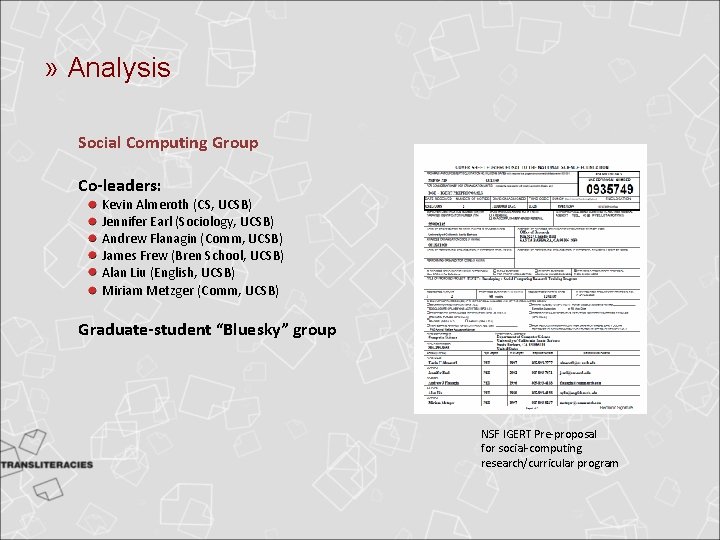
» Analysis Social Computing Group Co-leaders: Kevin Almeroth (CS, UCSB) Jennifer Earl (Sociology, UCSB) Andrew Flanagin (Comm, UCSB) James Frew (Bren School, UCSB) Alan Liu (English, UCSB) Miriam Metzger (Comm, UCSB) Graduate-student “Bluesky” group NSF IGERT Pre-proposal for social-computing research/curricular program
» Direction From Reading to Social Computing
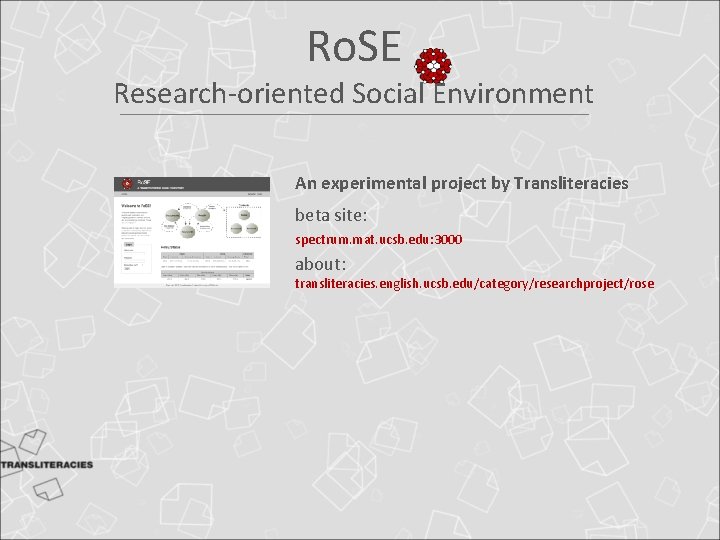
Ro. SE Research-oriented Social Environment An experimental project by Transliteracies beta site: spectrum. mat. ucsb. edu: 3000 about: transliteracies. english. ucsb. edu/category/researchproject/rose
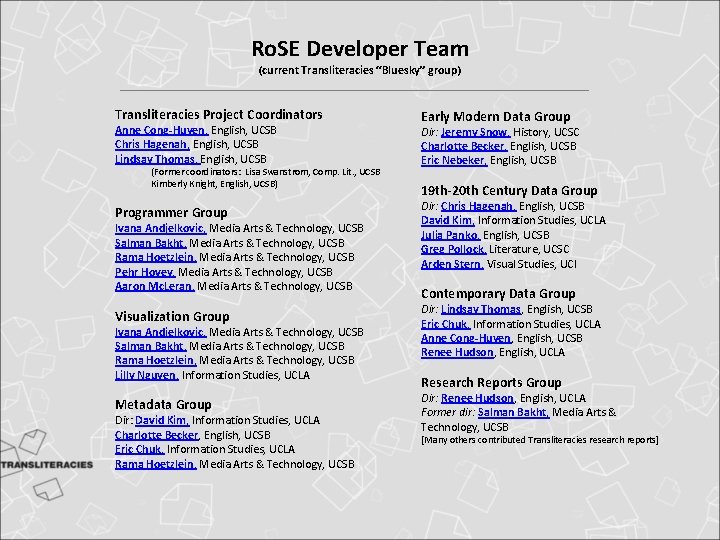
Ro. SE Developer Team (current Transliteracies “Bluesky” group) Transliteracies Project Coordinators Anne Cong-Huyen, English, UCSB Chris Hagenah, English, UCSB Lindsay Thomas, English, UCSB (Former coordinators: Lisa Swanstrom, Comp. Lit. , UCSB Kimberly Knight, English, UCSB) Programmer Group Ivana Andjelkovic, Media Arts & Technology, UCSB Salman Bakht, Media Arts & Technology, UCSB Rama Hoetzlein, Media Arts & Technology, UCSB Pehr Hovey, Media Arts & Technology, UCSB Aaron Mc. Leran, Media Arts & Technology, UCSB Visualization Group Ivana Andjelkovic, Media Arts & Technology, UCSB Salman Bakht, Media Arts & Technology, UCSB Rama Hoetzlein, Media Arts & Technology, UCSB Lilly Nguyen, Information Studies, UCLA Metadata Group Dir: David Kim, Information Studies, UCLA Charlotte Becker, English, UCSB Eric Chuk, Information Studies, UCLA Rama Hoetzlein, Media Arts & Technology, UCSB Early Modern Data Group Dir: Jeremy Snow, History, UCSC Charlotte Becker, English, UCSB Eric Nebeker, English, UCSB 19 th-20 th Century Data Group Dir: Chris Hagenah, English, UCSB David Kim, Information Studies, UCLA Julia Panko, English, UCSB Greg Pollock, Literature, UCSC Arden Stern, Visual Studies, UCI Contemporary Data Group Dir: Lindsay Thomas, English, UCSB Eric Chuk, Information Studies, UCLA Anne Cong-Huyen, English, UCSB Renee Hudson, English, UCLA Research Reports Group Dir: Renee Hudson, English, UCLA Former dir: Salman Bakht, Media Arts & Technology, UCSB [Many others contributed Transliteracies research reports]
Ro. SE Research-oriented Social Environment Ro. SE is being developed at a seed-funding level as a working platform stocked with a representative set of data/metadata and a sample set of interfaces, data visualizations, and other end-user experiences. It is a conceptual demo -- robust enough to suggest what is possible, but still malleable enough to be open to critique and revision. It is a hands-on platform for thinking about some of the combined philosophical and technical issues that would need to be confronted if Ro. SE were to be implemented as a production-scale system. These issues include (the topics of our breakout sessions): Expertise and networked public knowledge Data-mining and visualization of social networks Information credibility Fluid ontologies and metadata for social and historical research Online reading and research environments.
Ro. SE Research-oriented Social Environment cument-centric Ro. SE creates a convergence between and knowledge socially-network
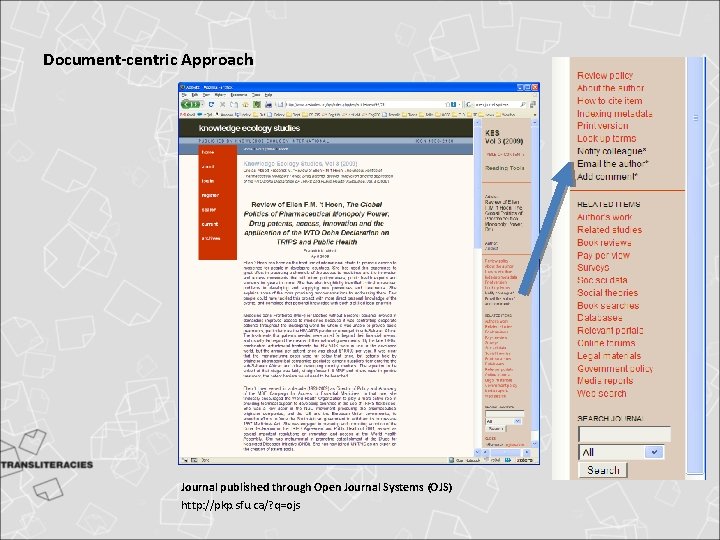
Document-centric Approach Journal published through Open Journal Systems (OJS) http: //pkp. sfu. ca/? q=ojs
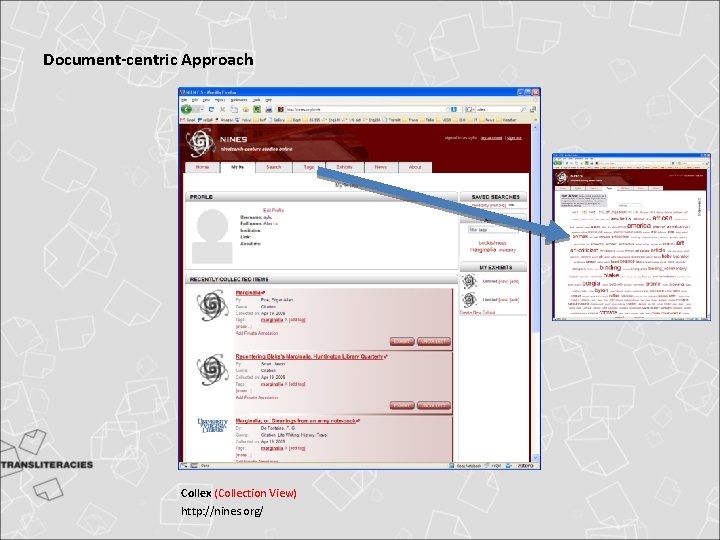
Document-centric Approach Collex (Collection View) http: //nines. org/
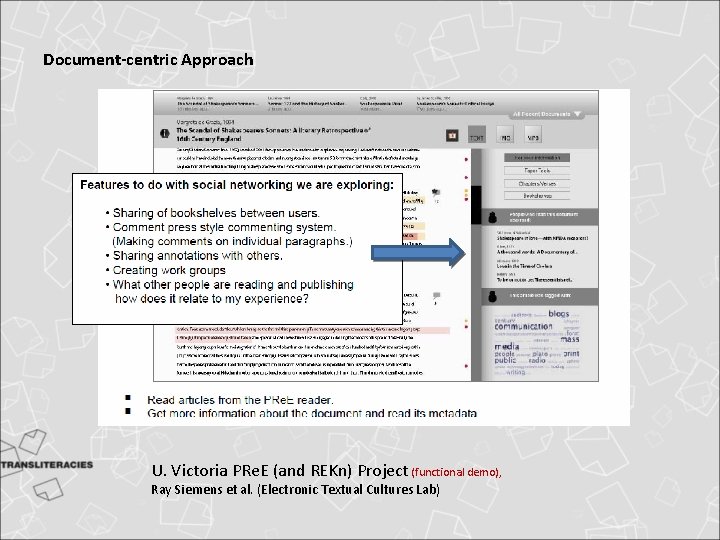
Document-centric Approach U. Victoria PRe. E (and REKn) Project (functional demo), Ray Siemens et al. (Electronic Textual Cultures Lab)
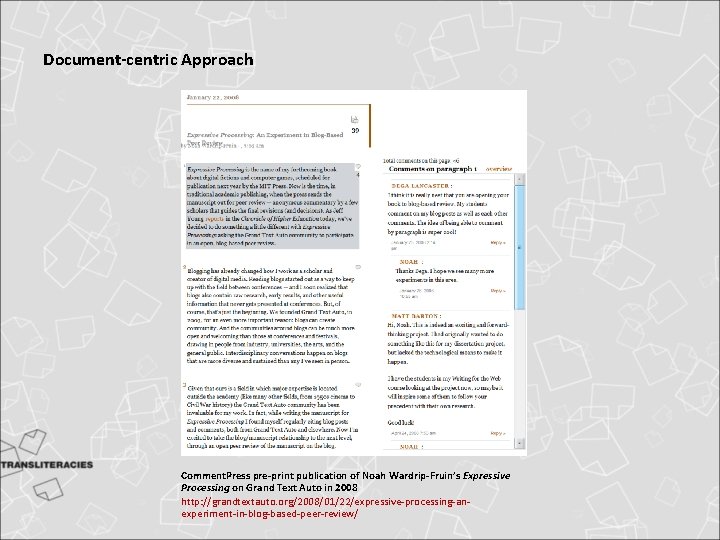
Document-centric Approach Comment. Press pre-print publication of Noah Wardrip-Fruin’s Expressive Processing on Grand Text Auto in 2008 http: //grandtextauto. org/2008/01/22/expressive-processing-anexperiment-in-blog-based-peer-review/
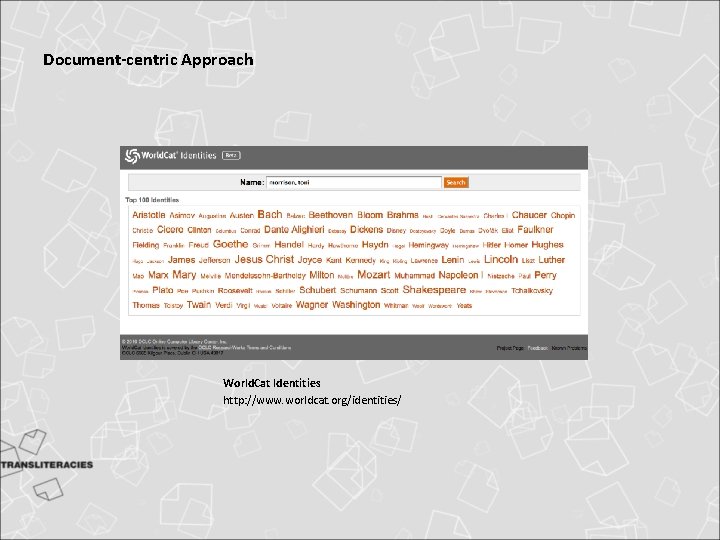
Document-centric Approach World. Cat Identities http: //www. worldcat. org/identities/
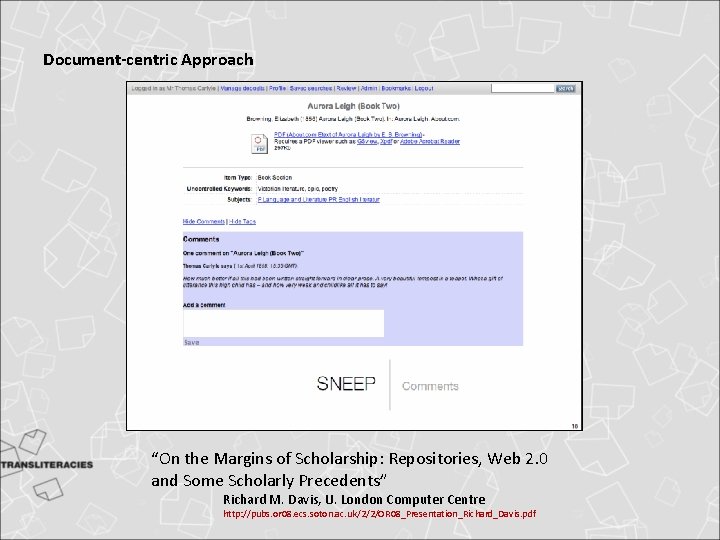
Document-centric Approach “On the Margins of Scholarship: Repositories, Web 2. 0 and Some Scholarly Precedents” Richard M. Davis, U. London Computer Centre http: //pubs. or 08. ecs. soton. ac. uk/2/2/OR 08_Presentation_Richard_Davis. pdf
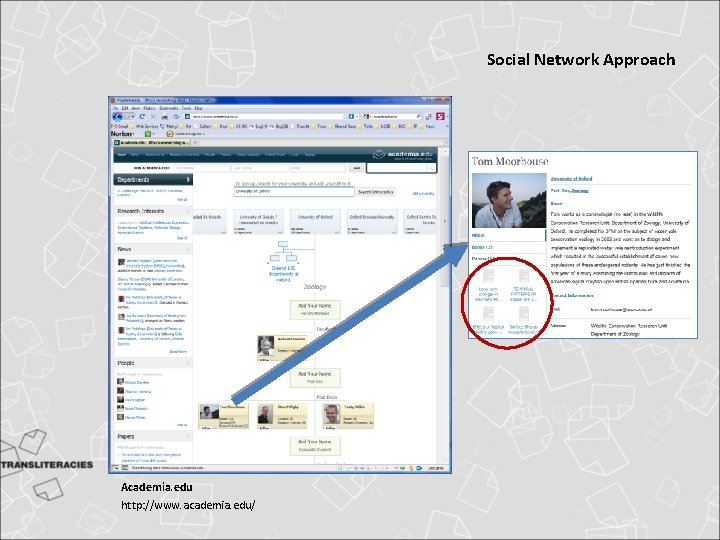
Social Network Approach Academia. edu http: //www. academia. edu/
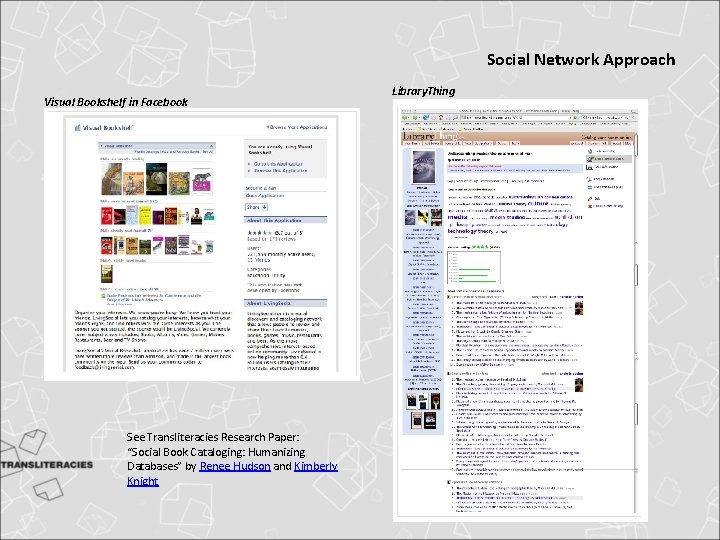
Social Network Approach Visual Bookshelf in Facebook See Transliteracies Research Paper: “Social Book Cataloging: Humanizing Databases” by Renee Hudson and Kimberly Knight Library. Thing
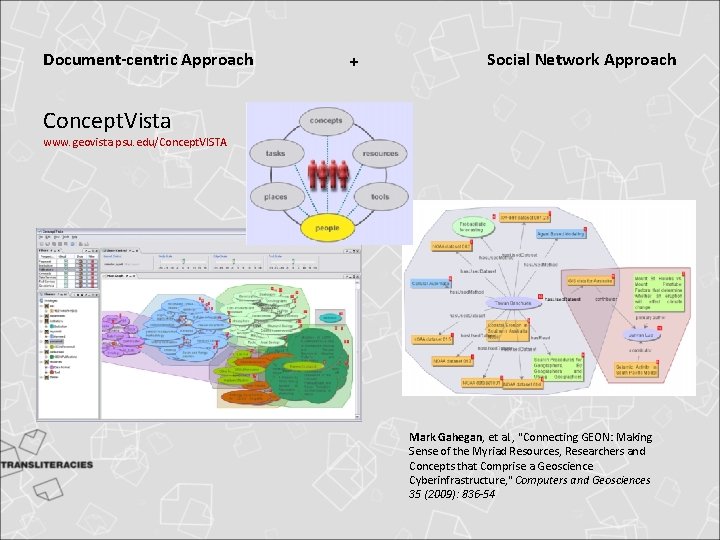
Document-centric Approach + Social Network Approach Concept. Vista www. geovista. psu. edu/Concept. VISTA Mark Gahegan, et al. , "Connecting GEON: Making Sense of the Myriad Resources, Researchers and Concepts that Comprise a Geoscience Cyberinfrastructure, " Computers and Geosciences 35 (2009): 836 -54
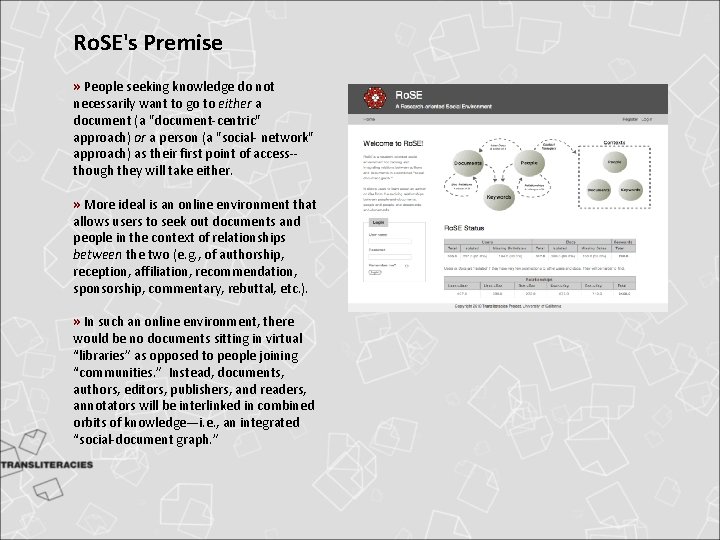
Ro. SE's Premise » People seeking knowledge do not necessarily want to go to either a document (a "document-centric" approach) or a person (a "social- network" approach) as their first point of access-though they will take either. » More ideal is an online environment that allows users to seek out documents and people in the context of relationships between the two (e. g. , of authorship, reception, affiliation, recommendation, sponsorship, commentary, rebuttal, etc. ). » In such an online environment, there would be no documents sitting in virtual “libraries” as opposed to people joining “communities. ” Instead, documents, authors, editors, publishers, and readers, annotators will be interlinked in combined orbits of knowledge—i. e. , an integrated “social-document graph. ”
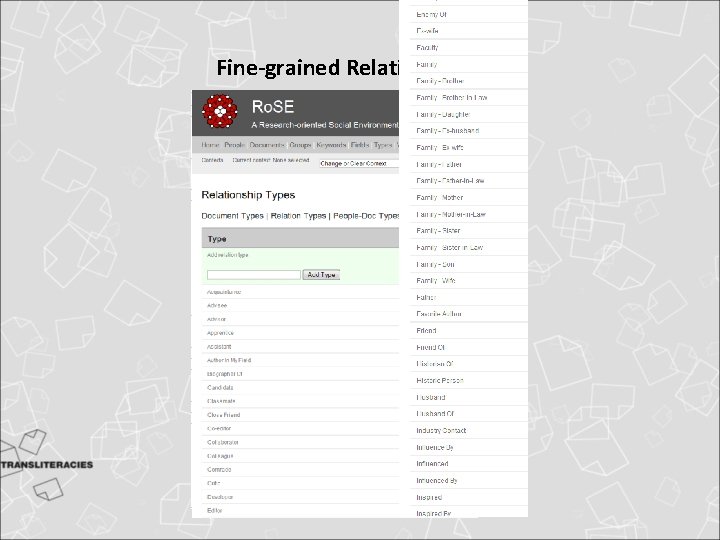
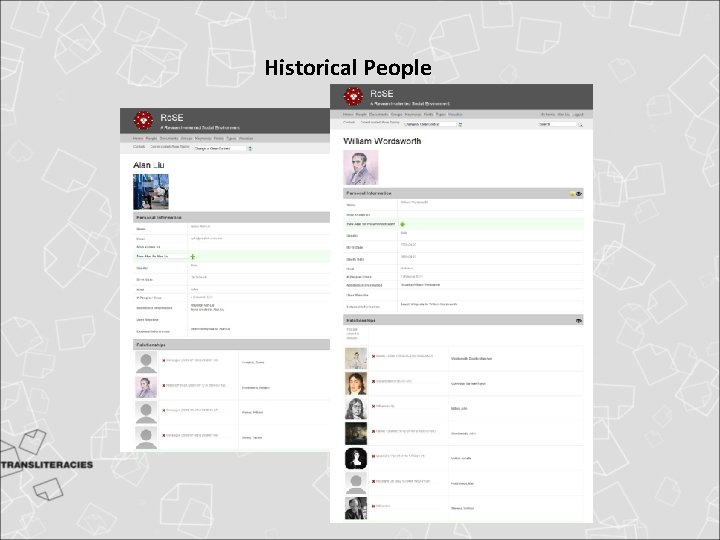
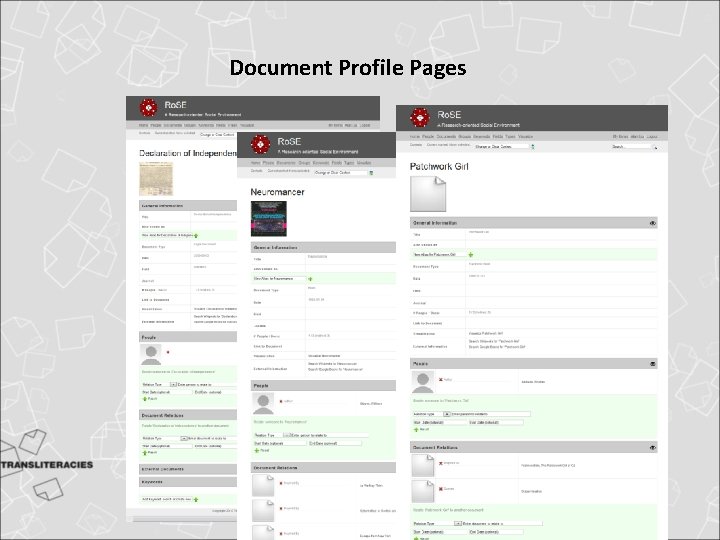
Unique Features of Ro. SE » Ro. SE allows for fine-grained relationship types. Not every person or every document is just a "friend. ” » Ro. SE's social network includes historical or "dead" people, who have their own profile pages. After all, the nature of true research is that it does not respect a natural divide between the living and the dead. Its "longitudinal" horizon is much more extensive. » In Ro. SE, some documents will have profile pages. » Though not possible without implementation-scale funding (or partnering with other projects), Ro. SE envisions using data-mining to simulate agency on the profile pages and "walls" of historical people (and influential documents). » Imagine, for instance, that Shakespeare's page could be refreshed with content drawn from his writings or those of his followers, scholars, etc. , in response to breaking new research or recent news events. » Or imagine that the U. S. Constitution had its own profile page and wall, so that yesterday’s Supreme Court decision could trigger on the Constitution’s page--through data-mining of related people and documents--“learned commentary” about that decision.
Fine-grained Relationships
Historical People
Document Profile Pages
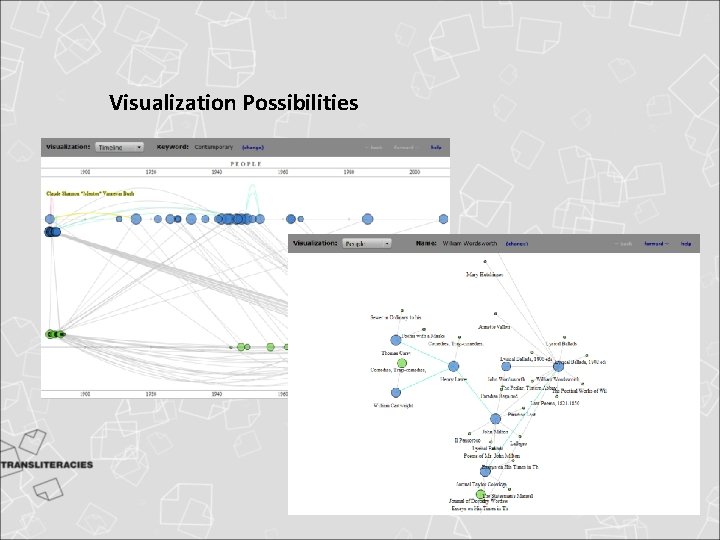
Visualization Possibilities
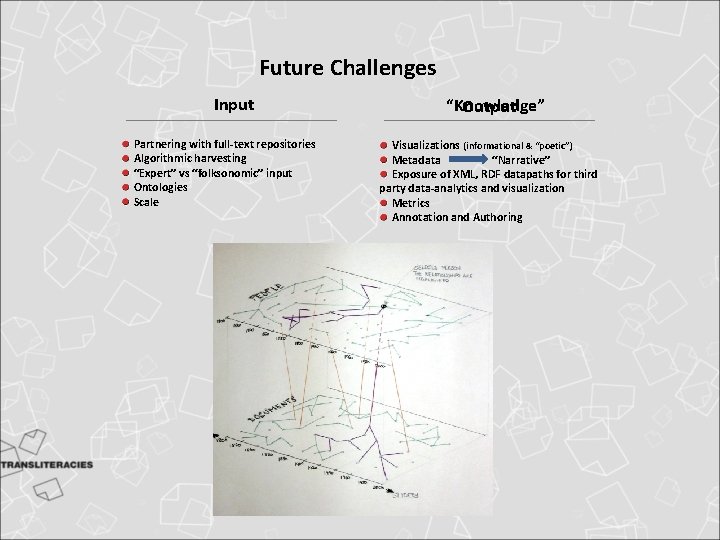
Future Challenges Input Partnering with full-text repositories Algorithmic harvesting “Expert” vs “folksonomic” input Ontologies Scale “Knowledge” Output Visualizations (informational & “poetic”) Metadata “Narrative” Exposure of XML, RDF datapaths for third party data-analytics and visualization Metrics Annotation and Authoring
Ro. SE Research-oriented Social Environment » You want to know something. You look in Ro. SE to spot a cluster of evolving relationships (whether of authorship, trust, influence, controversy, etc. ) between the people and the documents that seems to have defined the current knowledge-scape on that topic. So you go there--to that hive of knowledge relationships--to learn. » If you want, you can move the time slider back and forward to see how the relationships looked then and now. » Then it comes clear: what you know and still do not know, and who or what next to research, to read.