Translating Malcolm Gladwells Small Change The Role of

- Slides: 13
Translating Malcolm Gladwell’s “Small Change”: The Role of Citizenship Education in Civil Disobedience by Hasmik Hovhannisyan Instructor: Dr. Hourig Attarian May, 15, 2020
Table of Contents Abstract Introduction Literature Review Reflection Չնչին Փոփոխություն References
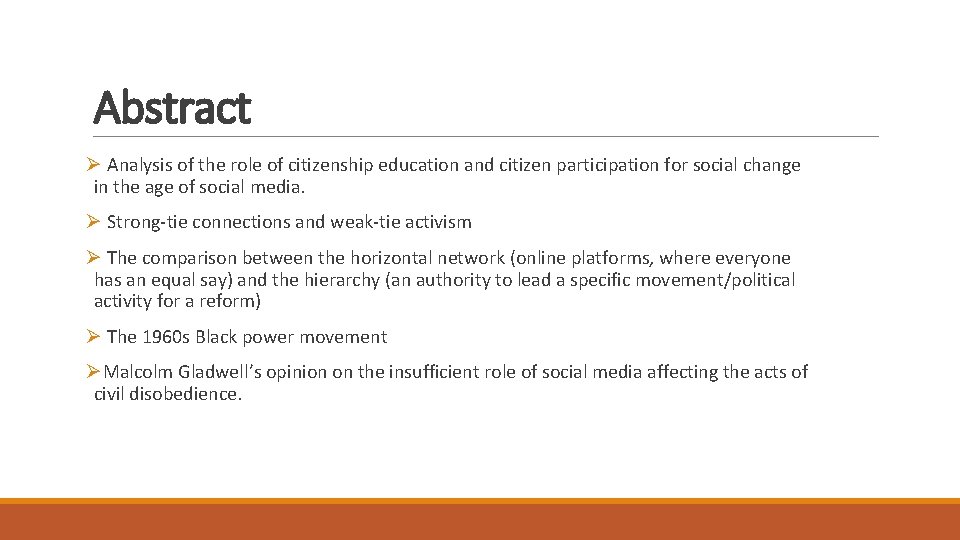
Abstract Ø Analysis of the role of citizenship education and citizen participation for social change in the age of social media. Ø Strong-tie connections and weak-tie activism Ø The comparison between the horizontal network (online platforms, where everyone has an equal say) and the hierarchy (an authority to lead a specific movement/political activity for a reform) Ø The 1960 s Black power movement ØMalcolm Gladwell’s opinion on the insufficient role of social media affecting the acts of civil disobedience.
Why “Small Change”? Ø To have a piece in Armenian reflecting the vital role of sit-in movements ØHighlight the role of education and hierarchy model in social movement organization ØImportance of citizenship education in social protests Ø“Good citizen” – the main basis of successful political activism
Introduction ØDoes online activism have a role in leading to social change? Ø “Digital- only activism sits on the lowest rung of the citizen participation reputation ladder” (Yang, 2016). Ø 1960 s Civil rights movement - The enlightenment of society, leadership, human participation Ø“Small change” - describes the concept of civil disobedience
Literature Review Ø The gradual change of the political leadership in the perception of Armenian Society. “In reality, the protests were political in nature, but the topics were not. There was an emerging core group of activists who participated in various protests, but no formal hierarchy; leadership was flexible, mostly based on self-cooptation in the course of the protests. ”(Iskandaryan, 2018, p. 474) Ø The online platforms of social media are built around weak ties and Twitter is just a way of following (or being followed by) people you may never have met, meanwhile, considering Facebook as a tool for keeping up with people one would not otherwise be able to stay in touch with (Gladwell, 2018)
Literature Review ØSince everybody is equal in that network there is a low chance to be able to make difficult choices that will drive social change (Gladwell, 2018). Ø What are these digital communities up to without a real leader and the system of hierarchy compared to the real crowd, requesting, in person, for a change (Malchik, 2019). ØThere a huge number of educational programs that aim to nurture “good citizens”. “Programs that seek to develop personally responsible citizens hope to build character and personal responsibility by emphasizing honesty, integrity, self-discipline, and hard work” (Westheimer & Kahne, 2004, p. 2).
Reflection Ø A desire to produce a piece for the Armenian reader regarding how, in reality, sit-in movements are initiated and what is the role of citizenship education beyond these acts that drive social change Øthe article “Small Changes, ” published in the New Yorker in October, 2010, written by Malcolm Gadwell, who is best known for his unique perspective on popular culture. Ø“Small Change” - an eye-opener for our attempts to understand what real activism is. Ø Will help the Armenian reader to learn the importance of “strong ties” among activists, the actual gatherings and the role of education.
Reflection Ø As Freire stated in his book called “The Politics of Education: Culture, Power and Liberation” “Democracy requires oppressed groups to develop political determination. To organize and mobilize in order to achieve their own objectives” ensuring that education makes such democracy possible (Freire, 1985) ØPeople should be taught to participate, be active citizens and learn to make political choices. This includes real connections, relationships, gatherings in real spaces, walks, which eventually will make these citizens care about each other, support and nurture each other, bringing about strong-tie connections.
Reflection ØAfter 25 years, Gladwell shared the same thoughts as Freire. Going against the mainstream, and the notion of online campaigning he claims that effective mass protests are based on real human friendship and a shared experience rather than online society where the biggest acquisition is to be able to address a “weak-tie” issue such as “finding a bone marrow donor”. (Gladwell, 2018, p. 6) Ø Considers social media platforms risk-free spaces for campaigns and communication stating that their utmost contribution is not even close to a complex human interaction, and is not a sacrifice made for social change.
Reflection ØThe inspiration of Gladwell’s “Small Change - 1960 s Civil Rights Movement in the United States Ø"Why the revolution will not be tweeted” – a direct reference to Gil Scott-Heron's iconic and strong poem “The Revolution will not be Televised” - a popular slogan among the 1960 s Black Power movements ØSituates himself in this line of activist history
Reflection Translation Process Ø Words and concepts that do not exist in the Armenian reality – E. g. - “was eating our lunch on the Internet” - was defeating us, “are you chicken” – a person who is not brave Ø The original piece includes names of various organizations, universities, and other terms (such as N. A. A. C. P, CORE, AT. & T. etc. ) - translated them into Armenian, provided footnotes as necessary and defined other culturally specific references explaining their context, which are critically important to understanding the piece. ØGladwell’s uses a sarcastic tone to demonstrate his points and transmitting his voice into Armenian while maintaining the right dose of sarcasm was challenging.
References Freire, P. (1985). The politics of education: Culture, power, and liberation. South Hadley, Mass: Bergin & Garvey Iskandaryan, A. , (2018). The Velvet Revolution in Armenia: How to Lose Power in Two Weeks. Demokratizatsiya: The Journal of Post-Soviet Democratization, Volume 26, Number 4, Fall 2018, pp. 465 -482 Malchik, A. (2019). The Problem With Social-Media Protests. Retrieved from https: //www. theatlantic. com/technology/archive/2019/05/in-person-protests-stronger-online-activism-a-walkinglife/578905/ Westheimer, J. & Kahne, J. (2004) Educating the “good” citizen: Political choices and pedagogical goals. Political Science & Politics, 38(2), 1 -7. http: //democraticdialogue. com/DDpdfs/Westheimer. Kahne. PS. pdf Yang, G. (2016). Activism. In Peters B. (Ed. ), Digital Keywords: A Vocabulary of Information Society and Culture (pp. 1 -17). Princeton; Oxford: Princeton University Press.