Topic 8 Option 8 A Lesson 2 Health
- Slides: 32
Topic 8: Option 8 A Lesson 2 Health, Human Rights and Intervention
Previous Lessons 1 : Objectives To appreciate that concepts and measures of human development are complex and contested in different parts of the world To analyse these differences using a wide selection of geographical skills including global distribution maps , ranked data sets, scattergraphs and correlation techniques
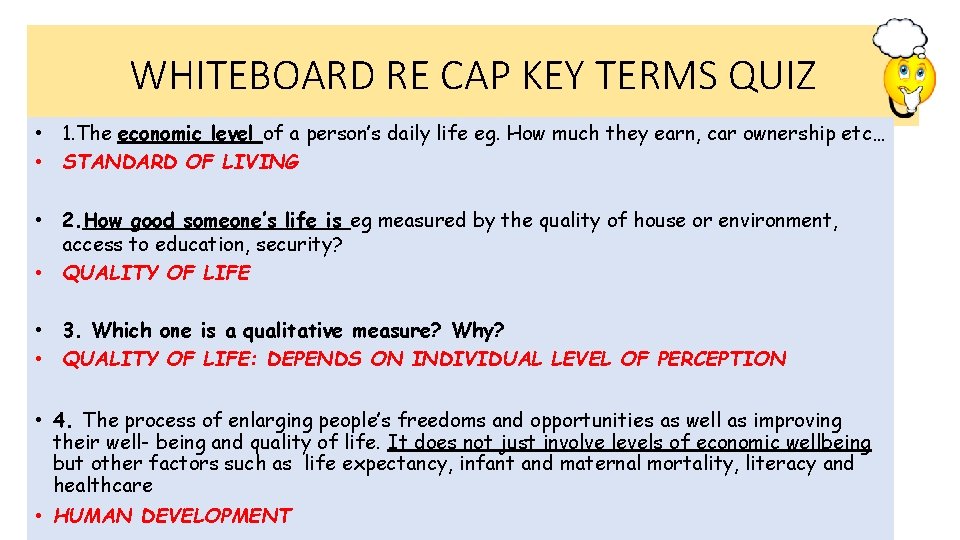
WHITEBOARD RE CAP KEY TERMS QUIZ • 1. The economic level of a person’s daily life eg. How much they earn, car ownership etc… • STANDARD OF LIVING • 2. How good someone’s life is eg measured by the quality of house or environment, access to education, security? • QUALITY OF LIFE • 3. Which one is a qualitative measure? Why? • QUALITY OF LIFE: DEPENDS ON INDIVIDUAL LEVEL OF PERCEPTION • 4. The process of enlarging people’s freedoms and opportunities as well as improving their well- being and quality of life. It does not just involve levels of economic wellbeing but other factors such as life expectancy, infant and maternal mortality, literacy and healthcare • HUMAN DEVELOPMENT
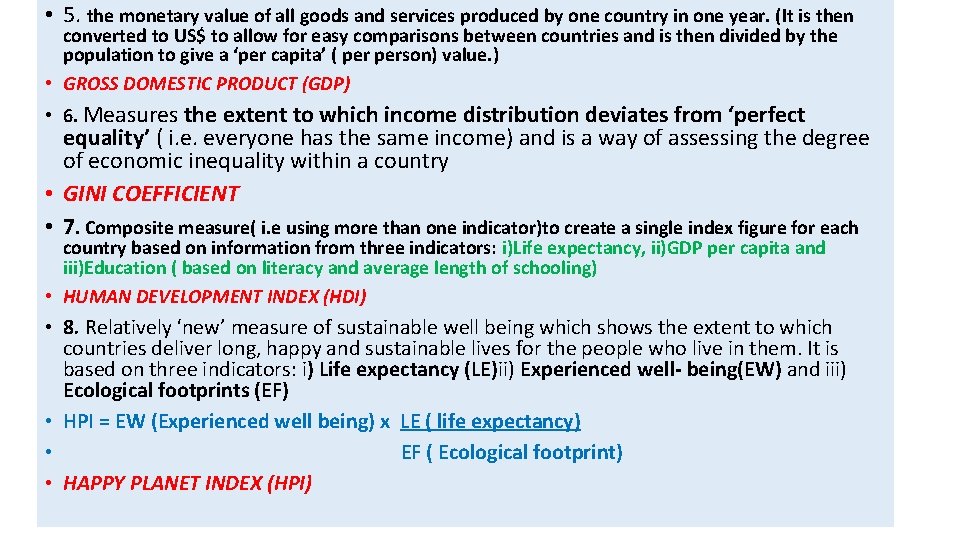
• 5. the monetary value of all goods and services produced by one country in one year. (It is then converted to US$ to allow for easy comparisons between countries and is then divided by the population to give a ‘per capita’ ( person) value. ) • GROSS DOMESTIC PRODUCT (GDP) • 6. Measures the extent to which income distribution deviates from ‘perfect equality’ ( i. e. everyone has the same income) and is a way of assessing the degree of economic inequality within a country • GINI COEFFICIENT • 7. Composite measure( i. e using more than one indicator)to create a single index figure for each country based on information from three indicators: i)Life expectancy, ii)GDP per capita and iii)Education ( based on literacy and average length of schooling) • HUMAN DEVELOPMENT INDEX (HDI) • 8. Relatively ‘new’ measure of sustainable well being which shows the extent to which countries deliver long, happy and sustainable lives for the people who live in them. It is based on three indicators: i) Life expectancy (LE)ii) Experienced well- being(EW) and iii) Ecological footprints (EF) • HPI = EW (Experienced well being) x LE ( life expectancy) • EF ( Ecological footprint) • HAPPY PLANET INDEX (HPI)
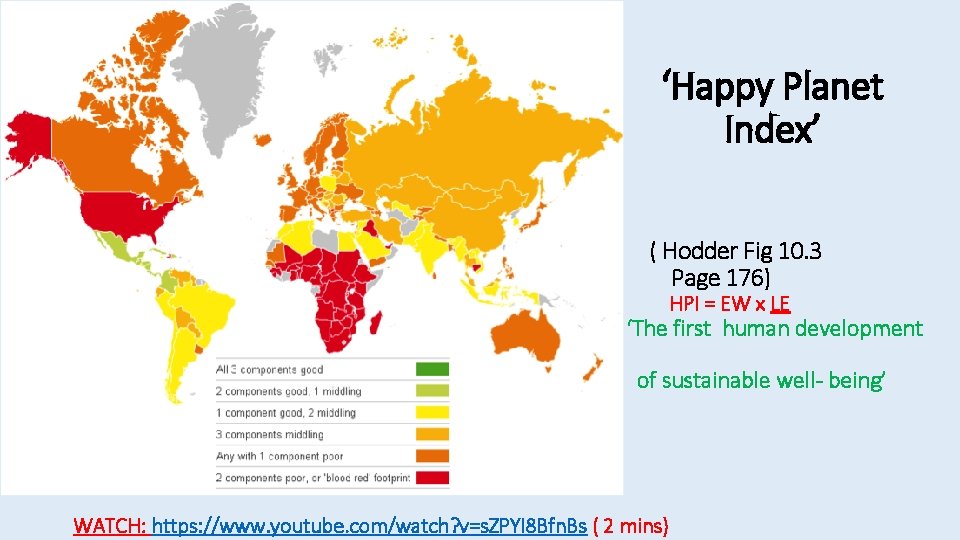
HPI ‘Happy Planet Index’ ( Hodder Fig 10. 3 Page 176) HPI = EW x LE measure ‘The first human development of sustainable well- being’ WATCH: https: //www. youtube. com/watch? v=s. ZPYI 8 Bfn. Bs ( 2 mins)
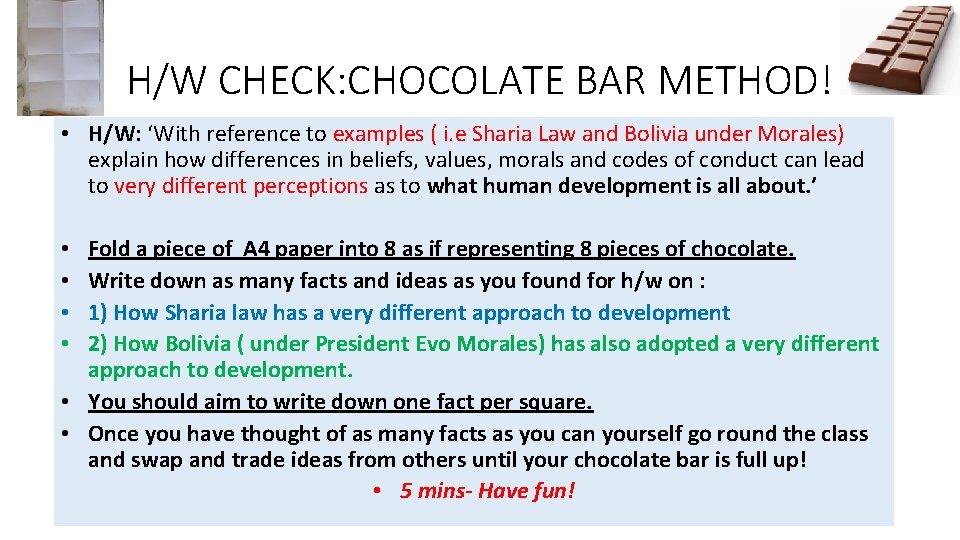
H/W CHECK: CHOCOLATE BAR METHOD! • H/W: ‘With reference to examples ( i. e Sharia Law and Bolivia under Morales) explain how differences in beliefs, values, morals and codes of conduct can lead to very different perceptions as to what human development is all about. ’ Fold a piece of A 4 paper into 8 as if representing 8 pieces of chocolate. Write down as many facts and ideas as you found for h/w on : 1) How Sharia law has a very different approach to development 2) How Bolivia ( under President Evo Morales) has also adopted a very different approach to development. • You should aim to write down one fact per square. • Once you have thought of as many facts as you can yourself go round the class and swap and trade ideas from others until your chocolate bar is full up! • 5 mins- Have fun! • •
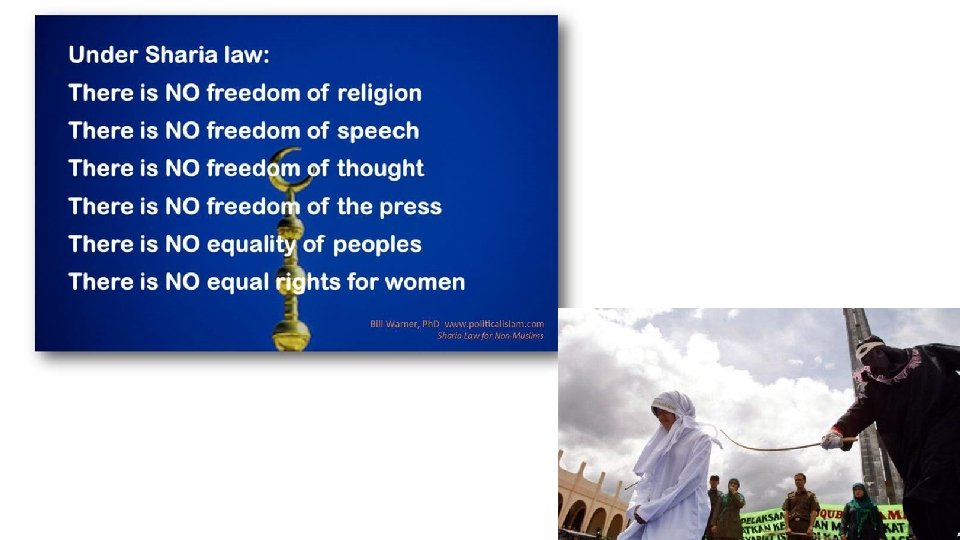
A few ‘chocolate bar’ facts: Sharia Law • Most ‘western’ countries have separated national government ( state and law) from religion ( called ‘secularisation’) but this is not so in the Muslim world. • An assumption has been that this is necessary for a country to become democratic with full respect for universal human rights which allows for development. • The Muslim world does not see secularism as necessary for development. • Sharia (Islamic ) law is not restricted to religious matters but also covers inheritance, marriage, contracts and criminal punishments. • As such, Sharia law creates a code of conduct and a set of values that are incomprehensible with the perceptions of human development widely held elsewhere in the world. • E. g. According to Sharia law – theft is punishable by the amputation of the right hand…. a non- Muslim man who marries a Muslim woman is punishable by death…
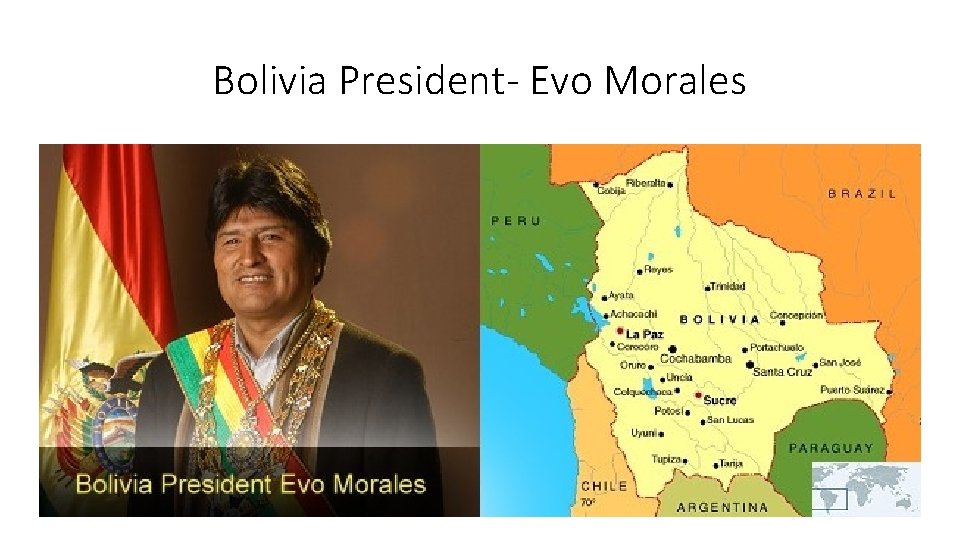
A few ‘chocolate bar’ facts: Bolivia under Morales • Evo Morales became Bolivia’s first indigenous president in 2006 • He introduced a socialist model approach – he was interested in sharing the wealth from the country’s natural gas and mineral resources between the people. • As an indigenous person himself he has prioritised the rights of the indigenous people not to be negatively affected by megainfrastructure or development projects. He reoriented Bolivia’s economy ( which used to be based on mining exports)As a result he has helped to lift half a million Bolivians out of poverty. • His model can be criticised for having a rather limited view on development as it has little to say about other ‘human’ aspects of development such as education, equal opportunities or freedom of speech.
Bolivia President- Evo Morales
Lesson 2: Objectives • To continue with the idea that concepts of human development are complex and contested: • To understand Rosling’s ideas about improvements in environmental quality, health, life expectancy and human rights being more significant goals for human development while economic growth is often the best means of delivering them. • To analyse the notion that ‘education is central to human development’ – a view that is not universally shared… • SKILLS: To evaluate these concepts using a wide selection of geographical skills including GIS , global distribution maps, graphs and interpretation of written documents
Enquiry question 1: What is human development and why do levels vary from place to place? • TODAY’S SPECIFICATION CONTENT: • • Key idea: 8 A. 1 Concepts of human development are complex and contested. Detailed content: b. Improvements in environmental quality, health, life expectancy and human rights are seen by some (Rosling) as more significant goals for development while economic growth is often the best means of delivering them. • c. Education is central to economic development (human capital) and to the understanding and assertion of human rights; this view is, however, not universally shared (attitudes to gender equality in education) as both access to education and standards of achievement vary greatly among countries (The United Nations Educational, Scientific and Cultural Organisation (UNESCO).
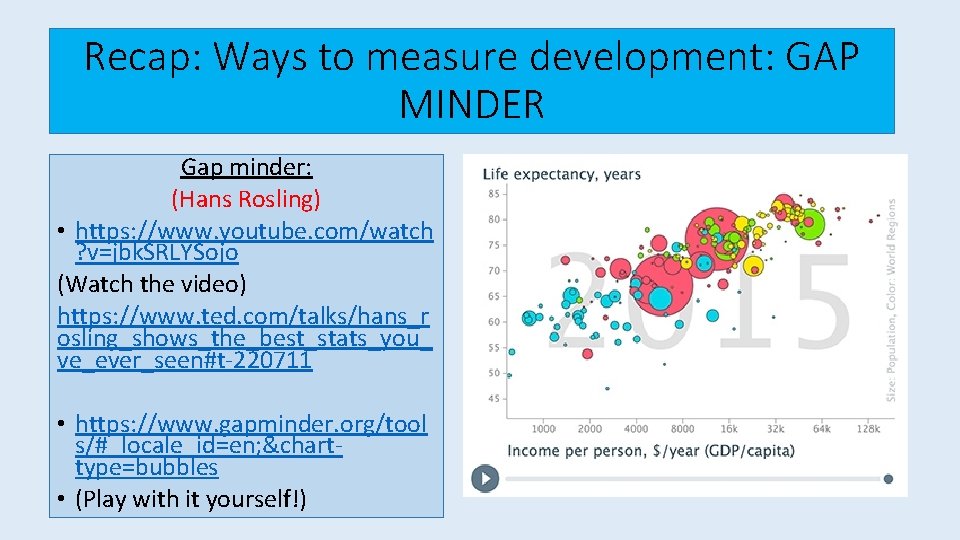
Recap: Ways to measure development: GAP MINDER Gap minder: (Hans Rosling) • https: //www. youtube. com/watch ? v=jbk. SRLYSojo (Watch the video) https: //www. ted. com/talks/hans_r osling_shows_the_best_stats_you_ ve_ever_seen#t-220711 • https: //www. gapminder. org/tool s/#_locale_id=en; &charttype=bubbles • (Play with it yourself!)
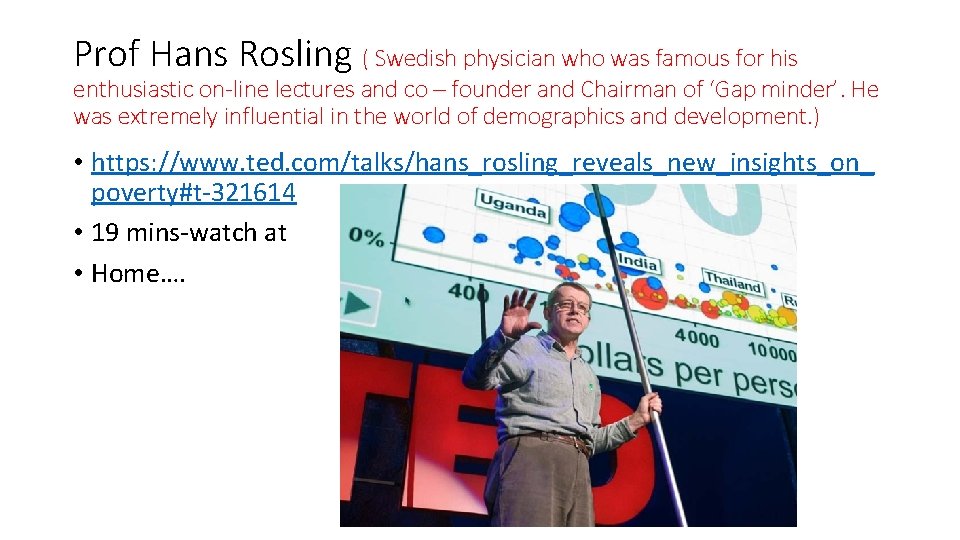
Prof Hans Rosling ( Swedish physician who was famous for his enthusiastic on-line lectures and co – founder and Chairman of ‘Gap minder’. He was extremely influential in the world of demographics and development. ) • https: //www. ted. com/talks/hans_rosling_reveals_new_insights_on_ poverty#t-321614 • 19 mins-watch at • Home….
Prof Rosling’s View: • Rosling argued that the world has made great strides in health, family size and life expectancy since 1980. Those countries that have developed most rapidly ( such as South Korea) have improved the most. However, progress has also occurred in the world’s poorest countries , such as Malawi. He argued that there is still some way to go and that he felt the future goals should be to improve: • 1) Environmental quality e. g. air and water quality • 2) The health and life expectancy of the poorest • 3) Human rights, e. g. rights for women • *Rosling believed that ECONOMIC GROWTH is the most important way of achieving these three goals but he also argued that HUMAN RIGHTS ARE ESSENTIAL TO ECONOMIC GROWTH and that human rights cannot exist without good, stable governance. *
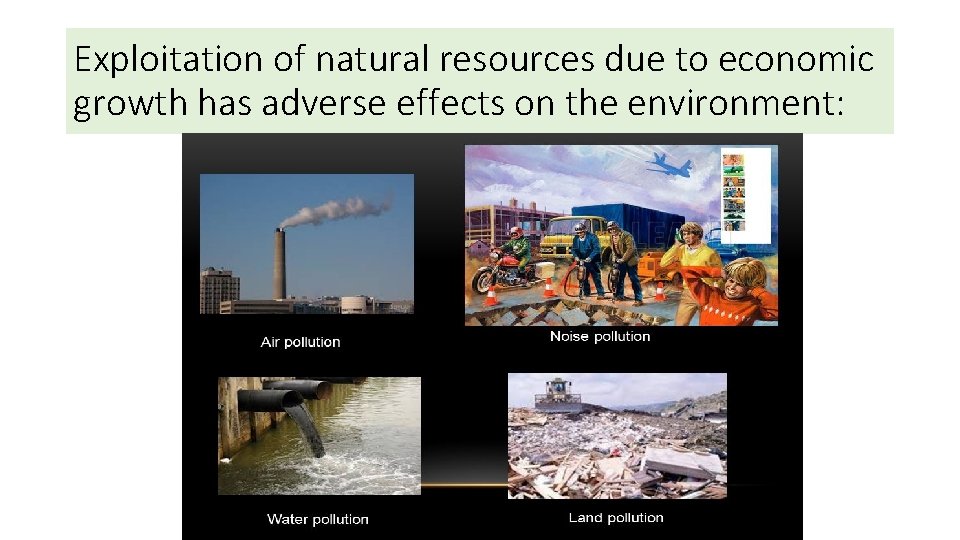
Why is there a tension between economic development and environmental quality? • Most are agreed that advancements in health, life expectancy and human rights are only likely to be delivered by economic growth. However there is a problem: • *Economic growth is frequently based on the exploitation of natural resources. Such exploitation almost inevitably has adverse effects on the environment. * • E. g air, water , land noise pollution • This most likely explains why improvements in environmental quality are not always cited as a development objective.
Exploitation of natural resources due to economic growth has adverse effects on the environment:
KEY TERM: • Human Rights: • The moral principles that underlie standards of human behaviour, the inalienable rights to which a person is entitled regardless of their nationality, language, ethnicity or gender. The rights include liberty, freedom of movement and speech, personal security and access to education and justice.
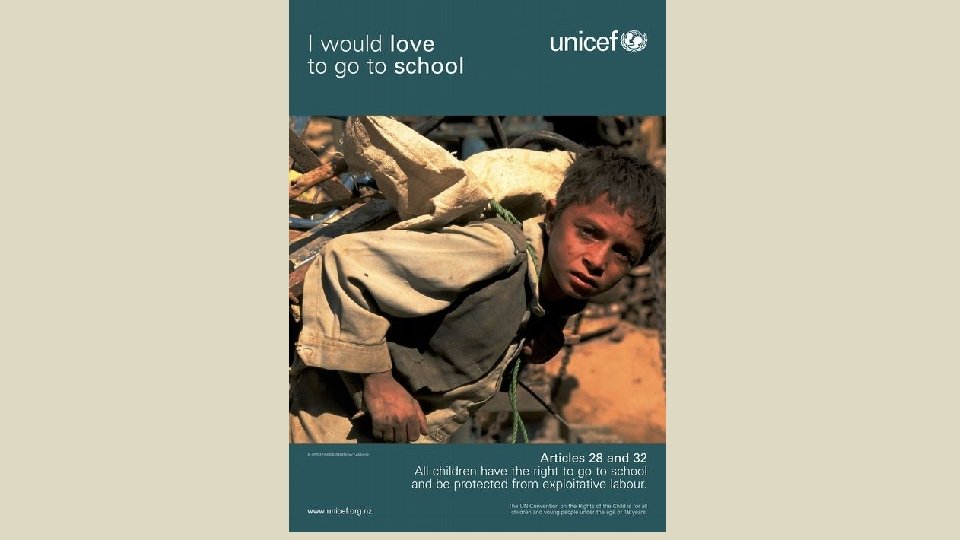
Why is education important for development? www. ted. com/talks/shabana_basij_rasikh_dare_to_educate_afghan_girls Paired/Group Discussion: • Why is education important to economic development? • Why is it not equal globally? • What happens when you don’t educate girls? • Do you think education is the best way to close the development gap? • 7 mins
Discussion points… • Why is education important to economic development? • Education is seen as a form of ‘human capital investment’. People need knowledge, understanding and skills in order to improve their lives and better workers help the development of a country. Through education literacy levels improve so that people are able to understand the need for basic hygiene and health care, ways to control their family size, how to become involved in decision making and their rights in the 21 st century world…. • Why is it not equal globally? • It is impeded by obstacles such as ethnicity, physical and mental disability, social class and wealth…. • What happens when you don’t educate girls? • Birth rates remain high as there is little/ no knowledge about contraception. Half of the world’s population is at a major social and economic disadvantage. Historically across the world the role of females has not been equal to that of males. Today gender imbalance is significant as girls make up 54% of the world’s non- schooled population…. • Do you think education is the best way to close the development gap? • Your view? . . Mine is that it is certainly a major contributory factor…
UNESCO (United Nations Educational, Scientific and Cultural Organisation) • *UNESCO sees education to be the main driver of human development and a fundamental right of all people*
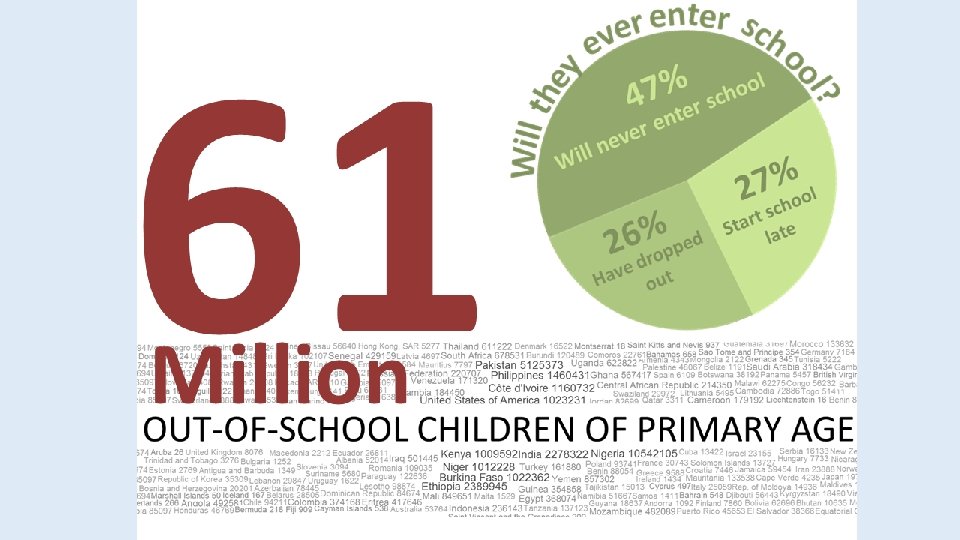
UNESCO (United Nations Educational, Scientific and Cultural Organisation) • http: //uis. unesco. org/ • Despite improvements in the numbers of children attending school worldwide, UNESCO has found that access to education still remains inaccessible to over 60 mill children of primary school age world wide. • This is often due to continuing inequalities and marginalisation; children do not have access to basic education because of inequalities such as their gender, health or cultural identity( e. g. ethnic origin, language or religion) • UNESCO has reported that sub- Saharan Africa has the highest number of children without access to education- 32 mill! Central and E. Asia as well as the Pacific , are also affected with more than 20 mill uneducated children. • Among these countries gender imbalance is significant with 54% of the world’s non educated female population mainly occurring in Arab states and Asia ( where culture and tradition give privileged treatment to boys) and also in many Sub- Saharan countries.
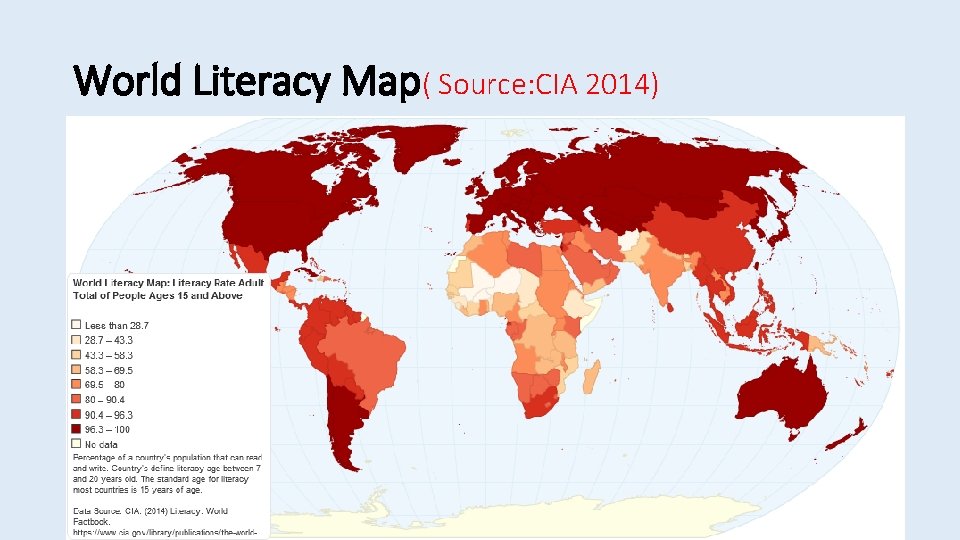
World Literacy Map( Source: CIA 2014)
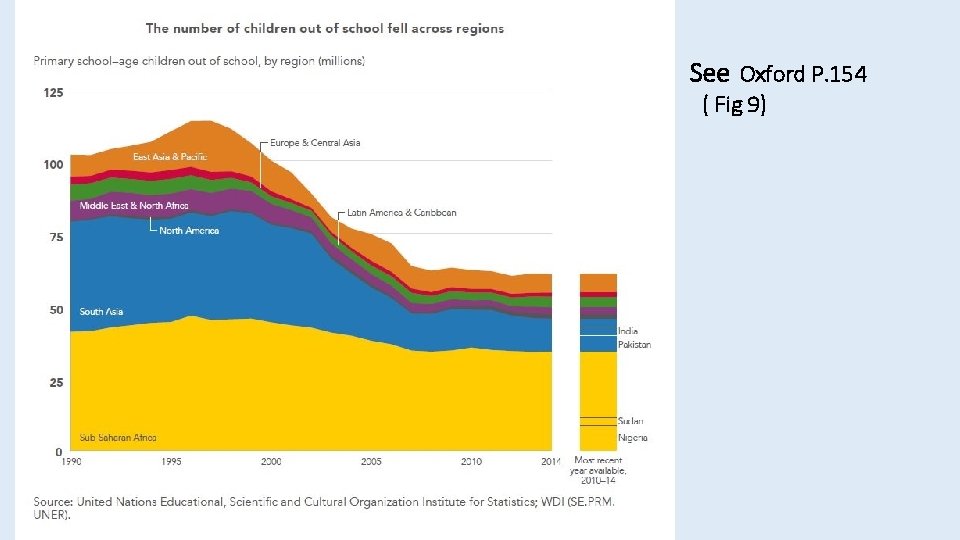
See Oxford P. 154 ( Fig 9)
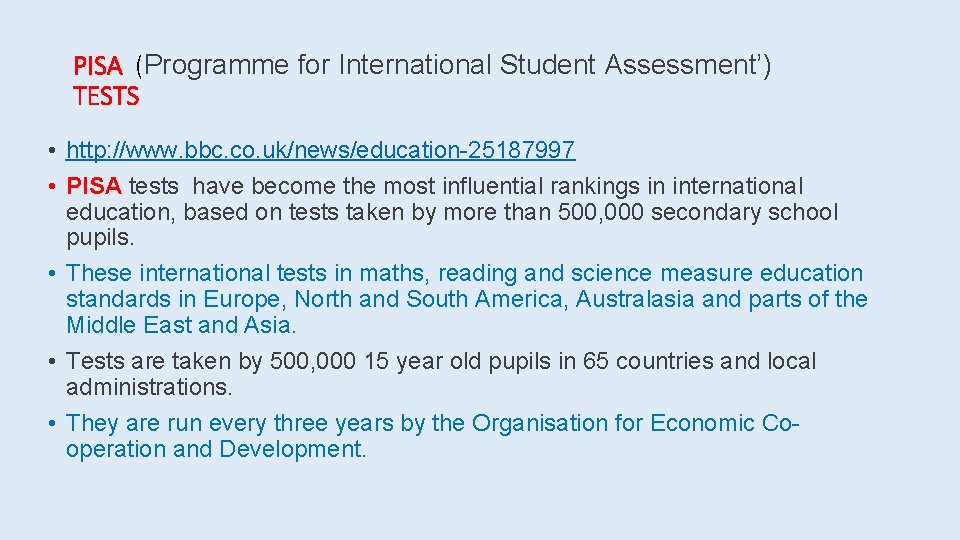
PISA (Programme for International Student Assessment’) TESTS • http: //www. bbc. co. uk/news/education-25187997 • PISA tests have become the most influential rankings in international education, based on tests taken by more than 500, 000 secondary school pupils. • These international tests in maths, reading and science measure education standards in Europe, North and South America, Australasia and parts of the Middle East and Asia. • Tests are taken by 500, 000 15 year old pupils in 65 countries and local administrations. • They are run every three years by the Organisation for Economic Cooperation and Development.
TASKS • 1. Using the previous World Literacy Map describe the global distribution of adult literacy ( age 15 and above) • 2. Using the previous graph describe how the number of primary school- aged children fell in different regions across the world between 1990 – 2014. Which regions were the worst affected? • 3. Using the BBC news link on the previous slide compare the PISA test scores for the UK with those of Singapore. Why do you think they are so different ?
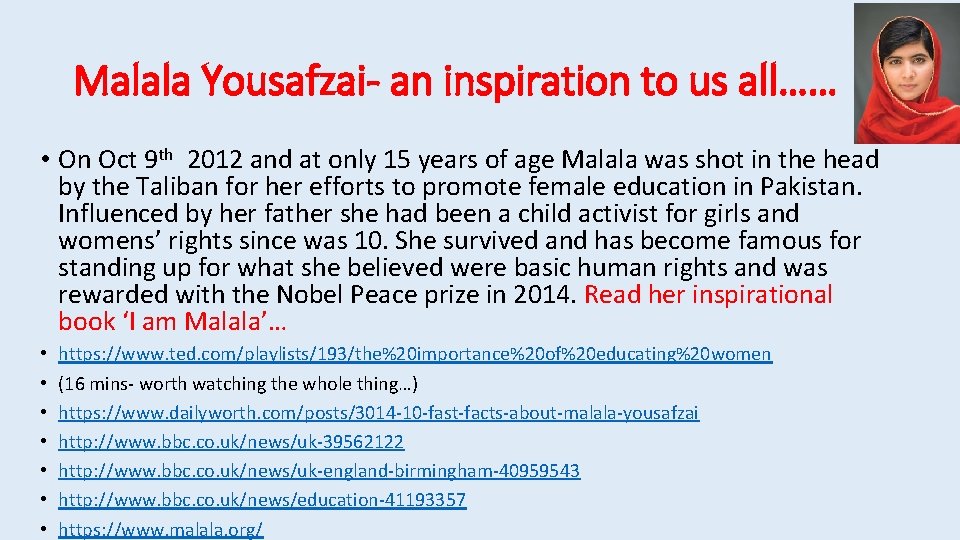
Malala Yousafzai- an inspiration to us all…… • On Oct 9 th 2012 and at only 15 years of age Malala was shot in the head by the Taliban for her efforts to promote female education in Pakistan. Influenced by her father she had been a child activist for girls and womens’ rights since was 10. She survived and has become famous for standing up for what she believed were basic human rights and was rewarded with the Nobel Peace prize in 2014. Read her inspirational book ‘I am Malala’… • • https: //www. ted. com/playlists/193/the%20 importance%20 of%20 educating%20 women (16 mins- worth watching the whole thing…) https: //www. dailyworth. com/posts/3014 -10 -fast-facts-about-malala-yousafzai http: //www. bbc. co. uk/news/uk-39562122 http: //www. bbc. co. uk/news/uk-england-birmingham-40959543 http: //www. bbc. co. uk/news/education-41193357 https: //www. malala. org/
Plenary: Whiteboards out! • Which 10 countries are said to have the best education systems in the world? • https: //www. youtube. com/watch? v=n. Vx. WRp. Ubvt. A • DID YOU GET ANY RIGHT? !
TASKS • 4. Watch the previous TED talks clip on Malala Yousafzai and use it to explain the importance of educating women in the world. • 5. Explain why many view education as central to enabling the economic development of countries ( this could be an 8 marker…) • Possible exam question for future reference: • Explain why economic growth is thought to be the power that drives human development.
EXTENSION A* TASK! : *Edexcel Recommended Resource* European Environment Agency Health Report 2010 • https: //www. eea. europa. eu/soer/synthesis/chapter 5. xhtml • 1) Read document , explore the health map (fig 5. 1) highlight and make summary notes on changes that have occurred within the following areas: • Natural environment , built environment , activities, local economy, community and lifestyle • 2) Identify the different developments that have improved health in the past 100 years, for example, early health improvements were in reducing child mortality whereas more recent developments have focused on improving life expectancy for the over 65 s. • THIS IS A LONG DOCUMENT- THE SKILL IS PICKING OUT THE MAIN POINTS TO MAKE A PAGE LONG (MAX)SUMMARY!!