Topic 3 Lesson 3 Taking Up Arms Guiding


- Slides: 19
Topic 3 Lesson 3: Taking Up Arms
Guiding Questions 1. What was the Boston Tea Party, and how did later British actions heighten tensions among the colonists? 2. What actions were taken at the Frist and Second Continental Congress? 3. What advantages and disadvantages did each side have as the Revolutionary War began?
I. The Boston Tea Party A. Parliament gave the British East India Company exclusive rights to sell tea to the American colonies. B. Mercantilist system met resistance due to taxation of tea in the American colonies. C. As a result, many colonists refused to buy British tea and directly purchased less expensive tea from the Dutch and French smugglers. D. British East India Company found itself in deep financial troubles. 1. 15 million lbs of tea sat unsold in warehouses.
E. Parliament tries to help the company by passing the Tea Act of 1773. 1. Allowed company to bypass the merchants and sell directly to colonists. 2. Gave company a rebate on tea taxes. (Colonists still pay taxes on tea, just not as much as before. ) 3. Colonists protest the Tea Act- are against anything that taxes colonists for the benefit of England. 4. Tea merchants angry because they were cut of the trade. F. Colonists boycotted the new law. 1. Daughters of Liberty made “liberty tea” out of raspberry leaves. 2. Sons of Liberty kept BEI Company ships from unloading.
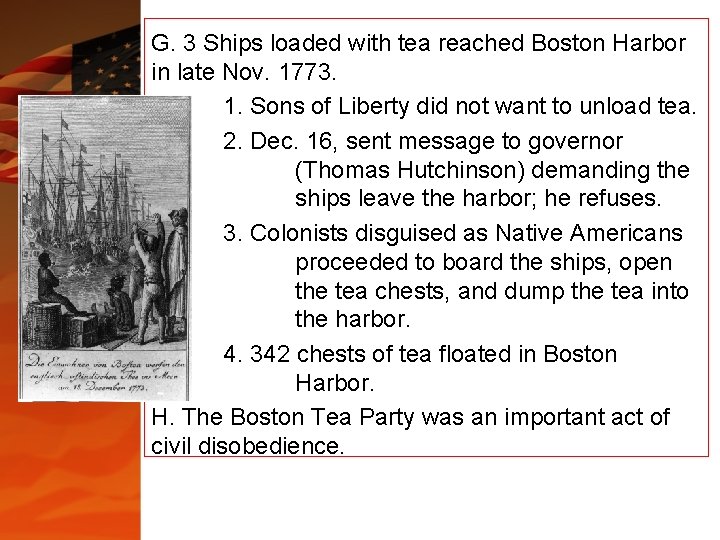
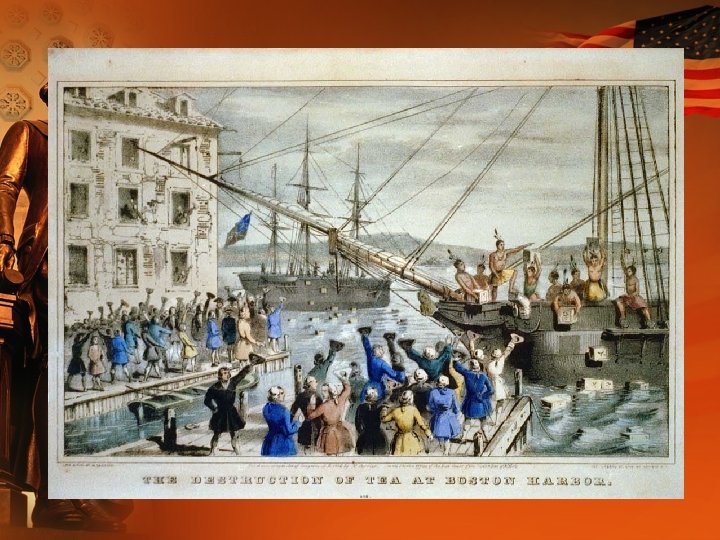
G. 3 Ships loaded with tea reached Boston Harbor in late Nov. 1773. 1. Sons of Liberty did not want to unload tea. 2. Dec. 16, sent message to governor (Thomas Hutchinson) demanding the ships leave the harbor; he refuses. 3. Colonists disguised as Native Americans proceeded to board the ships, open the tea chests, and dump the tea into the harbor. 4. 342 chests of tea floated in Boston Harbor. H. The Boston Tea Party was an important act of civil disobedience.
Primary Source “ This destruction of tea is so bold, so daring, so firm…it must have such important and lasting results that I can’t help considering it a turning point in history. ” - Diary of John Adams Dec. 17, 1773
II. British Strike Back at Boston A. British were outraged Boston’s lawless behavior. B. Parliament passes the “Intolerable Acts, ” a series of 4 laws meant to punish the colonists. 1. Shut down Boston Harbor. (Would remain closed until colonists paid for the tea they destroyed & damage to personal property. ) 2. Forbade MA colonists to hold town meetings more than once a year without governor’s permission. Public officials no longer elected but chosen by king.
3. Allowed customs officers & other officials to be tried in Canada or Britain. (Meant to prevent officials from breaking laws because they thought they would get a sympathetic colonial jury. ) 4. Quartering Act made the colonists house British troops when no other housing was available.
C. Parliament also passes the Quebec Act. 1. Set-up gov’t in Canada & gave complete religious freedom to French Catholics. 2. Also extended the boarders of Quebec, angering some colonies who claimed these lands. D. Committees of correspondence spread news of the Intolerable Acts to other colonies. 1. People responded by sending rice, corn and flour to help the starving of Boston.
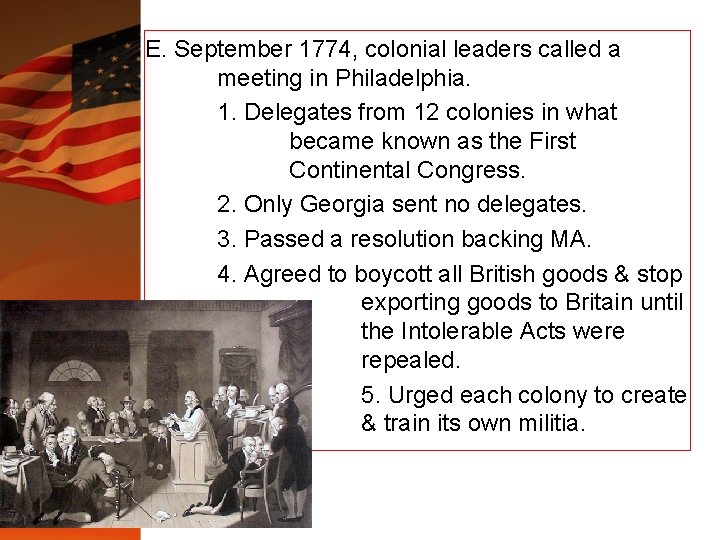
E. September 1774, colonial leaders called a meeting in Philadelphia. 1. Delegates from 12 colonies in what became known as the First Continental Congress. 2. Only Georgia sent no delegates. 3. Passed a resolution backing MA. 4. Agreed to boycott all British goods & stop exporting goods to Britain until the Intolerable Acts were repealed. 5. Urged each colony to create & train its own militia.
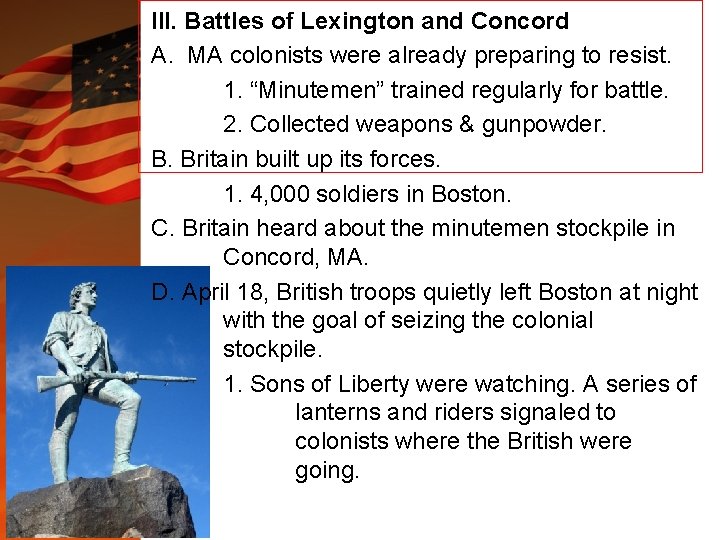
III. Battles of Lexington and Concord A. MA colonists were already preparing to resist. 1. “Minutemen” trained regularly for battle. 2. Collected weapons & gunpowder. B. Britain built up its forces. 1. 4, 000 soldiers in Boston. C. Britain heard about the minutemen stockpile in Concord, MA. D. April 18, British troops quietly left Boston at night with the goal of seizing the colonial stockpile. 1. Sons of Liberty were watching. A series of lanterns and riders signaled to colonists where the British were going.
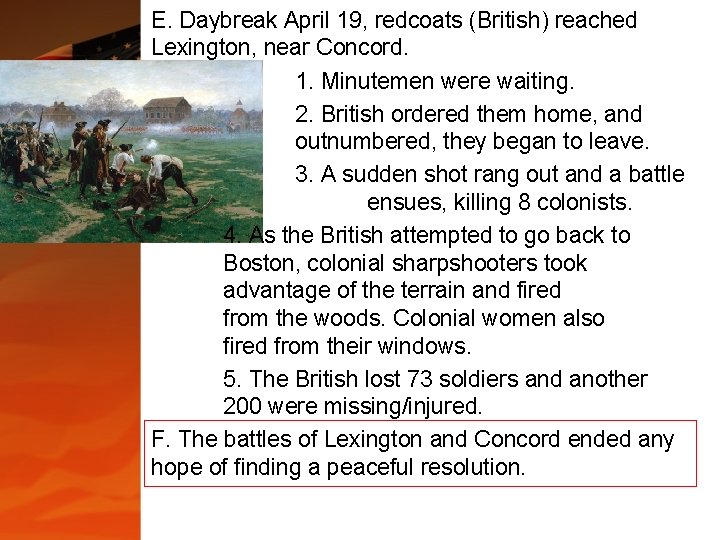
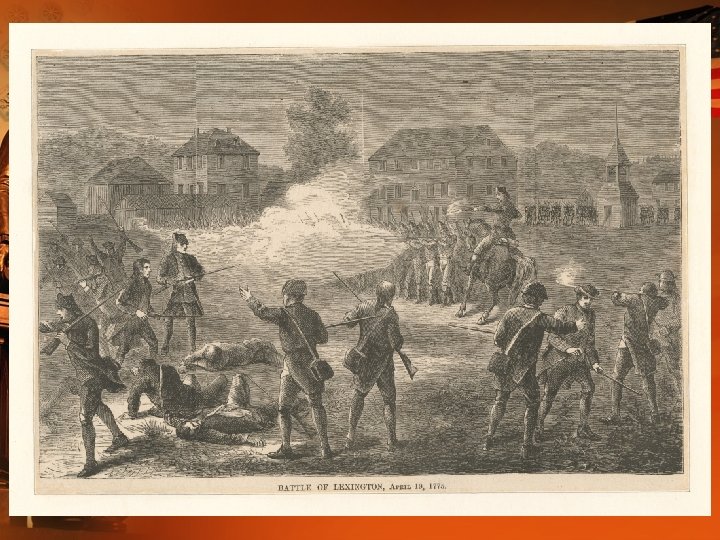
E. Daybreak April 19, redcoats (British) reached Lexington, near Concord. 1. Minutemen were waiting. 2. British ordered them home, and outnumbered, they began to leave. 3. A sudden shot rang out and a battle ensues, killing 8 colonists. 4. As the British attempted to go back to Boston, colonial sharpshooters took advantage of the terrain and fired from the woods. Colonial women also fired from their windows. 5. The British lost 73 soldiers and another 200 were missing/injured. F. The battles of Lexington and Concord ended any hope of finding a peaceful resolution.
IV. The Revolutionary War Begins A. May 10, 1775, Second Continental Congress met in Philadelphia. 1. All 13 colonies represented. Most still hoped to avoid a break with Britain. 2. Sent the Olive Branch Petition to King George, declaring their loyalty and asking for a repeal of the Intolerable Acts. 3. Some colonial leaders did not believe war could be avoided. 4. King reacted harshly and sent another 20, 000 soldiers to the colonies.
B. Ethan Allen did not wait for war to begin. 1. Led Green Mountain Boys of Vermont in a surprise attack on British Fort Ticonderoga. 2. Knew the fort held cannons the colonists could use, and location was strategic. 3. Quickly overpowered the guards and entered the fort. 4. British commander forced to surrender the fort and the colonists won a valuable supply of cannons & gunpowder.
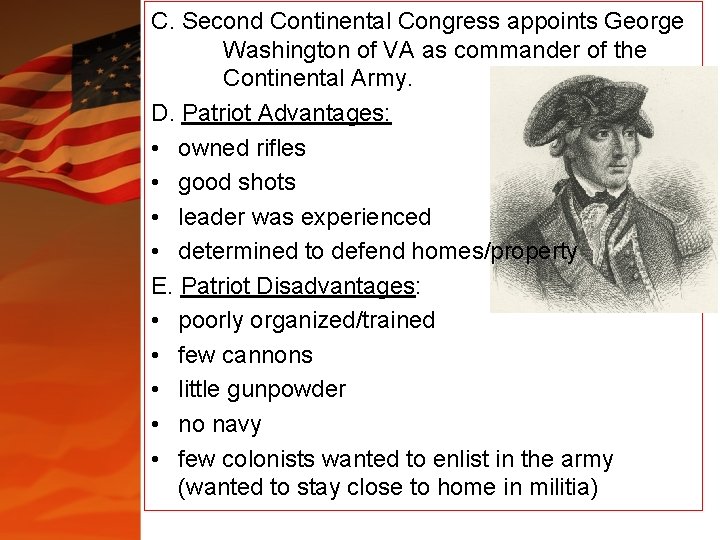
C. Second Continental Congress appoints George Washington of VA as commander of the Continental Army. D. Patriot Advantages: • owned rifles • good shots • leader was experienced • determined to defend homes/property E. Patriot Disadvantages: • poorly organized/trained • few cannons • little gunpowder • no navy • few colonists wanted to enlist in the army (wanted to stay close to home in militia)
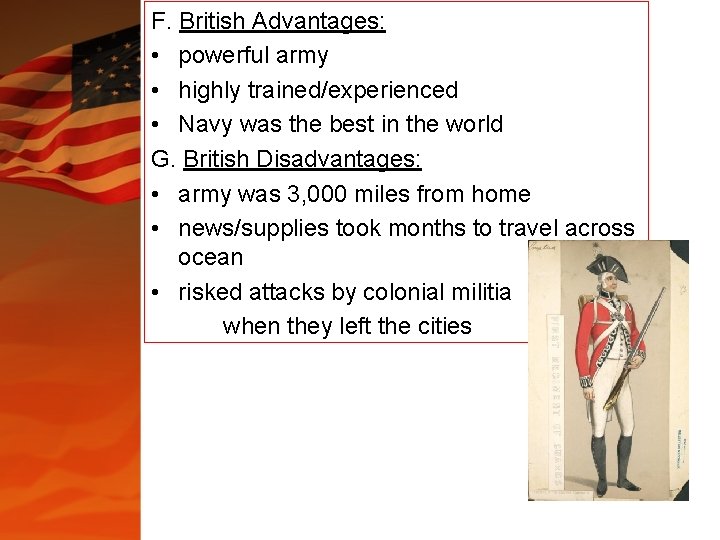
F. British Advantages: • powerful army • highly trained/experienced • Navy was the best in the world G. British Disadvantages: • army was 3, 000 miles from home • news/supplies took months to travel across ocean • risked attacks by colonial militia when they left the cities
H. Colonists who remained loyal to Britain were called Loyalists. 1. Included wealthy merchants and former royal gov’t officials. 2. Some farmers/crafts workers included as well. 3. More Loyalists from Middle and Southern Colonies than New England. 4. Faced hard times during the war. (Patriots tarred and feathered people known to favor the British) 5. Many fled to England/Canada or found shelter in British-controlled cities, but lost everything they left behind.