Tolerating Hardware Device Failures in Software Asim Kadav

- Slides: 1
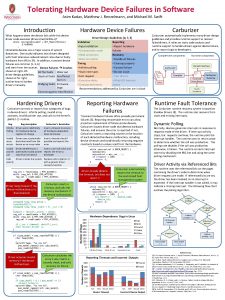
Tolerating Hardware Device Failures in Software Asim Kadav, Matthew J. Renzelmann, and Michael M. Swift Introduction What happens when the device fails while this device driver code executes (drivers/net/3 c 59 x. c)? while (ioread 16(ioaddr + Wn 7_Master. Status) & 0 x 8000) ; Unreliable devices are a major source of system downtime. One study indicates that drivers designed with fault tolerance reduced reboot rates due to faulty hardware from 8% to 3%. In addition, transient device failures are common [1, 3, 6] and stem from the sources Device Failures Crashes shown at right. OS Bit flip faults Wear out driver design guidelines, Stuck-at faults Insufficient shown at far right, burn in outline how to harden Bridging faults Firmware drivers manually. bugs Electromagnetic Interference Hardware Device Failures Driver Design Guidelines [4, 7, 5] Validation Reporting • Input validation • Report hardware • Unrepeatable reads failures • DMA protection Recovery • Data corruption • Handle all failures Timing • Cleanup properly • Infinite polling • Conceal failure • Stuck interrupts • Do not crash • Lost request • Test drivers • Excessive delay • Wrap I/O memory • Unexpected events access Recommendations addressed by Carburizer are in black Hardening Drivers Carburizer corrects or reports four categories of bugs in device drivers: infinite polling, invalid array accesses, invalid pointer use, and calls to the kernel’s panic() routine. Bug description Infinite Driver waits indefinitely Polling for hardware device register to change Carburizer’s Resolution Insert a timeout to ensure all hardware-dependent loops terminate Invalid array access Insert a bounds check if possible and reports the error Driver uses a potentiallybad value read from the device as an array index Reporting Hardware Failures while (miicontrol & BMCR_RESET) { msleep(10); miicontrol = mii_rw(. . . ); if (tries++ > 100) return -1; } Calls Driver crashes the system Replace calls to panic() with a generic driver recovery function reg_val = readl(mmio + PHY_ACCESS); while (reg_val & PHY_CMD_ACTIVE) reg_val = readl(mmio + PHY_ACCESS); Driver loops forever if the device malfunctions or is disconnected Driver already detects the timeout, but does not report it Carburizer inserts a timeout, and calls the recovery mechanism if the device malfunctions if ((pas_model = pas_read(0 x. FF 88))) { char temp[100]; … sprintf(temp, "%s rev %d", pas_model_names[(int) pas_model], pas_read(0 x 2789)); … Driver accesses invalid memory if the device malfunctions Carburizer calculates the array’s size, inserts a bounds check, and calls recovery on failure if ((pas_model = pas_read(0 x. FF 88))) { char temp[100]; … if (pas_model < 0 || pas_model >= 5) recover_driver(); sprintf(temp, "%s rev %d", pas_model_names[(int) pas_model], pas_read(0 x 2789)); … Number of Bugs } 450 400 350 300 250 200 150 100 50 0 Carburizer automatically reports the timeout to the centralized fault management system Dynamic Array Driver Faulty Hardware The Carburizer runtime recovery system is based on Shadow Drivers [8]. The runtime also recovers from stuck and missing interrupts. Dynamic Polling Normally, devices generate interrupts in response to requests made of the driver. If interrupt activity stops, but requests continue, the runtime polls the interrupt handler. The runtime uses its return value to determine whether the call was productive. The polling rate doubles if the call was productive; otherwise, it halves. The runtime corrects interrupt storms by disabling the IRQ line and using the same polling mechanism. The runtime uses the referenced bits on the pages containing the driver’s code to determine when driver requests are made. If referenced bits are set, the driver has been invoked, so an interrupt is expected. If the interrupt handler is not called, it may indicate a missing interrupt. The following flow chart outlines the polling algorithm. Panic Found 500 Fixed 400 300 200 100 SCSI Sound Other Device Timeout Net Problem pending? Yes No 600 Net Carburizer Runtime Hardened Driver Binary IRQ handler called? Reporting Timeouts and Incorrect Outputs 0 If (c==0) {. print (“Driver init”); }. . Compiler If (c==0) {. print (“Driver init”); }. . SCSI Sound Other Incorrect Device Output No Yes IRQ handler called? No Problem pending = no Call Interrupt handler No Referenced bits set? Yes Productive? Timer length /= 2 Static Array Kernel Interface Yes Net SCSI Sound Video Other Infinite Polling Run-time components Carburizer Hardware-Dependence Bugs in Linux Number of Reports if (_cur < timeout) rdstcll(_cur); else recover_driver (); Compile-time components Driver Activity via Referenced Bits while (miicontrol & BMCR_RESET) { msleep(10); miicontrol = mii_rw(. . . ); if (tries++ > 100) { sys_report(". . . “, module_name, device_id); return -1; } } unsigned long delta = (cpu/khz/HZ)*2; unsigned long _start = 0, _cur = 0; … timeout = rdstcll(_start) + delta; reg_val = readl(mmio + PHY_ACCESS); while (reg_val & PHY_CMD_ACTIVE) { reg_val = readl(mmio + PHY_ACCESS); Carburizer automatically implements many driver design guidelines and provides runtime support to recover failed drivers. It relies on static code analysis and runtime support to harden drivers against device failure, and to report bugs to developers. Runtime Fault Tolerance Transient hardware failures often precede permanent failures [6]. Reporting recoverable errors can allow proactive replacement of failure-prone devices. Carburizer locates driver code that detects hardware failures, and ensures the error is reported. If not, Carburizer inserts a reporting routine at the location of each detected hardware malfunction, including device timeouts and conditionally returning negative constants based on values read from the hardware. Invalid Driver dereferences a Insert a not-null check and pointer potentially-invalid pointer reports the error to use read from the device developer Carburizer No Problem pending = yes Timer length *= 2 References [1] R. H. Arpaci-Dusseau and A. C. Arpaci-Dusseau. Failstutter fault tolerance. In Proc. of the Eighth IEEE HOTOS, May 2001. [2] S. Arthur. Fault resilient drivers for Longhorn server, May 2004. Microsoft Corporation, Win. Hec 2004 Presentation DW 04012. [3] L. N. Bairavasundaram, G. R. Goodson, S. Pasupathy, and J. Schindler. An Analysis of Latent Sector Errors in Disk Drives. In Proc. of the 7 th SIGMETRICS, June 2007. [4] S. Graham. Writing drivers for reliability, robustness and fault tolerant systems. http: //www. microsoft. com/whdc/archive/FTdrv. mspx, Apr. 2004. [5] Intel Corporation and IBM Corporation. Device driver hardening design specification draft release 0. 5 h. http: //hardeneddrivers. sourceforge. net/downloads/DDH-Spec 0. 5 h. pdf, Aug. 2002. [6] E. Pinheiro, W. -D. Weber, and L. A. Barroso. Failure trends in a large disk drive population. In Proc. of the 5 th FAST, 2007. [7] Sun Microsystems. Solaris Express Software Developer Collection: Writing Device Drivers, chapter 13: Hardening Solaris Drivers. Sun Microsystems, 2007. [8] M. Swift, M. Annamalau, B. N. Bershad, and H. M. Levy. Recovering device drivers. ACM Transactions on Computer Systems, 24(4), Nov. 2006.