To Snack or Not to Snack Childrens SelfRegulation


- Slides: 16
To Snack or Not to Snack? Children’s Self-Regulation in the Presence of a Peer Phoebe Caplin
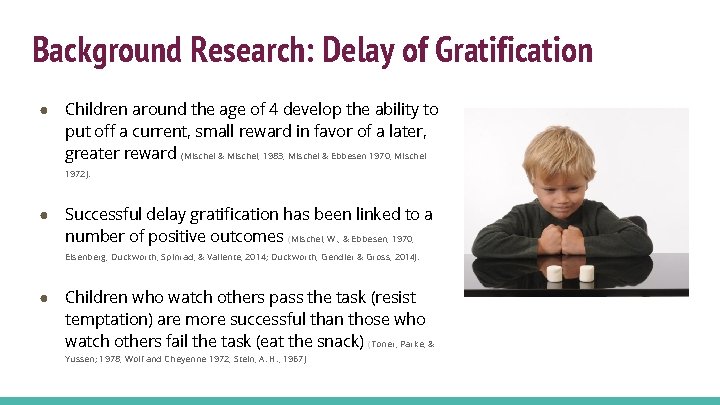
Background Research: Delay of Gratification ● Children around the age of 4 develop the ability to put off a current, small reward in favor of a later, greater reward (Mischel & Mischel, 1983, Mischel & Ebbesen 1970, Mischel 1972). ● Successful delay gratification has been linked to a number of positive outcomes (Mischel, W. , & Ebbesen, 1970, Eisenberg, Duckworth, Spinrad, & Valiente, 2014; Duckworth, Gendler & Gross, 2014). ● Children who watch others pass the task (resist temptation) are more successful than those who watch others fail the task (eat the snack) (Toner, Parke, & Yussen; 1978, Wolf and Cheyenne 1972, Stein, A. H. , 1967)
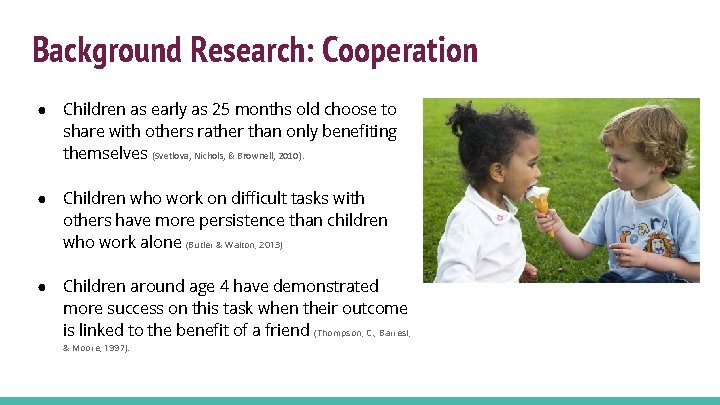
Background Research: Cooperation ● Children as early as 25 months old choose to share with others rather than only benefiting themselves (Svetlova, Nichols, & Brownell, 2010). ● Children who work on difficult tasks with others have more persistence than children who work alone (Butler & Walton, 2013) ● Children around age 4 have demonstrated more success on this task when their outcome is linked to the benefit of a friend (Thompson, C. , Barresi, & Moore, 1997).
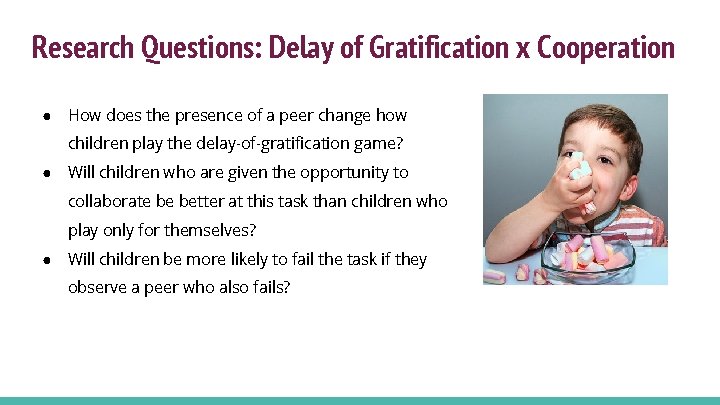
Research Questions: Delay of Gratification x Cooperation ● How does the presence of a peer change how children play the delay-of-gratification game? ● Will children who are given the opportunity to collaborate be better at this task than children who play only for themselves? ● Will children be more likely to fail the task if they observe a peer who also fails?
Sample ● 48 children total were recruited (27 female, 21 male, 12 children per condition) ● Children were an average of 3. 94 years old ● 75% of children were White, 18. 75 % of children were Biracial, 4% of children were Hispanic, and 2% were Asian Indian ● A majority of families made over $70, 000 annually (some participants did not report)
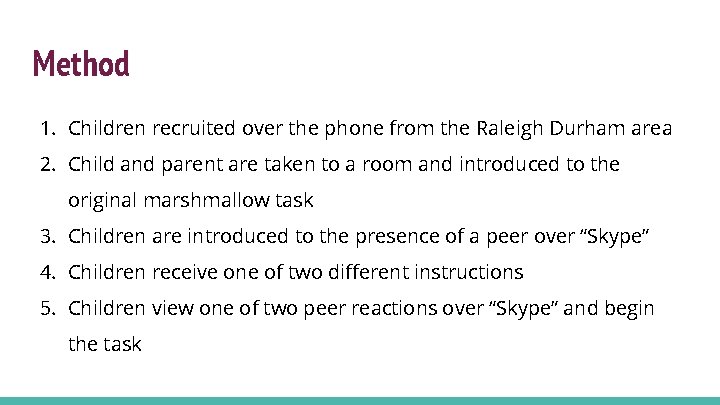
Method 1. Children recruited over the phone from the Raleigh Durham area 2. Child and parent are taken to a room and introduced to the original marshmallow task 3. Children are introduced to the presence of a peer over “Skype” 4. Children receive one of two different instructions 5. Children view one of two peer reactions over “Skype” and begin the task
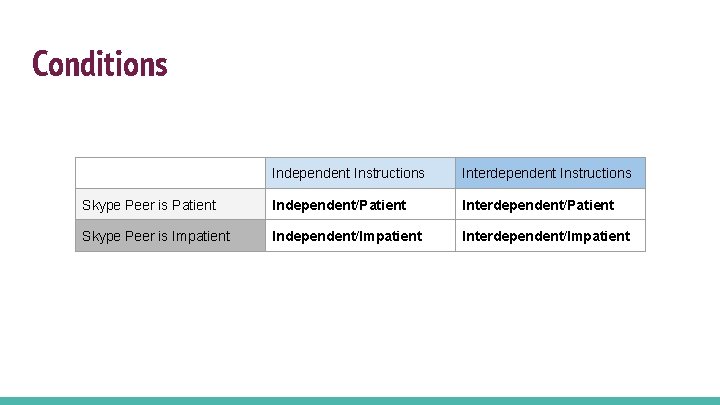
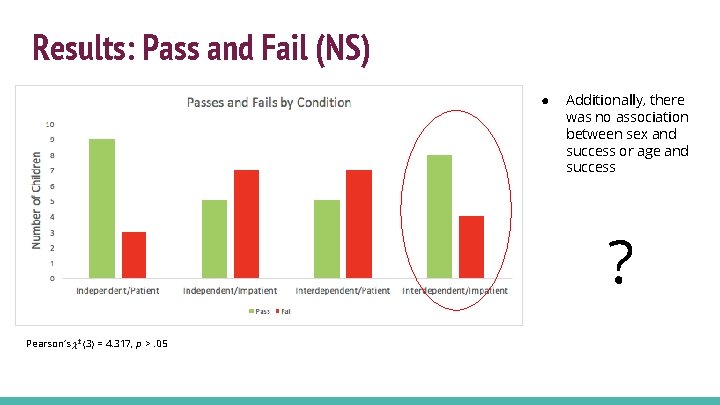
Conditions Independent Instructions Interdependent Instructions Skype Peer is Patient Independent/Patient Interdependent/Patient Skype Peer is Impatient Independent/Impatient Interdependent/Impatient
Instruction Delivery Example
Video Stimuli
Reactions
Results: Pass and Fail (NS) ● Additionally, there was no association between sex and success or age and success ? Pearson’s χ2 (3) = 4. 317, p >. 05
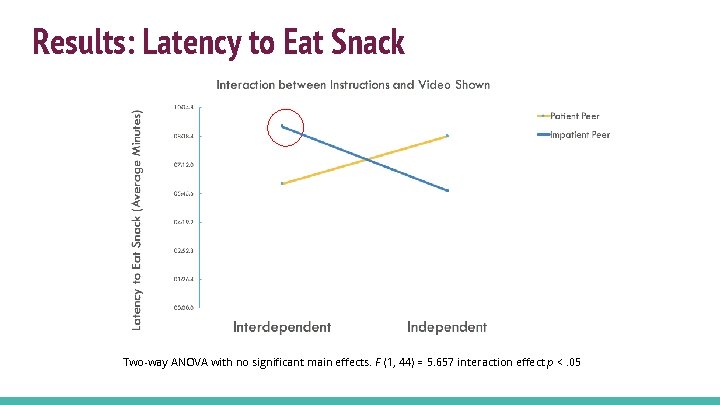
Results: Latency to Eat Snack Two-way ANOVA with no significant main effects. F (1, 44) = 5. 657 interaction effect p <. 05
Interaction Effect: one explanation ● By averaging latency to eating the snack, important features of data are lost ○ Children who failed tended to fail right away ○ Children who failed tended to fail before the “impatient” video showed the peer eating her snack ○ Session lengths were all slightly different in the case of a pass
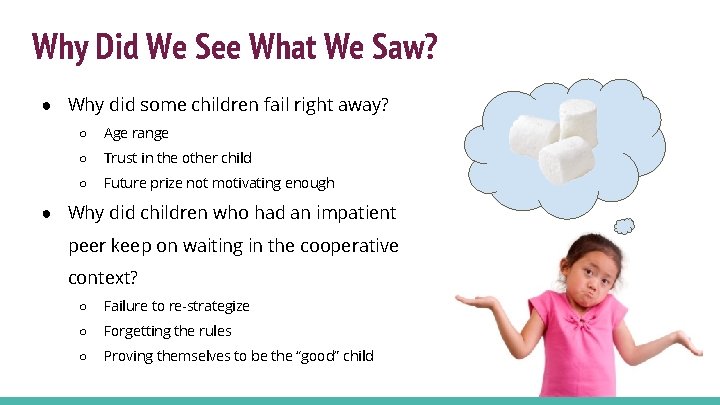
Why Did We See What We Saw? ● Why did some children fail right away? ○ Age range ○ Trust in the other child ○ Future prize not motivating enough ● Why did children who had an impatient peer keep on waiting in the cooperative context? ○ Failure to re-strategize ○ Forgetting the rules ○ Proving themselves to be the “good” child
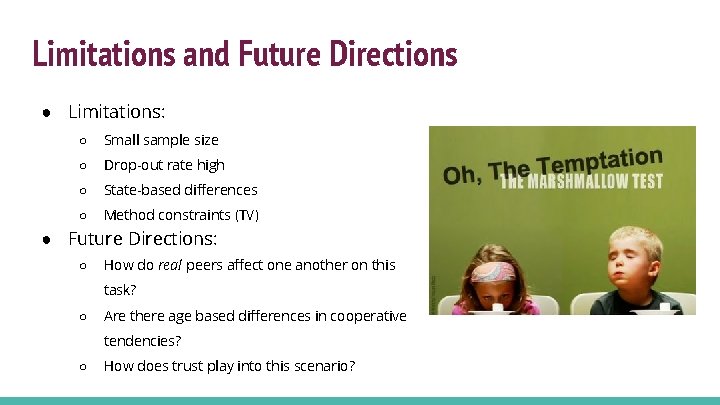
Limitations and Future Directions ● Limitations: ○ Small sample size ○ Drop-out rate high ○ State-based differences ○ Method constraints (TV) ● Future Directions: ○ How do real peers affect one another on this task? ○ Are there age based differences in cooperative tendencies? ○ How does trust play into this scenario?
Acknowledgements Special thanks to: ● Rita Svetlova (P. I. ) ● Michael Tomasello & Makeba Wilbourn (Panelists) ● Paula Yust (Graduate Student) ● Celia Kholer & Tia Kelley (Experimenters) ● Andre Mego (Recruitment and Coding)