Timing MPI Programs l l l The elapsed
- Slides: 8
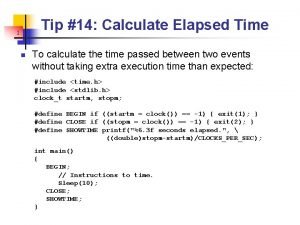
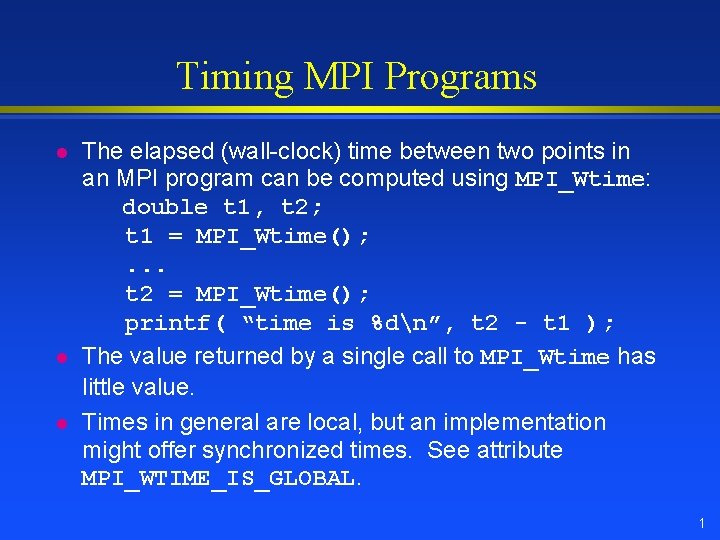
Timing MPI Programs l l l The elapsed (wall-clock) time between two points in an MPI program can be computed using MPI_Wtime: double t 1, t 2; t 1 = MPI_Wtime(); . . . t 2 = MPI_Wtime(); printf( “time is %dn”, t 2 - t 1 ); The value returned by a single call to MPI_Wtime has little value. Times in general are local, but an implementation might offer synchronized times. See attribute MPI_WTIME_IS_GLOBAL. 1
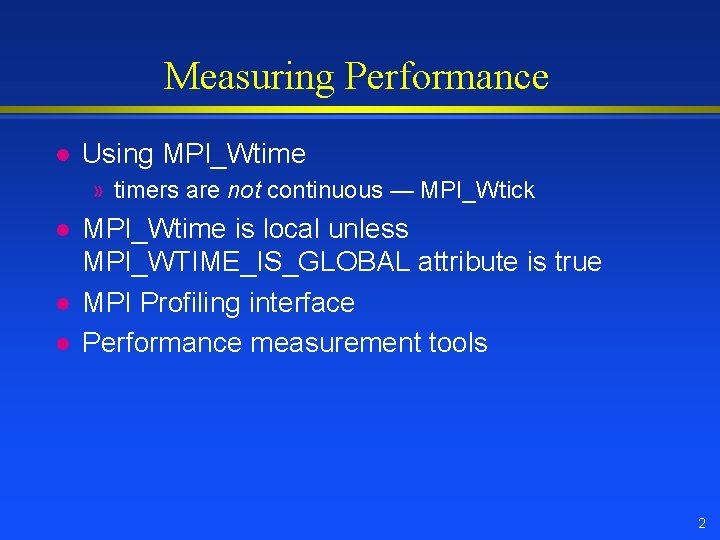
Measuring Performance l Using MPI_Wtime » timers are not continuous — MPI_Wtick l l l MPI_Wtime is local unless MPI_WTIME_IS_GLOBAL attribute is true MPI Profiling interface Performance measurement tools 2
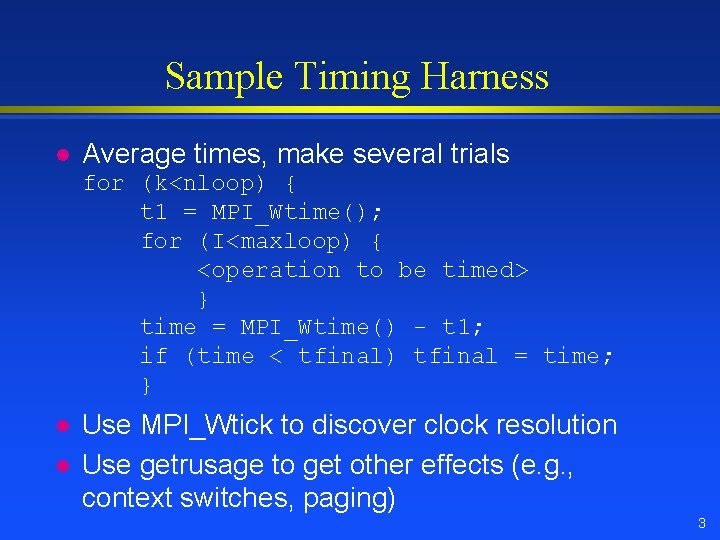
Sample Timing Harness l Average times, make several trials for (k<nloop) { t 1 = MPI_Wtime(); for (I<maxloop) { <operation to be timed> } time = MPI_Wtime() - t 1; if (time < tfinal) tfinal = time; } l l Use MPI_Wtick to discover clock resolution Use getrusage to get other effects (e. g. , context switches, paging) 3
Pitfalls in timing l Time too short: t = MPI_Wtime(); MPI_Send(…); time = MPI_Wtime() - t; l l l Underestimates by MPI_Wtick, over by cost of calling MPI_Wtime “Correcting” MPI_Wtime by subtracting average of MPI_Wtime calls overestimates MPI_Wtime Code not paged in (always run at least twice) Minimums not what users see Tests with 2 processors may not be representative » T 3 D has processors in pairs, pingpong give 130 MB/sec for 2 but 75 MB/sec for 4 (for MPI_Ssend) 4
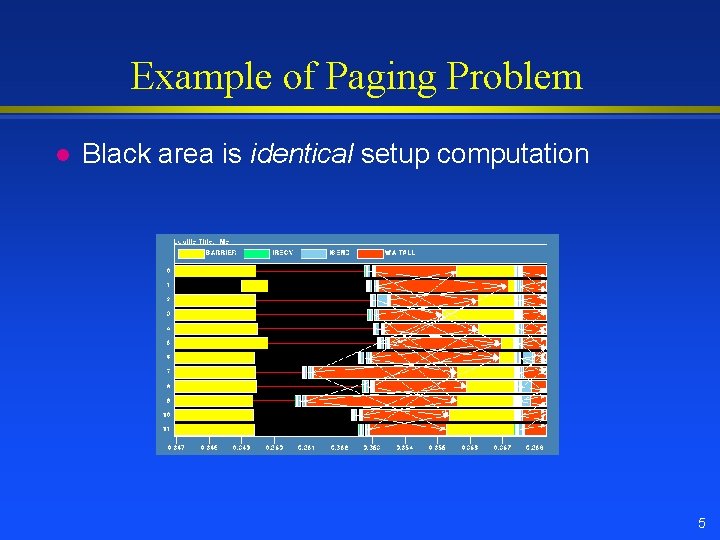
Example of Paging Problem l Black area is identical setup computation 5
Latency and Bandwidth l l Simplest model s + r n s includes both hardware (gate delays) and software (context switch, setup) r includes both hardware (raw bandwidth of interconnection and memory system) and software (packetization, copies between user and system) Head-to-head and pingpong values may differ 6
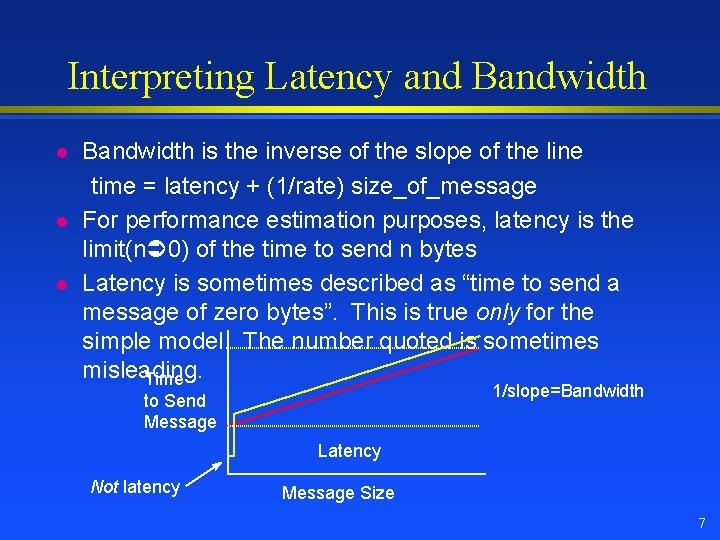
Interpreting Latency and Bandwidth l l l Bandwidth is the inverse of the slope of the line time = latency + (1/rate) size_of_message For performance estimation purposes, latency is the limit(n 0) of the time to send n bytes Latency is sometimes described as “time to send a message of zero bytes”. This is true only for the simple model. The number quoted is sometimes misleading. Time 1/slope=Bandwidth to Send Message Latency Not latency Message Size 7
Exercise: Timing MPI Operations l Estimate the latency and bandwidth for some MPI operation (e. g. , Send/Recv, Bcast, Ssend/Irecv-Wait) » Make sure all processes are ready before starting the test » How repeatable are your measurements? » How does the performance compare to the performance of other operations (e. g. , memcpy, floating multiply)? 8