Tillys Old and New Repertoires of Contention Patronized
- Slides: 11
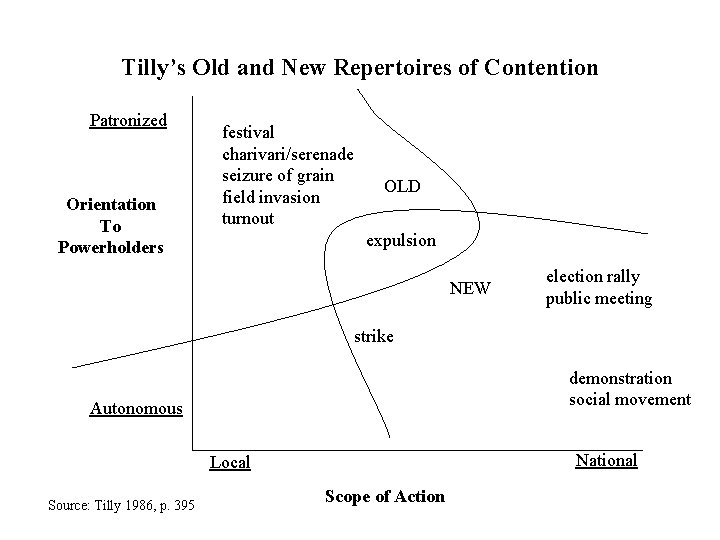
Tilly’s Old and New Repertoires of Contention Patronized Orientation To Powerholders festival charivari/serenade seizure of grain field invasion turnout OLD expulsion NEW election rally public meeting strike demonstration social movement Autonomous National Local Source: Tilly 1986, p. 395 Scope of Action
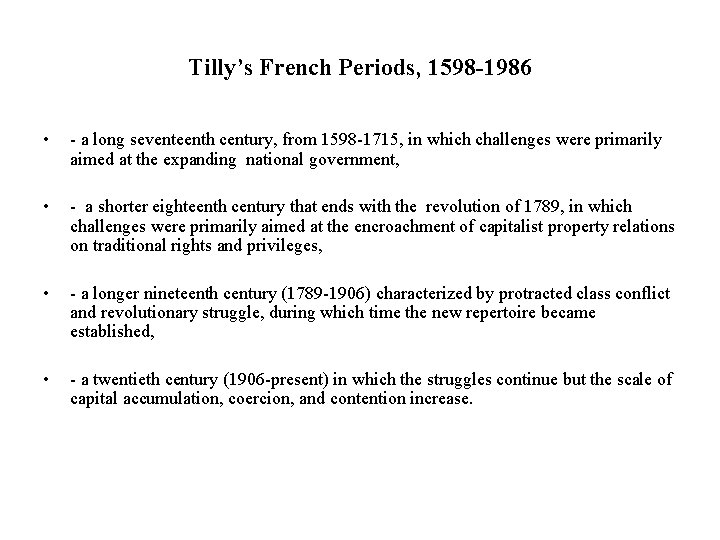
Tilly’s French Periods, 1598 -1986 • - a long seventeenth century, from 1598 -1715, in which challenges were primarily aimed at the expanding national government, • - a shorter eighteenth century that ends with the revolution of 1789, in which challenges were primarily aimed at the encroachment of capitalist property relations on traditional rights and privileges, • - a longer nineteenth century (1789 -1906) characterized by protracted class conflict and revolutionary struggle, during which time the new repertoire became established, • - a twentieth century (1906 -present) in which the struggles continue but the scale of capital accumulation, coercion, and contention increase.
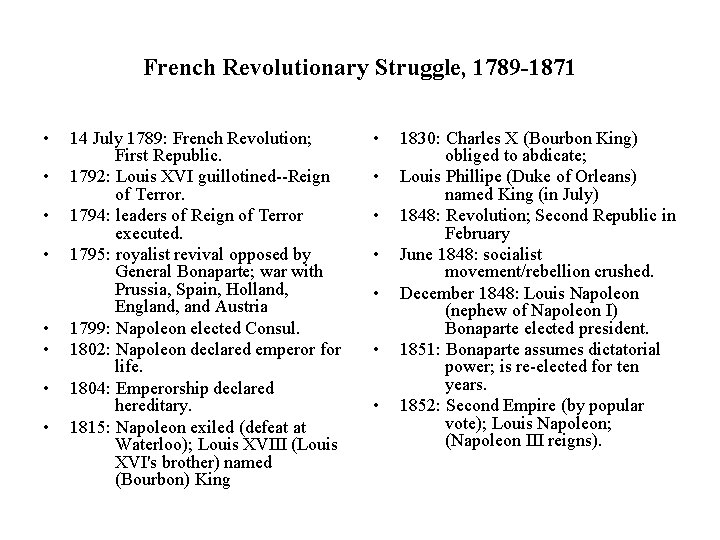
French Revolutionary Struggle, 1789 -1871 • • 14 July 1789: French Revolution; First Republic. 1792: Louis XVI guillotined--Reign of Terror. 1794: leaders of Reign of Terror executed. 1795: royalist revival opposed by General Bonaparte; war with Prussia, Spain, Holland, England, and Austria 1799: Napoleon elected Consul. 1802: Napoleon declared emperor for life. 1804: Emperorship declared hereditary. 1815: Napoleon exiled (defeat at Waterloo); Louis XVIII (Louis XVI's brother) named (Bourbon) King • • 1830: Charles X (Bourbon King) obliged to abdicate; Louis Phillipe (Duke of Orleans) named King (in July) 1848: Revolution; Second Republic in February June 1848: socialist movement/rebellion crushed. December 1848: Louis Napoleon (nephew of Napoleon I) Bonaparte elected president. 1851: Bonaparte assumes dictatorial power; is re-elected for ten years. 1852: Second Empire (by popular vote); Louis Napoleon; (Napoleon III reigns).
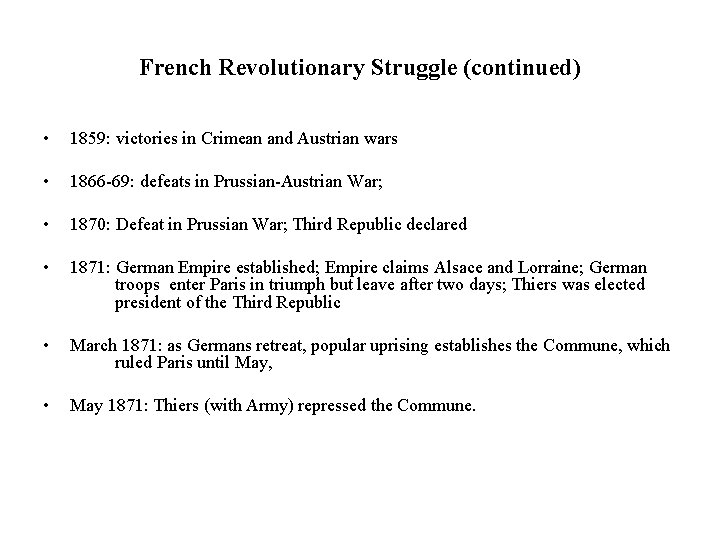
French Revolutionary Struggle (continued) • 1859: victories in Crimean and Austrian wars • 1866 -69: defeats in Prussian-Austrian War; • 1870: Defeat in Prussian War; Third Republic declared • 1871: German Empire established; Empire claims Alsace and Lorraine; German troops enter Paris in triumph but leave after two days; Thiers was elected president of the Third Republic • March 1871: as Germans retreat, popular uprising establishes the Commune, which ruled Paris until May, • May 1871: Thiers (with Army) repressed the Commune.
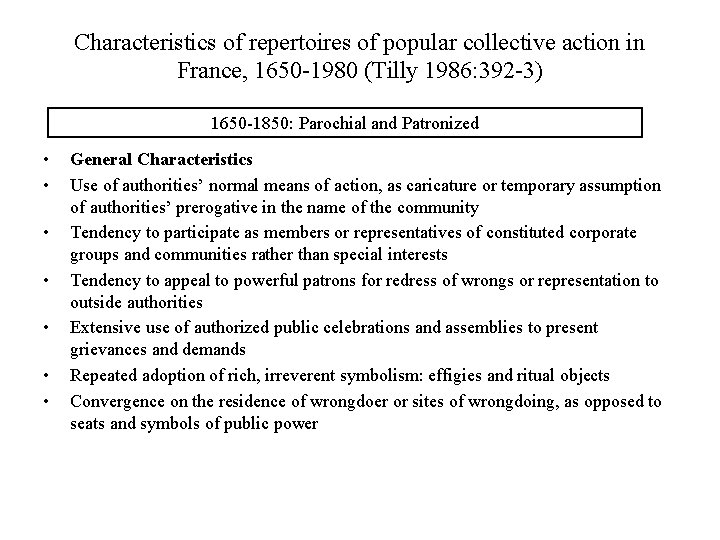
Characteristics of repertoires of popular collective action in France, 1650 -1980 (Tilly 1986: 392 -3) 1650 -1850: Parochial and Patronized • • General Characteristics Use of authorities’ normal means of action, as caricature or temporary assumption of authorities’ prerogative in the name of the community Tendency to participate as members or representatives of constituted corporate groups and communities rather than special interests Tendency to appeal to powerful patrons for redress of wrongs or representation to outside authorities Extensive use of authorized public celebrations and assemblies to present grievances and demands Repeated adoption of rich, irreverent symbolism: effigies and ritual objects Convergence on the residence of wrongdoer or sites of wrongdoing, as opposed to seats and symbols of public power
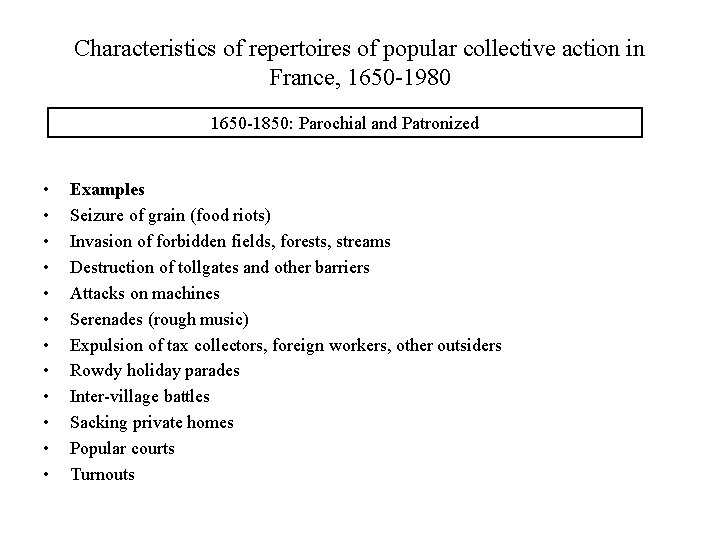
Characteristics of repertoires of popular collective action in France, 1650 -1980 1650 -1850: Parochial and Patronized • • • Examples Seizure of grain (food riots) Invasion of forbidden fields, forests, streams Destruction of tollgates and other barriers Attacks on machines Serenades (rough music) Expulsion of tax collectors, foreign workers, other outsiders Rowdy holiday parades Inter-village battles Sacking private homes Popular courts Turnouts
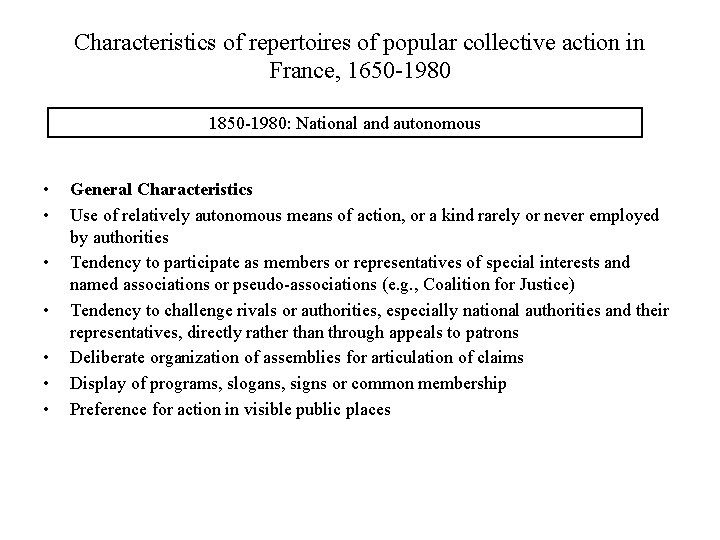
Characteristics of repertoires of popular collective action in France, 1650 -1980 1850 -1980: National and autonomous • • General Characteristics Use of relatively autonomous means of action, or a kind rarely or never employed by authorities Tendency to participate as members or representatives of special interests and named associations or pseudo-associations (e. g. , Coalition for Justice) Tendency to challenge rivals or authorities, especially national authorities and their representatives, directly rather than through appeals to patrons Deliberate organization of assemblies for articulation of claims Display of programs, slogans, signs or common membership Preference for action in visible public places
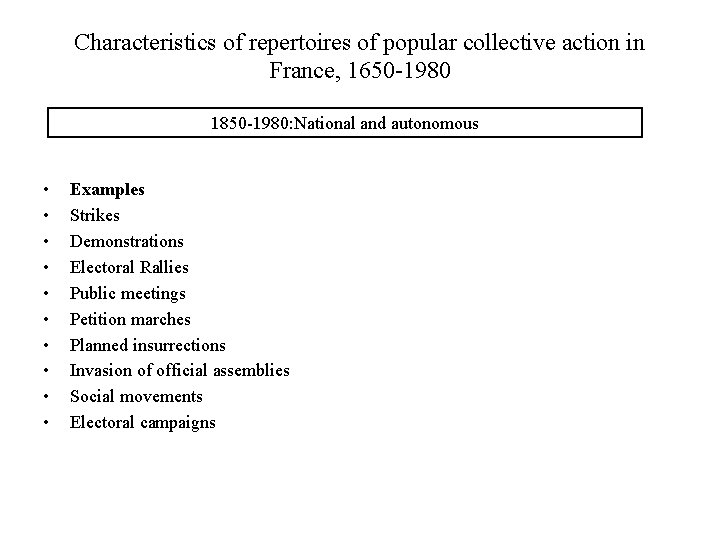
Characteristics of repertoires of popular collective action in France, 1650 -1980 1850 -1980: National and autonomous • • • Examples Strikes Demonstrations Electoral Rallies Public meetings Petition marches Planned insurrections Invasion of official assemblies Social movements Electoral campaigns
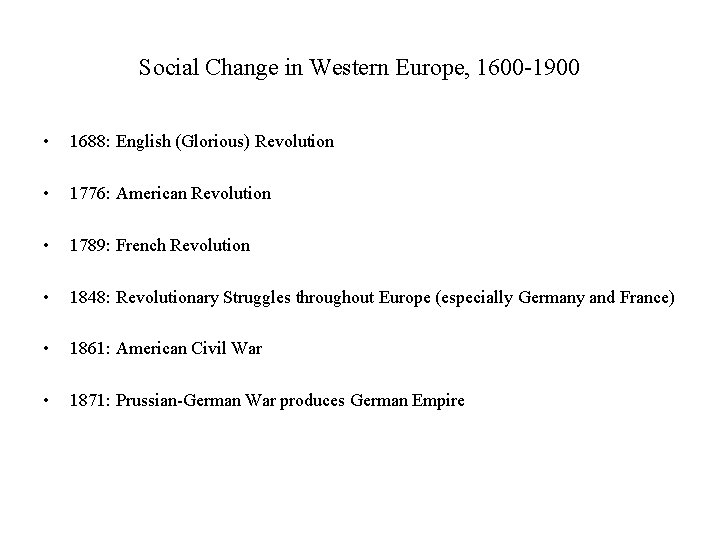
Social Change in Western Europe, 1600 -1900 • 1688: English (Glorious) Revolution • 1776: American Revolution • 1789: French Revolution • 1848: Revolutionary Struggles throughout Europe (especially Germany and France) • 1861: American Civil War • 1871: Prussian-German War produces German Empire
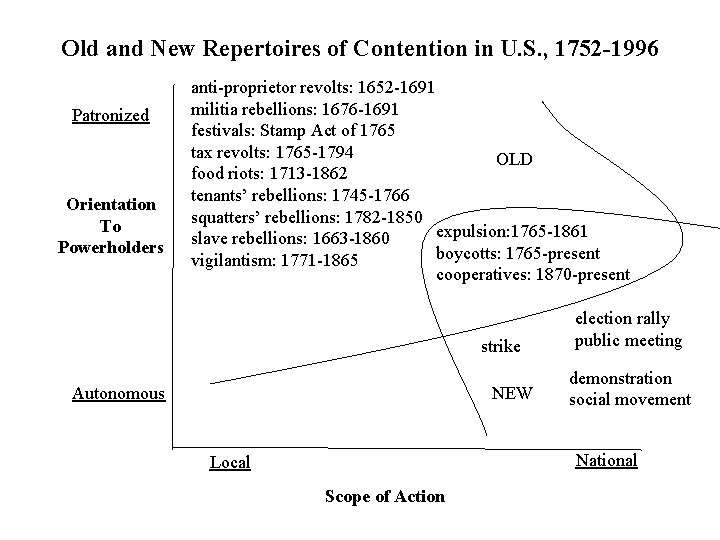
Old and New Repertoires of Contention in U. S. , 1752 -1996 Patronized Orientation To Powerholders anti-proprietor revolts: 1652 -1691 militia rebellions: 1676 -1691 festivals: Stamp Act of 1765 tax revolts: 1765 -1794 OLD food riots: 1713 -1862 tenants’ rebellions: 1745 -1766 squatters’ rebellions: 1782 -1850 expulsion: 1765 -1861 slave rebellions: 1663 -1860 boycotts: 1765 -present vigilantism: 1771 -1865 cooperatives: 1870 -present strike Autonomous NEW election rally public meeting demonstration social movement National Local Scope of Action
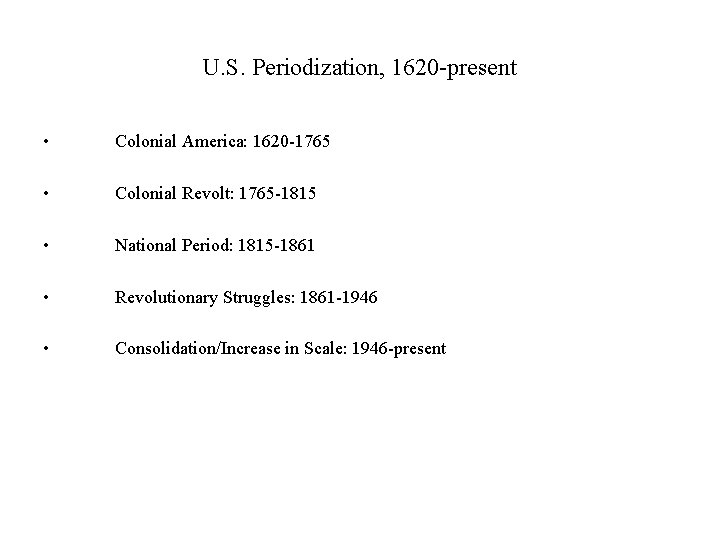
U. S. Periodization, 1620 -present • Colonial America: 1620 -1765 • Colonial Revolt: 1765 -1815 • National Period: 1815 -1861 • Revolutionary Struggles: 1861 -1946 • Consolidation/Increase in Scale: 1946 -present