Three Lessons from Nepal Steve Chisnell Royal Oak



- Slides: 24
Three Lessons from Nepal Steve Chisnell Royal Oak High School
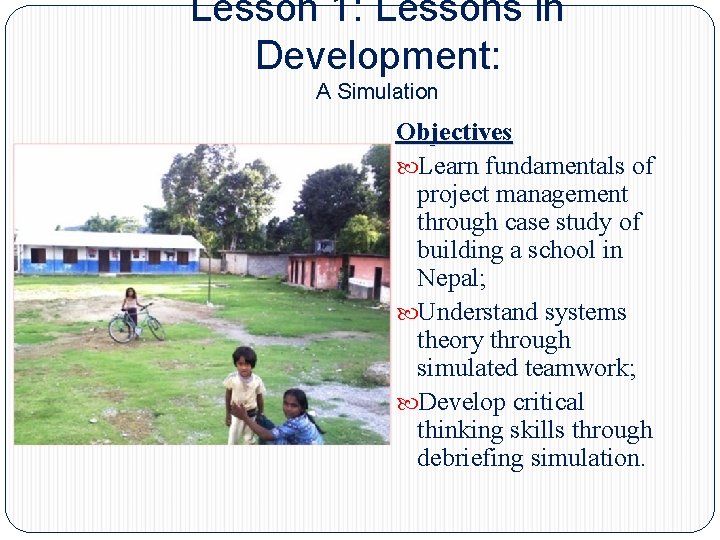
Lesson 1: Lessons in Development: A Simulation Objectives Learn fundamentals of project management through case study of building a school in Nepal; Understand systems theory through simulated teamwork; Develop critical thinking skills through debriefing simulation.
Overall Structure of Unit Two to Ten Hours of Instruction 1. 2. 3. 4. 5. 6. 7. Introduction of Scenario / Developing critical questions Group Dynamic Setting – Pre-planning and strategy Opening Decisions and Results Debrief of Initial Results SCENARIO: Follow-up Decisions; Results; Complicators; Recording of Progress Final Assessment of Successes De-brief Simulation can be broken into smaller parts, but these steps should be part of any lesson.
The Scenario Your NGO (group can choose name) has decided to help a small community in rural Nepal build a school for its children. Your job in this scenario is to employ your best leadership and organizational skills to realizing the goal. The school will be built in Hamsapur, outside the city of Pokhara, Nepal. It will teach as many as 125 students across all grades. To date, for our scenario, these children have had no local school and, if they attended, they have had to walk to neighboring villages.
Phases of Project Land Acquisition and Procurement of Building Supplies 1. 2. 3. Financing Facilities/Classrooms Utilities: Power, Water, etc. Construction & Materials 4. 5. 6. Labor Classrooms Technology School Management 7. 8. 9. Curriculum Governance Future Change/Growth
Group Steps Sub-questions/challenges are placed before the group (i. e. “How will building materials be acquired and delivered to Hamsapur? ” (Overall cost: $xx, 000. ) 2. Groups will have different general approaches for each challenge. For instance: 1. Foreign direct aid National development aid Partner NGOs and charitable contributions Local community fundraising efforts Private / corporate donors
Group Steps 3. 4. 5. Each decision they make must be carefully written (managed) to reveal that they understand SMART management. Instructor reveals results of decision based upon Suvedi/UNDP lessons of development. Results are scaled based on 6. 7. Physical Success of Project Happiness of Community Likelihood of Long-Term Self-Sustainability Groups de-brief and re-align work before next decision and new challenge is given. Advanced groups may make additional decisions on their own beyond the challenges offered (i. e. setting up a computer lab).
Suvedi-UNDP Lessons Summary Suvedi Lessons UNDP Lessons Respond to their needs (leaning and Political commitment at nat’l levels change) Informal local leaders over formal nat’l Outsiders develop, locals lead Capacity-building takes time and consistent effort Fund projects to reimburse costs piece by piece Decision-making power with locals (accountability and responsibility) Locals know how to manage problems and resolve disputes Respect culture, listen to local leaders and people; stay away from politics: water has no color is too low or too short-term Outside actors do not understand local needs or capabilities, often erring low Nat’l ownership and leadership is key to success. Local capacity to negotiate and coordinate. Local budgets and projects (SWAps —sector-wide approaches, like the rural sectors of Nepal for UNDP) Understanding that public sector is dynamic Each decision result from instructor will be based upon above lessons until students are able to generalize these concepts for themselves in de-brief at end of unit.
Background Concepts UNDP Development Process: Engage, Assess, Respond, Implement, Evaluate UNDP Core Issues for Concern: Institution, Leadership, Knowledge, Accountability SMART Decisions: Specific, Measurable, Agreed, Relevant/Realistic, Time-Bound SMARTER Decisions: Add Energizing/Exciting and Recorded
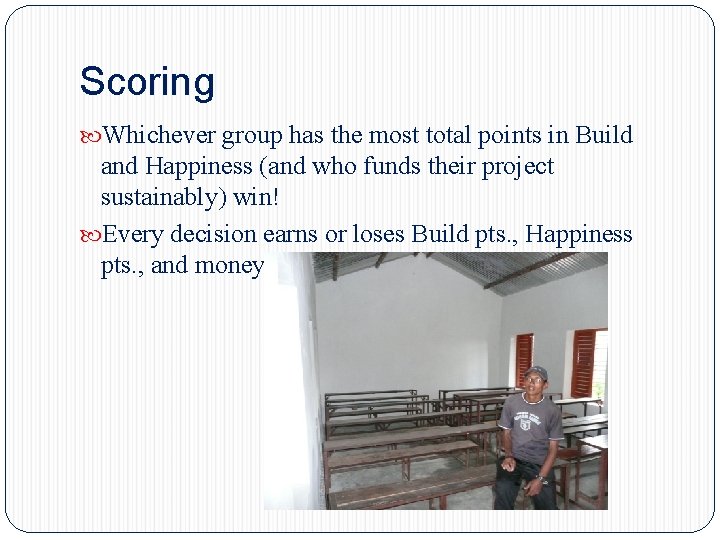
Scoring Whichever group has the most total points in Build and Happiness (and who funds their project sustainably) win! Every decision earns or loses Build pts. , Happiness pts. , and money.
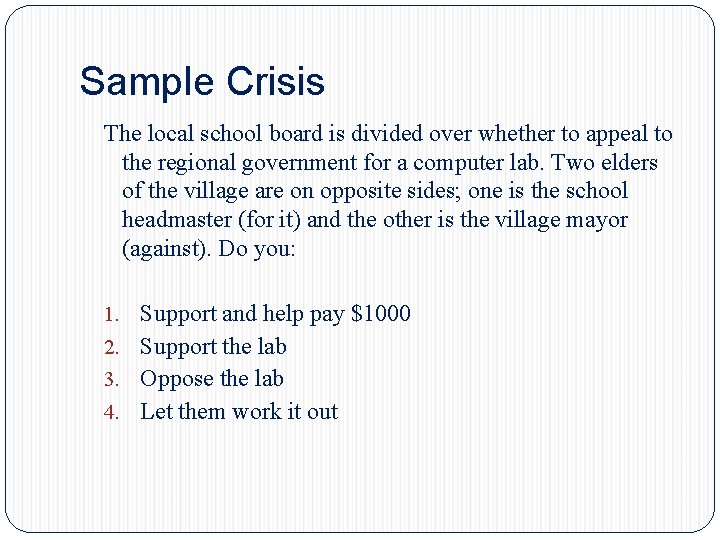
Sample Crisis The local school board is divided over whether to appeal to the regional government for a computer lab. Two elders of the village are on opposite sides; one is the school headmaster (for it) and the other is the village mayor (against). Do you: 1. Support and help pay $1000 2. Support the lab 3. Oppose the lab 4. Let them work it out
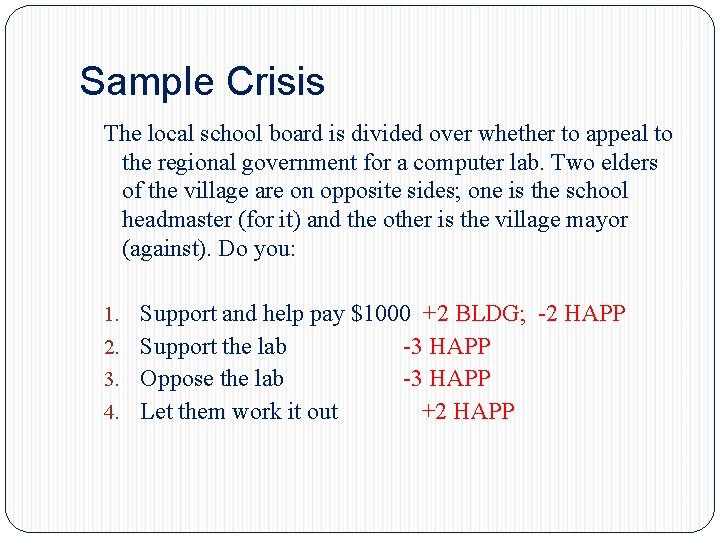
Sample Crisis The local school board is divided over whether to appeal to the regional government for a computer lab. Two elders of the village are on opposite sides; one is the school headmaster (for it) and the other is the village mayor (against). Do you: 1. Support and help pay $1000 +2 BLDG; -2 HAPP 2. Support the lab 3. Oppose the lab 4. Let them work it out -3 HAPP +2 HAPP
Debriefing Questions What did you predict accurately? What surprised you by the results? What frustrated you the most? What challenges (expected or not) do aid recipients meet in development projects? What do donors meet? Where was this simulation realistic? Not realistic? What would you change? What generalizations can you draw from the results? After seeing the UNDP lessons, how effective is SMART? Do you agree with the UNDP points?
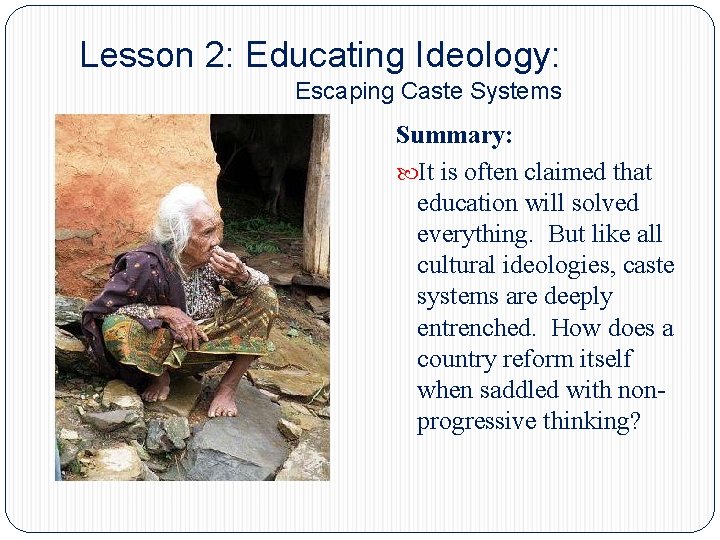
Lesson 2: Educating Ideology: Escaping Caste Systems Summary: It is often claimed that education will solved everything. But like all cultural ideologies, caste systems are deeply entrenched. How does a country reform itself when saddled with nonprogressive thinking?
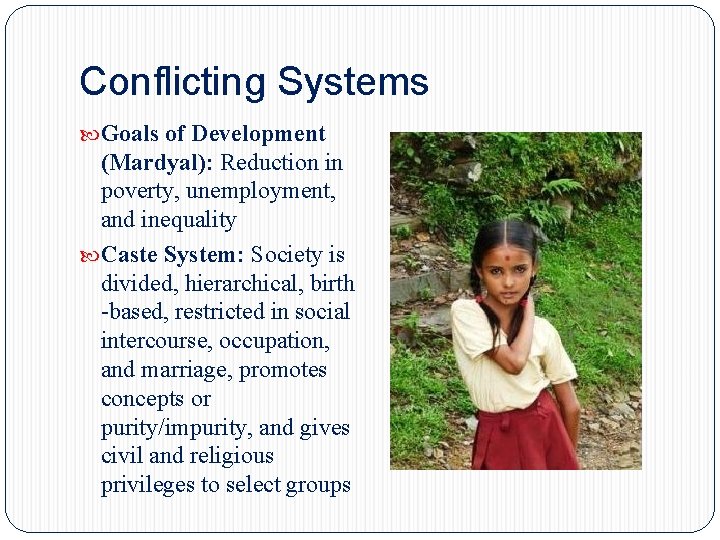
Conflicting Systems Goals of Development (Mardyal): Reduction in poverty, unemployment, and inequality Caste System: Society is divided, hierarchical, birth -based, restricted in social intercourse, occupation, and marriage, promotes concepts or purity/impurity, and gives civil and religious privileges to select groups
Structure of Lesson Instructor provides overview of caste system in Nepal 2. Focus on Dalits: 1. 2. 3. 4. 5. In Hindu religion Socio-Economic status Cultural/Symbolic status Legal /Political status Consciousness of Dalits Students brainstorm social engineering policies which might be enacted 4. Instructor offers list of methods implemented in Nepal 5. Debrief 3.
Nepali Measures to Uplift Dalits Democratic reform at local levels Educating leadership in checks and balances systems Create social programs for dalit discussion/voices Education in literacy, criticism and persuasion Development projects that are dalit-led Nat’l policy pressure on local communities to accept at temples, water supply, milk centers, etc. Nat’l laws and enforcement (& education in laws for dalits) Scholarship and job programs implementation PR campaigns condemning discrimination, etc. Political participation promotion Legitimizing traditional/cultural dalit economies Awareness campaigns (i. e. Dalit alcoholism or dowries) NGOs promote leadership/management/savings for Dalits
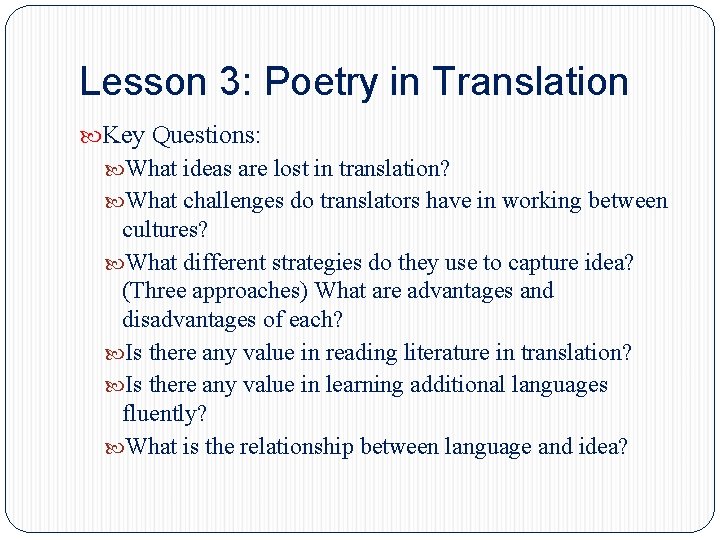
Lesson 3: Poetry in Translation Key Questions: What ideas are lost in translation? What challenges do translators have in working between cultures? What different strategies do they use to capture idea? (Three approaches) What are advantages and disadvantages of each? Is there any value in reading literature in translation? Is there any value in learning additional languages fluently? What is the relationship between language and idea?
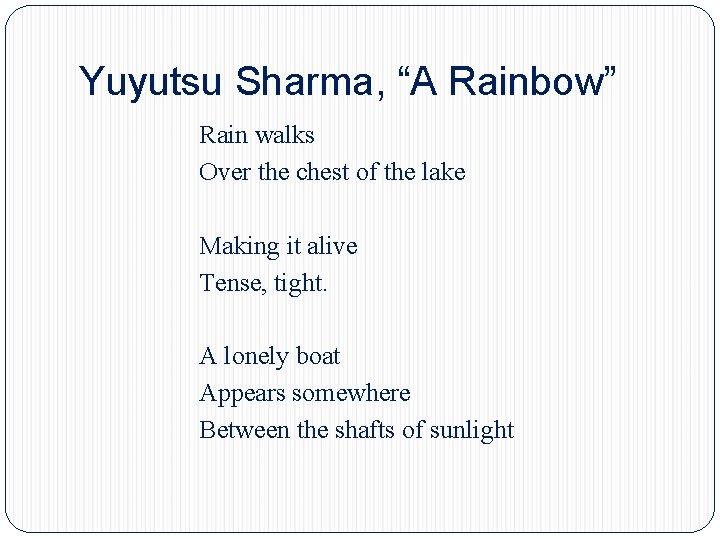
Yuyutsu Sharma, “A Rainbow” Rain walks Over the chest of the lake Making it alive Tense, tight. A lonely boat Appears somewhere Between the shafts of sunlight
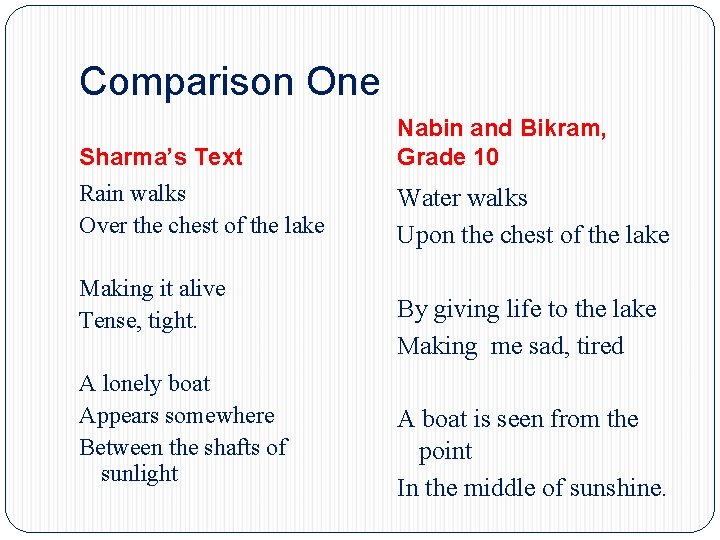
Comparison One Sharma’s Text Nabin and Bikram, Grade 10 Rain walks Over the chest of the lake Water walks Upon the chest of the lake Making it alive Tense, tight. A lonely boat Appears somewhere Between the shafts of sunlight By giving life to the lake Making me sad, tired A boat is seen from the point In the middle of sunshine.
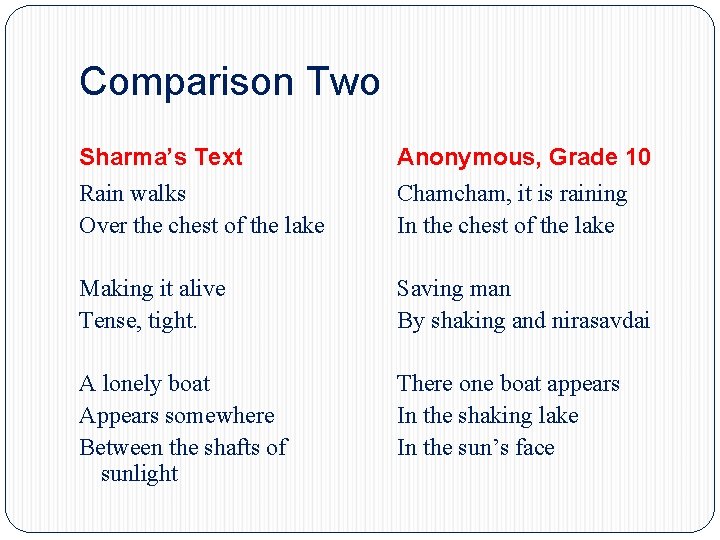
Comparison Two Sharma’s Text Anonymous, Grade 10 Rain walks Over the chest of the lake Chamcham, it is raining In the chest of the lake Making it alive Tense, tight. Saving man By shaking and nirasavdai A lonely boat Appears somewhere Between the shafts of sunlight There one boat appears In the shaking lake In the sun’s face
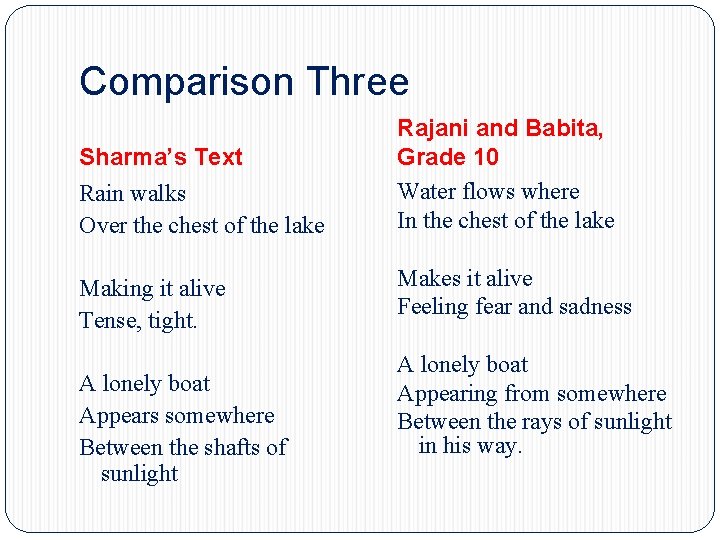
Comparison Three Sharma’s Text Rain walks Over the chest of the lake Making it alive Tense, tight. A lonely boat Appears somewhere Between the shafts of sunlight Rajani and Babita, Grade 10 Water flows where In the chest of the lake Makes it alive Feeling fear and sadness A lonely boat Appearing from somewhere Between the rays of sunlight in his way.
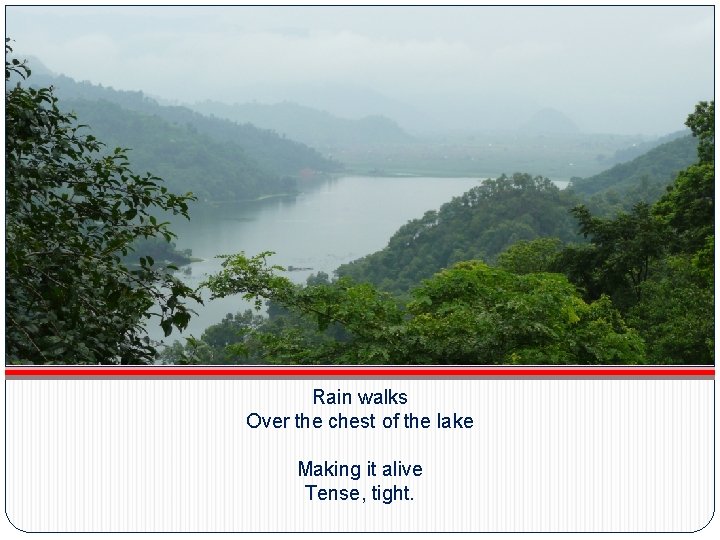
Rain walks Over the chest of the lake Making it alive Tense, tight.
Bibliography ‘Capacity is Development’ 2009, ” UNDP, CDG Global Event SB 22 March 09. pdf, March 2009. www. undp. org. “Capacity Development and Aid Effectiveness, ” UNDP Capacity Development Group, UNDP Aid Effectiveness Capacity Development Compendium. doc, April 2008. www. undp. org Parajuli, Biswo Kalyan & Khagda KC. “The Problems of Disadvantaged People in Caste Society: An Appraisal from Civil Society Perspective, ” The Institutionalization of Democratic Polity in Nepal, T. U. , 2000: 92 -110. Bista, Dor Bahadur. Fatalism and Development. Hyderabad: Orient Longman, 1991. Sharma, Yuyutsu. The Lake Fewa and A Horse. Delhi: Nirala Publications, 2005.