The role of climate in sugar maple health




- Slides: 17
The role of climate in sugar maple health: Historical relationships and future projections 1, 2 Jennifer Pontius, 3 Evan Oswald, 4 Sandy Wilmot, 3 Lesley-Ann Dupigney-Giroux and 3 Shelly Rayback 1 UVM, Rubenstein School of Environment and Natural Resources 2 USFS Northern Research Station 3 UVM Department of Geography 4 VT Forests Parks and Recreation
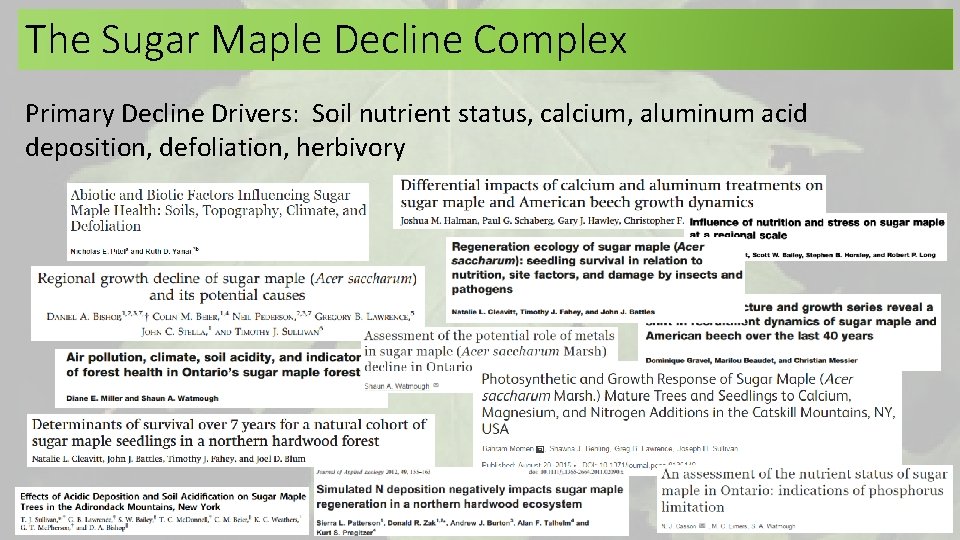
The Sugar Maple Decline Complex Primary Decline Drivers: Soil nutrient status, calcium, aluminum acid deposition, defoliation, herbivory
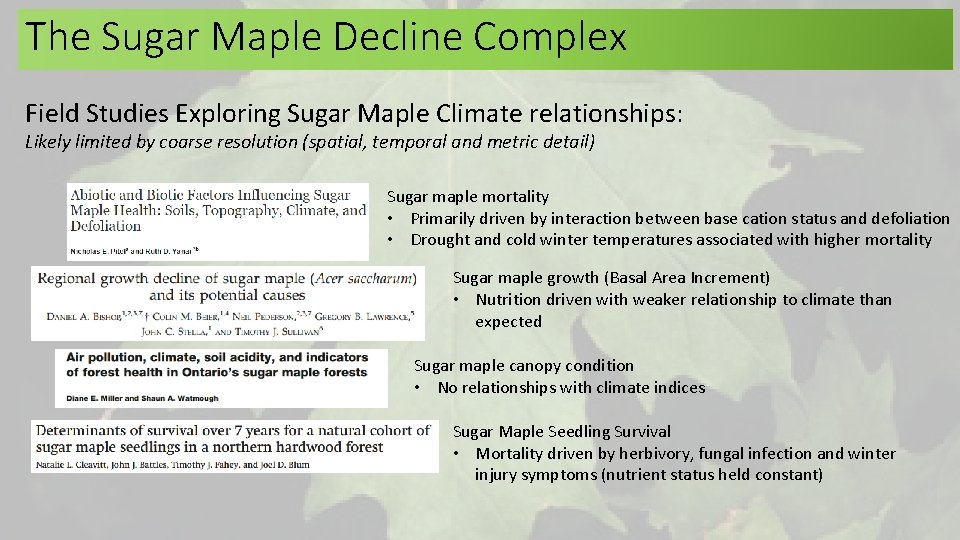
The Sugar Maple Decline Complex Field Studies Exploring Sugar Maple Climate relationships: Likely limited by coarse resolution (spatial, temporal and metric detail) Sugar maple mortality • Primarily driven by interaction between base cation status and defoliation • Drought and cold winter temperatures associated with higher mortality Sugar maple growth (Basal Area Increment) • Nutrition driven with weaker relationship to climate than expected Sugar maple canopy condition • No relationships with climate indices Sugar Maple Seedling Survival • Mortality driven by herbivory, fungal infection and winter injury symptoms (nutrient status held constant)
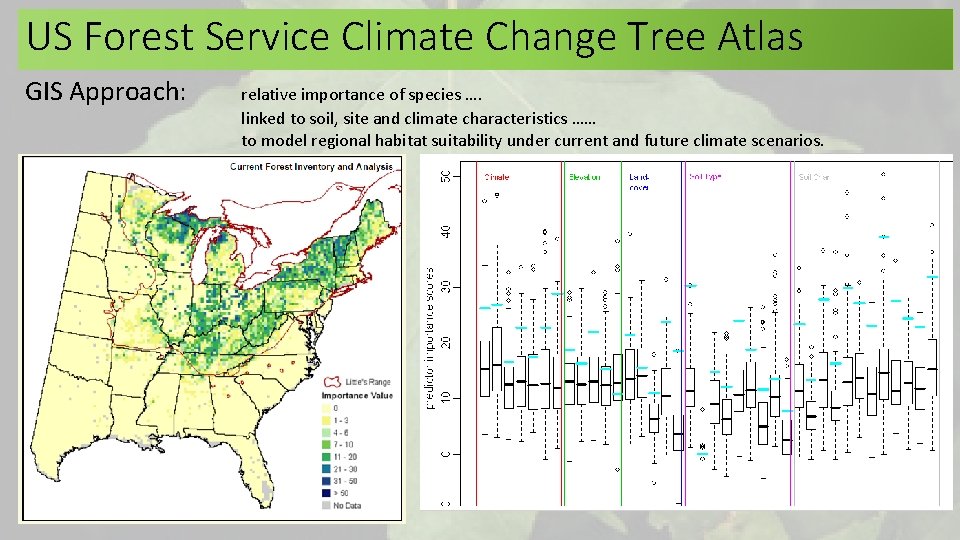
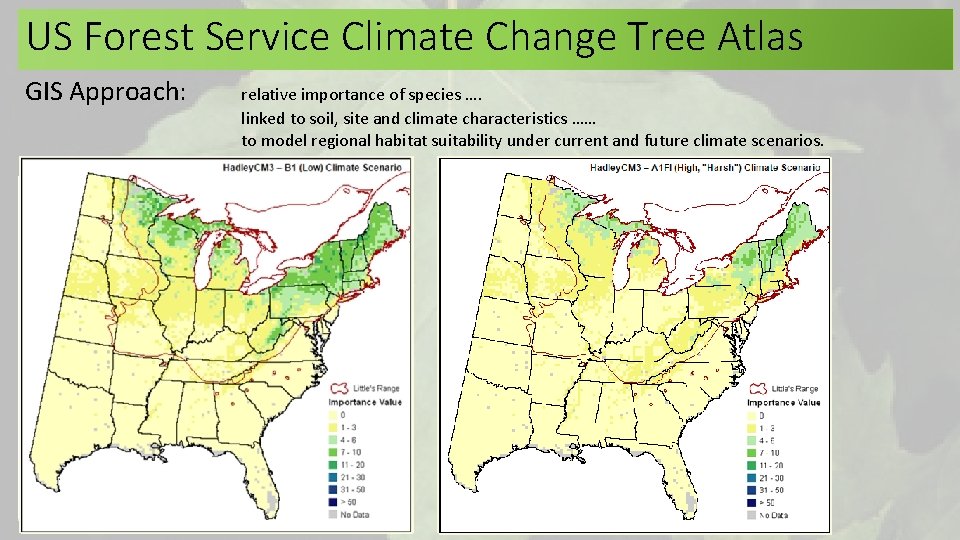
US Forest Service Climate Change Tree Atlas GIS Approach: relative importance of species …. linked to soil, site and climate characteristics …… to model regional habitat suitability under current and future climate scenarios.
US Forest Service Climate Change Tree Atlas GIS Approach: relative importance of species …. linked to soil, site and climate characteristics …… to model regional habitat suitability under current and future climate scenarios.
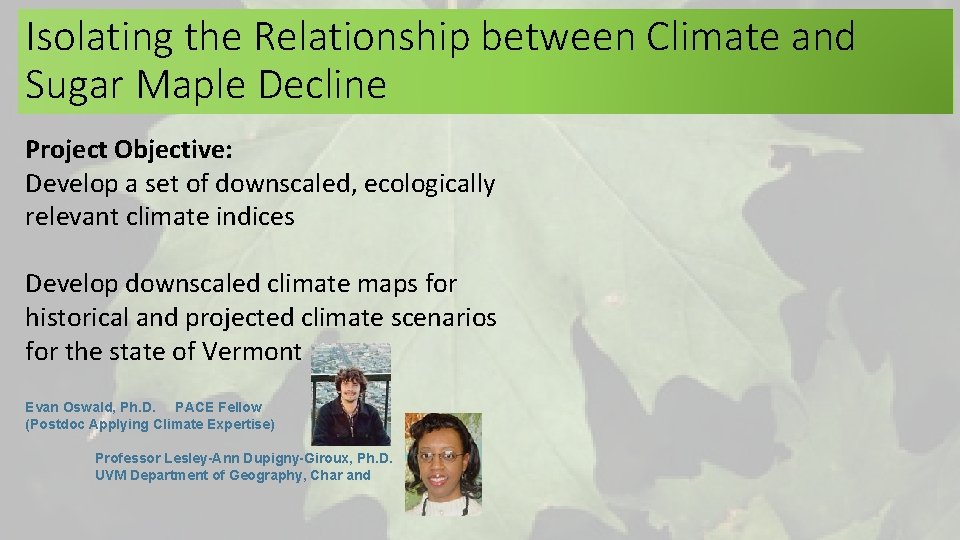
Isolating the Relationship between Climate and Sugar Maple Decline Project Objective: Develop a set of downscaled, ecologically relevant climate indices Develop downscaled climate maps for historical and projected climate scenarios for the state of Vermont Evan Oswald, Ph. D. PACE Fellow (Postdoc Applying Climate Expertise) Professor Lesley-Ann Dupigny-Giroux, Ph. D. UVM Department of Geography, Char and
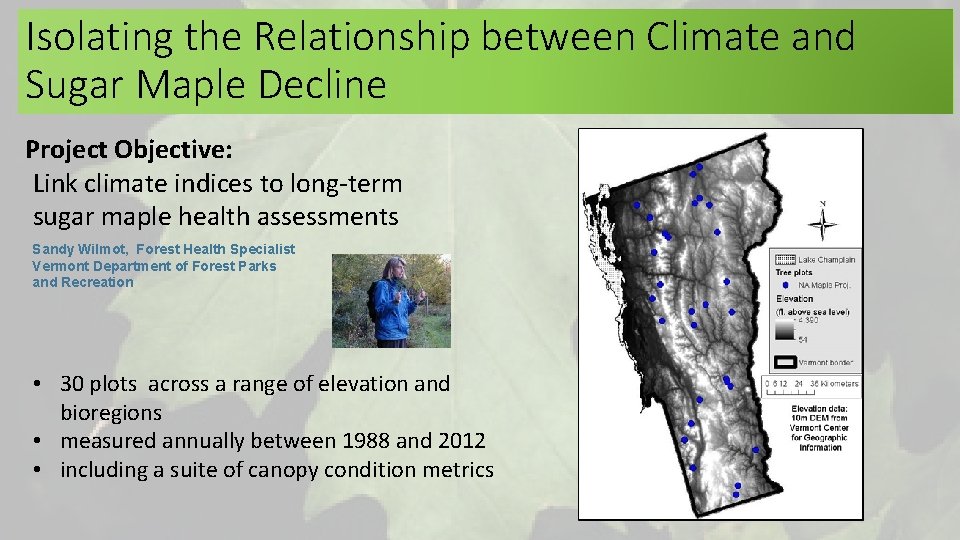
Isolating the Relationship between Climate and Sugar Maple Decline Project Objective: Link climate indices to long-term sugar maple health assessments Sandy Wilmot, Forest Health Specialist Vermont Department of Forest Parks and Recreation • 30 plots across a range of elevation and bioregions • measured annually between 1988 and 2012 • including a suite of canopy condition metrics
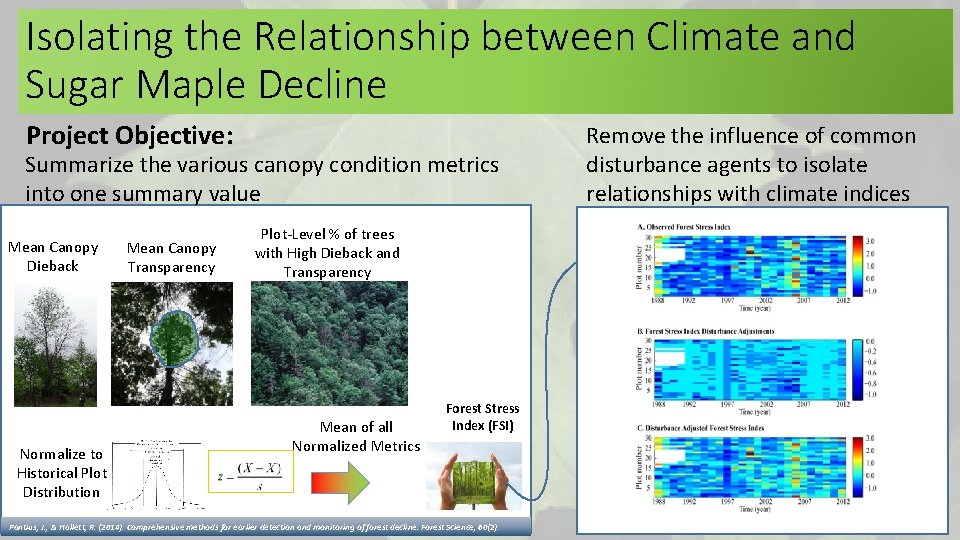
Isolating the Relationship between Climate and Sugar Maple Decline Project Objective: Summarize the various canopy condition metrics into one summary value Mean Canopy Dieback Normalize to Historical Plot Distribution Mean Canopy Transparency Plot-Level % of trees with High Dieback and Transparency Mean of all Normalized Metrics Forest Stress Index (FSI) Pontius, J. , & Hallett, R. (2014). Comprehensive methods for earlier detection and monitoring of forest decline. Forest Science, 60(2). Remove the influence of common disturbance agents to isolate relationships with climate indices
Isolating the Relationship between Climate and Sugar Maple Decline Climate Only 5 -terms r 2 = 0. 185 p < 0. 001 RMSE = 0. 541 PRESS RMSE = 0. 546 Climate Plus Disturbance 5 -terms r 2 = 0. 309 p < 0. 001 RMSE = 0. 541 PRESS RMSE = 0. 546 Predicted FSI Project Objective: Identify key climate indices linked to sugar maple condition and model FSI under various climate scenarios Actual FSI
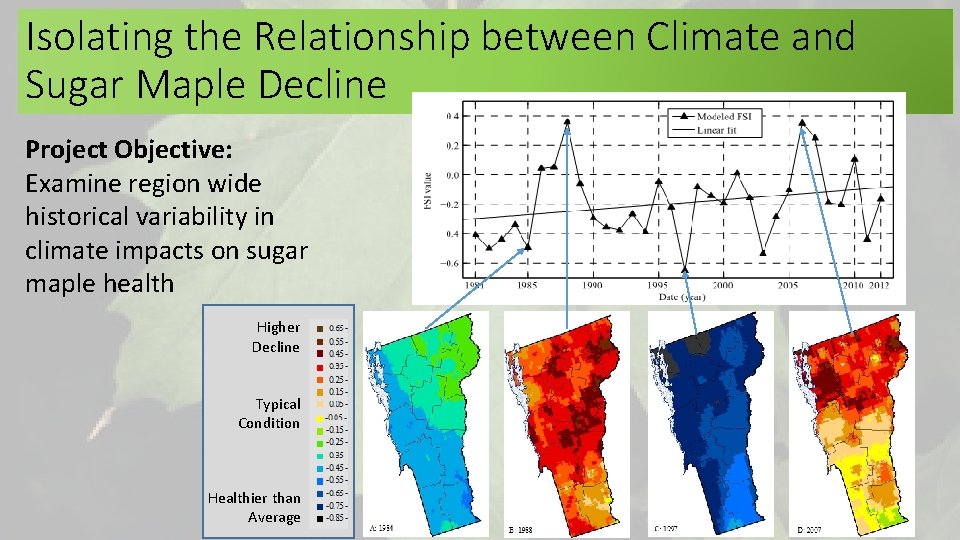
Isolating the Relationship between Climate and Sugar Maple Decline Project Objective: Examine region wide historical variability in climate impacts on sugar maple health Higher Decline Typical Condition Healthier than Average
Isolating the Relationship between Climate and Sugar Maple Decline Project Objective: Project potential impacts to FSI under future climate scenarios Higher Decline 2021 – 2050 Low Emissions (B 1) High Emissions (A 2) 2041 – 2070 Low Emissions (B 1) High Emissions (A 2) Typical Condition Healthier than Norm Change in stress condition 0. 162 0. 201 Change in stress condition 0. 344 0. 675
Isolating the Relationship between Climate and Sugar Maple Decline Project Objective: Project potential impacts to FSI under future climate scenarios Higher Decline Low Emissions (B 1) 2070 – 2099 High Emissions (A 2) Change in stress condition Low Emissions FSI 0. 678 High Emissions Scenario FSI 1. 557 Typical Condition
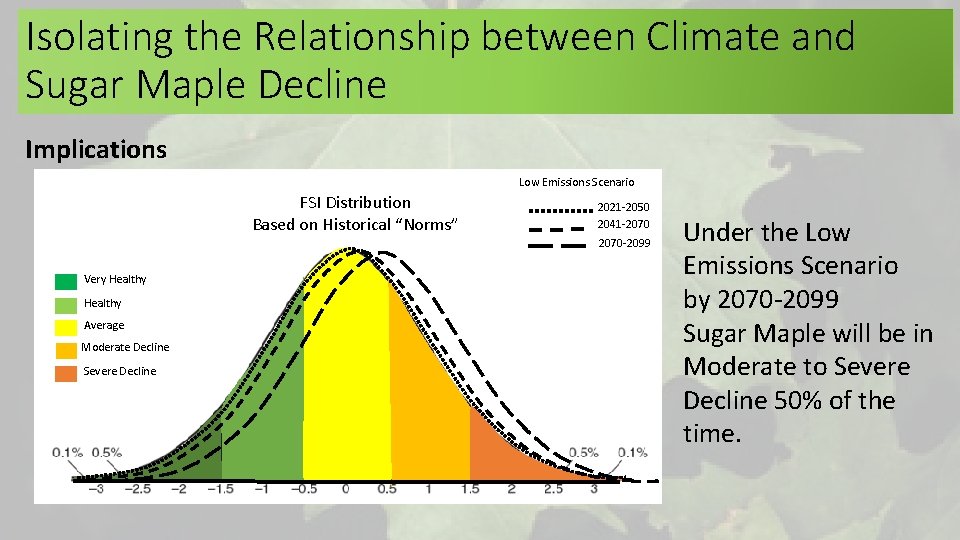
Isolating the Relationship between Climate and Sugar Maple Decline Implications Low Emissions Scenario FSI Distribution Based on Historical “Norms” 2021 -2050 2041 -2070 -2099 Very Healthy Average Moderate Decline Severe Decline Under the Low Emissions Scenario by 2070 -2099 Sugar Maple will be in Moderate to Severe Decline 50% of the time.
Isolating the Relationship between Climate and Sugar Maple Decline Implications High Emissions Scenario FSI Distribution Based on Historical “Norms” Very Healthy Average Moderate Decline Severe Decline 2021 -2050 2041 -2070 -2099 Under the High Emissions Scenario by 2070 -2099 Sugar Maple will be in Moderate to Severe Decline 80% of the time.
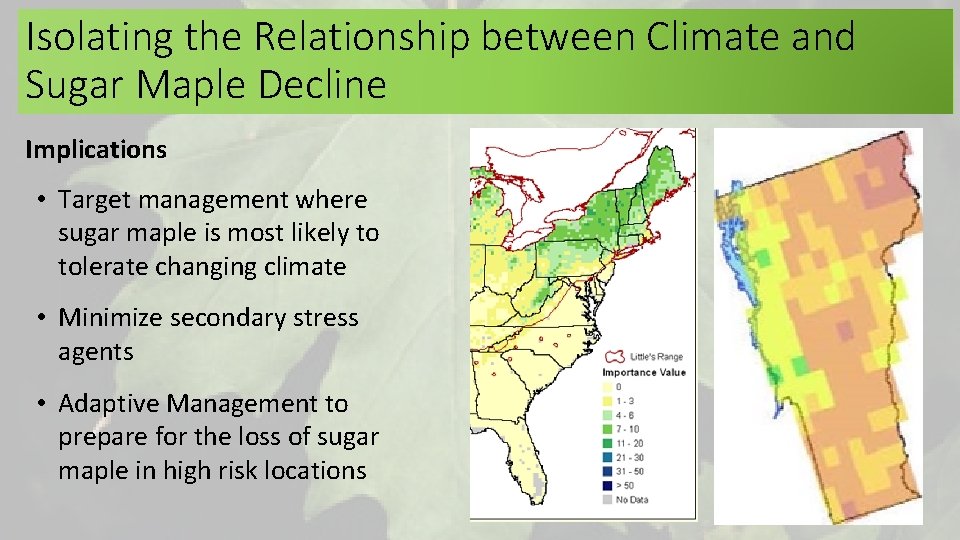
Isolating the Relationship between Climate and Sugar Maple Decline Implications • Target management where sugar maple is most likely to tolerate changing climate • Minimize secondary stress agents • Adaptive Management to prepare for the loss of sugar maple in high risk locations
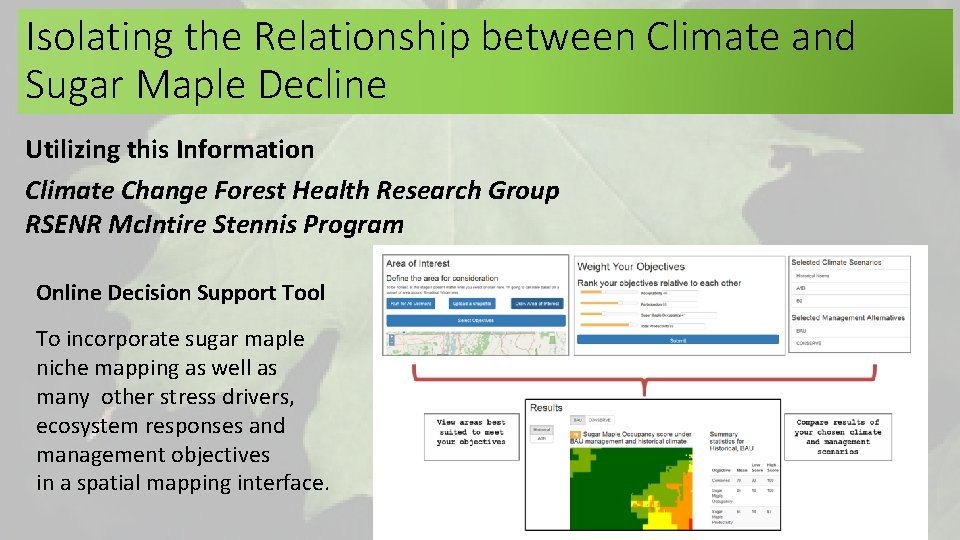
Isolating the Relationship between Climate and Sugar Maple Decline Utilizing this Information Climate Change Forest Health Research Group RSENR Mc. Intire Stennis Program Online Decision Support Tool To incorporate sugar maple niche mapping as well as many other stress drivers, ecosystem responses and management objectives in a spatial mapping interface.
Isolating the Relationship between Climate and Sugar Maple Decline