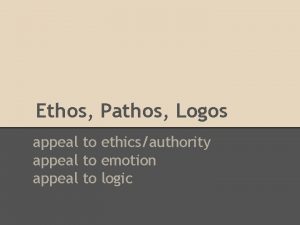
THE RHETORIC OF THE OPED PAGE ETHOS LOGOS

- Slides: 38
THE RHETORIC OF THE OP-ED PAGE ETHOS, LOGOS AND PATHOS
ACTIVITY 1: QUICKWRITE/GETTING READY TO READ (EDLUND) • Consider the title and subheads in the article “Three Ways to Persuade” by John Edlund. What do you think the article is going to be about? Read the article and briefly respond to the “Questions for Discussion” at the end of each section
ACTIVITY 2: EXPLORING KEY CONCEPTS For each term, answer the following questions: Ethos, Logos, Pathos, and persuasion • 1. What does this term mean to you? • 2. Should we use the Greek word, or is there an English word that means exactly the same thing? • 3. Look at the discussion questions for each section. Are Aristotle’s three terms relevant to your own writing?
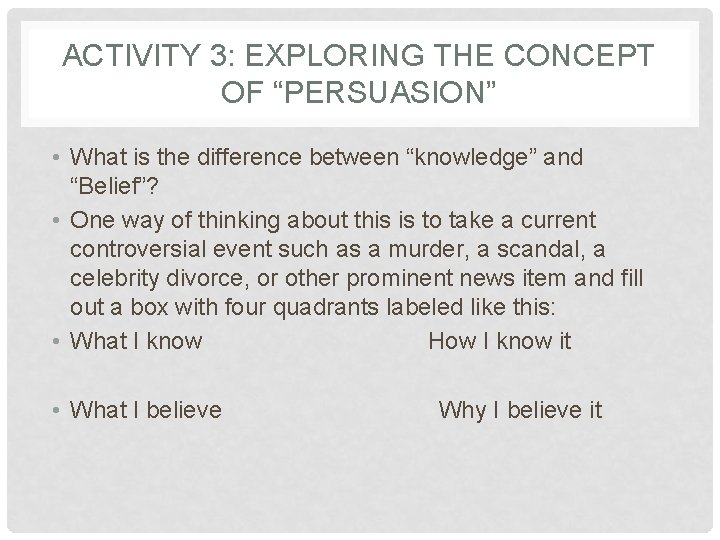
ACTIVITY 3: EXPLORING THE CONCEPT OF “PERSUASION” • What is the difference between “knowledge” and “Belief”? • One way of thinking about this is to take a current controversial event such as a murder, a scandal, a celebrity divorce, or other prominent news item and fill out a box with four quadrants labeled like this: • What I know How I know it • What I believe Why I believe it
ACTIVITY 3: EXPLORING THE CONCEPT OF “PERSUASION” • Is proving different from persuading? • Does proving lead to knowledge, while persuasion lead to belief? • How do we prove that something is true? • Are there some notions that we believe strongly even though we cannot prove them?
ACTIVITY 4: SURVEYING THE TEXT (RIFKIN) • When and where was the article published? • Who wrote the article? Do you know anything about this writer? (Hint: look at the end of the article) How could you find out more? • What is the subtitle of the article? What does that tell you about what the article might say? • What do you think it means that the article was published on the editorial page? • Do a quick internet search on the author and record three significant findings
ACTIVITY 5: MAKING PREDICTIONS AND ASKING QUESTIONS (RIFKIN) • What does it mean to have a change of heart? • What are some common ideas or feelings people have about animals? • What kinds of experiences might cause someone to change his or her ideas or feelings about animals? • What are some groups of people who have strong feelings about how animals are treated? What do you know about them? What do they usually believe? • What is a vegan or vegetarian? What are some reasons for making these choices? • Do you think that Jeremy Rifkin might be a vegetarian?
ACTIVITY 6: UNDERSTANDING KEY VOCABULARY • Develop a word tree for the following terms to better understand “A Change of Heart about Animals” • Humane and inhumane • Cognitive • Genetically wired • Empathy
ACTIVITY 7: READING FOR UNDERSTANDING • Now you are ready to read Jeremy Rifkin’s “A Change of Heart about Animals. ” For the first time through, you should read to understand the text. Read as if you trust Rifkin, and focus on what he is trying to say. Try to see whether the predictions you have made about the text are true. Is the article about what you thought it would be about? Does Rifkin say what you thought he would say?
ACTIVITY 7: READING FOR UNDERSTANDING • • 1. Which predictions turned out to be true? 2. What surprised you? 3. What does Rifkin want readers to believe? 4. What are some of the things people believe humans can do that animals cannot? How does Rifkin challenge those beliefs? • 5. What authorities does Rifkin use to support his case? • 6. What action does Rifkin want readers to take? • 7. How does Rifkin organize his essay? Is it an effective organization?
ACTIVITY 8 A: CONSIDERING THE STRUCTURE OF THE TEXT • 1. Draw a line across the page where the introduction ends. Is the line after the first paragraph, or are there more introductory paragraphs? • 2. Divide the body of the essay into sections on the basis of the topics addressed. • 3. Draw a line where the conclusion begins. Is it the last paragraph, or does it begin before that?
ACTIVITY 8 B: DESCRIPTIVE OUTLINING • 1. Write brief statements describing the rhetorical function and content of each paragraph or section. • a. What does each section do for the reader? What is the writer trying to accomplish? • b. What does each section say? What is the content? • 2. After making the descriptive outline, ask questions about the article’s organizational structure: • a. Which section is the most developed? • b. Which section is the least developed? Does it need more development? • c. Which section is the most persuasive? The least?
ACTIVITY 9: NOTICING LANGUAGE • Revisit your “word trees” (from activity 6) and add as many additional words that utilize the same root. See Cognition example
ACTIVITY 10: SECOND READING “AGAINST THE GRAIN • In the second reading you will read to question the text. This is a process known as reading against the grain.
ACTIVITY 10: ANNOTATING AND QUESTIONING THE TEXT • 1. Underline (with a double underline) or highlight in one color thesis and major claims or assertions made in the article. • 2. Underline (with a single underline) or highlight in a second color the evidence in support of the claims and assertions. • 3. Write your comments and questions in the margins
ACTIVITY 11: ANALYZING STYLISTIC CHOICES • Loaded Words- Language That Puts a Slant on Reality • 1. Paragraph 4 of the article says • Studies on pig’s social behavior funded by Mc. Donald’s at Purdue University, for example, have found that they crave affection and are easily depressed if isolated or denied playtime with each other. The lack of mental and physical stimuli can result in a deterioration of health • Circle words associated with human behavior and put formal, scientific words in quotes
ACTIVITY 11: ANALYZING STYLISTIC CHOICES • Paragraph 7 of the article says: • Researchers were stunned recently by findings (published in the journal Science) on the conceptual abilities of New Caledionian crows. Because scientific experiments are carefully planned and controlled, scientists are rarely “stunned” by their results. • What is the effect of using the word “stunned” here? What are some other words or phrases that might fit here that would sound more scientific? Try rewriting the sentence in a more clinical, scientific way.
ACTIVITY 11: ANALYZING STYLISTIC CHOICES • Paragraph 10 of the article says: • An orangutan named Chantek who lives at the Atlanta Zoo used a mirror to groom his teeth and adjust his sunglasses. • “Groom” is a word that has different meanings when applied to humans and animals. If animals groom each other, it usually means that one cleans the other’s fur or searches the fur to remove fleas and other parasites. It is a part of social bonding. If a human grooms a horse, it means combing and brushing the animal. What does “groom” mean when applied to humans? In what sense is it used here? Rewrite the sentence to make is more scientific.
ACTIVITY 12: QUESTIONS ABOUT RIFKIN • How would you describe the style of this article? Is it formal? Informal? Academic? Scientific? Conversational? • What is the effect of giving names of most of the animals involved in the experiments but not the names of the sceintists? • Throughout most of the article Rifkin refers to “researchers” and “scientists. ” In paragraph 13, however, he directly quotes Step[hen M. Siviy, whom he refers to as “a behavioral scientist at Gettysburg College in Pennsylvania. ” What is the effect of this sudden specificity? • What is the effect opf the rhetorical questions in paragraph 15, followed be “such questions are being raised” in the next paragraph?
ACTIVITY 13: SUMMARIZING AND RESPONDING • Use the annotations that you made in the margins and the descriptive outliining activity to construct a summary using your knowledge of the author’s structure of the text. • Write four open-ended questions about the Rifkin article that can be used for the basis of a class discussion.
ACTIVITY 14: THINKING CRITICALLY • See handout • Thumbs up/Thumbs down poll • “Logical appeals in arguments are superior to emotional appeals”
ACTIVITY 15: SURVEYING THE TEXT (BRAITHWAITE) • The following questions, applied to the Rifkin article above, are equally relevant here: • When and where was the article published? • Who wrote the article? Do you know anything about this writer? (Hint: look at the end of the article) How could you find out more? Is this writer likely to be more or less credible than Jeremy Rifkin? • What is the title of this article? The subtitle? What do these words tell you about what the article might say? What predictions can you make?
ACTIVITY 16: • See Vocab. Handout
ACTIVITY 17: READING FOR UNDERSTANDING (BRAITHWAITE) • Before reading the Braithwaite article, discuss the following questions: • Have you ever gone fishing? Did you catch a fish? What did the fish do? How did it behave? Did you eat it? • What other experiences have you had with live fish? Do you have an aquarium at home? Have you been to a public aquarium? What did you learn from these experiences? • From your experiences, do you think that fish feel pain? Why or why not?
ACTIVITY 18: CONSIDERING THE STRUCTURE OF THE TEXT (BRAITHWAITE) • Do a descriptive outline of the Braithwaite text. • Are we justified in treating fish differently from other animals?
ACTIVITY 19: ANALYZING STYLISTIC CHOICES • What is the effect of the use of scientific terms in an article that is written for newspaper readers? • Do these terms confuse the reader? • Do they make the writer more credible? • Do they help the reader understand the type of argument being made?
ACTIVITY 20: POST READING • Summarize the article in your own words, answering the following questions: • Why does Victoria Braithwaite think that we should treat fish more like the way we treat other animals, such as birds and mammals? Do you agree? Why or why not?
ACTIVITY 21: READING FOR UNDERSTANDING (YONG) • Have you ever seen gorillas, chimpanzees, bonobos (which are sometimes called “pygmy chimpanzees”) or orangutans, all of which are considered to be “great apes, ” at a zoo? In what ways are they like humans? In what ways are they different? • Most of us know people who treat their pets like people. What does this mean? What types of behavior characterize these pet owners? • Do great apes deserve to be treated like people? Why or why not? • If apes had “personhood, ” would it still be okay to keep them in zoos?
ACTIVITY 22: VOCABULARY (YONG) • See Handout
ACTIVITY 23: ANALYZING STYLISTIC CHOICES- REPRESENTING RELATIONSHIPS AND THEIR POSITIONS • See Handout
ACTIVITY 24: SUMMARIZING AND RESPONDING-QUICKWRITE • Summarize the Yong article in your own words, answering the following questions: • What is the event or events related to animal rights that motivate Ed Yong to write this article? • What questions does Yong raise about this issue? • What positions do people take on these questions?
ACTIVITY 25: THINKING CRITICALLY— DEFINING “PERSONHOOD” • 1. What exactly is Hiasl? • 2. What qualities does Hiasl have that would make us call him a person? What qualities does he have that would make us call him something else? (You might want to make a chart. ) • 3. Is Hiasl a person? • 4. What should we do about Hiasl? • 5. Does Hiasl’s plight have potential as an appeal to pathos? • 6. Does Yong use it for this purpose? • 7. Is Yong entirely objective?
ACTIVITY 26: REFLECTING ON YOUR READING PROCESS • • Answer the following questions: 1. What problems did you have reading these texts? 2. What strategies helped you overcome these problems? 3. Do you think these strategies will work with other readings?
ACTIVITIES 27 -30: WRITING ASSIGNMENTS • See handouts
ACTIVITY 31: TRYING ON WORDS, PERSPECTIVES, AND IDEAS • These could be policy questions: • (What should we do about _______? ) • or value questions • (Is ______ good or bad? ). • Your task is to think, • “What would ____ say about this? ” • “How would ____ answer this question? ”
ACTIVITY 32: GATHERING EVIDENCE TO SUPPORT YOUR CLAIMS • What are you going to quote or paraphrase from the article or articles you read? What do you want to say in response? • What information do you need to support your claims? Where are you going to find it? (This may involve Internet searches. If so, what search terms will you use? ) • How closely does this piece of evidence relate to the claim it is supposed to support? • Is this piece of evidence a fact or an opinion? Is it an example? • If this evidence is a fact, what kind of fact is it (statistic, experimental result, quotation)? • If it is an opinion, what makes the opinion credible? • What makes this evidence persuasive? • How well will the evidence suit the audience and the rhetorical purpose of the piece?
ACTIVITY 33: QUOTE, PARAPHRASE, AND RESPOND • Choose three passages from the article you might be able to use in a letter or an essay. You may want to choose passages you strongly agree or disagree with. • First, write each passage down as a correctly punctuated direct quotation. • Second, paraphrase the material in your own words. What does the author mean by this? • Third, respond to the idea expressed in the passage by agreeing or disagreeing with it and explaining why.
ACTIVITY 34: GETTING READY TO WRITE • Organize your notes and other materials in the order you think you will use them. • Create a rough outline of your main points. (This is usually a good idea if you are going to do a timed writing, but it also can keep you on track as you write a longer piece. )