The Pumping Lemma for CFLs Statement Applications 1
- Slides: 15
The Pumping Lemma for CFL’s Statement Applications 1
Intuition u. Recall the pumping lemma for regular languages. u. It told us that if there was a string long enough to cause a cycle in the DFA for the language, then we could “pump” the cycle and discover an infinite sequence of strings that had to be in the language. 2
Intuition – (2) u. For CFL’s the situation is a little more complicated. u. We can always find two pieces of any sufficiently long string to “pump” in tandem. w That is: if we repeat each of the two pieces the same number of times, we get another string in the language. 3
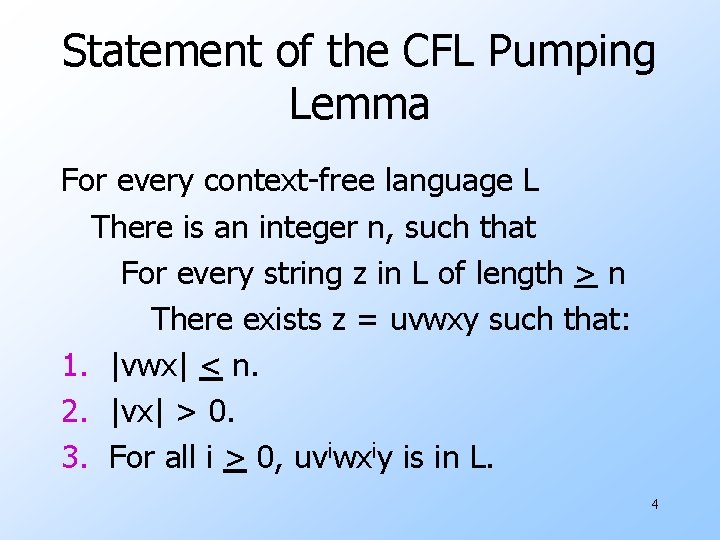
Statement of the CFL Pumping Lemma For every context-free language L There is an integer n, such that For every string z in L of length > n There exists z = uvwxy such that: 1. |vwx| < n. 2. |vx| > 0. 3. For all i > 0, uviwxiy is in L. 4
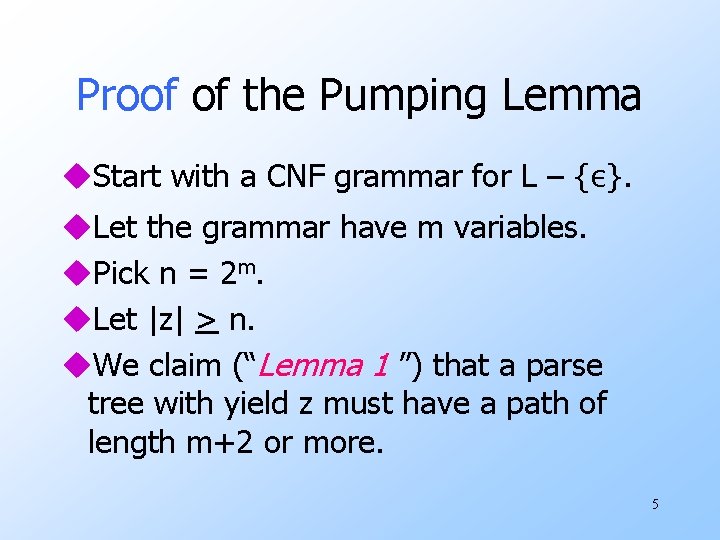
Proof of the Pumping Lemma u. Start with a CNF grammar for L – {ε}. u. Let the grammar have m variables. u. Pick n = 2 m. u. Let |z| > n. u. We claim (“Lemma 1 ”) that a parse tree with yield z must have a path of length m+2 or more. 5
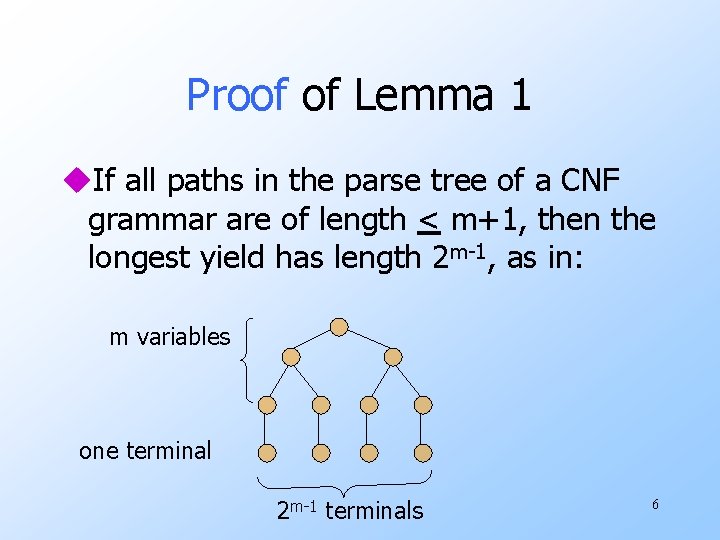
Proof of Lemma 1 u. If all paths in the parse tree of a CNF grammar are of length < m+1, then the longest yield has length 2 m-1, as in: m variables one terminal 2 m-1 terminals 6
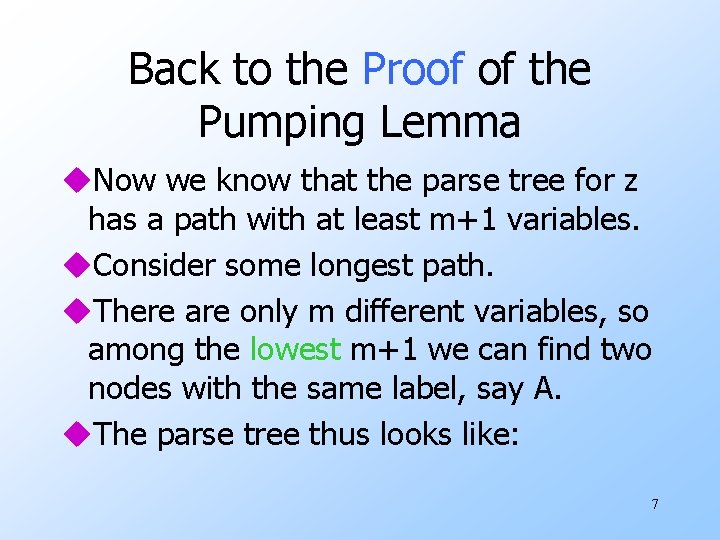
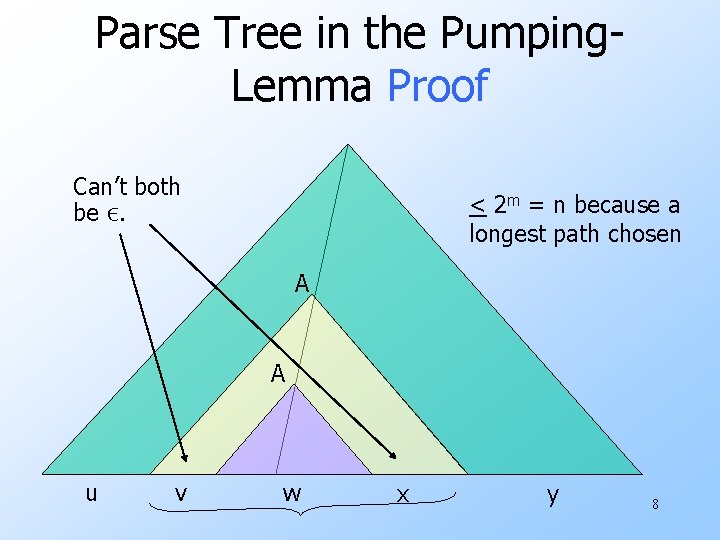
Back to the Proof of the Pumping Lemma u. Now we know that the parse tree for z has a path with at least m+1 variables. u. Consider some longest path. u. There are only m different variables, so among the lowest m+1 we can find two nodes with the same label, say A. u. The parse tree thus looks like: 7
Parse Tree in the Pumping. Lemma Proof Can’t both be ε. < 2 m = n because a longest path chosen A A u v w x y 8
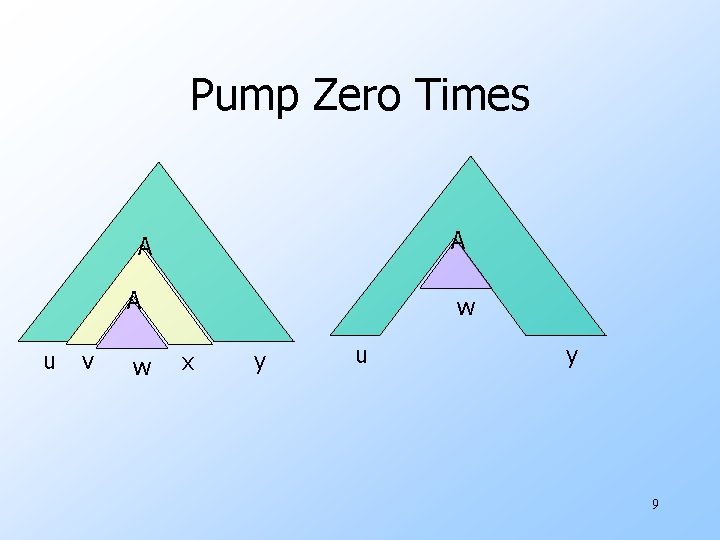
Pump Zero Times A A A u v w w x y u y 9
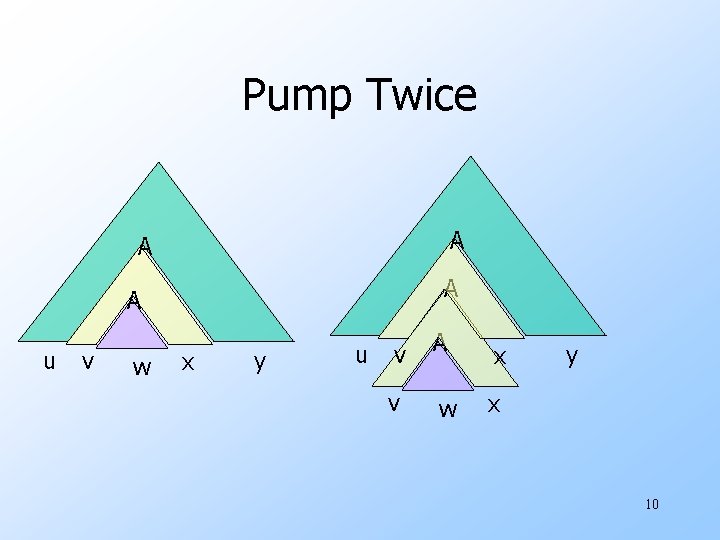
Pump Twice A A u v w x y u v A v w x y x 10
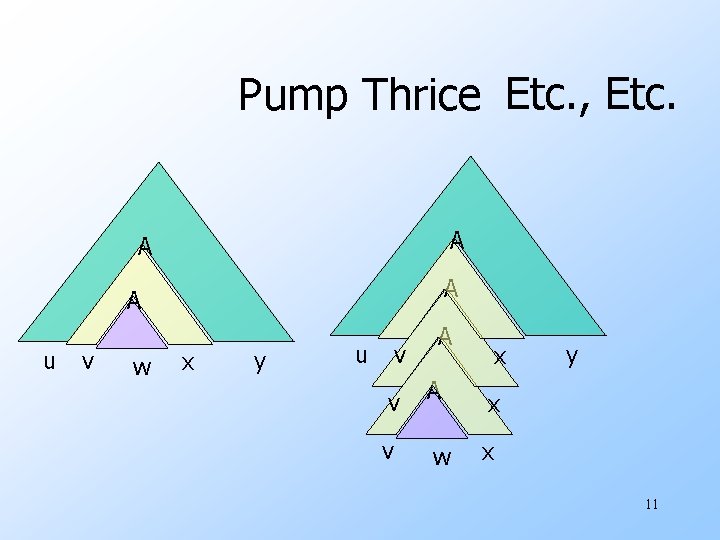
Pump Thrice Etc. , Etc. A A u v w x y u v A v w x y x x 11
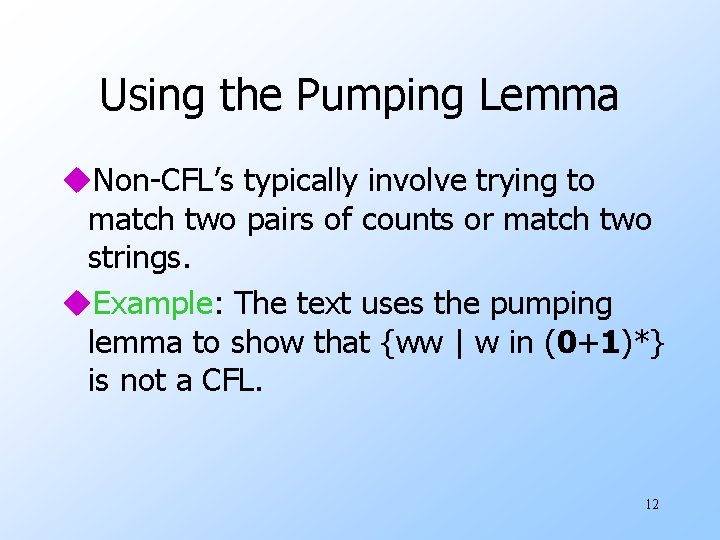
Using the Pumping Lemma u. Non-CFL’s typically involve trying to match two pairs of counts or match two strings. u. Example: The text uses the pumping lemma to show that {ww | w in (0+1)*} is not a CFL. 12
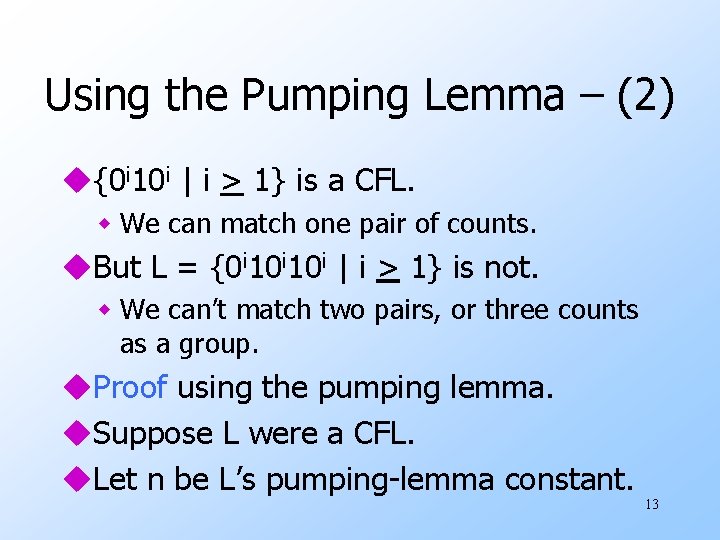
Using the Pumping Lemma – (2) u{0 i 10 i | i > 1} is a CFL. w We can match one pair of counts. u. But L = {0 i 10 i | i > 1} is not. w We can’t match two pairs, or three counts as a group. u. Proof using the pumping lemma. u. Suppose L were a CFL. u. Let n be L’s pumping-lemma constant. 13
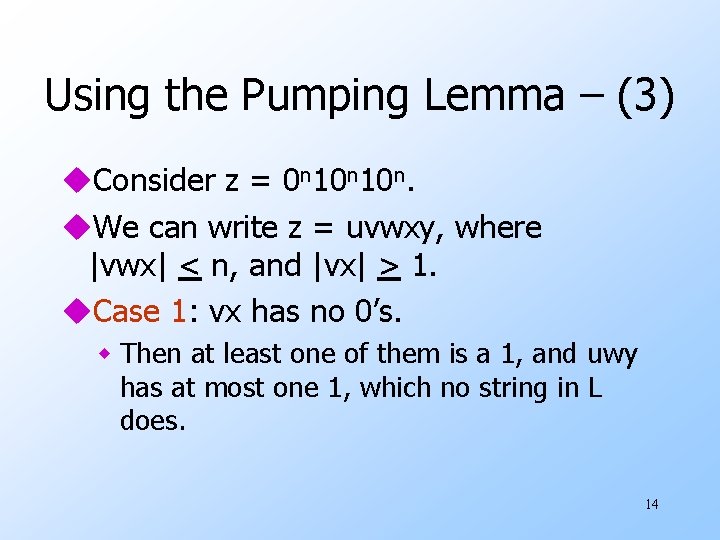
Using the Pumping Lemma – (3) u. Consider z = 0 n 10 n. u. We can write z = uvwxy, where |vwx| < n, and |vx| > 1. u. Case 1: vx has no 0’s. w Then at least one of them is a 1, and uwy has at most one 1, which no string in L does. 14
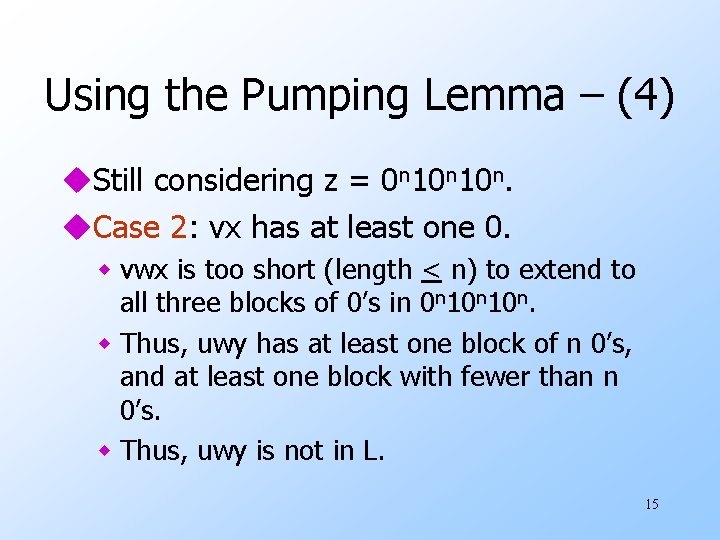
Using the Pumping Lemma – (4) u. Still considering z = 0 n 10 n. u. Case 2: vx has at least one 0. w vwx is too short (length < n) to extend to all three blocks of 0’s in 0 n 10 n. w Thus, uwy has at least one block of n 0’s, and at least one block with fewer than n 0’s. w Thus, uwy is not in L. 15