The Physics of Electrostatic Air Cleaners and Xerox

- Slides: 16
The Physics of Electrostatic Air Cleaners and Xerox Machines
Preliminaries…. Not all things can be explained by gravity, mechanical forces: • Shocking your self by touching doorknobs, car doors. • Hair-raising experiences • Lighting a flourescent lamp while walking on a carpet Observed ‘Repulsion’ & Strength of Attraction’ Postulate: 1. Presence of ‘charges’(2 types: positive & negative) that flow from 1 object to another 2. Opposite charges attract (pull). Like charges repel (push) 3. Forces increase with decreasing separation.
What we know about ‘electric charges’ • Charge is conserved • Charge is quantized in fundamental units of e = 1. 6 x 10 -19 Coulombs • Charge is intrinsic to matter: Sub-atomic particles: electrons have q = - e protons have q = + e What does it mean to have a net charge ? • Net charge is the sum of an object’s +, - charges. • Just because an object is negatively-charged doesn’t mean it has no + charges • Normally, objects have neutral charge (equal +, - charges) How does one normally ‘charge’ an object ? • By rubbing against a different material • Connecting to one side of a battery
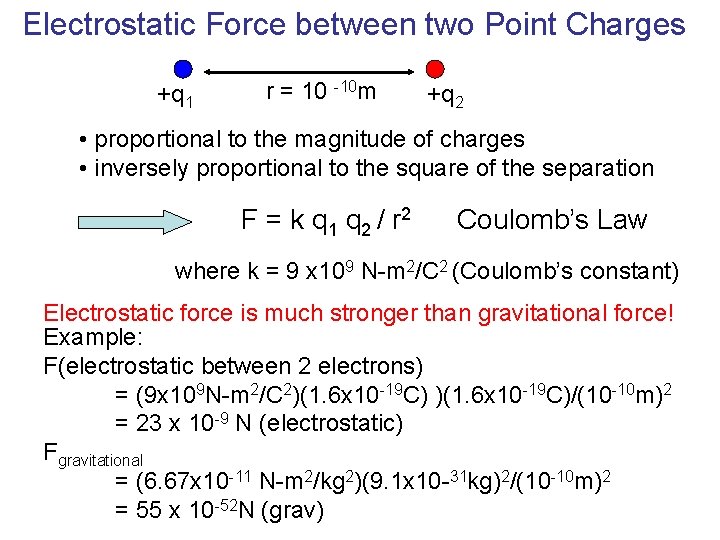
Electrostatic Force between two Point Charges +q 1 r = 10 -10 m +q 2 • proportional to the magnitude of charges • inversely proportional to the square of the separation F = k q 1 q 2 / r 2 Coulomb’s Law where k = 9 x 10⁹ N-m 2/C 2 (Coulomb’s constant) Electrostatic force is much stronger than gravitational force! Example: F(electrostatic between 2 electrons) = (9 x 10⁹ N-m 2/C 2)(1. 6 x 10 -19 C)/(10 -10 m)2 = 23 x 10 -9 N (electrostatic) Fgravitational = (6. 67 x 10 -11 N-m 2/kg 2)(9. 1 x 10 -31 kg)2/(10 -10 m)2 = 55 x 10 -52 N (grav)
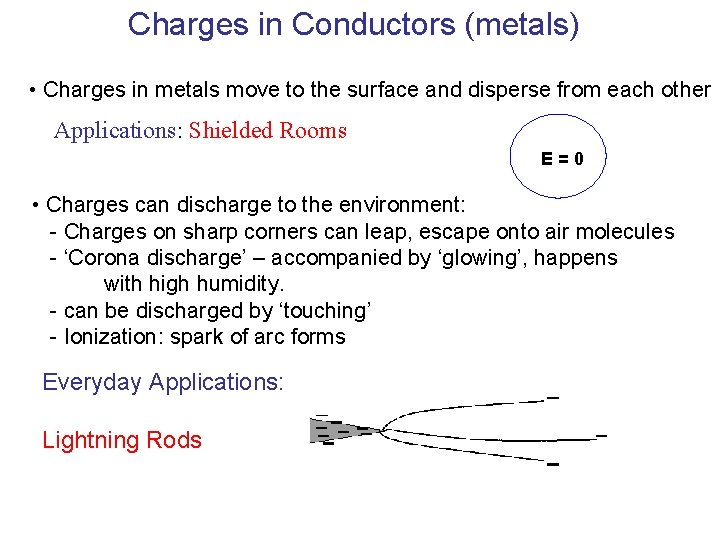
Charges in Conductors (metals) • Charges in metals move to the surface and disperse from each other Applications: Shielded Rooms E=0 • Charges can discharge to the environment: - Charges on sharp corners can leap, escape onto air molecules - ‘Corona discharge’ – accompanied by ‘glowing’, happens with high humidity. - can be discharged by ‘touching’ - Ionization: spark of arc forms Everyday Applications: Lightning Rods
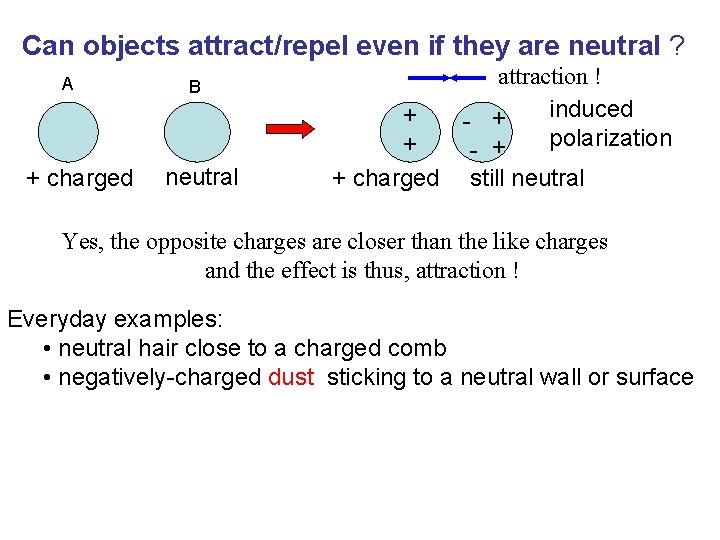
Can objects attract/repel even if they are neutral ? A + charged B neutral attraction ! induced + - + polarization + - + + charged still neutral Yes, the opposite charges are closer than the like charges and the effect is thus, attraction ! Everyday examples: • neutral hair close to a charged comb • negatively-charged dust sticking to a neutral wall or surface
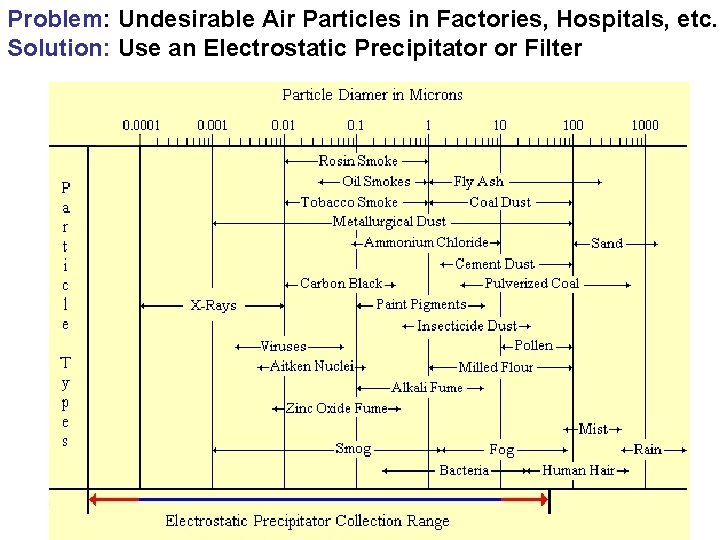
Problem: Undesirable Air Particles in Factories, Hospitals, etc. Solution: Use an Electrostatic Precipitator or Filter
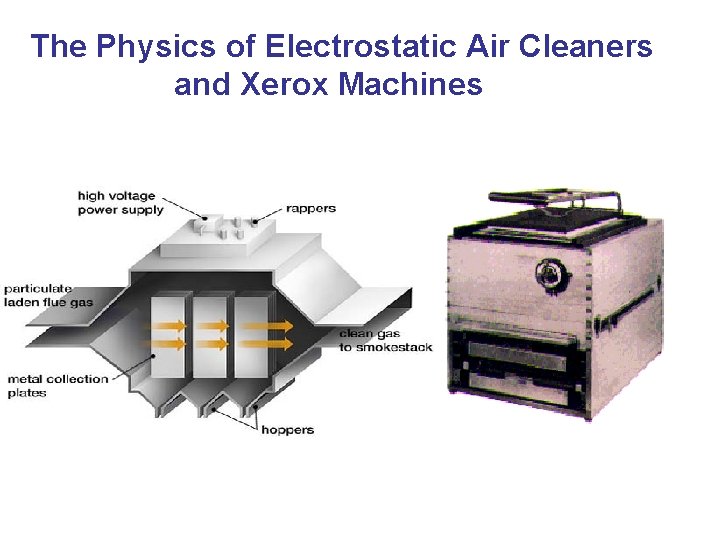
Application 1: Electrostatic Air Cleaners Dust particles charged negatively in air charged using high voltage and collected on positivelycharged metal plates
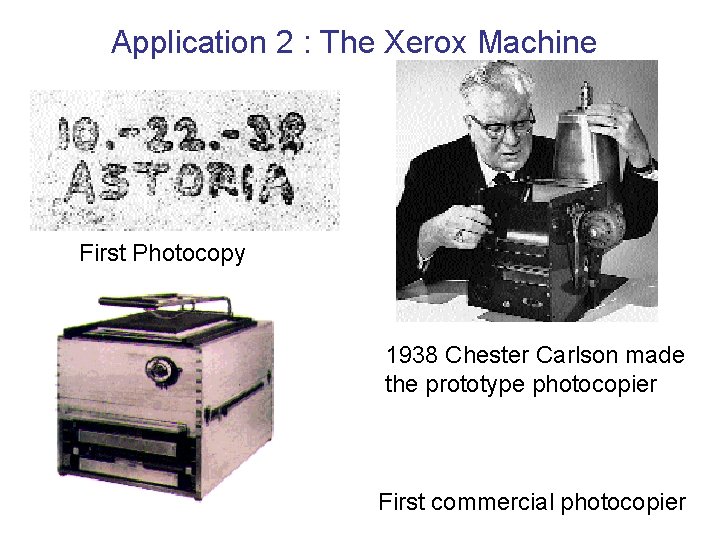
Application 2 : The Xerox Machine First Photocopy 1938 Chester Carlson made the prototype photocopier First commercial photocopier
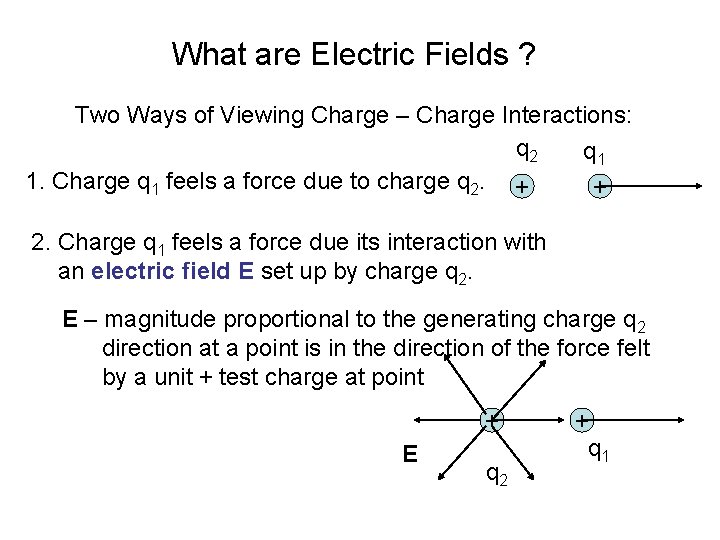
What are Electric Fields ? Two Ways of Viewing Charge – Charge Interactions: q 2 q 1 1. Charge q 1 feels a force due to charge q 2. + + 2. Charge q 1 feels a force due its interaction with an electric field E set up by charge q 2. E – magnitude proportional to the generating charge q 2 direction at a point is in the direction of the force felt by a unit + test charge at point + E q 2 + q 1
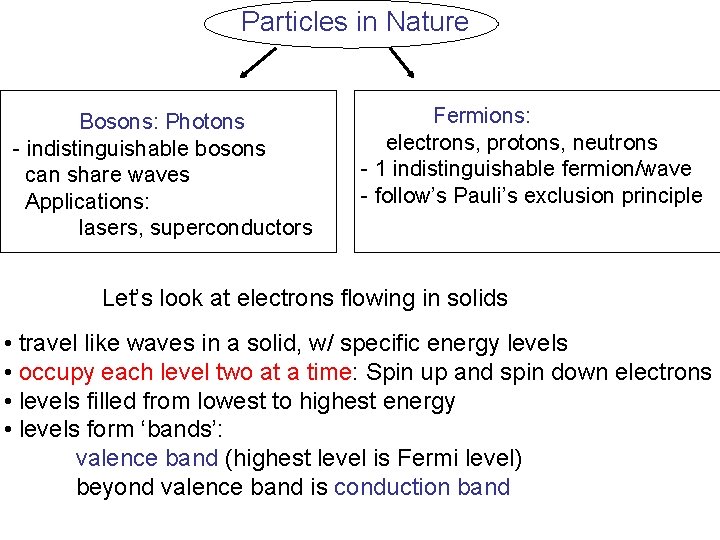
Particles in Nature Bosons: Photons - indistinguishable bosons can share waves Applications: lasers, superconductors Fermions: electrons, protons, neutrons - 1 indistinguishable fermion/wave - follow’s Pauli’s exclusion principle Let’s look at electrons flowing in solids • travel like waves in a solid, w/ specific energy levels • occupy each level two at a time: Spin up and spin down electrons • levels filled from lowest to highest energy • levels form ‘bands’: valence band (highest level is Fermi level) beyond valence band is conduction band
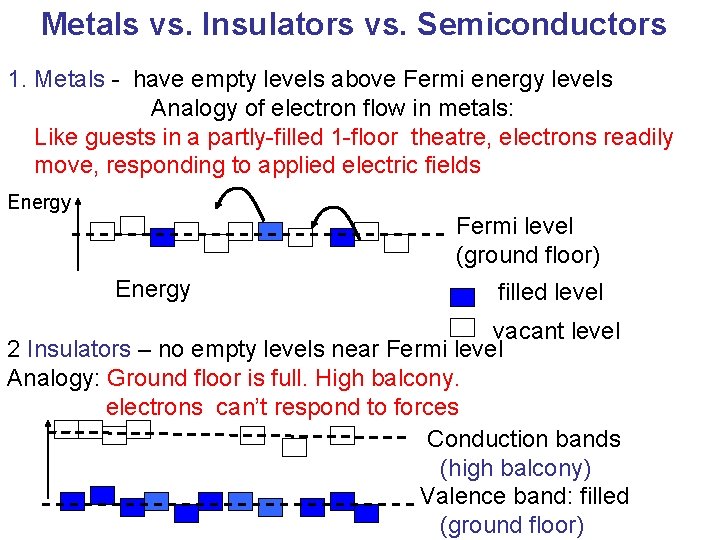
Metals vs. Insulators vs. Semiconductors 1. Metals - have empty levels above Fermi energy levels Analogy of electron flow in metals: Like guests in a partly-filled 1 -floor theatre, electrons readily move, responding to applied electric fields Energy Fermi level (ground floor) Energy filled level vacant level 2 Insulators – no empty levels near Fermi level Analogy: Ground floor is full. High balcony. electrons can’t respond to forces Conduction bands (high balcony) Valence band: filled (ground floor)
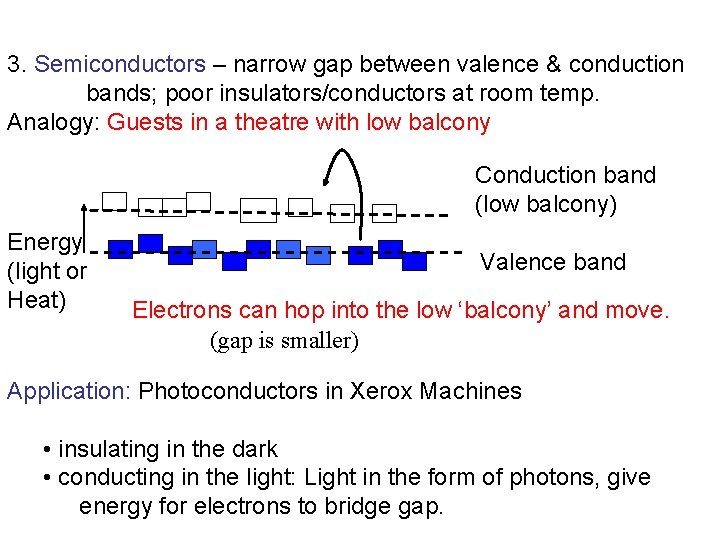
3. Semiconductors – narrow gap between valence & conduction bands; poor insulators/conductors at room temp. Analogy: Guests in a theatre with low balcony Conduction band (low balcony) Energy (light or Heat) Valence band Electrons can hop into the low ‘balcony’ and move. (gap is smaller) Application: Photoconductors in Xerox Machines • insulating in the dark • conducting in the light: Light in the form of photons, give energy for electrons to bridge gap.
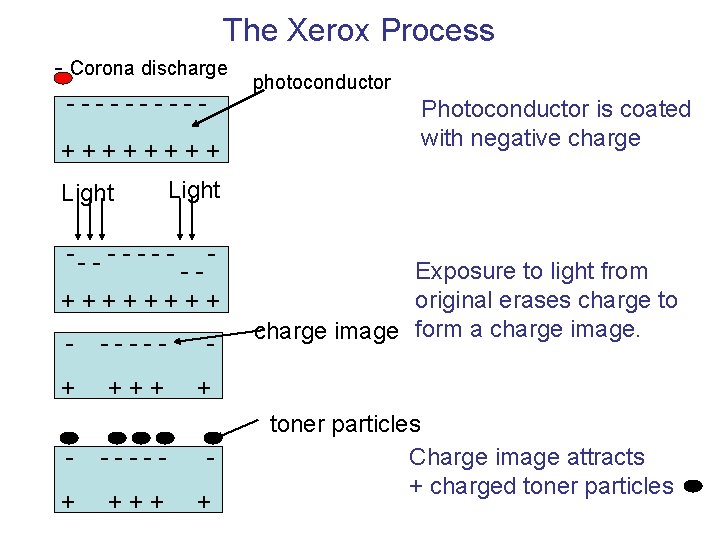
The Xerox Process - Corona discharge -----++++ Light - -++++ +- Photoconductor is coated with negative charge Light -- - - - +- photoconductor -----+-+- +- Exposure to light from original erases charge to charge image form a charge image. toner particles Charge image attracts + charged toner particles
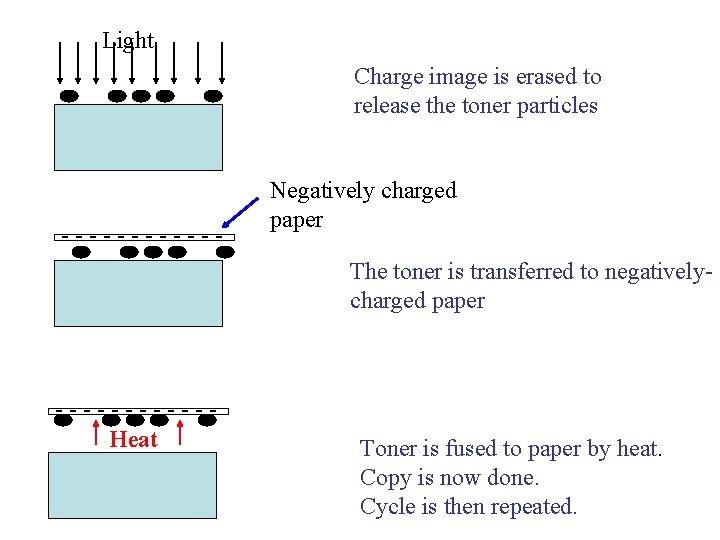
Light Charge image is erased to release the toner particles - ------------ - ------Heat - ----- - Negatively charged paper The toner is transferred to negativelycharged paper Toner is fused to paper by heat. Copy is now done. Cycle is then repeated.
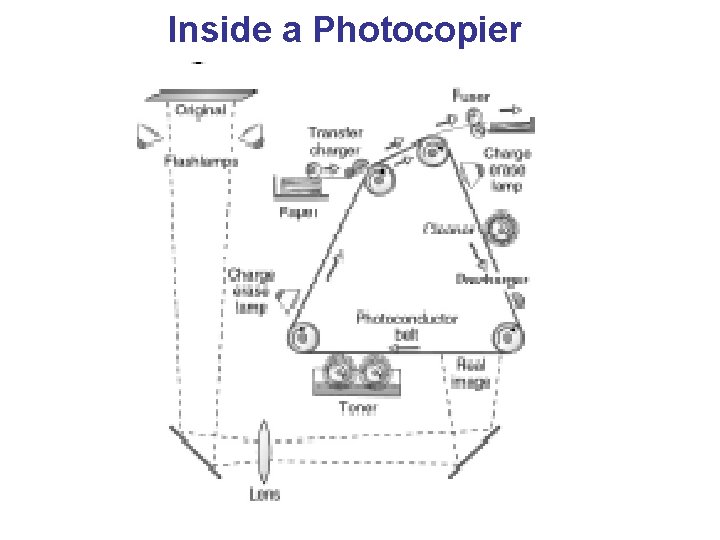
Inside a Photocopier