The Fisherman and the Jinnee From The Thousand




- Slides: 11
The Fisherman and the Jinnee From The Thousand One Nights Translated by N. J Dawood
The Fisherman and the Jinnee �Ancient Persian and Muslim Folklore �Has story-within-a-story structure �Folktales – part of the oral tradition passed down by word of mouth for centuries before being written down. �Usually contain magical details �Usually contain a lesson about life �Usually contain characters who possess one or two main traits �Usually contain a clear separation between good and evil.
Reading Strategy: Summarizing �A Summary is a brief statement expressing the key details of a literary work. �To summarize: �Identify the details that are essential to your understanding of the story �Next, organize those details into a concise statement �Summarize to aid your understanding of literature.
Vocabulary Builder �Inverted �Blasphemous �Adjured �indignantly �Resolutely �Adj. upside down �Adj, showing disrespect toward God or religious teachings �Ordered solemnly �Adv. In a way showing righteous anger or scorn �Adv. In a determined way
Vocabulary Continued �Enraptured �Munificence �ominous �Adj. Completely delighted; spellbound �N. Great generosity �Adj. Hinting at bad things to come
Word Analysis: Latin Root vert �The Latin root –vert- means “turn. ” �Inverted – means “turned upside down. ” �Using your understanding of the root word –vert-, write a brief definition of the italicized word in each of the following sentences: �We can convert this old theater into a store. �If the new system does not work, we will revert to the old one. �The plane was diverted to another airport.
Spelling Strategy – “f” Spelled as “ph” �The f sound is sometimes spelled ph, as in blasphemous. �More often, it is spelled f or ff: fish, staff. �Rewrite the following sentence, correcting the misspelled words in italics. �The fysician was bafled by the ffisherman’s afliction.
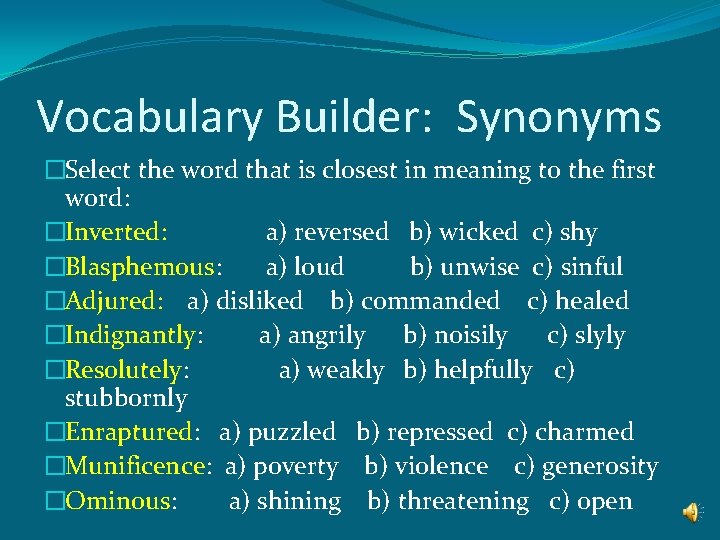
Vocabulary Builder: Synonyms �Select the word that is closest in meaning to the first word: �Inverted: a) reversed b) wicked c) shy �Blasphemous: a) loud b) unwise c) sinful �Adjured: a) disliked b) commanded c) healed �Indignantly: a) angrily b) noisily c) slyly �Resolutely: a) weakly b) helpfully c) stubbornly �Enraptured: a) puzzled b) repressed c) charmed �Munificence: a) poverty b) violence c) generosity �Ominous: a) shining b) threatening c) open
Grammar and Style Lesson �Action Verbs such as saw, thought , and went, express physical or mental action. �Linking verbs, such as was, felt, and became, express a state of being. �Linking verbs are followed by a noun or pronoun that renames the subject or by an adjective that describes it. �Some linking verbs can also function as action verbs. � If you can replace the verb with a form of be – such as am, is, are, was, were - and still express a similar meaning, the verb is a linking verb.
Action and Linking Verbs Action Verb Linking Verb �The Fisherman looked in the bottle �We tasted the food. �The jinnee looked monstrous (was) �The food tasted good. (was) � Notice how the subject takes action to perform the verb. �Notice how the subjects are in a state of being; they cannot perform an action. �Notice how both highlighted verbs can be replaced with the being verb “was. ”
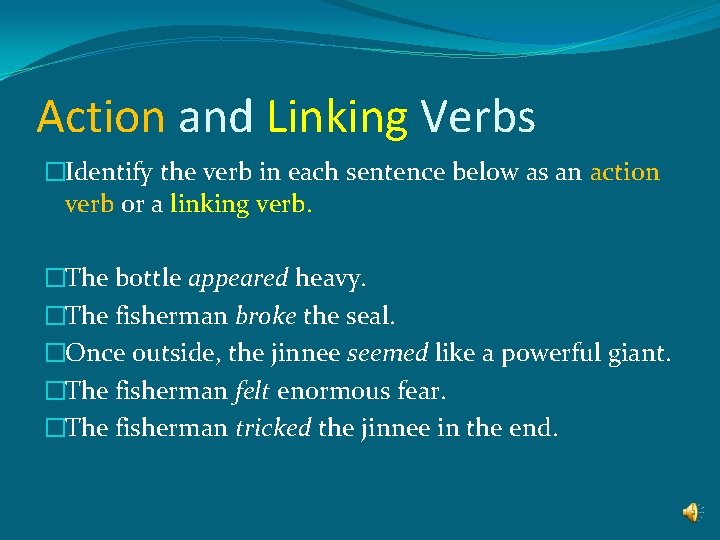
Action and Linking Verbs �Identify the verb in each sentence below as an action verb or a linking verb. �The bottle appeared heavy. �The fisherman broke the seal. �Once outside, the jinnee seemed like a powerful giant. �The fisherman felt enormous fear. �The fisherman tricked the jinnee in the end.