The European Parliament and chemicals policy Axel Singhofen
- Slides: 9
The European Parliament and chemicals policy Axel Singhofen Adviser for Public Health and Consumer Policy
EC legislative process l European Commission (COM) - right of initiative = only body that can make a legisl. proposal - > 90% of all COM proposals will become law - ± 80% of final content determined by COM proposal l European Parliament (EP) and enviro legislation - co-legislator = equal power to all 15 Member States (=Council) - no fixed majorities, no “governing” party • 8 political groups: – 2 big groups: Conservatives 37%, Socialists 28% – 3 small groups: Liberals 8%, United Left 8%, Greens/EFA 7% – 3 very small groups: UEN 4%, EDD 3%, non-attached 5%) - EP generally the “greenest” of all three institutions
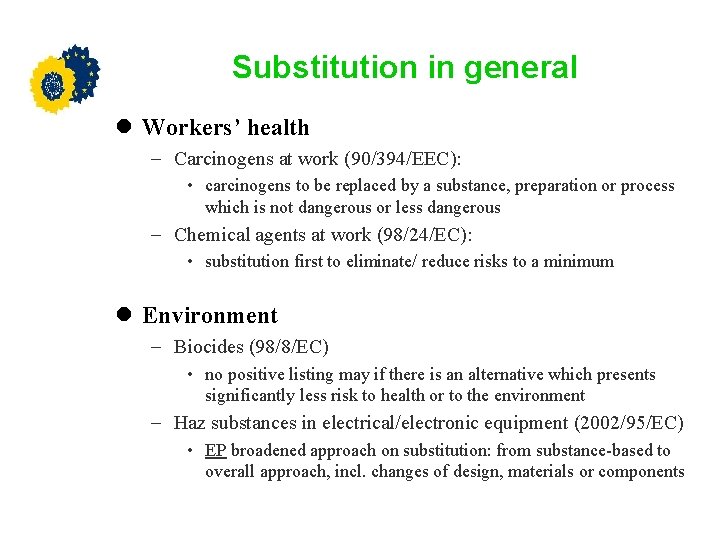
Substitution in general l Workers’ health - Carcinogens at work (90/394/EEC): • carcinogens to be replaced by a substance, preparation or process which is not dangerous or less dangerous - Chemical agents at work (98/24/EC): • substitution first to eliminate/ reduce risks to a minimum l Environment - Biocides (98/8/EC) • no positive listing may if there is an alternative which presents significantly less risk to health or to the environment - Haz substances in electrical/electronic equipment (2002/95/EC) • EP broadened approach on substitution: from substance-based to overall approach, incl. changes of design, materials or components
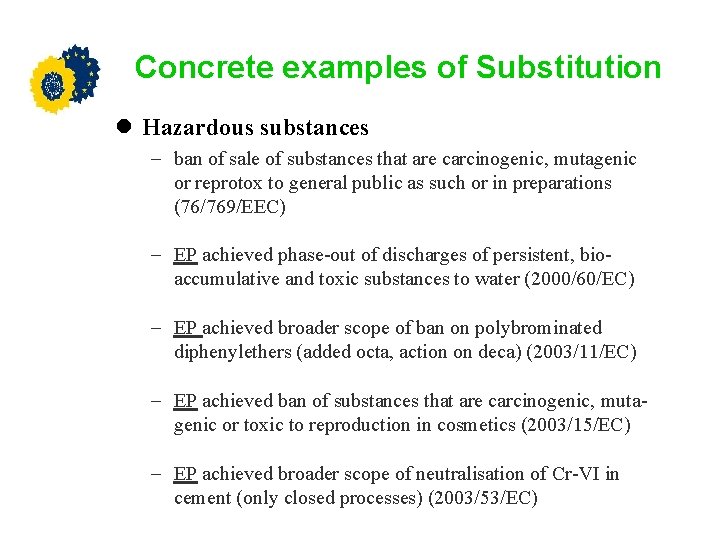
Concrete examples of Substitution l Hazardous substances - ban of sale of substances that are carcinogenic, mutagenic or reprotox to general public as such or in preparations (76/769/EEC) - EP achieved phase-out of discharges of persistent, bioaccumulative and toxic substances to water (2000/60/EC) - EP achieved broader scope of ban on polybrominated diphenylethers (added octa, action on deca) (2003/11/EC) - EP achieved ban of substances that are carcinogenic, mutagenic or toxic to reproduction in cosmetics (2003/15/EC) - EP achieved broader scope of neutralisation of Cr-VI in cement (only closed processes) (2003/53/EC)
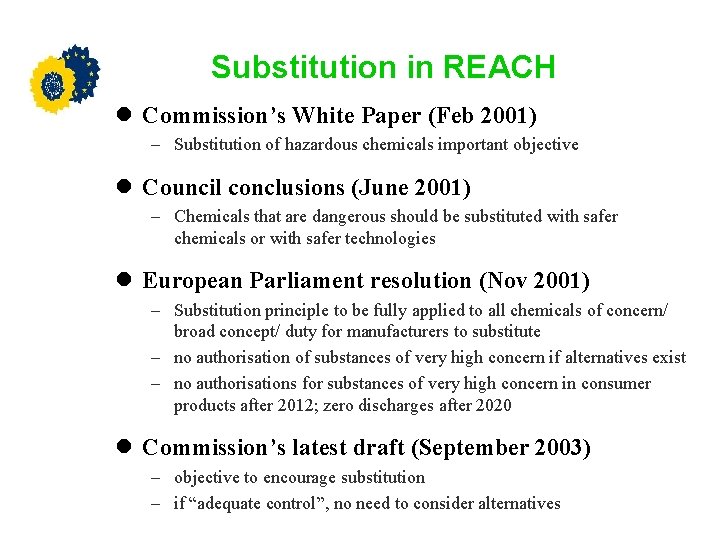
Substitution in REACH l Commission’s White Paper (Feb 2001) - Substitution of hazardous chemicals important objective l Council conclusions (June 2001) - Chemicals that are dangerous should be substituted with safer chemicals or with safer technologies l European Parliament resolution (Nov 2001) - Substitution principle to be fully applied to all chemicals of concern/ broad concept/ duty for manufacturers to substitute - no authorisation of substances of very high concern if alternatives exist - no authorisations for substances of very high concern in consumer products after 2012; zero discharges after 2020 l Commission’s latest draft (September 2003) - objective to encourage substitution - if “adequate control”, no need to consider alternatives
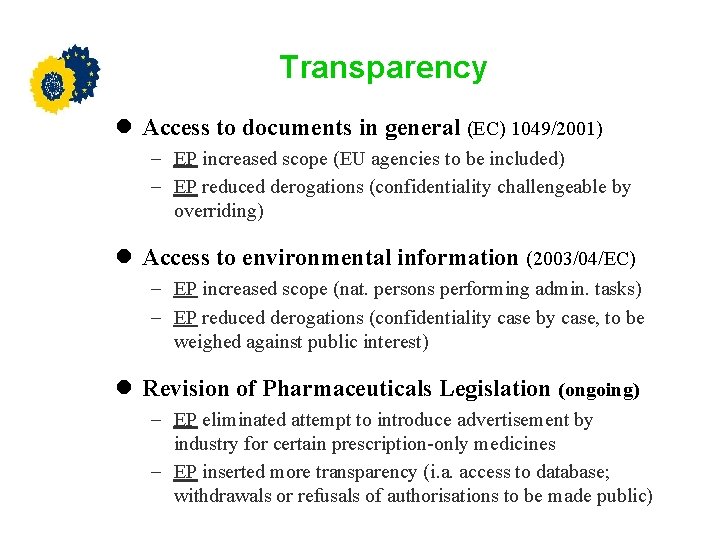
Transparency l Access to documents in general (EC) 1049/2001) - EP increased scope (EU agencies to be included) - EP reduced derogations (confidentiality challengeable by overriding) l Access to environmental information (2003/04/EC) - EP increased scope (nat. persons performing admin. tasks) - EP reduced derogations (confidentiality case by case, to be weighed against public interest) l Revision of Pharmaceuticals Legislation (ongoing) - EP eliminated attempt to introduce advertisement by industry for certain prescription-only medicines - EP inserted more transparency (i. a. access to database; withdrawals or refusals of authorisations to be made public)
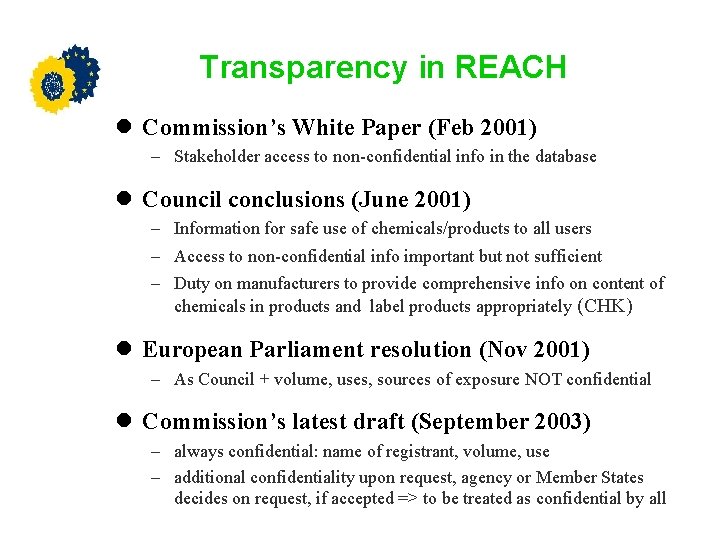
Transparency in REACH l Commission’s White Paper (Feb 2001) - Stakeholder access to non-confidential info in the database l Council conclusions (June 2001) - Information for safe use of chemicals/products to all users - Access to non-confidential info important but not sufficient - Duty on manufacturers to provide comprehensive info on content of chemicals in products and label products appropriately (CHK) l European Parliament resolution (Nov 2001) - As Council + volume, uses, sources of exposure NOT confidential l Commission’s latest draft (September 2003) - always confidential: name of registrant, volume, use - additional confidentiality upon request, agency or Member States decides on request, if accepted => to be treated as confidential by all
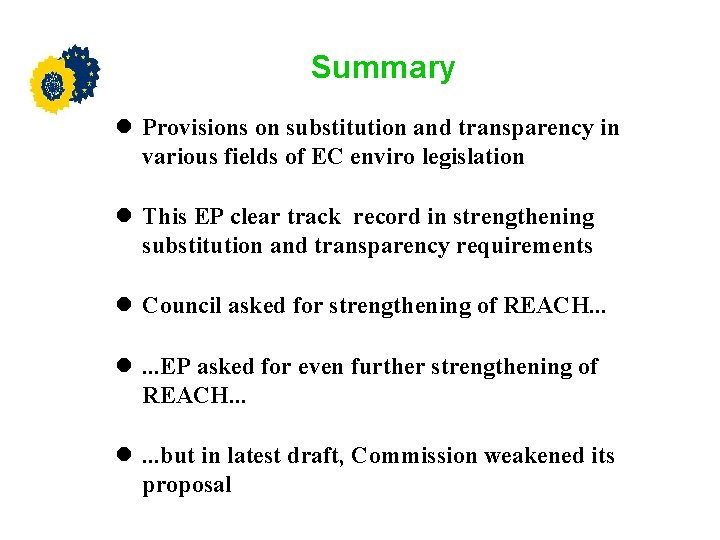
Summary l Provisions on substitution and transparency in various fields of EC enviro legislation l This EP clear track record in strengthening substitution and transparency requirements l Council asked for strengthening of REACH. . . l. . . EP asked for even further strengthening of REACH. . . l. . . but in latest draft, Commission weakened its proposal
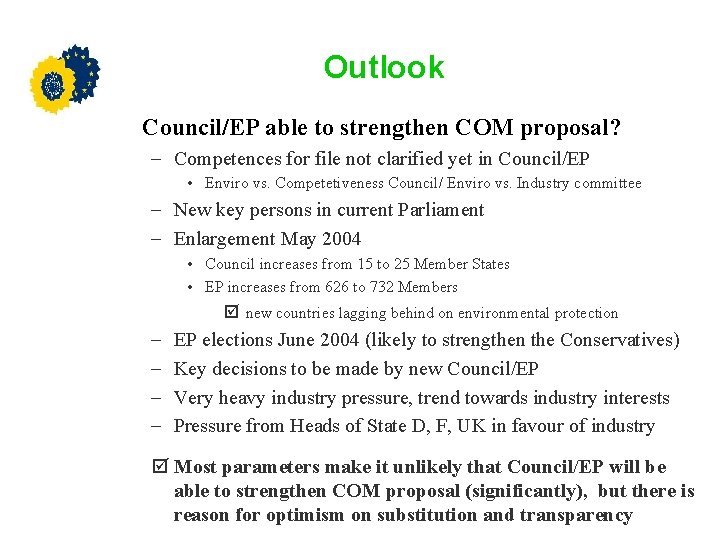
Outlook Council/EP able to strengthen COM proposal? - Competences for file not clarified yet in Council/EP • Enviro vs. Competetiveness Council/ Enviro vs. Industry committee - New key persons in current Parliament - Enlargement May 2004 • Council increases from 15 to 25 Member States • EP increases from 626 to 732 Members þ new countries lagging behind on environmental protection - EP elections June 2004 (likely to strengthen the Conservatives) Key decisions to be made by new Council/EP Very heavy industry pressure, trend towards industry interests Pressure from Heads of State D, F, UK in favour of industry þ Most parameters make it unlikely that Council/EP will be able to strengthen COM proposal (significantly), but there is reason for optimism on substitution and transparency