The Creation of the Monster GUIDED ANALYSIS p


- Slides: 6
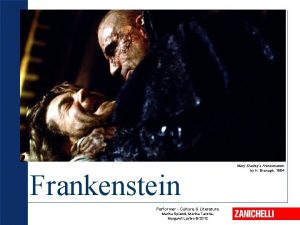
The Creation of the Monster GUIDED ANALYSIS p. 300 FRANKENSTEIN OR THE MODERN PROMETHEUS
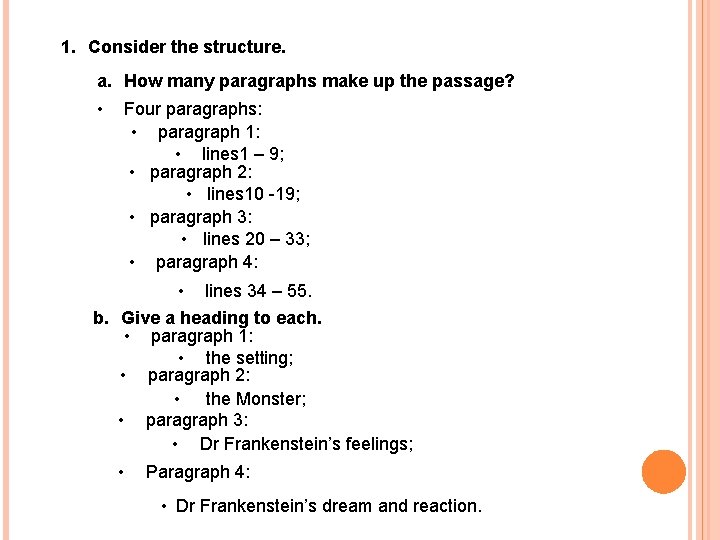
1. Consider the structure. a. How many paragraphs make up the passage? • Four paragraphs: • paragraph 1: • lines 1 – 9; • paragraph 2: • lines 10 -19; • paragraph 3: • lines 20 – 33; • paragraph 4: • lines 34 – 55. b. Give a heading to each. • paragraph 1: • the setting; • paragraph 2: • the Monster; • paragraph 3: • Dr Frankenstein’s feelings; • Paragraph 4: • Dr Frankenstein’s dream and reaction.
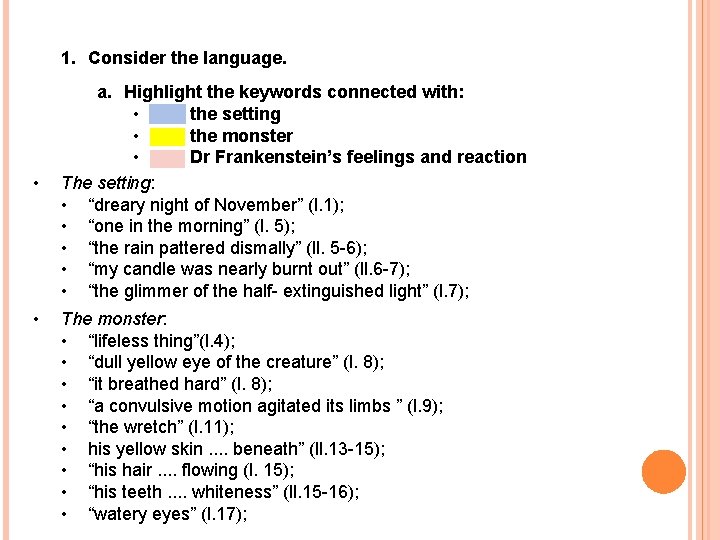
1. Consider the language. • • a. Highlight the keywords connected with: • the setting • the monster • Dr Frankenstein’s feelings and reaction The setting: • “dreary night of November” (l. 1); • “one in the morning” (l. 5); • “the rain pattered dismally” (ll. 5 -6); • “my candle was nearly burnt out” (ll. 6 -7); • “the glimmer of the half- extinguished light” (l. 7); The monster: • “lifeless thing”(l. 4); • “dull yellow eye of the creature” (l. 8); • “it breathed hard” (l. 8); • “a convulsive motion agitated its limbs ” (l. 9); • “the wretch” (l. 11); • his yellow skin. . beneath” (ll. 13 -15); • “his hair. . flowing (l. 15); • “his teeth. . whiteness” (ll. 15 -16); • “watery eyes” (l. 17);
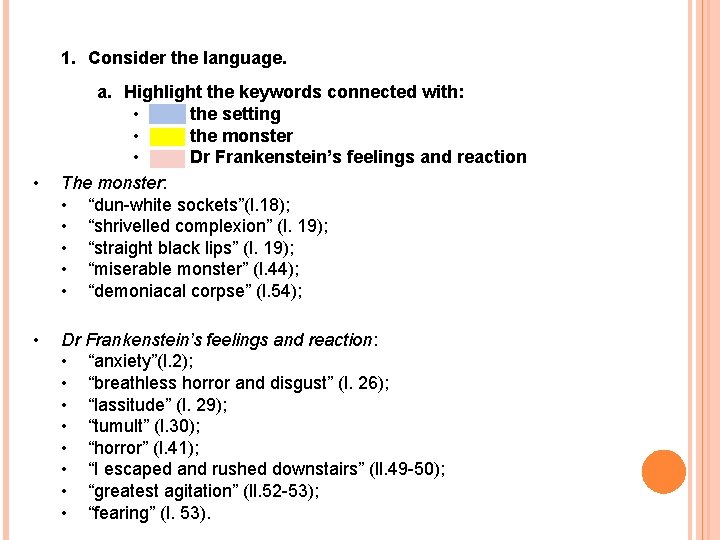
1. Consider the language. • • a. Highlight the keywords connected with: • the setting • the monster • Dr Frankenstein’s feelings and reaction The monster: • “dun-white sockets”(l. 18); • “shrivelled complexion” (l. 19); • “straight black lips” (l. 19); • “miserable monster” (l. 44); • “demoniacal corpse” (l. 54); Dr Frankenstein’s feelings and reaction: • “anxiety”(l. 2); • “breathless horror and disgust” (l. 26); • “lassitude” (l. 29); • “tumult” (l. 30); • “horror” (l. 41); • “I escaped and rushed downstairs” (ll. 49 -50); • “greatest agitation” (ll. 52 -53); • “fearing” (l. 53).
b. Analyse your answer to the previous question and say if the setting, the creature and Frankenstein’s reaction are related. Give reasons. • Yes, they are strictly connected because they all contribute to creating an atmosphere of horror, fear and uneasiness. 3. Now consider the narrative technique. a. How is the story told? Who is the narrator? • The story is told by a first-person narrator. The narrator is Dr Frankenstein himself. b. What narrative mode/s is/are used? a. Narration b. Description c. Dialogue 4. Complete the summary with the words given. One word is used twice? • demoniacal pane dreary monster nightmares experiments refuge horror rain regretting does assembled life 4. Dr Frankenstein’s experiments come to an end on a dreary November night, with the rain beating on the windows panes: he finally succeeds in bringing to life thing he has assembled. As soon as he does, he is filled with horror at what he sees. He takes refuge in his room but has nightmares; on waking he sees the monster at his bedside. Again filled with horror, he rushes downstairs, regretting he ever created what he calls a “ demoniacal corpse”.
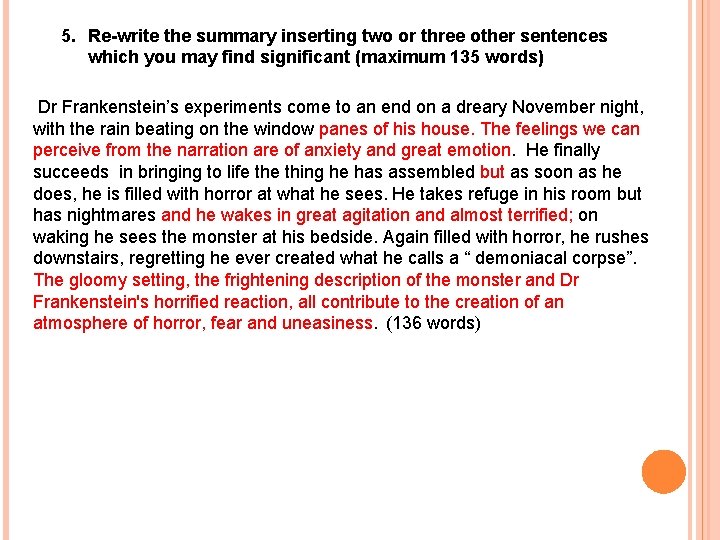
5. Re-write the summary inserting two or three other sentences which you may find significant (maximum 135 words) Dr Frankenstein’s experiments come to an end on a dreary November night, with the rain beating on the window panes of his house. The feelings we can perceive from the narration are of anxiety and great emotion. He finally succeeds in bringing to life thing he has assembled but as soon as he does, he is filled with horror at what he sees. He takes refuge in his room but has nightmares and he wakes in great agitation and almost terrified; on waking he sees the monster at his bedside. Again filled with horror, he rushes downstairs, regretting he ever created what he calls a “ demoniacal corpse”. The gloomy setting, the frightening description of the monster and Dr Frankenstein's horrified reaction, all contribute to the creation of an atmosphere of horror, fear and uneasiness. (136 words)