TEM in geological science polymorphism polytypism polysomatism F
- Slides: 26
TEM in geological science polymorphism, polytypism, polysomatism F. Nieto Dto. de Mineralogía y Petrología Instituto Ándaluz de Ciencias de la Tierra Universidad de Granada-CSIC
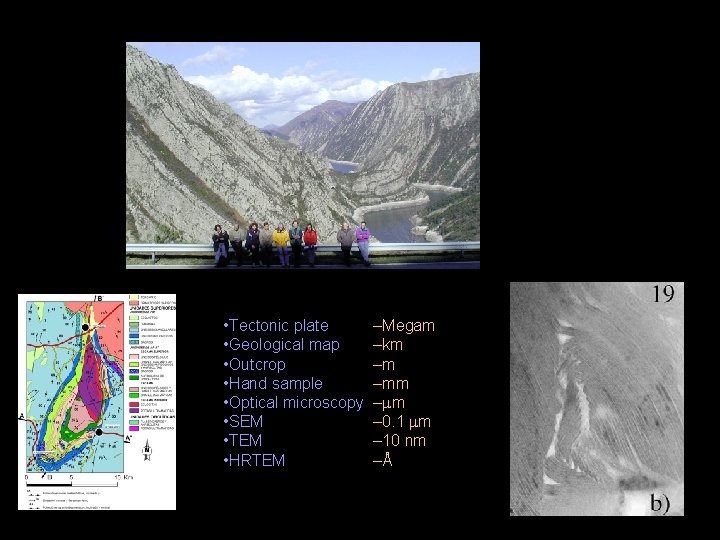
• Tectonic plate • Geological map • Outcrop • Hand sample • Optical microscopy • SEM • TEM • HRTEM –Megam –km –m –mm – 0. 1 m – 10 nm –Å
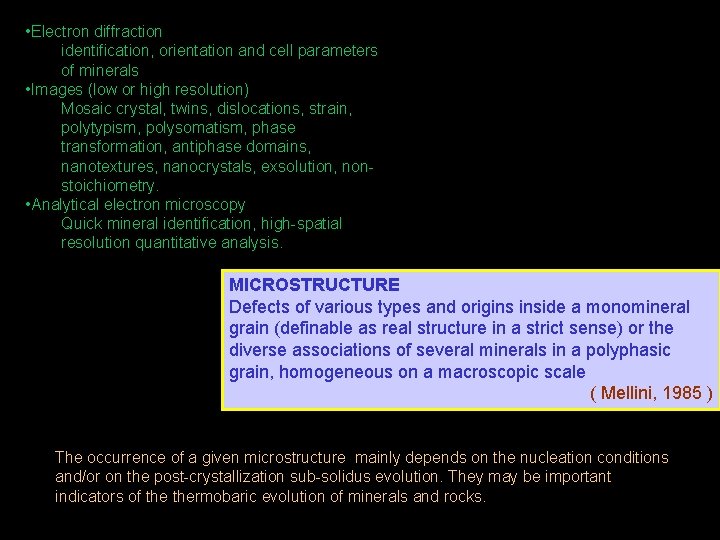
• Electron diffraction identification, orientation and cell parameters of minerals • Images (low or high resolution) Mosaic crystal, twins, dislocations, strain, polytypism, polysomatism, phase transformation, antiphase domains, nanotextures, nanocrystals, exsolution, nonstoichiometry. • Analytical electron microscopy Quick mineral identification, high-spatial resolution quantitative analysis. MICROSTRUCTURE Defects of various types and origins inside a monomineral grain (definable as real structure in a strict sense) or the diverse associations of several minerals in a polyphasic grain, homogeneous on a macroscopic scale ( Mellini, 1985 ) The occurrence of a given microstructure mainly depends on the nucleation conditions and/or on the post-crystallization sub-solidus evolution. They may be important indicators of thermobaric evolution of minerals and rocks.
Polymorphic transformations • Reconstructive transformations • Displacive transformations • Order-disorder transformations Polytypism Polysomatism
Polymorphic transformations • Reconstructive transformations • Displacive transformations • Order-disorder transformations
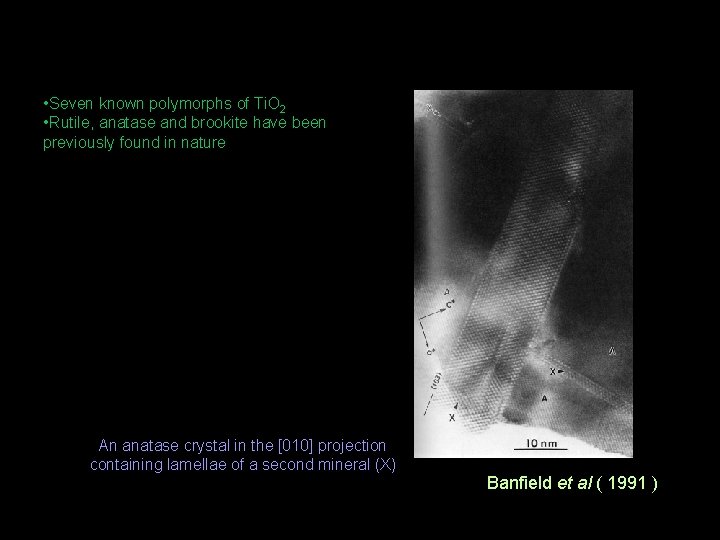
• Seven known polymorphs of Ti. O 2 • Rutile, anatase and brookite have been previously found in nature An anatase crystal in the [010] projection containing lamellae of a second mineral (X) Banfield et al ( 1991 )
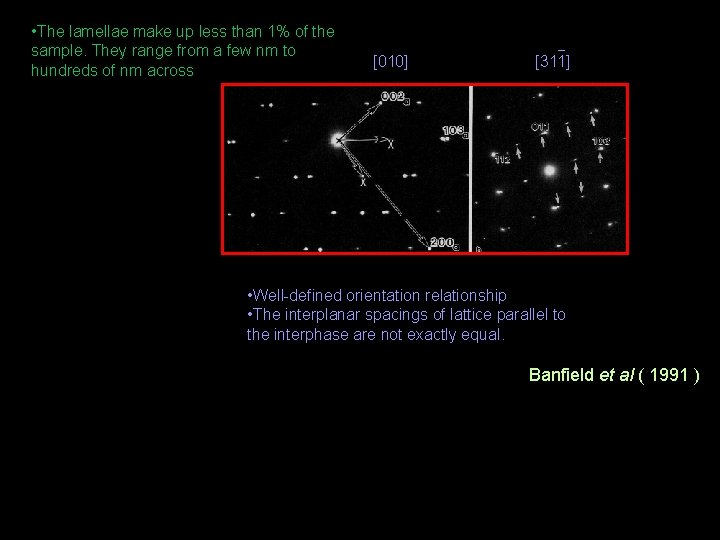
• The lamellae make up less than 1% of the sample. They range from a few nm to hundreds of nm across [010] [311] • Well-defined orientation relationship • The interplanar spacings of lattice parallel to the interphase are not exactly equal. Banfield et al ( 1991 )
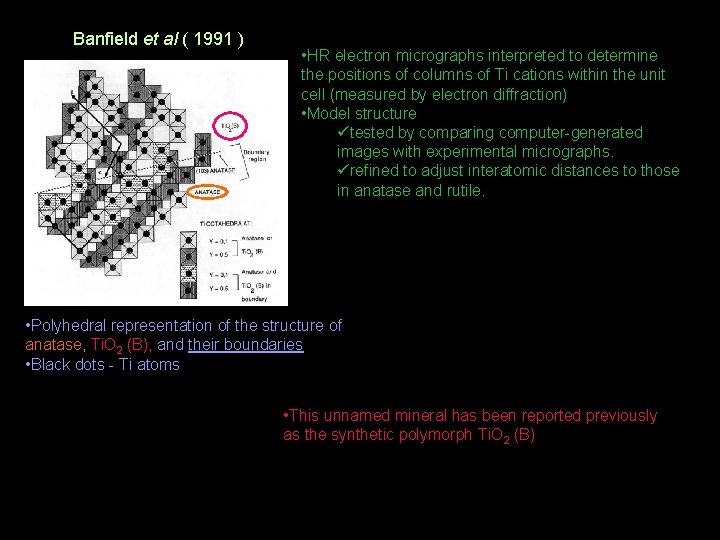
Banfield et al ( 1991 ) • HR electron micrographs interpreted to determine the positions of columns of Ti cations within the unit cell (measured by electron diffraction) • Model structure ütested by comparing computer-generated images with experimental micrographs. ürefined to adjust interatomic distances to those in anatase and rutile. • Polyhedral representation of the structure of anatase, Ti. O 2 (B), and their boundaries • Black dots - Ti atoms • This unnamed mineral has been reported previously as the synthetic polymorph Ti. O 2 (B)
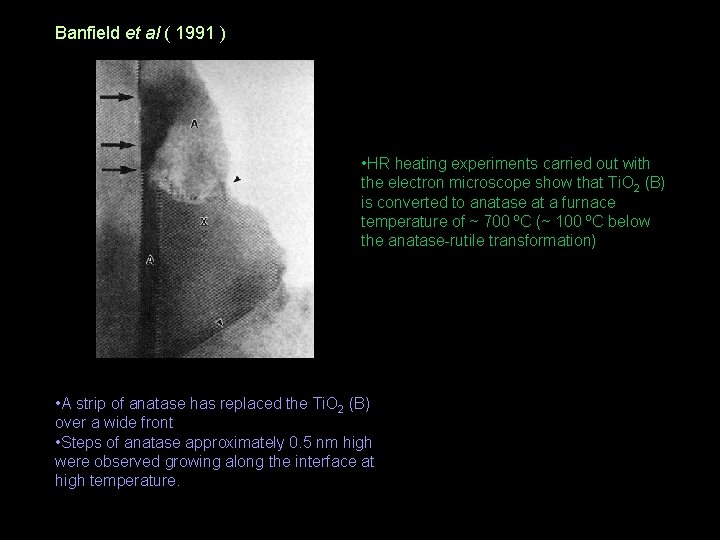
Banfield et al ( 1991 ) • HR heating experiments carried out with the electron microscope show that Ti. O 2 (B) is converted to anatase at a furnace temperature of ~ 700 ºC (~ 100 ºC below the anatase-rutile transformation) • A strip of anatase has replaced the Ti. O 2 (B) over a wide front • Steps of anatase approximately 0. 5 nm high were observed growing along the interface at high temperature.
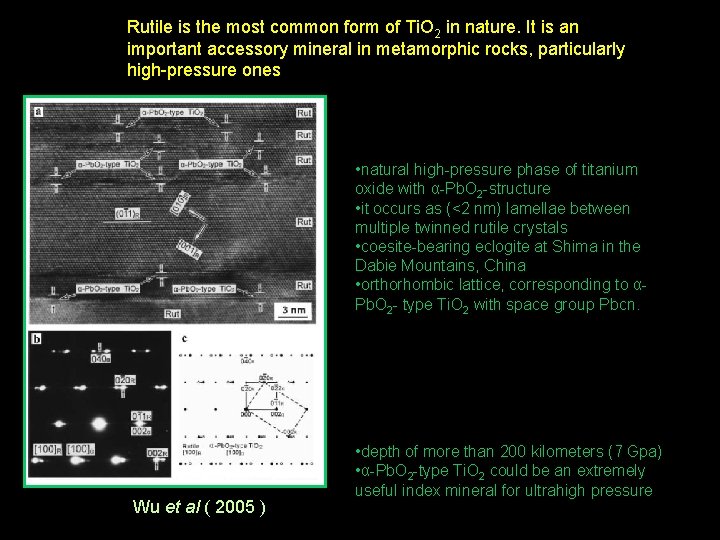
Rutile is the most common form of Ti. O 2 in nature. It is an important accessory mineral in metamorphic rocks, particularly high-pressure ones • natural high-pressure phase of titanium oxide with α-Pb. O 2 -structure • it occurs as (<2 nm) lamellae between multiple twinned rutile crystals • coesite-bearing eclogite at Shima in the Dabie Mountains, China • orthorhombic lattice, corresponding to αPb. O 2 - type Ti. O 2 with space group Pbcn. Wu et al ( 2005 ) • depth of more than 200 kilometers (7 Gpa) • α-Pb. O 2 -type Ti. O 2 could be an extremely useful index mineral for ultrahigh pressure
Polymorphic transformations • Reconstructive transformations • Displacive transformations • Order-disorder transformations
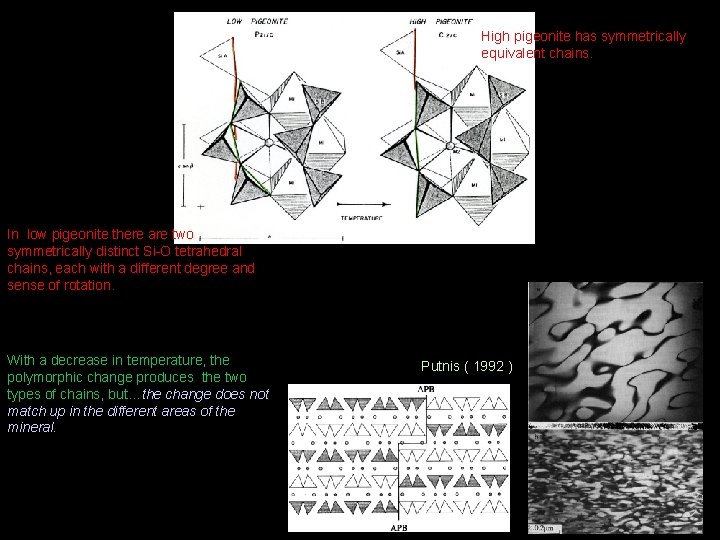
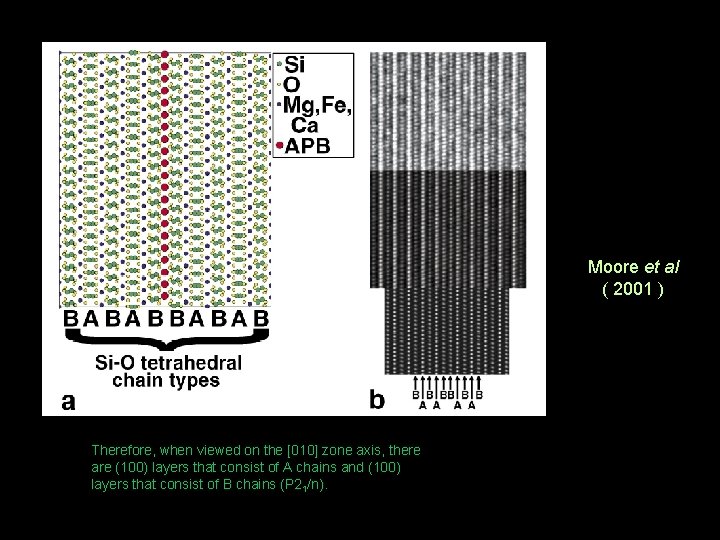
High pigeonite has symmetrically equivalent chains. In low pigeonite there are two symmetrically distinct Si-O tetrahedral chains, each with a different degree and sense of rotation. With a decrease in temperature, the polymorphic change produces the two types of chains, but…the change does not match up in the different areas of the mineral. Putnis ( 1992 )
Moore et al ( 2001 ) Therefore, when viewed on the [010] zone axis, there are (100) layers that consist of A chains and (100) layers that consist of B chains (P 21/n).
Polymorphic transformations • Reconstructive transformations • Displacive transformations • Order-disorder transformations
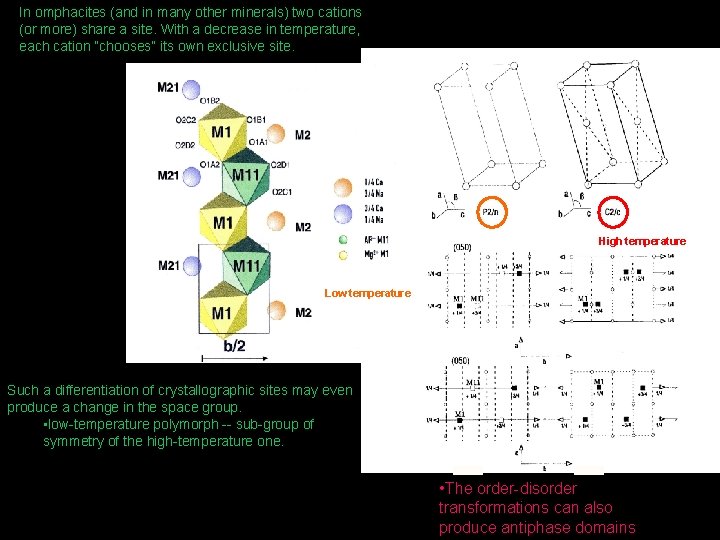
In omphacites (and in many other minerals) two cations (or more) share a site. With a decrease in temperature, each cation “chooses” its own exclusive site. High temperature Low temperature Such a differentiation of crystallographic sites may even produce a change in the space group. • low-temperature polymorph -- sub-group of symmetry of the high-temperature one. • The order-disorder transformations can also produce antiphase domains
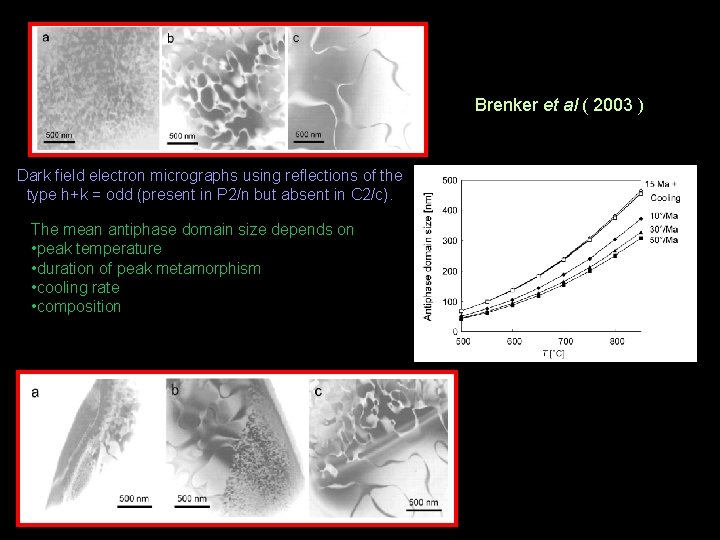
Brenker et al ( 2003 ) Dark field electron micrographs using reflections of the type h+k = odd (present in P 2/n but absent in C 2/c). The mean antiphase domain size depends on • peak temperature • duration of peak metamorphism • cooling rate • composition
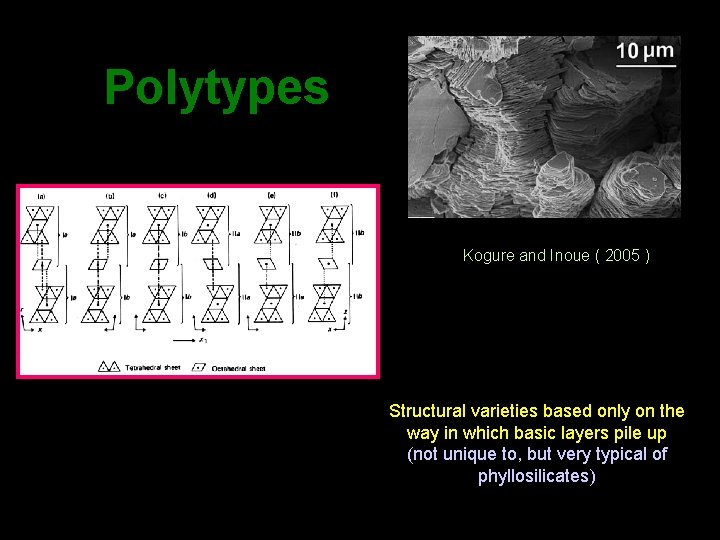
Polytypes Kogure and Inoue ( 2005 ) Structural varieties based only on the way in which basic layers pile up (not unique to, but very typical of phyllosilicates)
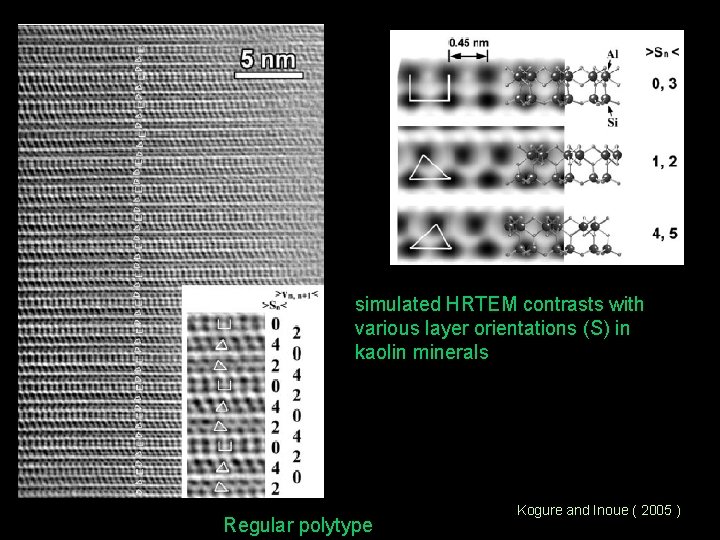
simulated HRTEM contrasts with various layer orientations (S) in kaolin minerals Regular polytype Kogure and Inoue ( 2005 )
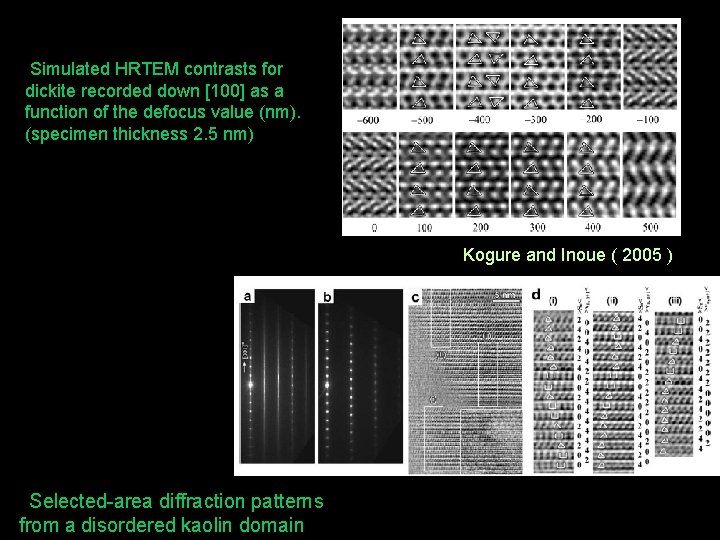
Simulated HRTEM contrasts for dickite recorded down [100] as a function of the defocus value (nm). (specimen thickness 2. 5 nm) Kogure and Inoue ( 2005 ) Selected-area diffraction patterns from a disordered kaolin domain
Polysomatism
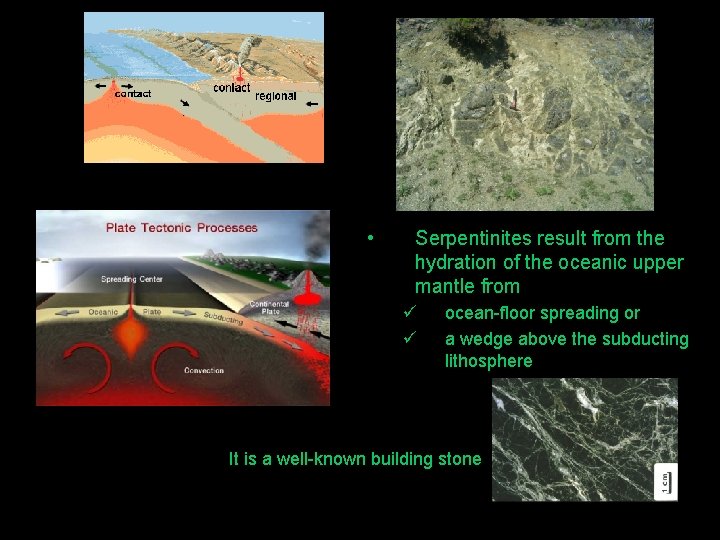
• Serpentinites result from the hydration of the oceanic upper mantle from ü ü ocean-floor spreading or a wedge above the subducting lithosphere It is a well-known building stone
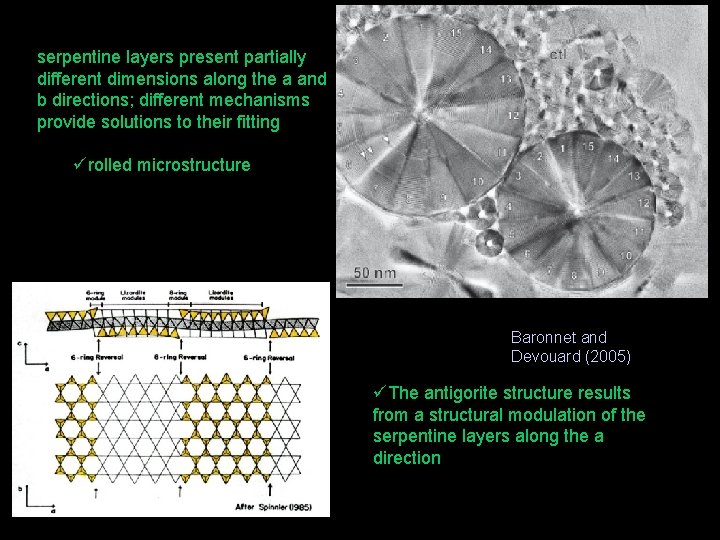
serpentine layers present partially different dimensions along the a and b directions; different mechanisms provide solutions to their fitting ürolled microstructure Baronnet and Devouard (2005) üThe antigorite structure results from a structural modulation of the serpentine layers along the a direction
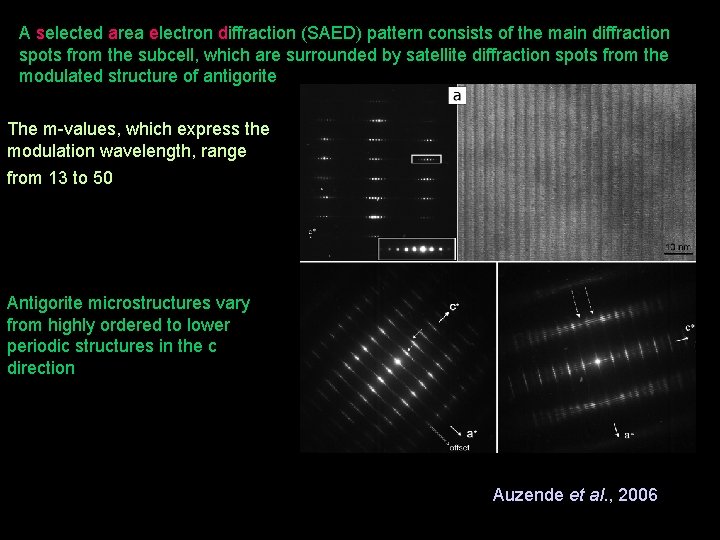
A selected area electron diffraction (SAED) pattern consists of the main diffraction spots from the subcell, which are surrounded by satellite diffraction spots from the modulated structure of antigorite The m-values, which express the modulation wavelength, range from 13 to 50 Antigorite microstructures vary from highly ordered to lower periodic structures in the c direction Auzende et al. , 2006
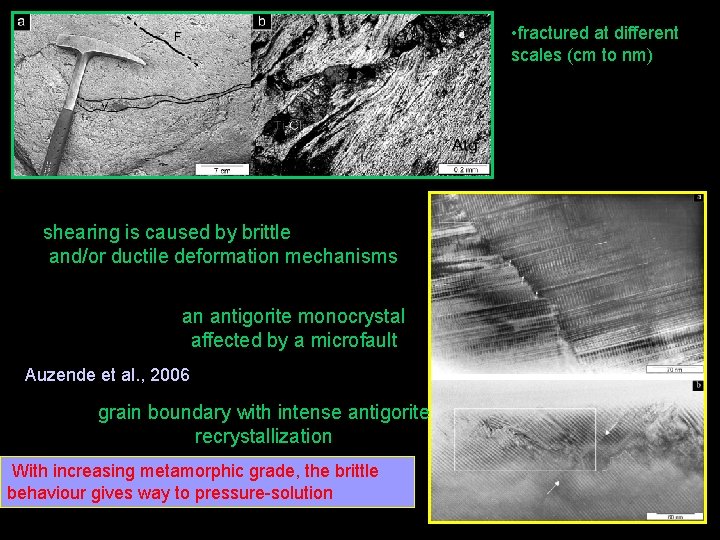
• fractured at different scales (cm to nm) shearing is caused by brittle and/or ductile deformation mechanisms an antigorite monocrystal affected by a microfault Auzende et al. , 2006 grain boundary with intense antigorite recrystallization With increasing metamorphic grade, the brittle behaviour gives way to pressure-solution
Serpentine microstructures can potentially preserve information on metamorphic conditions • Once the partial dehydration reaction is reached, antigorite may recrystallize mainly by a pressure-solution mechanism. The required fluids would be derived from the progressive dehydration of antigorite. When pore pressure becomes too high, a major fracturing event may occur (Dobson et al. , 2002) • Embrittlement accounts for deep earthquakes within the subducting lithosphere (e. g. Jung et al. , 2003) • Pressure solution is the most effective mechanism to accommodate deformation; its recurrent association with eclogite facies rocks in paleosubduction zones (the Alps, the Himalayas and the Caribbean) is consistent with the possible role of antigorite serpentinites in the preservation and exhumation of HP-LT rocks • Serpentinites can localize the deformation within a subduction/exhumation channel, thus making it possible to preserve eclogites from depths of about 100 km below the Earth’s surface.
Gracias por su atención