TAILORING EPORTFOLIOS FOR A PROFESSIONAL AUDIENCE Veena Chattaraman
- Slides: 1
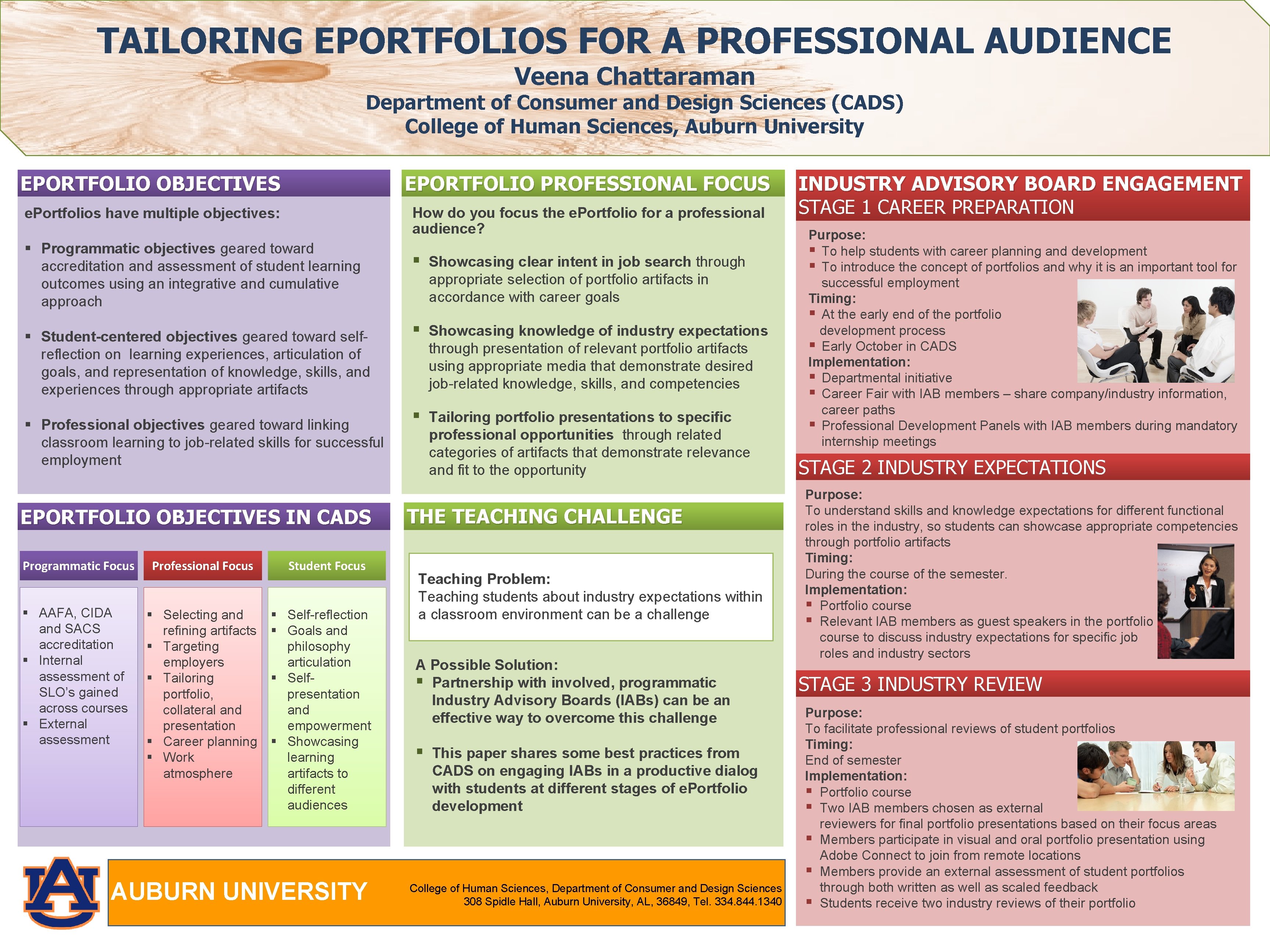
TAILORING EPORTFOLIOS FOR A PROFESSIONAL AUDIENCE Veena Chattaraman Department of Consumer and Design Sciences (CADS) College of Human Sciences, Auburn University EPORTFOLIO OBJECTIVES EPORTFOLIO PROFESSIONAL FOCUS e. Portfolios have multiple objectives: How do you focus the e. Portfolio for a professional audience? § Programmatic objectives geared toward accreditation and assessment of student learning outcomes using an integrative and cumulative approach § Student-centered objectives geared toward selfreflection on learning experiences, articulation of goals, and representation of knowledge, skills, and experiences through appropriate artifacts § Professional objectives geared toward linking classroom learning to job-related skills for successful employment EPORTFOLIO OBJECTIVES IN CADS Programmatic Focus Professional Focus § AAFA, CIDA and SACS accreditation § Internal assessment of SLO’s gained across courses § External assessment § Selecting and refining artifacts § Targeting employers § Tailoring portfolio, collateral and presentation § Career planning § Work atmosphere Student Focus § Self-reflection § Goals and philosophy articulation § Selfpresentation and empowerment § Showcasing learning artifacts to different audiences AUBURN UNIVERSITY § Showcasing clear intent in job search through appropriate selection of portfolio artifacts in accordance with career goals § Showcasing knowledge of industry expectations through presentation of relevant portfolio artifacts using appropriate media that demonstrate desired job-related knowledge, skills, and competencies § Tailoring portfolio presentations to specific professional opportunities through related categories of artifacts that demonstrate relevance and fit to the opportunity THE TEACHING CHALLENGE Teaching Problem: Teaching students about industry expectations within a classroom environment can be a challenge A Possible Solution: § Partnership with involved, programmatic Industry Advisory Boards (IABs) can be an effective way to overcome this challenge § This paper shares some best practices from CADS on engaging IABs in a productive dialog with students at different stages of e. Portfolio development College of Human Sciences, Department of Consumer and Design Sciences 308 Spidle Hall, Auburn University, AL, 36849, Tel. 334. 844. 1340 INDUSTRY ADVISORY BOARD ENGAGEMENT STAGE 1 CAREER PREPARATION Purpose: § To help students with career planning and development § To introduce the concept of portfolios and why it is an important tool for successful employment Timing: § At the early end of the portfolio development process § Early October in CADS Implementation: § Departmental initiative § Career Fair with IAB members – share company/industry information, career paths § Professional Development Panels with IAB members during mandatory internship meetings STAGE 2 INDUSTRY EXPECTATIONS Purpose: To understand skills and knowledge expectations for different functional roles in the industry, so students can showcase appropriate competencies through portfolio artifacts Timing: During the course of the semester. Implementation: § Portfolio course § Relevant IAB members as guest speakers in the portfolio course to discuss industry expectations for specific job roles and industry sectors STAGE 3 INDUSTRY REVIEW Purpose: To facilitate professional reviews of student portfolios Timing: End of semester Implementation: § Portfolio course § Two IAB members chosen as external reviewers for final portfolio presentations based on their focus areas § Members participate in visual and oral portfolio presentation using Adobe Connect to join from remote locations § Members provide an external assessment of student portfolios through both written as well as scaled feedback § Students receive two industry reviews of their portfolio