STEM and Expanded Learning in Providence NATIONAL ACADEMY


- Slides: 11
STEM and Expanded Learning in Providence NATIONAL ACADEMY OF ENGINEERING NATIONAL RESEARCH COUNCIL — BOARD ON SCIENCE EDUCATION Committee on Integrated STEM Education Washington, D. C. July 11, 2012
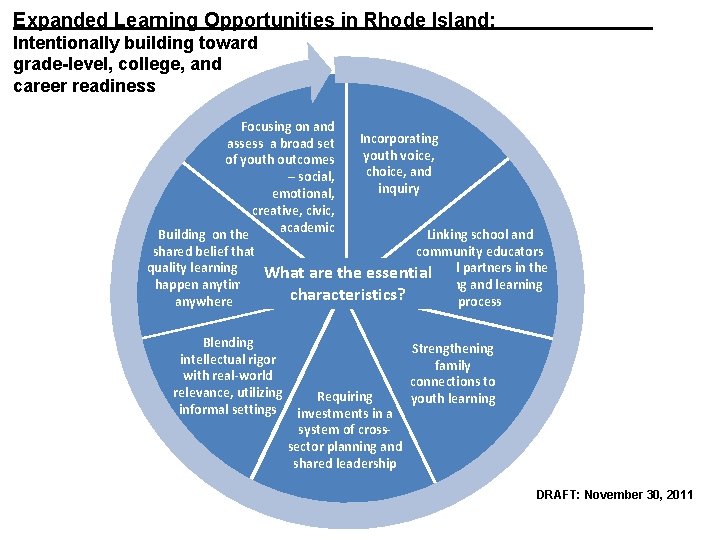
Expanded Learning Opportunities in Rhode Island: Intentionally building toward grade-level, college, and career readiness Focusing on and Incorporating assess a broad set youth voice, of youth outcomes choice, and – social, inquiry emotional, creative, civic, academic Building on the Linking school and shared belief that community educators quality learning can What are the essential as equal partners in the happen anytime, teaching and learning characteristics? anywhere process Blending intellectual rigor with real-world relevance, utilizing informal settings Requiring investments in a system of crosssector planning and shared leadership Strengthening family connections to youth learning DRAFT: November 30, 2011
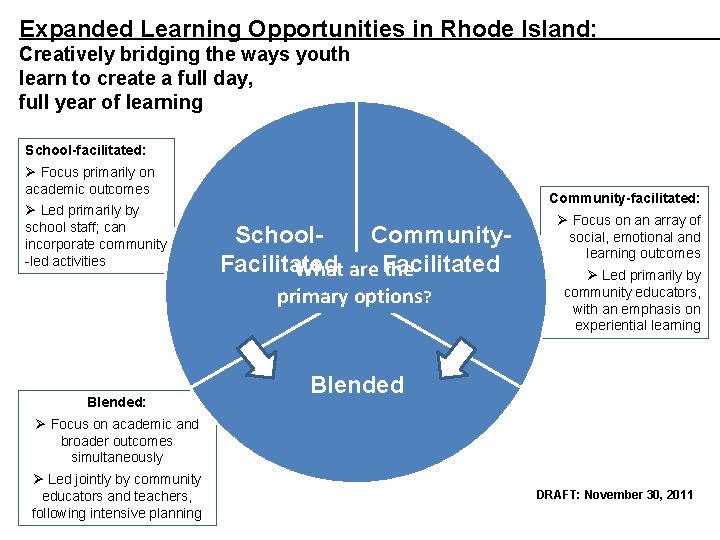
Expanded Learning Opportunities in Rhode Island: Creatively bridging the ways youth learn to create a full day, full year of learning School-facilitated: Ø Focus primarily on academic outcomes Ø Led primarily by school staff; can incorporate community -led activities Community-facilitated: School- Community- Facilitated What are Facilitated the primary options? Blended: Ø Focus on academic and broader outcomes simultaneously Ø Led jointly by community educators and teachers, following intensive planning Ø Focus on an array of social, emotional and learning outcomes Ø Led primarily by community educators, with an emphasis on experiential learning Blended DRAFT: November 30, 2011
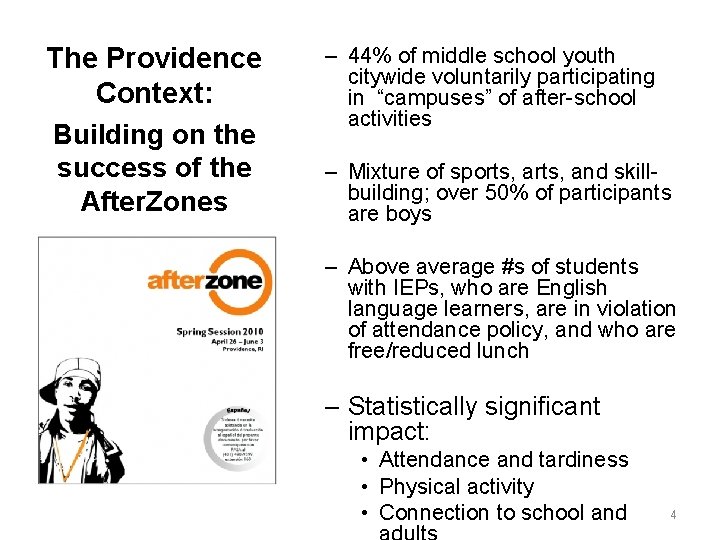
The Providence Context: Building on the success of the After. Zones – 44% of middle school youth citywide voluntarily participating in “campuses” of after-school activities – Mixture of sports, and skillbuilding; over 50% of participants are boys – Above average #s of students with IEPs, who are English language learners, are in violation of attendance policy, and who are free/reduced lunch – Statistically significant impact: • Attendance and tardiness • Physical activity • Connection to school and 4
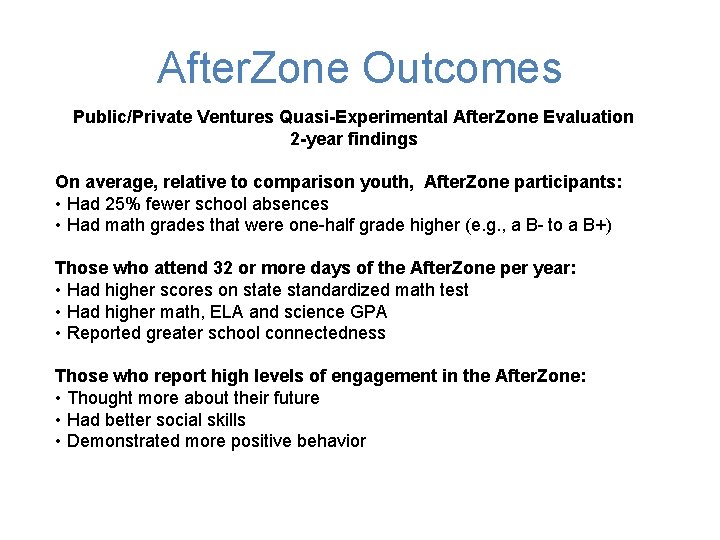
After. Zone Outcomes Public/Private Ventures Quasi-Experimental After. Zone Evaluation 2 -year findings On average, relative to comparison youth, After. Zone participants: • Had 25% fewer school absences • Had math grades that were one-half grade higher (e. g. , a B- to a B+) Those who attend 32 or more days of the After. Zone per year: • Had higher scores on state standardized math test • Had higher math, ELA and science GPA • Reported greater school connectedness Those who report high levels of engagement in the After. Zone: • Thought more about their future • Had better social skills • Demonstrated more positive behavior
Expanded Learning Elements for Providence Middle Schools Programs jointly designed and led by community educators and classroom teachers, with academic components woven into hands-on exploration Blended Practice “After. Zone Scholars” – Summer –School Year) Youth Development Programs Nationally recognized model serving as the Inquiry-Based central experience and Programs for expanded learning efforts On-going programs with defined curricula in arts, sports, and general skill-building Ongoing youth development programs led by educators taking lynchpin part in professional learning communities defining essential learning skills / strategies; includes high-quality STEM, English language arts, and academic skill-building curricula implemented by Ameri. Corps members
The Critical Components • Distilling the essential elements of inquiry-based training • Program Quality Assessment and coaching (Weikart Center, Ypsilanti, MI) • Communities of Practice (David Kolb, Experiential Learning) • Critical higher education partnerships (RI College, RI STEM Center, RI EPSCo. R) • Co-inquiry and pre-service teacher preparation (Robert Tai, University of Virginia) www. mypasa. org
High School Expanded Learning Opportunities “Learning happens anytime, anywhere (…for credit toward graduation). ”
Patrick Duhon Director of Expanded Learning patrick. duhon@ppsd. org 401 -241 -6202 mobile www. mypasa. org www. hubprov. com www. youtube. com/mypasaorg