State Community Solar Policy Trends National Conference of


- Slides: 15
State Community Solar Policy Trends National Conference of State Legislatures Webinar June 7, 2018 Autumn Proudlove Senior Manager of Policy Research NC Clean Energy Technology Center afproudl@ncsu. edu DC
About the NC Clean Energy Technology Center • Public Service Center administered by the College of Engineering at North Carolina State University • Mission is to advance a sustainable energy economy by educating, demonstrating and providing support for clean energy technologies practices, and policies. • Objective research, analysis, & technical assistance – no advocacy • Manage the Database of State Incentives for Renewables and Efficiency (DSIRE – www. dsireusa. org)
About the 50 States of Solar • Quarterly publication detailing state and utility distributed solar policy & rate design changes • Includes changes to state community solar policies – Regulatory actions, bills passing at least one chamber – States, IOUs, public power utilities with >100, 000 customers • Provide complimentary copies to state legislators and regulators https: //nccleantech. ncsu. edu/the-50 -states-reports/
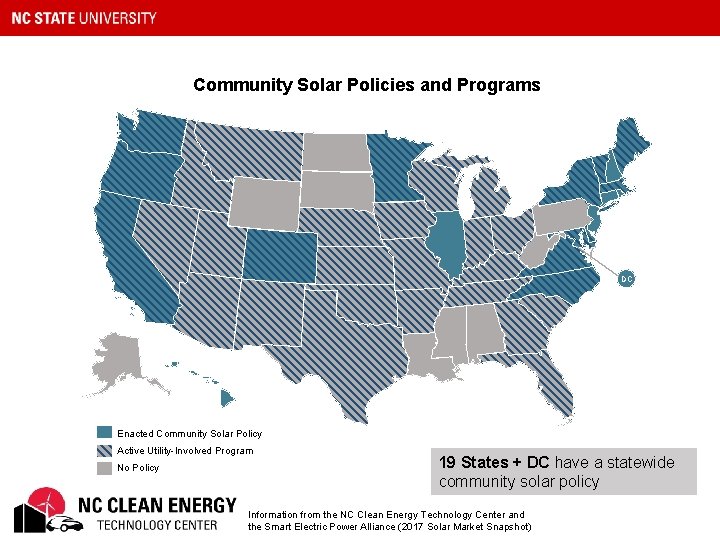
Community Solar Policies and Programs DC Enacted Community Solar Policy Active Utility-Involved Program No Policy 19 States + DC have a statewide community solar policy Information from the NC Clean Energy Technology Center and the Smart Electric Power Alliance (2017 Solar Market Snapshot)
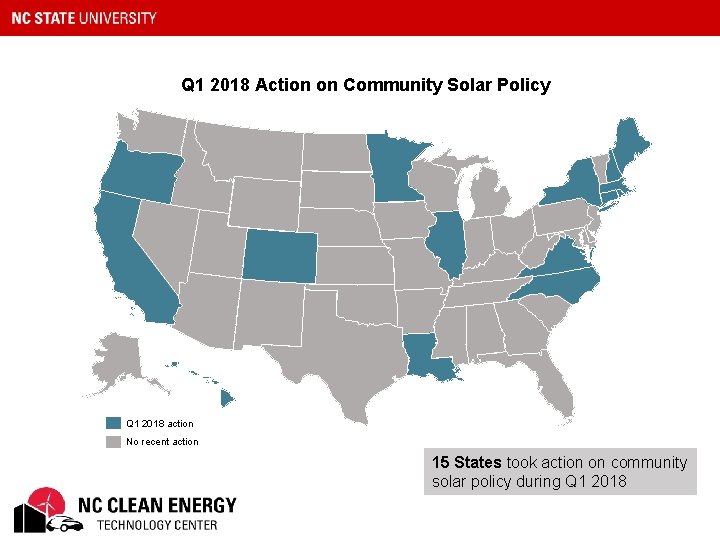
Q 1 2018 Action on Community Solar Policy Q 1 2018 action No recent action 15 States took action on community solar policy during Q 1 2018
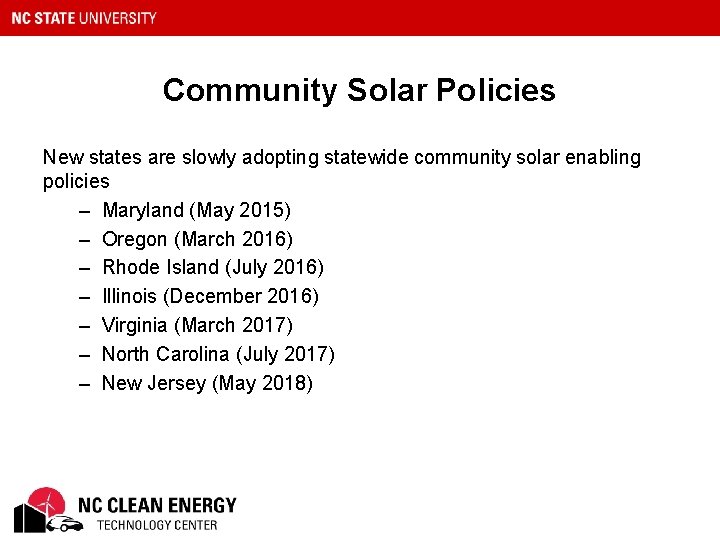
Community Solar Policies New states are slowly adopting statewide community solar enabling policies – Maryland (May 2015) – Oregon (March 2016) – Rhode Island (July 2016) – Illinois (December 2016) – Virginia (March 2017) – North Carolina (July 2017) – New Jersey (May 2018)
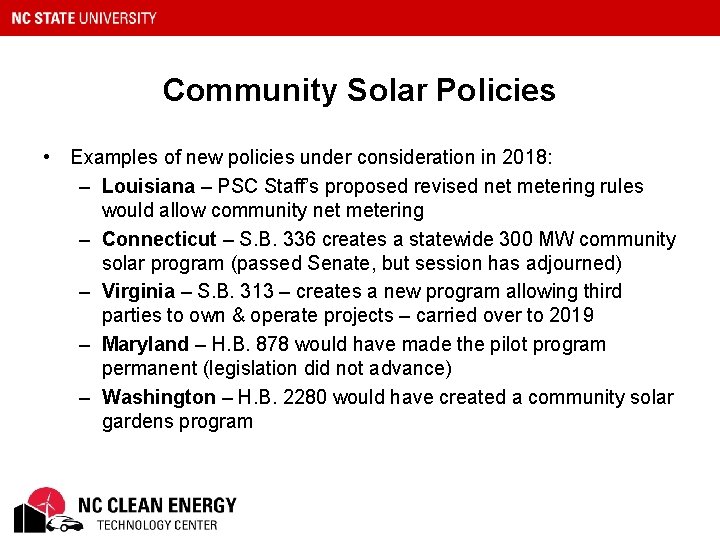
Community Solar Policies • Examples of new policies under consideration in 2018: – Louisiana – PSC Staff’s proposed revised net metering rules would allow community net metering – Connecticut – S. B. 336 creates a statewide 300 MW community solar program (passed Senate, but session has adjourned) – Virginia – S. B. 313 – creates a new program allowing third parties to own & operate projects – carried over to 2019 – Maryland – H. B. 878 would have made the pilot program permanent (legislation did not advance) – Washington – H. B. 2280 would have created a community solar gardens program
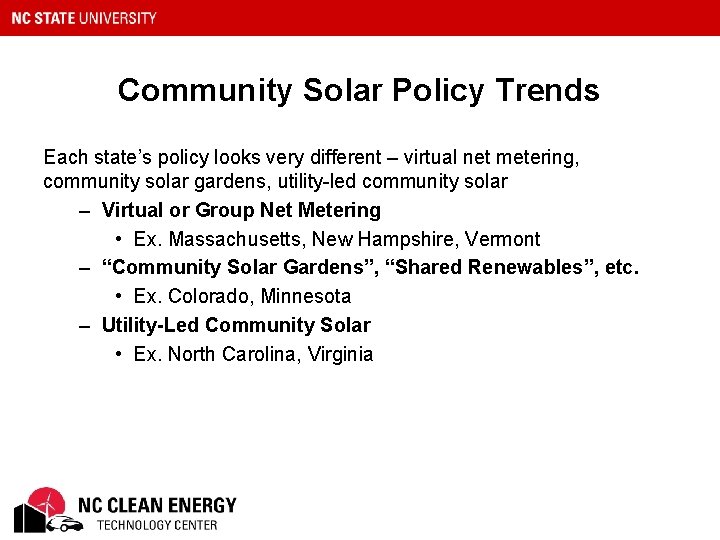
Community Solar Policy Trends Each state’s policy looks very different – virtual net metering, community solar gardens, utility-led community solar – Virtual or Group Net Metering • Ex. Massachusetts, New Hampshire, Vermont – “Community Solar Gardens”, “Shared Renewables”, etc. • Ex. Colorado, Minnesota – Utility-Led Community Solar • Ex. North Carolina, Virginia
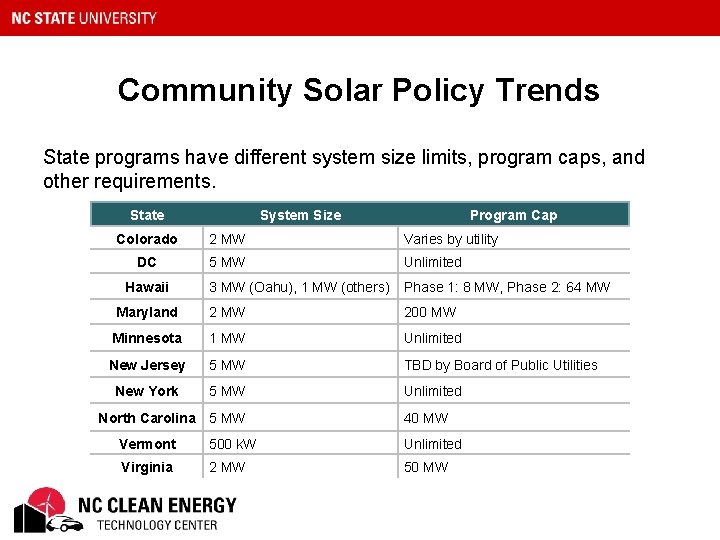
Community Solar Policy Trends State programs have different system size limits, program caps, and other requirements. State System Size Program Cap Colorado 2 MW Varies by utility DC 5 MW Unlimited 3 MW (Oahu), 1 MW (others) Phase 1: 8 MW, Phase 2: 64 MW Maryland 2 MW 200 MW Minnesota 1 MW Unlimited New Jersey 5 MW TBD by Board of Public Utilities New York 5 MW Unlimited Hawaii North Carolina 5 MW 40 MW Vermont 500 k. W Unlimited Virginia 2 MW 50 MW
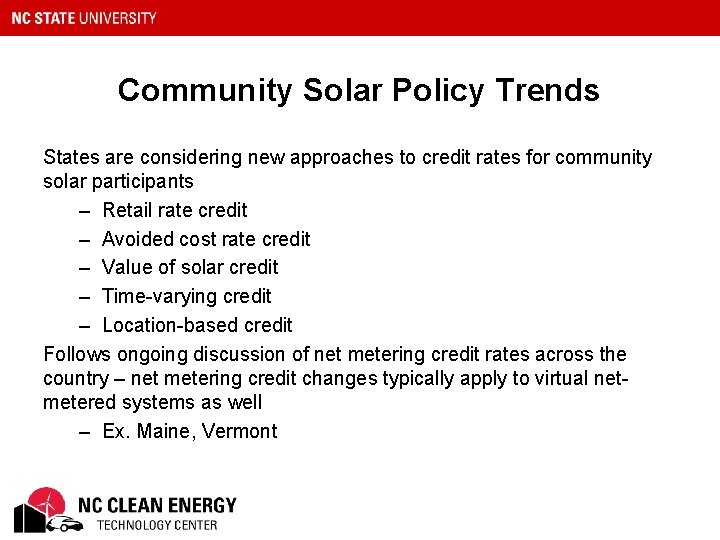
Community Solar Policy Trends States are considering new approaches to credit rates for community solar participants – Retail rate credit – Avoided cost rate credit – Value of solar credit – Time-varying credit – Location-based credit Follows ongoing discussion of net metering credit rates across the country – net metering credit changes typically apply to virtual netmetered systems as well – Ex. Maine, Vermont
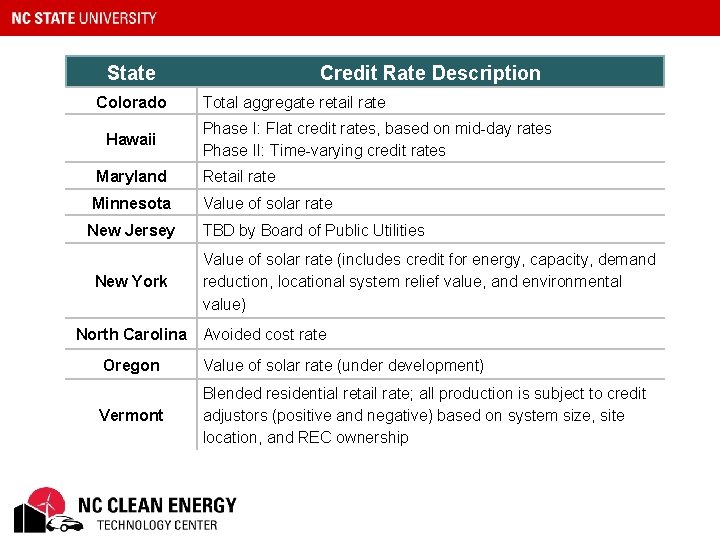
State Colorado Hawaii Credit Rate Description Total aggregate retail rate Phase I: Flat credit rates, based on mid-day rates Phase II: Time-varying credit rates Maryland Retail rate Minnesota Value of solar rate New Jersey TBD by Board of Public Utilities New York Value of solar rate (includes credit for energy, capacity, demand reduction, locational system relief value, and environmental value) North Carolina Avoided cost rate Oregon Value of solar rate (under development) Vermont Blended residential retail rate; all production is subject to credit adjustors (positive and negative) based on system size, site location, and REC ownership
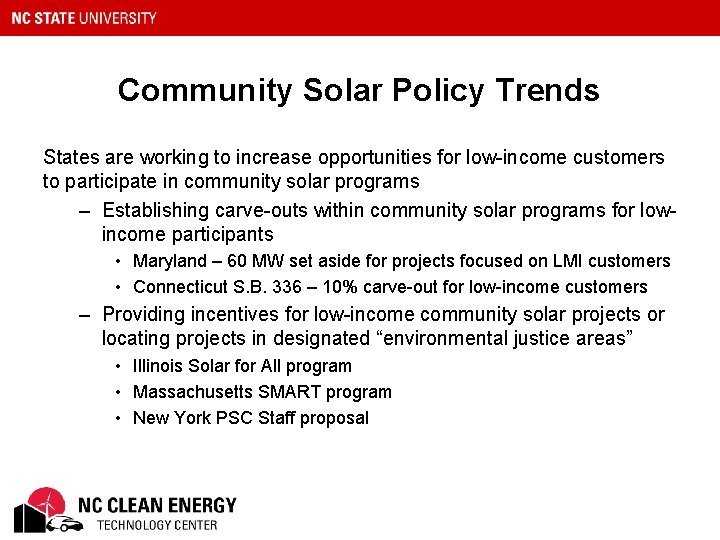
Community Solar Policy Trends States are working to increase opportunities for low-income customers to participate in community solar programs – Establishing carve-outs within community solar programs for lowincome participants • Maryland – 60 MW set aside for projects focused on LMI customers • Connecticut S. B. 336 – 10% carve-out for low-income customers – Providing incentives for low-income community solar projects or locating projects in designated “environmental justice areas” • Illinois Solar for All program • Massachusetts SMART program • New York PSC Staff proposal
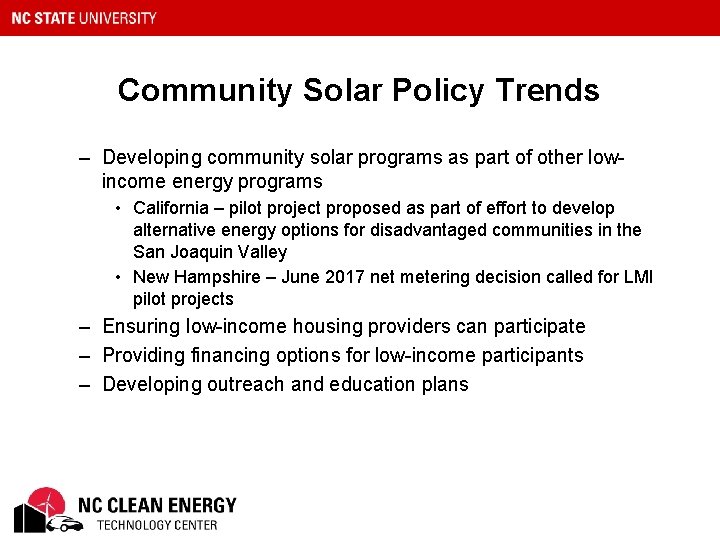
Community Solar Policy Trends – Developing community solar programs as part of other lowincome energy programs • California – pilot project proposed as part of effort to develop alternative energy options for disadvantaged communities in the San Joaquin Valley • New Hampshire – June 2017 net metering decision called for LMI pilot projects – Ensuring low-income housing providers can participate – Providing financing options for low-income participants – Developing outreach and education plans
Community Solar Policy Takeaways – Very likely to continue seeing states adopt new community solar policies, primarily through legislative action – Legislative language is important – program details are often worked out in a regulatory proceeding, but legislative framework impacts program success – Will continue seeing a focus on credit rates, especially movement toward value-based credit rates – Will continue seeing efforts to increase low-income participation
Thank you! Autumn Proudlove Senior Manager of Policy Research NC Clean Energy Technology Center afproudl@ncsu. edu