Socratic Seminars Shared inquiry of the meanings and



- Slides: 28
Socratic Seminars Shared inquiry of the meanings and interpretations of a text
Advantages of Seminars • In Socratic Seminar, the focus is on helping students think and question, not giving them answers. They are empowered to think for themselves rather than focus on being “right. ” • Students are much more engaged because they have to do all the thinking and discussing. • Students examine their own reasoning processes— how they developed their opinions and what evidence they have to support them. • In addition to learning content, they practice respect, active listening, and gain confidence.
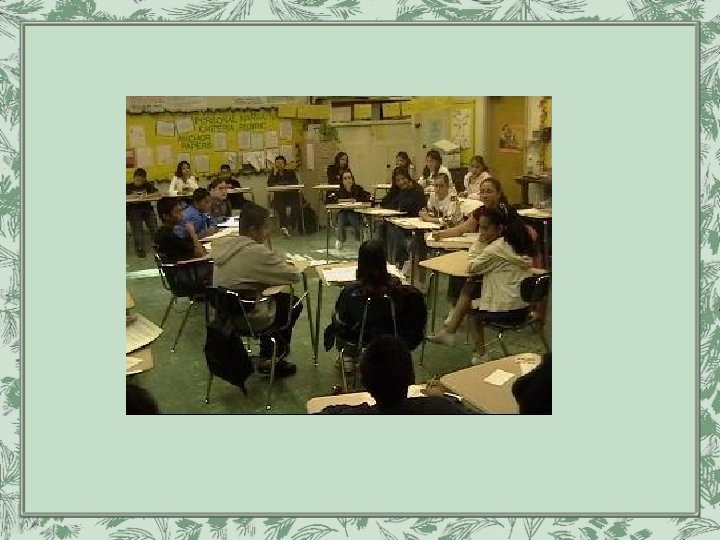
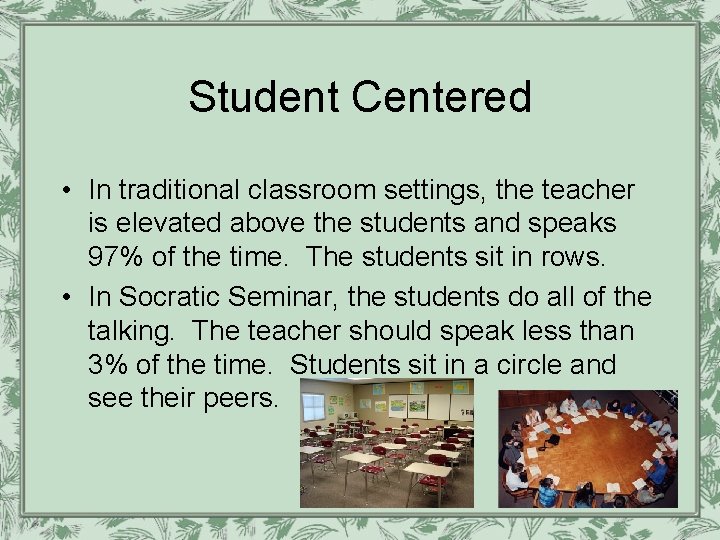
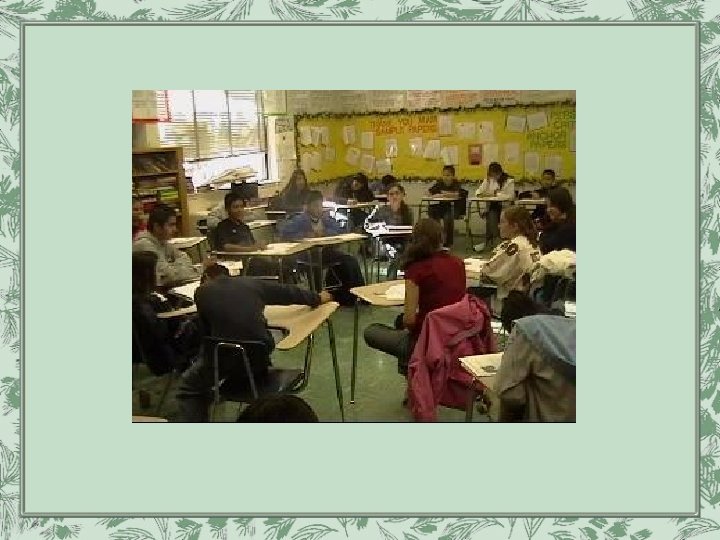
Student Centered • In traditional classroom settings, the teacher is elevated above the students and speaks 97% of the time. The students sit in rows. • In Socratic Seminar, the students do all of the talking. The teacher should speak less than 3% of the time. Students sit in a circle and see their peers.
Dialogue vs. Debate • • • Dialogue is collaborative: multiple sides work toward shared understanding. Debate is oppositional: two opposing sides try to prove each other wrong. In dialogue, one listens to understand, to make meaning, and to find common ground. In debate, one listens to find flaws, to spot differences, and to counter arguments. Dialogue enlarges and possibly changes a participant's point of view. Debate defends assumptions as truth. Dialogue creates an open-minded attitude: an openness to being wrong and an openness to change. Debate creates a close-minded attitude, a determination to be right. In dialogue, one submits one's best thinking, expecting that other people's reflections will help improve it rather than threaten it. In debate, one submits one's best thinking and defends it against challenge to show that it is right. Dialogue calls for temporarily suspending one's beliefs. Debate calls for investing wholeheartedly in one's beliefs. In dialogue, one searches for strengths in all positions. In debate, one searches for weaknesses in the other position. Dialogue respects all the other participants and seeks not to alienate or offend. Debate rebuts contrary positions and may belittle or deprecate other participants. Dialogue assumes that many people have pieces of answers and that cooperation can lead to a greater understanding. Debate assumes a single right answer that somebody already has. Dialogue remains open-ended. Debate demands a conclusion.
What does dialogue look like? • We suspend judgment. • We are not defensive. • We can explain our thinking and evaluate the possible limits of our thoughts. • We communicate our assumptions. • We explore other viewpoints more deeply. • We are open to being “wrong. ” • We see others as equals and allies in obtaining knowledge, not as adversaries.
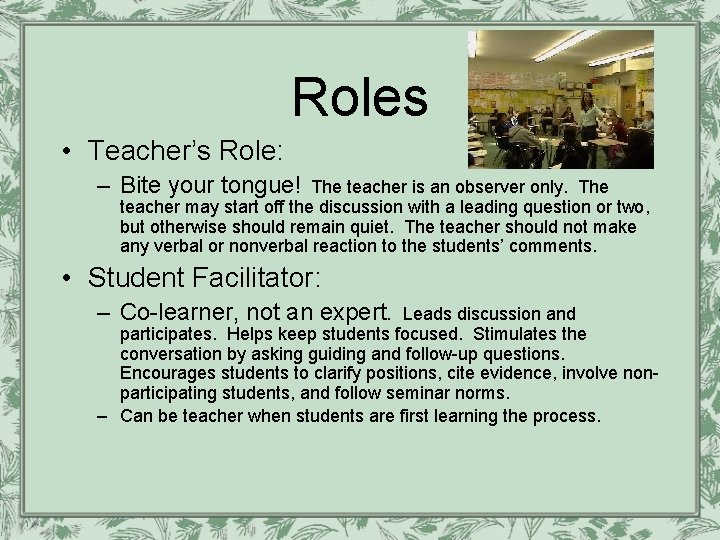
Roles • Teacher’s Role: – Bite your tongue! The teacher is an observer only. The teacher may start off the discussion with a leading question or two, but otherwise should remain quiet. The teacher should not make any verbal or nonverbal reaction to the students’ comments. • Student Facilitator: – Co-learner, not an expert. Leads discussion and participates. Helps keep students focused. Stimulates the conversation by asking guiding and follow-up questions. Encourages students to clarify positions, cite evidence, involve nonparticipating students, and follow seminar norms. – Can be teacher when students are first learning the process.
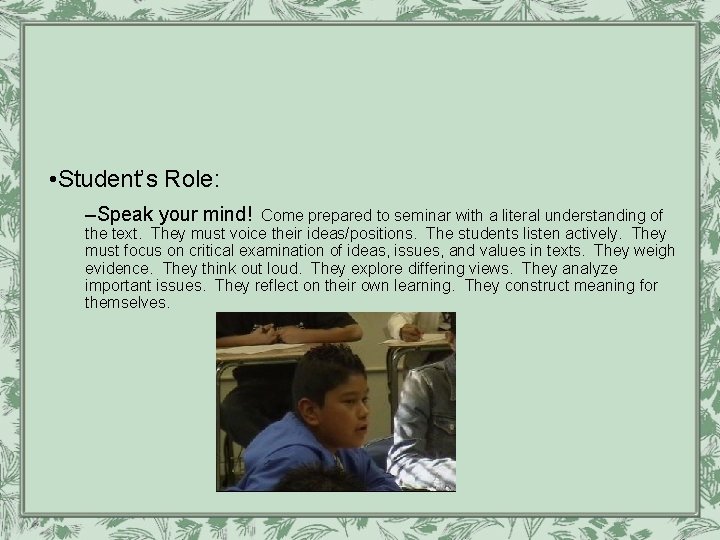
• Student’s Role: –Speak your mind! Come prepared to seminar with a literal understanding of the text. They must voice their ideas/positions. The students listen actively. They must focus on critical examination of ideas, issues, and values in texts. They weigh evidence. They think out loud. They explore differing views. They analyze important issues. They reflect on their own learning. They construct meaning for themselves.
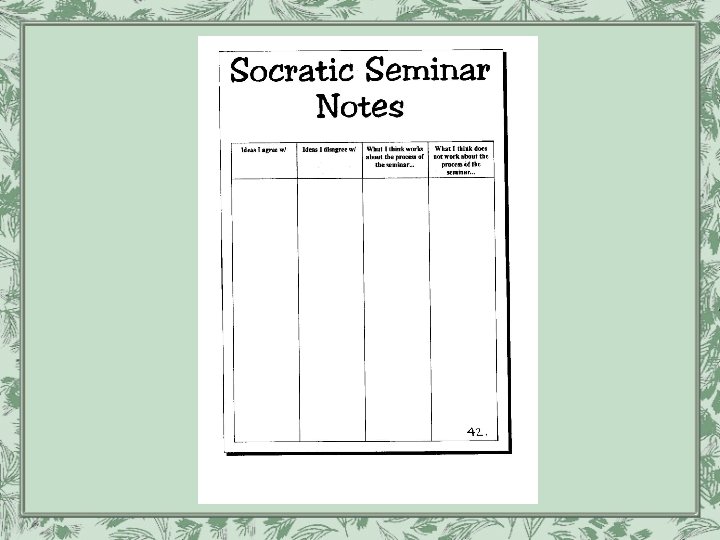
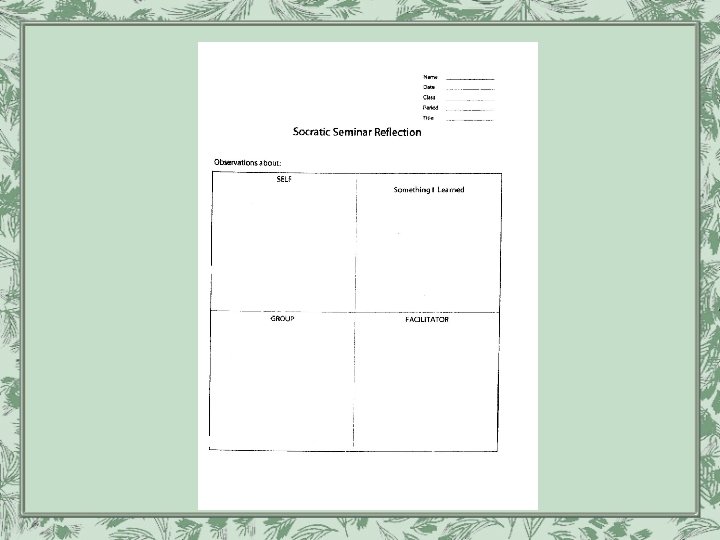
Procedure • Preparation (day before) – Read text aloud or individually for literal meaning/comprehension. – Close reading of the text: highlighting, underlining, etc. – Prepare questions about text. • Socratic Seminar (30 -40 minutes) – Move tables and chairs into a circle. – Review seminar guidelines. – Ask an opening question to start conversation. Choose a question that you’re honestly curious about and that has multiple answers. • Reflection/Debrief (10 -15 minutes) – Reflection sheets. • What did you observe about yourself, the other participants, the leader, and the process? • What did you learn through this process? – Students verbally express their thoughts about process.
Demonstration
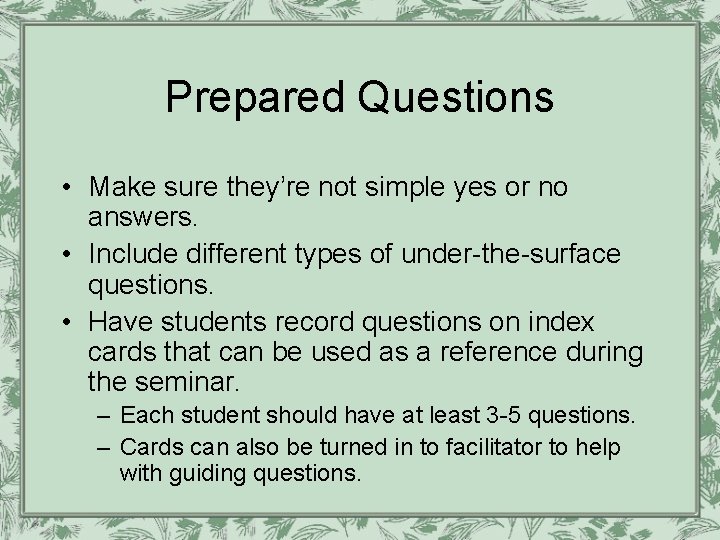
Prepared Questions • Make sure they’re not simple yes or no answers. • Include different types of under-the-surface questions. • Have students record questions on index cards that can be used as a reference during the seminar. – Each student should have at least 3 -5 questions. – Cards can also be turned in to facilitator to help with guiding questions.
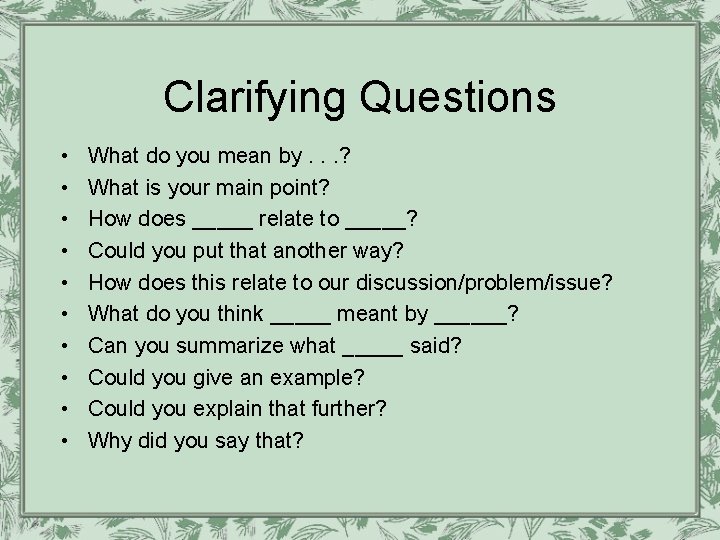
Clarifying Questions • • • What do you mean by. . . ? What is your main point? How does _____ relate to _____? Could you put that another way? How does this relate to our discussion/problem/issue? What do you think _____ meant by ______? Can you summarize what _____ said? Could you give an example? Could you explain that further? Why did you say that?
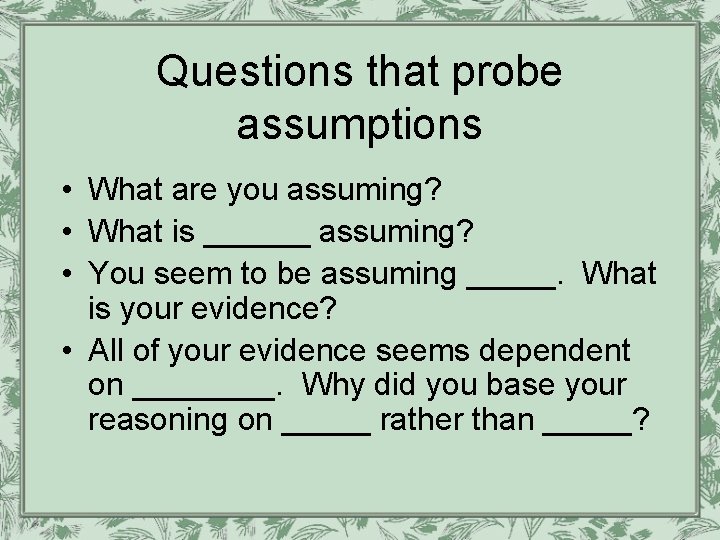
Questions that probe assumptions • What are you assuming? • What is ______ assuming? • You seem to be assuming _____. What is your evidence? • All of your evidence seems dependent on ____. Why did you base your reasoning on _____ rather than _____?
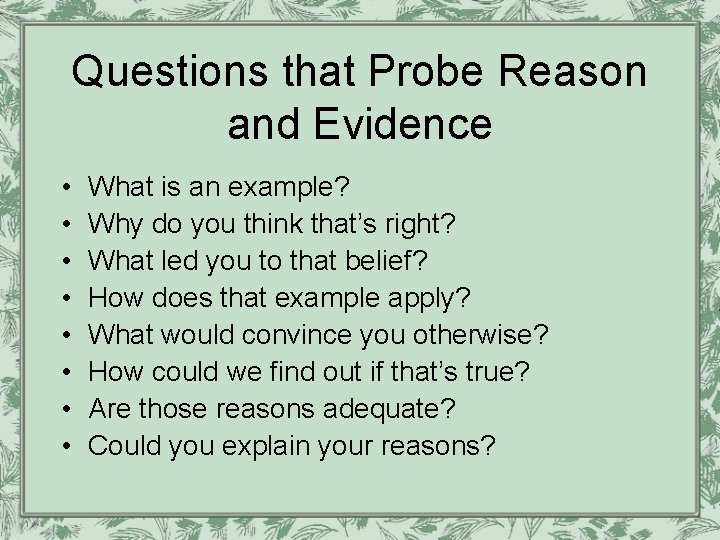
Questions that Probe Reason and Evidence • • What is an example? Why do you think that’s right? What led you to that belief? How does that example apply? What would convince you otherwise? How could we find out if that’s true? Are those reasons adequate? Could you explain your reasons?
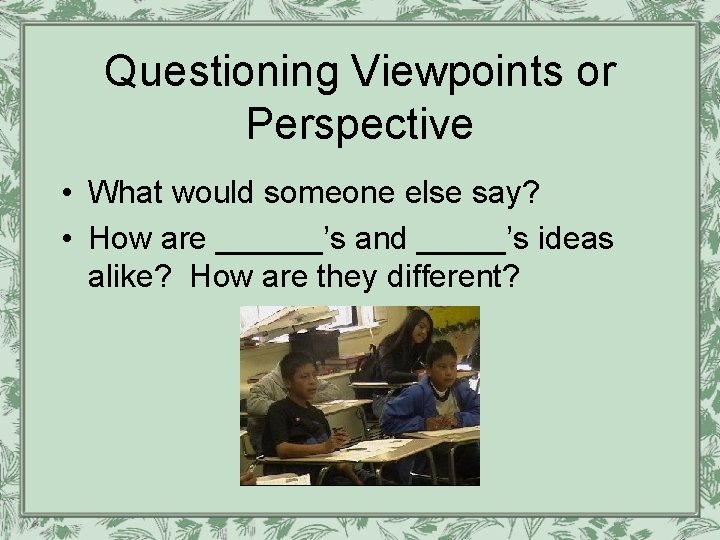
Questioning Viewpoints or Perspective • What would someone else say? • How are ______’s and _____’s ideas alike? How are they different?
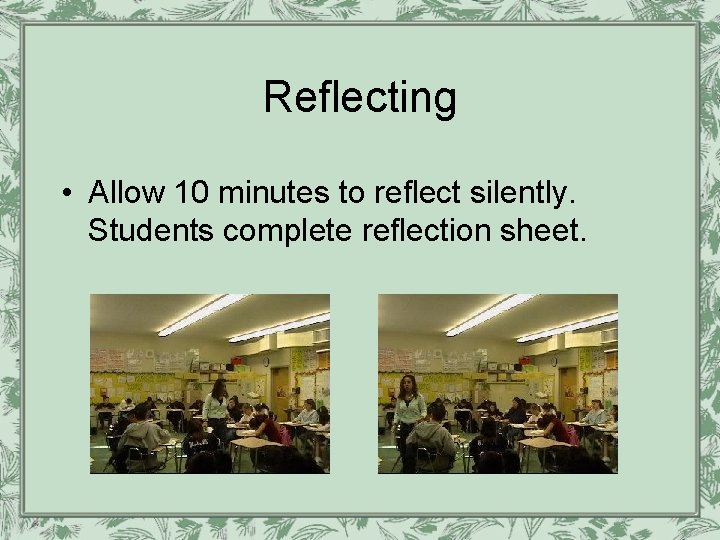
Reflecting • Allow 10 minutes to reflect silently. Students complete reflection sheet.
Guidelines aka “The Rules” • • • • Have a copy of the text with you and refer to it for evidence It’s o. k. to pass when asked to contribute. Help each other out. Take a risk. Be willing to think out loud and explore a new idea. Don’t bluff your way through the seminar. If you’re not prepared for the seminar, you cannot participate. Ask for clarification if you’re confused. Don’t get sidetracked on tangents. Take notes on points you want to come back to. Don’t raise your hand; take turns speaking. Listen actively. Speak loudly enough so that everyone can hear you. Don’t make it personal: discuss ideas, not just someone else’s opinion. Speak to each other, not the teacher or facilitator. Speak respectfully, use each other’s names when referring to someone else.
Problems and Solutions • If a student is unprepared (hasn’t read the material), they cannot participate. They may sit outside the circle taking notes. • Don’t be afraid of silence. Don’t rescue the students. Someone will say something. • Avoid eye contact if students are directing their comments to you. • Give students the “evil eye” if they are not abiding by the norms. • Provide dialogue stems to encourage accountable talk. • Some students may dominate the conversation; others may choose silence. – A facilitator can help moderate the flow and ask other guiding questions. – A talking “prop” can help if students tend to interrupt each other. • Don’t be a quitter. Practice makes perfect.
Possible Source Material • • • Socratic Seminar texts are chosen for their richness in ideas, issues, and values and their ability to stimulate extended, thoughtful dialogue. A seminar text can be drawn from readings in literature, history, science, math, health, and philosophy. You can use paintings, photographs, or political cartoons. You may use music. A good text raises important questions in the participants' minds, questions for which there are no right or wrong answers. At the end of a successful Socratic Seminar participants often leave with more questions than they brought with them.
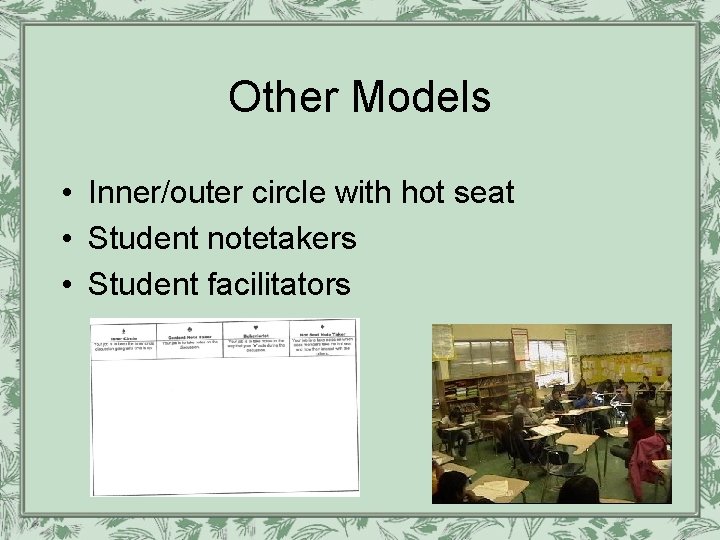
Other Models • Inner/outer circle with hot seat • Student notetakers • Student facilitators
When can you use a Socratic Seminar? • Into/through/beyond texts and/or concepts. • Into/through/beyond for a unit of study. • Prepare for a writing assignment. • Conflict resolution.
How do you know if you’ve had a good seminar? • The students complain when you say that time is up. • The students tell others about what they did in class. • The students ask when they can have another seminar.