SOCIAL AND POLITICAL TRUST Department of Sociology University
- Slides: 20
SOCIAL AND POLITICAL TRUST Department of Sociology University of Surrey Social and Political Trust Project (SAPT) Patrick Sturgis, Nick Allum Roger Patulny & Sarah Bulloch 1
SOCIAL AND POLITICAL TRUST Is trust a salient concept for the times? ‘A society that relies on generalised reciprocity is more efficient than a distrustful society, for the same reason that money is more efficient than barter. Trust lubricates social life. ’ (Putnam, 1993 p 3). 2
SOCIAL AND POLITICAL TRUST Trust in people and trust in government are strongly implicated in: • Social concerns - multiculturalism and social cohesion • Political concerns – functioning of government and political participation (voting) • (For sociologists) Theoretical concerns – ideas about human action, rational versus normative 3
SOCIAL AND POLITICAL TRUST Social and Political Trust • Social Trust: trust between people in society – horizontal. • Political Trust: between citizens and institutions such as government, or individuals such as politicians – vertical. 4
SOCIAL AND POLITICAL TRUST Particularised and Generalised Trust • Particularised trust: trust in a known other – identifiable individuals or groups. • Generalised trust: trust in an unknown other – in society. This is the good stuff. 5
SOCIAL AND POLITICAL TRUST • Trust has been made popular by the political and sociological study of Social Capital (Putnam, Coleman), – and recently by Uslaner – particularised vs generalised social trust. • Trust also has roots in the economic study of game theory and the Prisoner’s Dilemma (Nash, Axelrod, Dasgupta, Glaesar) – – Economic description more in common with particularised trust and is information dependent 6
SOCIAL AND POLITICAL TRUST • Trust has been linked statistically to many positive outcomes: 1. Economic – growth (Knack and Keefer) 2. Democratic – social capital, (Putnam), corruption (Rothstein and Uslaner) 3. Health – heart disease (Kawachi) 4. Emotional wellbeing – Happiness, Satisfaction (Veenhoeven, Helliwell) 5. Crime – neighbourhoods, delinquency (Sampson, Halpern) 6. Education – individually (Putnam), neighbourhoods (La Porta) • But does trust cause these things, or do these things cause trust? And what then, if trust is declining? 7
SOCIAL AND POLITICAL TRUST So, trust is a salient concept • BUT: Have we succeeded in appropriately measuring trust, its trends and its causes? These are the big issues. • Issue 1 – Trends – Is trust increasing or falling in the UK and other nations? – Problems with data used and question issues • Issue 2 (The big one) – Causality: What causes a person to start and stop trusting? – – Problems with data (mostly cross-sectional). 8
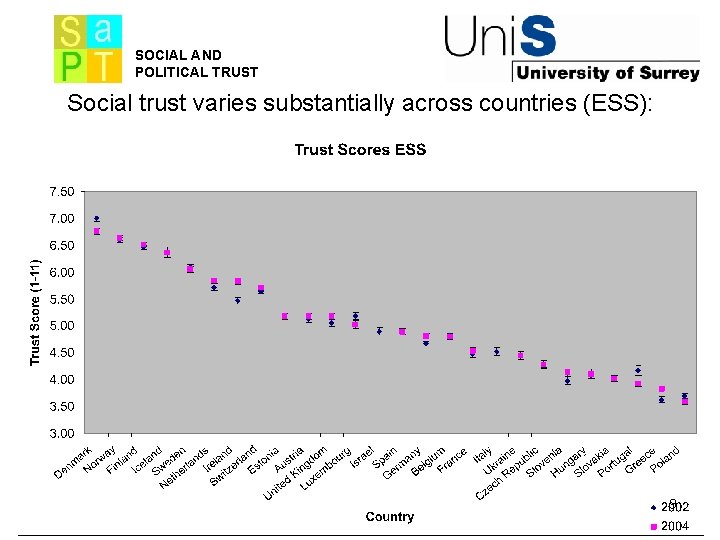
SOCIAL AND POLITICAL TRUST Social trust varies substantially across countries (ESS): 9
SOCIAL AND POLITICAL TRUST Research on Gender and Social Trust • • Conspicuous in its absence. Patchy, sidelined. Multiple, contradictory stories. What is the complete picture? 10
SOCIAL AND POLITICAL TRUST How do we measure trust? • GTQ – Generalised Trust question: ‘Generally speaking, would you say that most people can be trusted or that you can't be too careful in dealing with people? ’ • Exists in 2 forms: dichotomous and 11 point scale. 11
SOCIAL AND POLITICAL TRUST Measurement of trust II • The Rosenberg trust scale GTQ plus: Do you think that most people would try to take advantage of you if they got a chance or would they try to be fair? Would you say that most of the time people try to be helpful or are they mostly looking out for themselves? 12
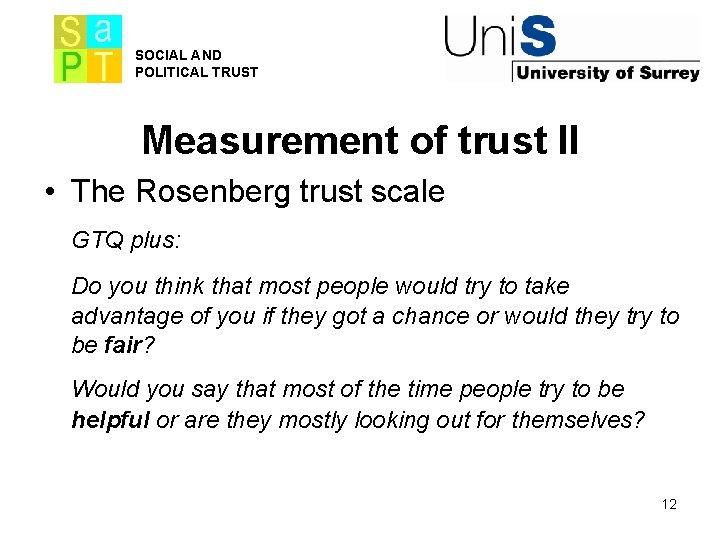
Gender-trust gap across Europe: GTQ Country Male Female Gender-trust gap* t Sig (2 -tailed) Denmark 6. 8 6. 7 6. 9 -0. 2 1. 82 0. 07 Norway 6. 6 6. 7 6. 6 0. 1 -0. 63 0. 53 Finland 6. 5 6. 6 -0. 1 0. 95 0. 34 Iceland 6. 4 6. 5 6. 2 0. 3 -1. 41 0. 16 Sweden 6. 1 6. 0 0. 1 -0. 96 0. 34 Ireland 5. 9 6. 1 5. 7 0. 3 -3. 46 0. 00 Netherlands 5. 8 5. 9 5. 7 0. 2 -2. 24 0. 03 Switzerland 5. 7 5. 8 5. 7 0. 1 -1. 06 0. 29 Estonia 5. 2 5. 1 5. 2 -0. 1 0. 92 0. 36 United Kingdom 5. 1 5. 2 5. 1 0. 1 -1. 48 0. 14 Austria 5. 1 5. 2 5. 1 0. 1 -0. 89 0. 37 Luxembourg 5. 0 5. 2 4. 8 0. 4 -2. 92 0. 00 Spain 4. 9 5. 0 4. 8 0. 2 -1. 82 0. 07 Belgium 4. 8 4. 9 4. 6 0. 3 -2. 73 0. 01 Germany 4. 8 4. 7 0. 1 -1. 71 0. 09 France 4. 5 0. 0 0. 42 0. 67 Ukraine 4. 3 4. 2 4. 4 -0. 2 1. 55 0. 12 Czech Republic 4. 2 4. 1 4. 2 -0. 1 1. 25 0. 21 Slovenia 4. 1 4. 3 4. 0 0. 4 -2. 86 0. 00 Slovakia 4. 0 0. 1 -0. 43 0. 67 Hungary 4. 0 0. 0 -0. 29 0. 77 Greece 3. 9 4. 0 3. 9 0. 1 -1. 24 0. 22 Portugal 3. 9 4. 0 3. 8 0. 3 -2. 60 0. 01 Poland 3. 6 0. 0 -0. 23 0. 82 13
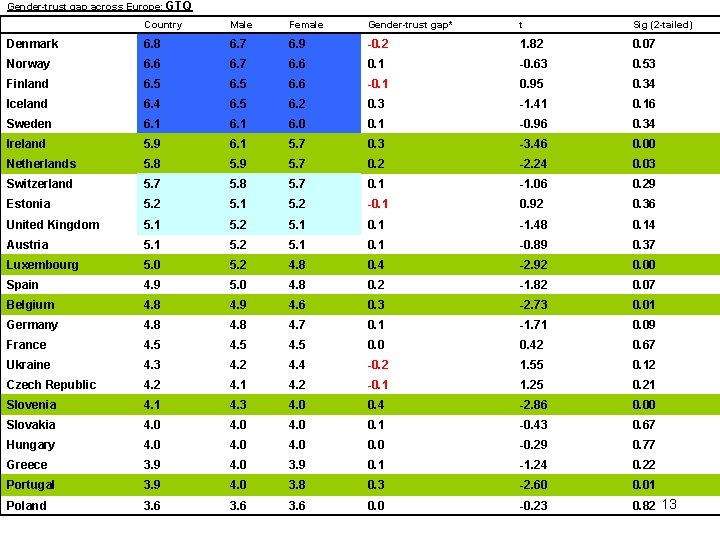
Gender-trust gap across Europe: Rosenberg scale Country Male Female Gender-trust gap t sig Denmark 20. 1 19. 5 20. 7 -1. 23 4. 8 0. 00 Norway 19. 5 19. 3 19. 9 -0. 62* 3. 0 0. 00 Iceland 19. 5 -0. 03* 0. 1 0. 94 Finland 19. 1 18. 7 19. 4 -0. 75 3. 9 0. 00 Sweden 18. 5 18. 2 18. 7 -0. 50* 2. 2 0. 03 Ireland 18. 2 18. 4 18. 1 0. 30 -1. 3 0. 19 Switzerland 17. 6 17. 5 17. 7 -0. 18* 0. 9 0. 37 Netherlands 17. 4 17. 5 17. 4 0. 10 -0. 5 0. 64 United Kingdom 16. 4 16. 5 16. 3 0. 23 -1. 0 0. 32 Austria 16. 2 15. 9 16. 4 -0. 44* 1. 8 0. 07 Luxembourg 15. 5 15. 7 15. 2 0. 50 -1. 8 0. 08 Estonia 15. 4 14. 9 15. 7 -0. 74 3. 1 0. 00 Germany 15. 3 15. 1 15. 4 -0. 32* 1. 6 0. 11 Belgium 14. 8 15. 1 14. 6 0. 47 -1. 9 0. 05 France 14. 7 14. 6 14. 9 -0. 32 1. 3 0. 18 Spain 14. 3 14. 5 14. 1 0. 34 -1. 3 0. 20 Czech Republic 13. 4 13. 3 13. 5 -0. 22 1. 0 0. 30 Slovenia 13. 3 13. 5 13. 1 0. 38 -1. 2 0. 23 Ukraine 12. 9 12. 2 13. 2 -1. 00 3. 4 0. 00 Hungary 12. 6 12. 4 12. 8 -0. 32 1. 1 0. 26 Portugal 12. 6 12. 9 12. 4 0. 53 -2. 4 0. 02 Slovakia 12. 3 12. 2 12. 3 -0. 12* 0. 4 0. 67 Poland 11. 4 11. 2 11. 7 -0. 48 1. 8 0. 08 Greece 10. 9 11. 0 10. 8 0. 17 -0. 7 0. 49 14
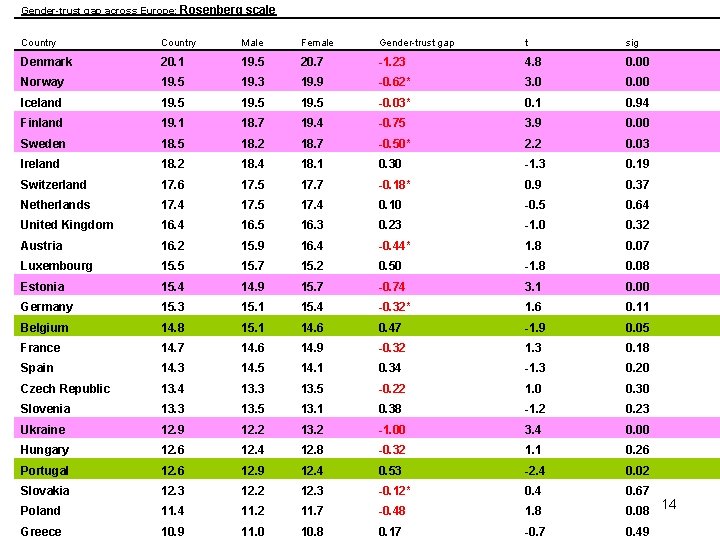
Gender-fair gap across Europe Country Male Female Gender-fair gap* t Sig. Denmark 7. 3 7. 0 7. 6 -0. 6 6. 12 0. 00 Iceland 6. 9 6. 8 7. 0 -0. 1 0. 83 0. 41 Norway 6. 9 6. 7 7. 1 -0. 4 4. 37 0. 00 Finland 6. 8 6. 6 7. 0 -0. 4 5. 10 0. 00 Sweden 6. 5 6. 4 6. 7 -0. 3 2. 97 0. 00 Switzerland 6. 4 6. 5 -0. 1 0. 91 0. 36 Netherlands 6. 2 0. 0 0. 39 0. 69 Ireland 6. 1 6. 0 0. 0 -0. 30 0. 76 Austria 5. 8 5. 6 6. 0 -0. 3 3. 33 0. 00 Germany 5. 7 5. 6 5. 8 -0. 2 2. 00 0. 05 Luxembourg 5. 7 5. 8 5. 6 0. 1 -1. 15 0. 25 Belgium 5. 6 0. 07 0. 95 France 5. 6 5. 7 -0. 1 0. 82 0. 41 United Kingdom 5. 5 5. 6 5. 5 0. 0 -0. 52 0. 60 Estonia 5. 4 5. 2 5. 6 -0. 3 3. 18 0. 00 Spain 5. 2 0. 1 -0. 48 0. 63 Czech Republic 5. 1 5. 2 -0. 1 1. 25 0. 21 Portugal 4. 8 4. 9 4. 8 0. 1 -1. 48 0. 14 Slovenia 4. 8 4. 7 4. 8 -0. 1 0. 51 0. 61 Ukraine 4. 7 4. 5 4. 9 -0. 4 3. 77 0. 00 Hungary 4. 6 0. 0 0. 24 0. 81 Poland 4. 6 4. 4 4. 7 -0. 3 2. 62 0. 01 Slovakia 4. 5 -0. 1 0. 49 0. 63 Greece 3. 7 3. 8 3. 7 0. 0 -0. 24 0. 81 15
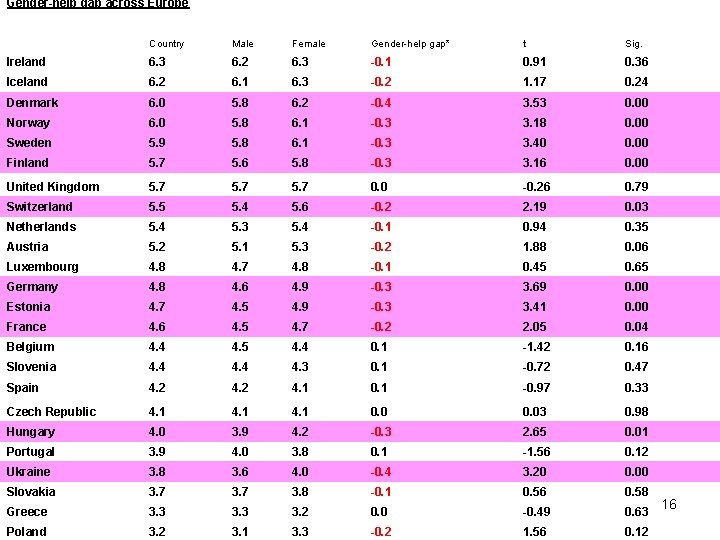
Gender-help gap across Europe Country Male Female Gender-help gap* t Sig. Ireland 6. 3 6. 2 6. 3 -0. 1 0. 91 0. 36 Iceland 6. 2 6. 1 6. 3 -0. 2 1. 17 0. 24 Denmark 6. 0 5. 8 6. 2 -0. 4 3. 53 0. 00 Norway 6. 0 5. 8 6. 1 -0. 3 3. 18 0. 00 Sweden 5. 9 5. 8 6. 1 -0. 3 3. 40 0. 00 Finland 5. 7 5. 6 5. 8 -0. 3 3. 16 0. 00 United Kingdom 5. 7 0. 0 -0. 26 0. 79 Switzerland 5. 5 5. 4 5. 6 -0. 2 2. 19 0. 03 Netherlands 5. 4 5. 3 5. 4 -0. 1 0. 94 0. 35 Austria 5. 2 5. 1 5. 3 -0. 2 1. 88 0. 06 Luxembourg 4. 8 4. 7 4. 8 -0. 1 0. 45 0. 65 Germany 4. 8 4. 6 4. 9 -0. 3 3. 69 0. 00 Estonia 4. 7 4. 5 4. 9 -0. 3 3. 41 0. 00 France 4. 6 4. 5 4. 7 -0. 2 2. 05 0. 04 Belgium 4. 4 4. 5 4. 4 0. 1 -1. 42 0. 16 Slovenia 4. 4 4. 3 0. 1 -0. 72 0. 47 Spain 4. 2 4. 1 0. 1 -0. 97 0. 33 Czech Republic 4. 1 0. 03 0. 98 Hungary 4. 0 3. 9 4. 2 -0. 3 2. 65 0. 01 Portugal 3. 9 4. 0 3. 8 0. 1 -1. 56 0. 12 Ukraine 3. 8 3. 6 4. 0 -0. 4 3. 20 0. 00 Slovakia 3. 7 3. 8 -0. 1 0. 56 0. 58 Greece 3. 3 3. 2 0. 0 -0. 49 0. 63 Poland 3. 2 3. 1 3. 3 -0. 2 1. 56 0. 12 16
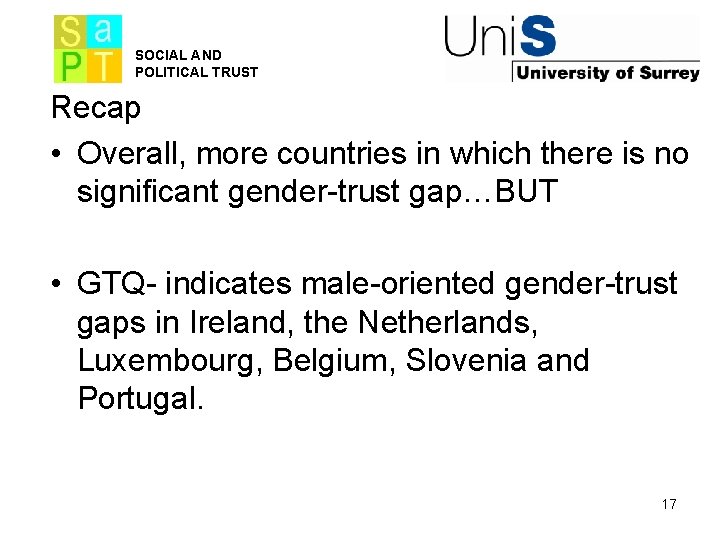
SOCIAL AND POLITICAL TRUST Recap • Overall, more countries in which there is no significant gender-trust gap…BUT • GTQ- indicates male-oriented gender-trust gaps in Ireland, the Netherlands, Luxembourg, Belgium, Slovenia and Portugal. 17
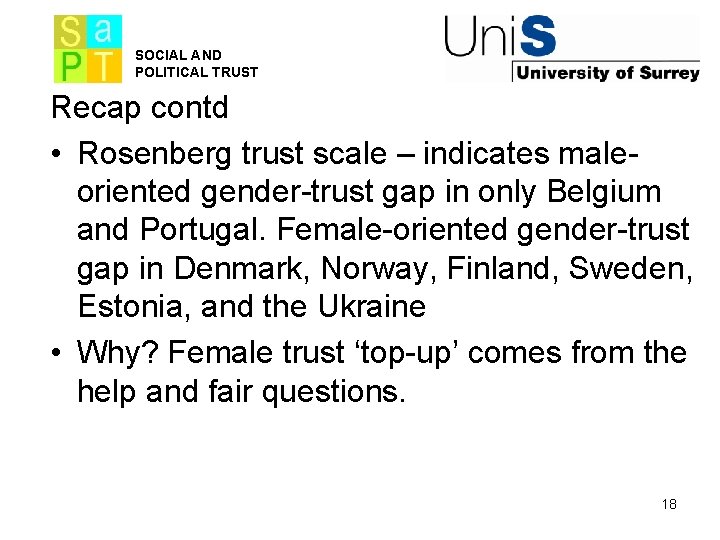
SOCIAL AND POLITICAL TRUST Recap contd • Rosenberg trust scale – indicates maleoriented gender-trust gap in only Belgium and Portugal. Female-oriented gender-trust gap in Denmark, Norway, Finland, Sweden, Estonia, and the Ukraine • Why? Female trust ‘top-up’ comes from the help and fair questions. 18
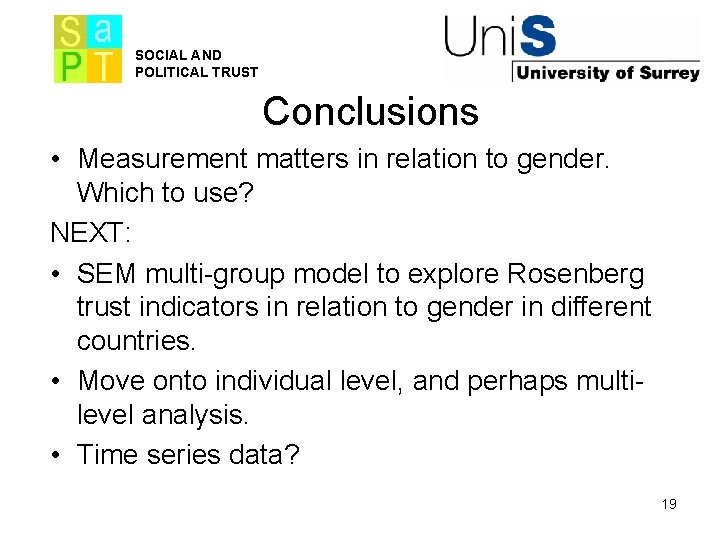
SOCIAL AND POLITICAL TRUST Conclusions • Measurement matters in relation to gender. Which to use? NEXT: • SEM multi-group model to explore Rosenberg trust indicators in relation to gender in different countries. • Move onto individual level, and perhaps multilevel analysis. • Time series data? 19
SOCIAL AND POLITICAL TRUST Thank you 20