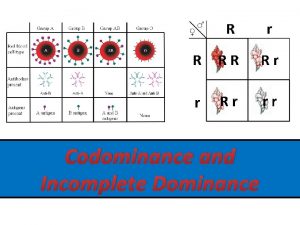
Snapdragons HUH Incomplete Dominance Neither allele is completely


- Slides: 22
• Snapdragons HUH?
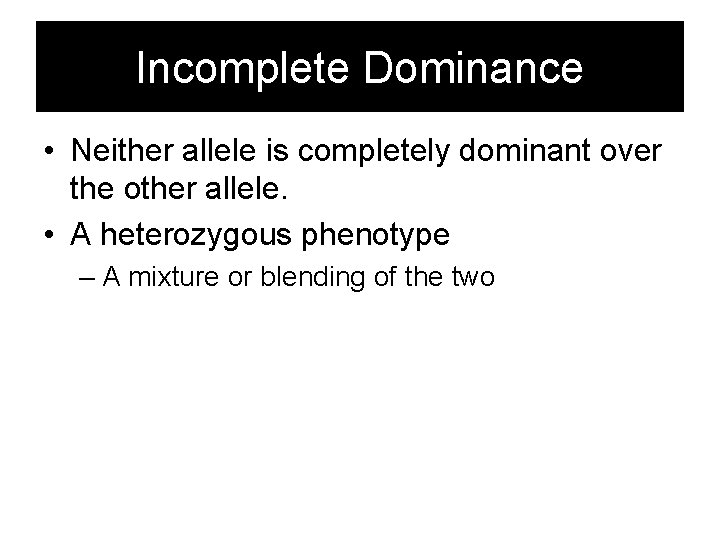
Incomplete Dominance • Neither allele is completely dominant over the other allele. • A heterozygous phenotype – A mixture or blending of the two
Four-o’ clock flowers • Incomplete dominance • Neither Red (R) • or White (W) is dominant When a homozygous red flower (RR) Mix with a homozygous white flower (WW), the alleles blend in the hybrid (RW) to produce pink flowers
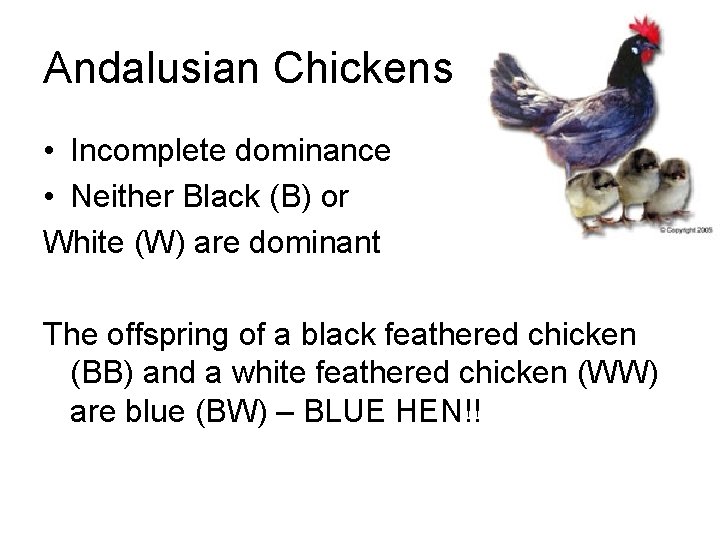
Andalusian Chickens • Incomplete dominance • Neither Black (B) or White (W) are dominant The offspring of a black feathered chicken (BB) and a white feathered chicken (WW) are blue (BW) – BLUE HEN!!
Codominance • Two equally dominant alleles are expressed at the same time. • Heterozygous phenotype will have both phenotypes visible
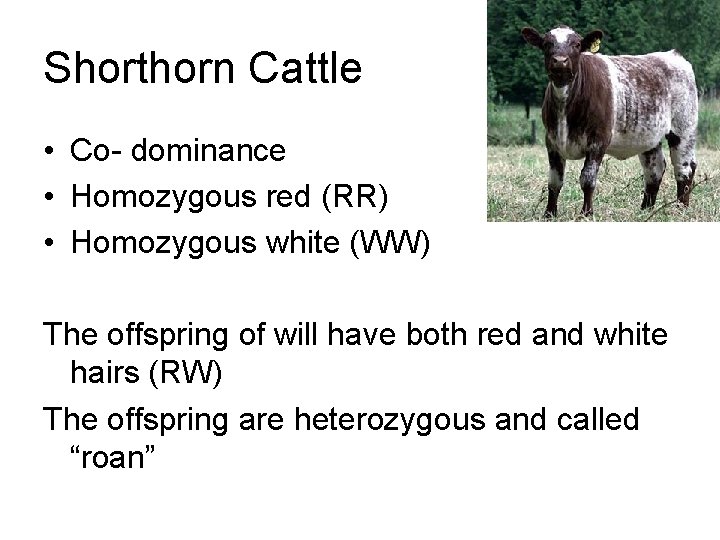
Shorthorn Cattle • Co- dominance • Homozygous red (RR) • Homozygous white (WW) The offspring of will have both red and white hairs (RW) The offspring are heterozygous and called “roan”
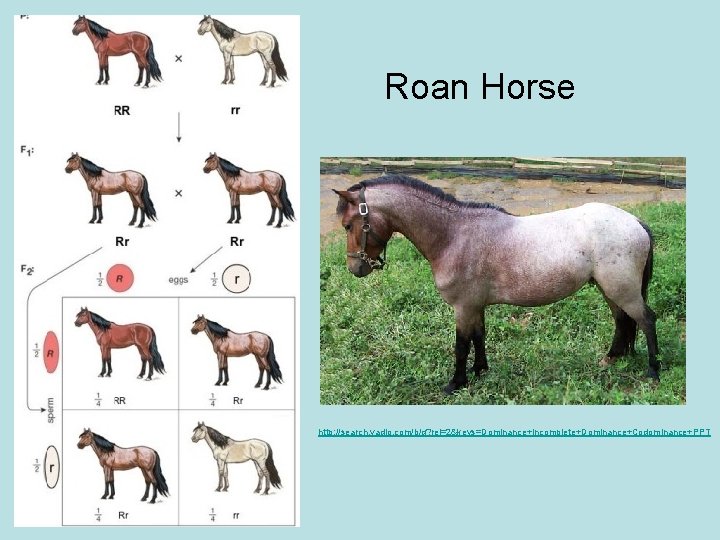
Roan Horse http: //search. vadlo. com/b/q? rel=2&keys=Dominance+Incomplete+Dominance+Codominance+PPT
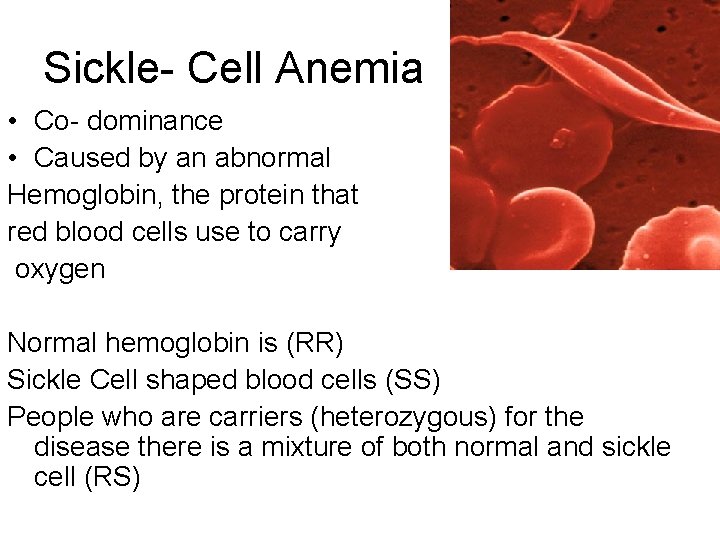
Sickle- Cell Anemia • Co- dominance • Caused by an abnormal Hemoglobin, the protein that red blood cells use to carry oxygen Normal hemoglobin is (RR) Sickle Cell shaped blood cells (SS) People who are carriers (heterozygous) for the disease there is a mixture of both normal and sickle cell (RS)
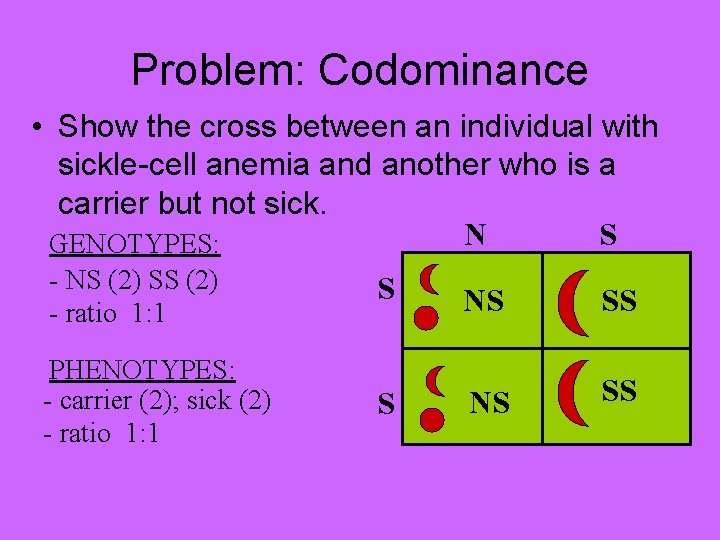
Problem: Codominance • Show the cross between an individual with sickle-cell anemia and another who is a carrier but not sick. N S GENOTYPES: - NS (2) SS (2) - ratio 1: 1 S NS SS PHENOTYPES: - carrier (2); sick (2) - ratio 1: 1 S NS SS
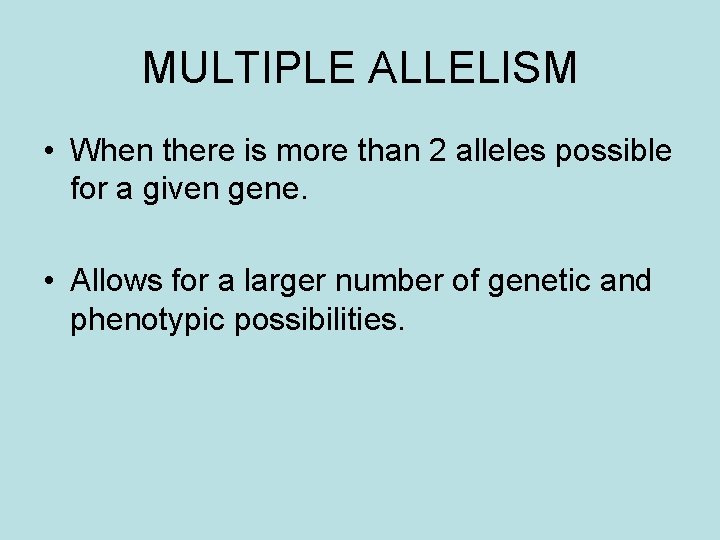
MULTIPLE ALLELISM • When there is more than 2 alleles possible for a given gene. • Allows for a larger number of genetic and phenotypic possibilities.
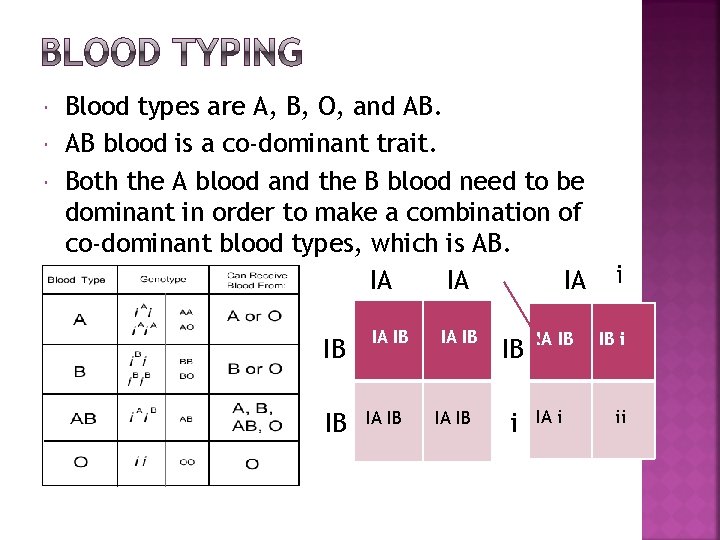
Blood types are A, B, O, and AB. AB blood is a co-dominant trait. Both the A blood and the B blood need to be dominant in order to make a combination of co-dominant blood types, which is AB. IA IA IA iiiiiiiiiiiiiiii IA IB IB IB IA IB i IA i ii
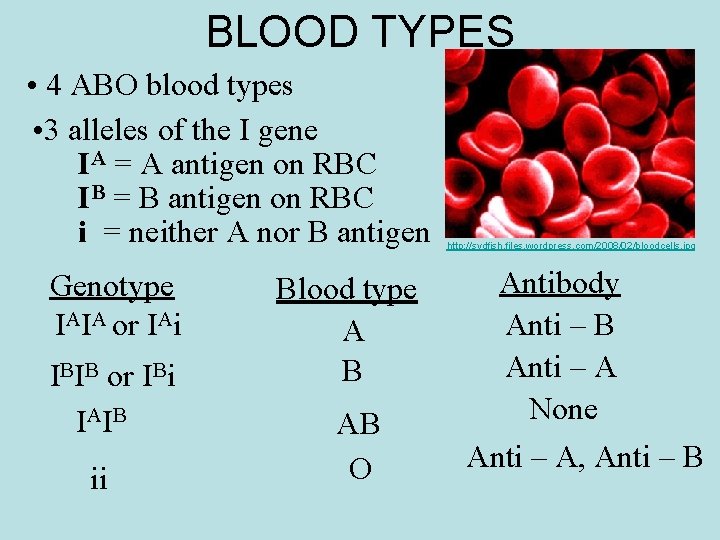
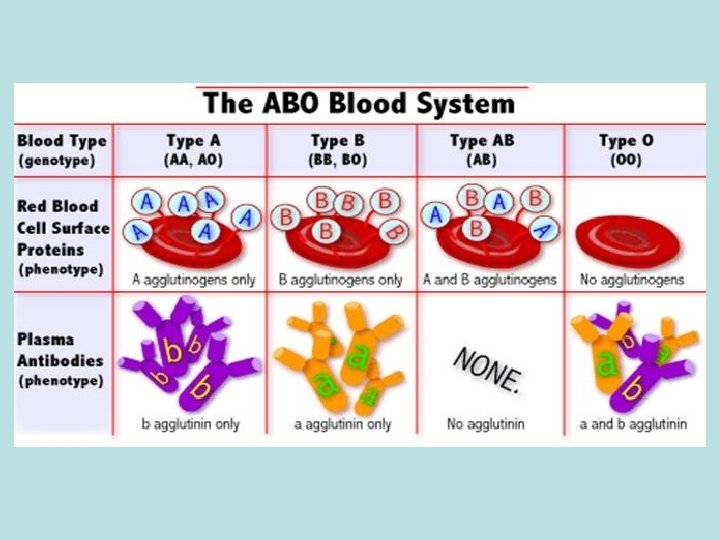
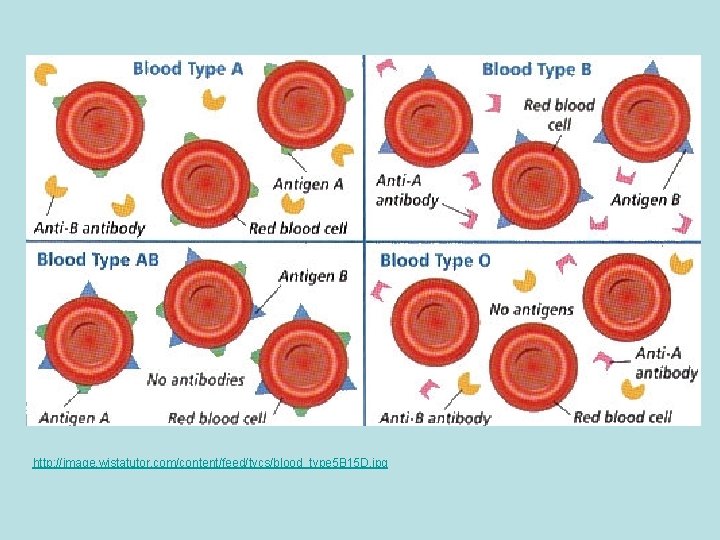
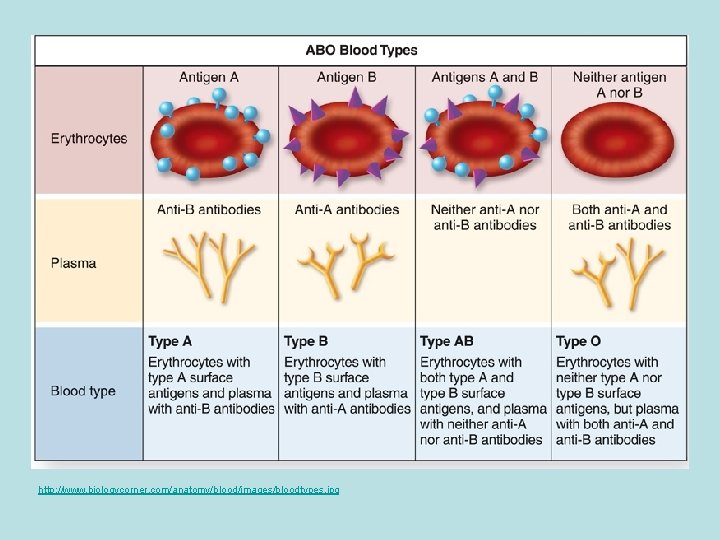
BLOOD TYPES • 4 ABO blood types • 3 alleles of the I gene IA = A antigen on RBC IB = B antigen on RBC i = neither A nor B antigen Genotype IAIA or IAi IBIB or IBi IA IB ii Blood type A B AB O http: //sydfish. files. wordpress. com/2008/02/bloodcells. jpg Antibody Anti – B Anti – A None Anti – A, Anti – B
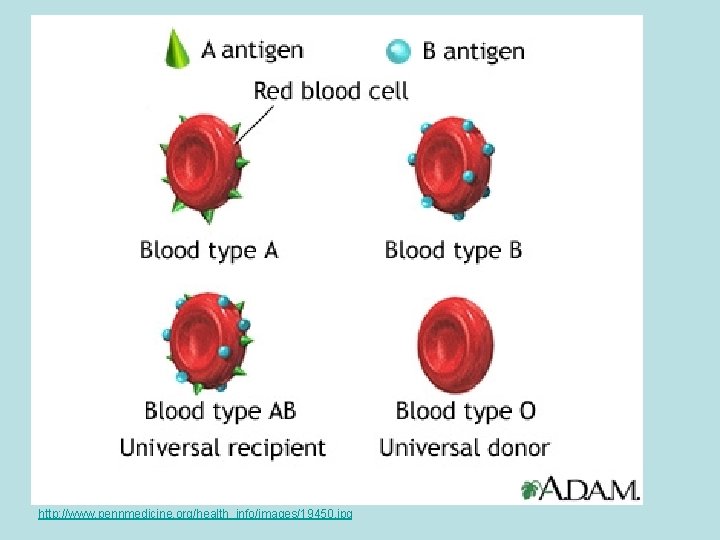
http: //www. pennmedicine. org/health_info/images/19450. jpg
http: //image. wistatutor. com/content/feed/tvcs/blood_type 5 B 15 D. jpg
http: //www. biologycorner. com/anatomy/blood/images/bloodtypes. jpg
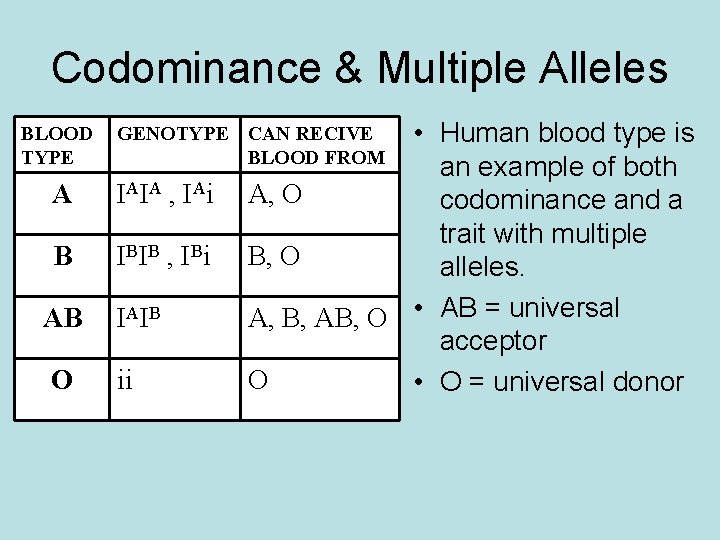
Codominance & Multiple Alleles BLOOD TYPE A IA IA , IA i B IB IB , IB i AB O • Human blood type is an example of both A, O codominance and a trait with multiple B, O alleles. A, B, AB, O • AB = universal acceptor O • O = universal donor GENOTYPE CAN RECIVE BLOOD FROM IA IB ii
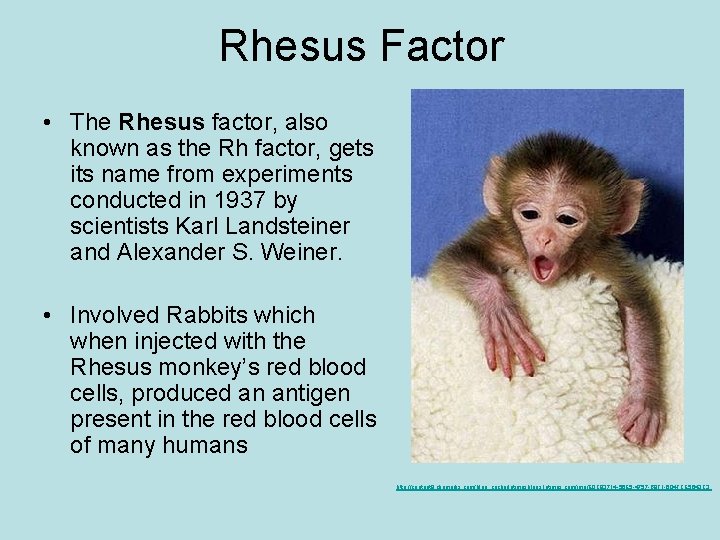
Rhesus Factor • The Rhesus factor, also known as the Rh factor, gets its name from experiments conducted in 1937 by scientists Karl Landsteiner and Alexander S. Weiner. • Involved Rabbits which when injected with the Rhesus monkey’s red blood cells, produced an antigen present in the red blood cells of many humans http: //content 9. clipmarks. com/blog_cache/latimesblogs. latimes. com/img/E 0 C 83714 -56 E 5 -4757 -B 9 F 1 -604 FCE 5643 C 3
Rhesus Factor • The Rhesus factor is an antigen, or more specifically a protein, that exists on the surface of red blood cells. • If a person has either two (+) genes for Rh or one (+) and one (-) Rh gene, they will test Rh(+). A person will be negative only if they have 2 (-).
Relevance of Rh Factor & ABO Typing? • It is very important in terms of babies: E. g. an Rh(-) mother may make antibody against an Rh(+) fetus if the baby gets a (+) gene from its father (Obstetricians screen pregnant women for this problem with blood tests). • The ABO and RH genes are only two of many blood antigens that are present on human red cells and must be matched up for successful blood transfusions.
Multifactorial • Referring to control of the expression of a trait by several genes and environmental factors. • Many multifactorial traits show continuous distribution.
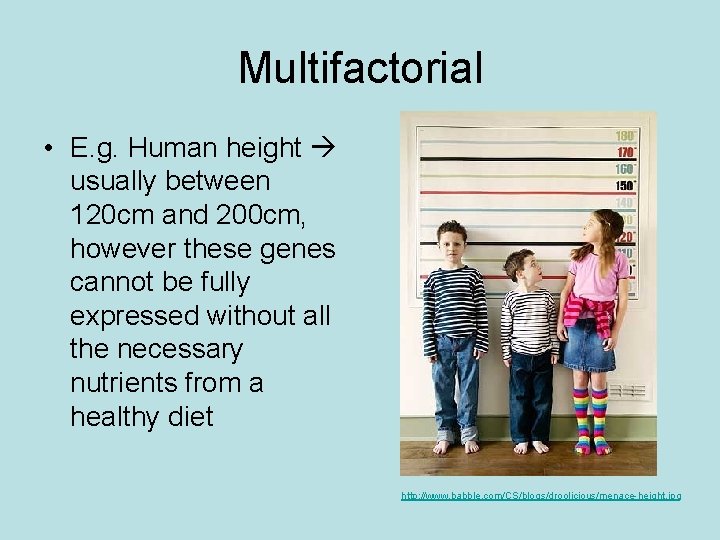
Multifactorial • E. g. Human height usually between 120 cm and 200 cm, however these genes cannot be fully expressed without all the necessary nutrients from a healthy diet http: //www. babble. com/CS/blogs/droolicious/menace-height. jpg