SimulationDriven Design of Photonic Quantum Communication Networks erhtjhtyhy

- Slides: 20
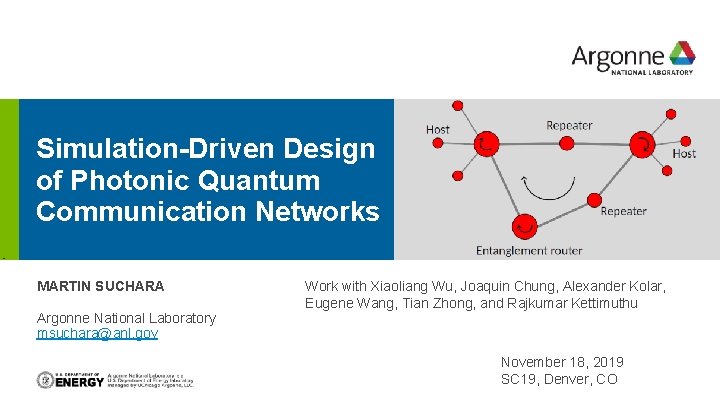
Simulation-Driven Design of Photonic Quantum Communication Networks erhtjhtyhy MARTIN SUCHARA Argonne National Laboratory msuchara@anl. gov Work with Xiaoliang Wu, Joaquin Chung, Alexander Kolar, Eugene Wang, Tian Zhong, and Rajkumar Kettimuthu November 18, 2019 SC 19, Denver, CO
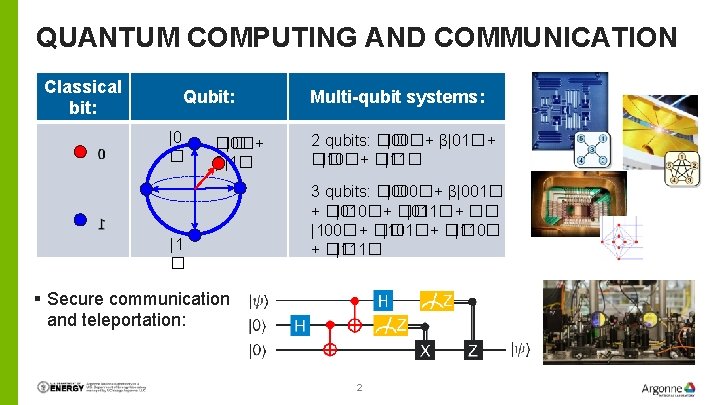
QUANTUM COMPUTING AND COMMUNICATION Classical bit: Qubit: |0 � �� |0� + β|1� |1 � Multi-qubit systems: 2 qubits: �� |00� + β|01� + �� |10� + �� |11� 3 qubits: �� |000� + β|001� + �� |010� + �� |011� + �� |100� + �� |101� + �� |110� + �� |111� § Secure communication and teleportation: 2
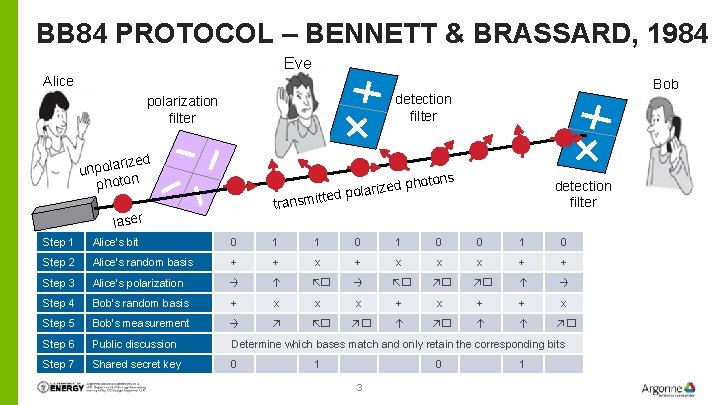
BB 84 PROTOCOL – BENNETT & BRASSARD, 1984 Eve Alice Bob detection filter polarization filter rized unpola photons p olarized p d e t it sm detection filter tran laser Step 1 Alice’s bit 0 1 1 0 0 1 0 Step 2 Alice’s random basis + + x x x + + Step 3 Alice’s polarization → ↑ ↖� → ↖� ↗� ↗� ↑ → Step 4 Bob’s random basis + x x x + + x Step 5 Bob’s measurement → ↗ ↖� ↗� ↑ ↑ ↗� Step 6 Public discussion Determine which bases match and only retain the corresponding bits Step 7 Shared secret key 0 1 0 3 1
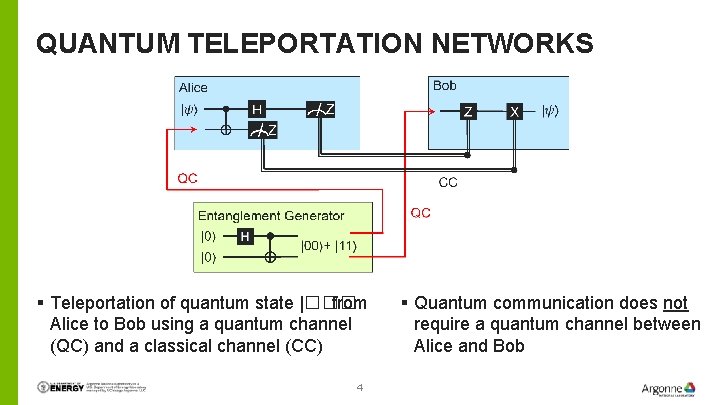
QUANTUM TELEPORTATION NETWORKS § Teleportation of quantum state |��� from Alice to Bob using a quantum channel (QC) and a classical channel (CC) 4 § Quantum communication does not require a quantum channel between Alice and Bob
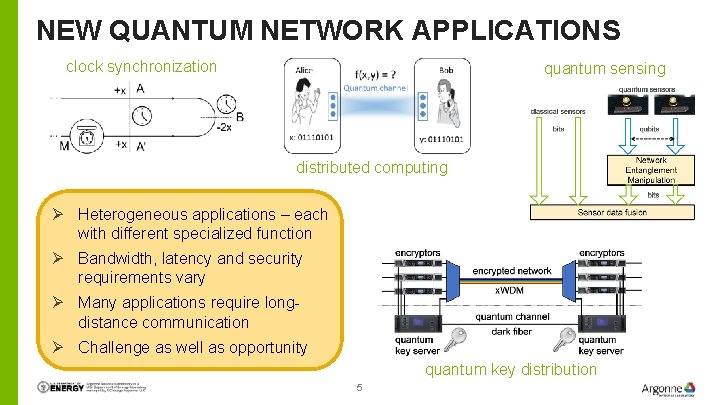
NEW QUANTUM NETWORK APPLICATIONS clock synchronization quantum sensing distributed computing Ø Heterogeneous applications – each with different specialized function Ø Bandwidth, latency and security requirements vary Ø Many applications require longdistance communication Ø Challenge as well as opportunity quantum key distribution 5
SIMULATIONS OF QUANTUM NETWORKS Quantum Network Simulation Team
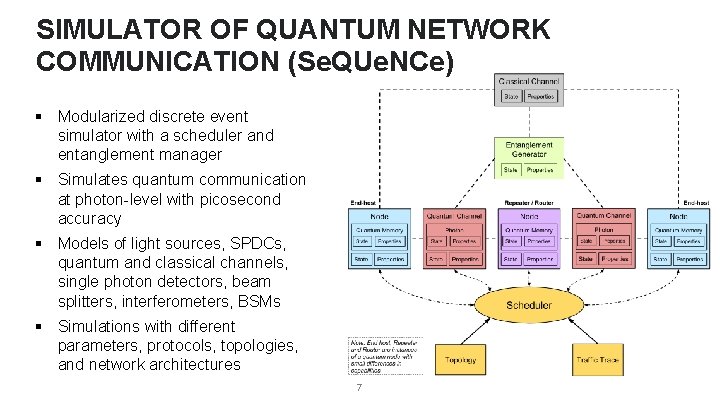
SIMULATOR OF QUANTUM NETWORK COMMUNICATION (Se. QUe. NCe) § Modularized discrete event simulator with a scheduler and entanglement manager § Simulates quantum communication at photon-level with picosecond accuracy § Models of light sources, SPDCs, quantum and classical channels, single photon detectors, beam splitters, interferometers, BSMs § Simulations with different parameters, protocols, topologies, and network architectures 7
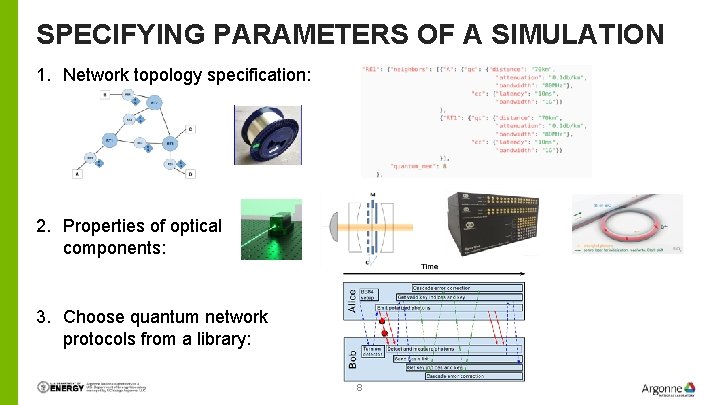
SPECIFYING PARAMETERS OF A SIMULATION 1. Network topology specification: 2. Properties of optical components: 3. Choose quantum network protocols from a library: 8
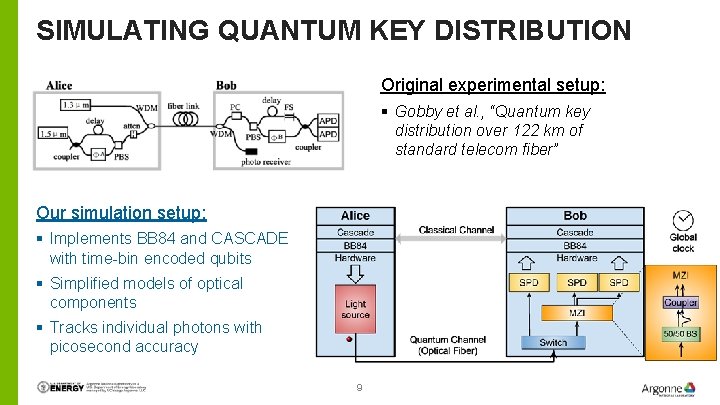
SIMULATING QUANTUM KEY DISTRIBUTION Original experimental setup: § Gobby et al. , “Quantum key distribution over 122 km of standard telecom fiber” Our simulation setup: § Implements BB 84 and CASCADE with time-bin encoded qubits § Simplified models of optical components § Tracks individual photons with picosecond accuracy 9
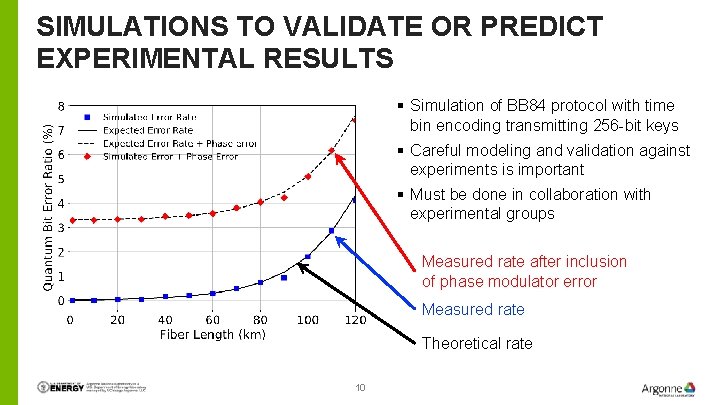
SIMULATIONS TO VALIDATE OR PREDICT EXPERIMENTAL RESULTS § Simulation of BB 84 protocol with time bin encoding transmitting 256 -bit keys § Careful modeling and validation against experiments is important § Must be done in collaboration with experimental groups Measured rate after inclusion of phase modulator error Measured rate Theoretical rate 10
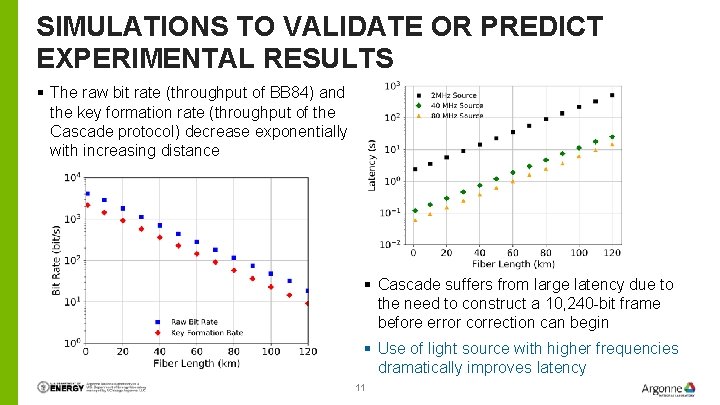
SIMULATIONS TO VALIDATE OR PREDICT EXPERIMENTAL RESULTS § The raw bit rate (throughput of BB 84) and the key formation rate (throughput of the Cascade protocol) decrease exponentially with increasing distance § Cascade suffers from large latency due to the need to construct a 10, 240 -bit frame before error correction can begin § Use of light source with higher frequencies dramatically improves latency 11
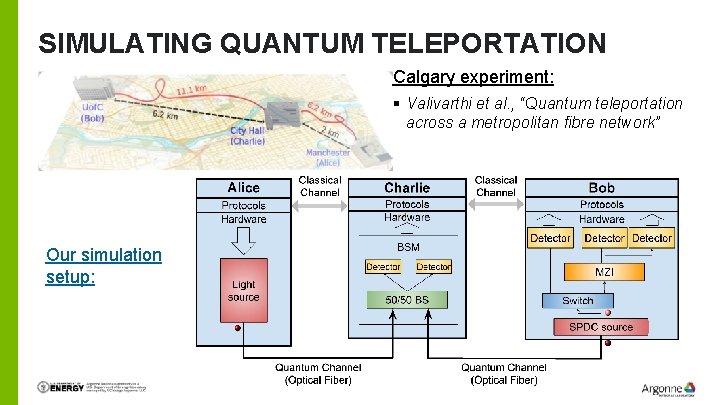
SIMULATING QUANTUM TELEPORTATION Calgary experiment: § Valivarthi et al. , “Quantum teleportation across a metropolitan fibre network” Our simulation setup:
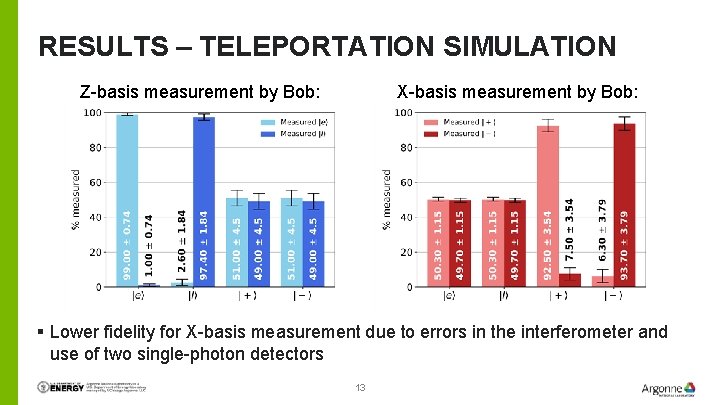
RESULTS – TELEPORTATION SIMULATION Z-basis measurement by Bob: X-basis measurement by Bob: § Lower fidelity for X-basis measurement due to errors in the interferometer and use of two single-photon detectors 13
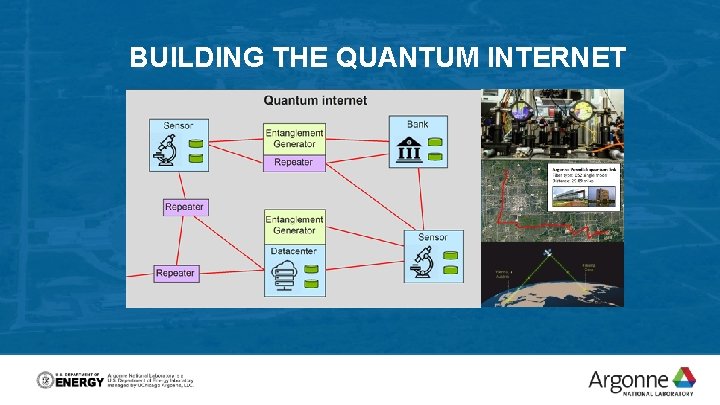
BUILDING THE QUANTUM INTERNET
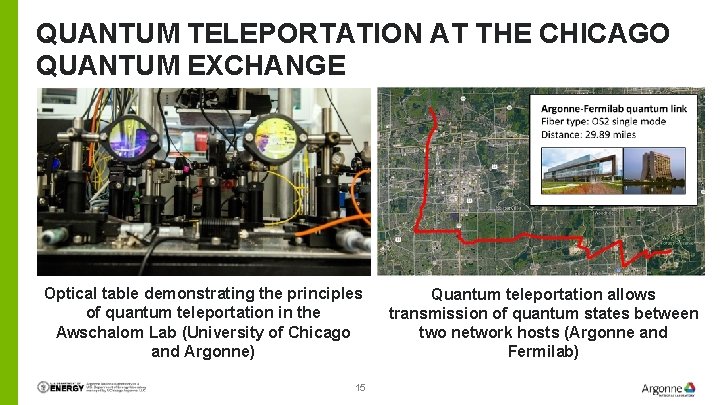
QUANTUM TELEPORTATION AT THE CHICAGO QUANTUM EXCHANGE Optical table demonstrating the principles of quantum teleportation in the Awschalom Lab (University of Chicago and Argonne) 15 Quantum teleportation allows transmission of quantum states between two network hosts (Argonne and Fermilab)
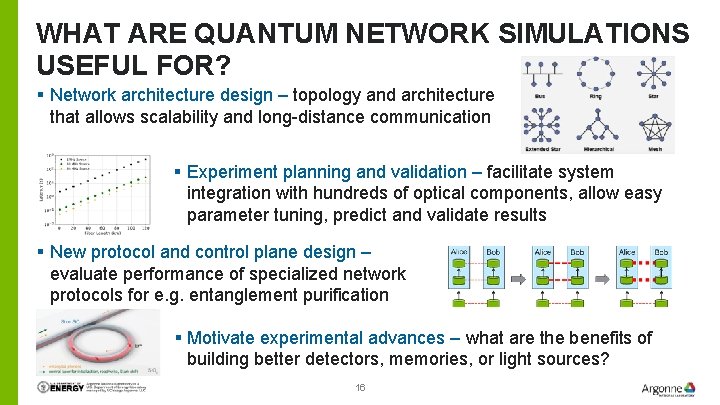
WHAT ARE QUANTUM NETWORK SIMULATIONS USEFUL FOR? § Network architecture design – topology and architecture that allows scalability and long-distance communication § Experiment planning and validation – facilitate system integration with hundreds of optical components, allow easy parameter tuning, predict and validate results § New protocol and control plane design – evaluate performance of specialized network protocols for e. g. entanglement purification § Motivate experimental advances – what are the benefits of building better detectors, memories, or light sources? 16
THANK YOU!
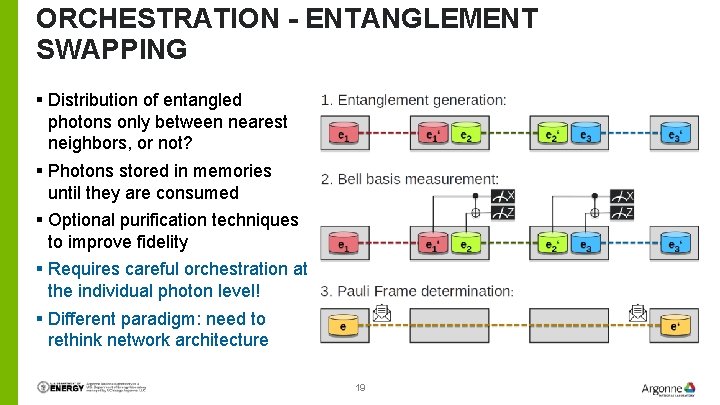
ORCHESTRATION - ENTANGLEMENT SWAPPING § Distribution of entangled photons only between nearest neighbors, or not? § Photons stored in memories until they are consumed § Optional purification techniques to improve fidelity § Requires careful orchestration at the individual photon level! § Different paradigm: need to rethink network architecture 19
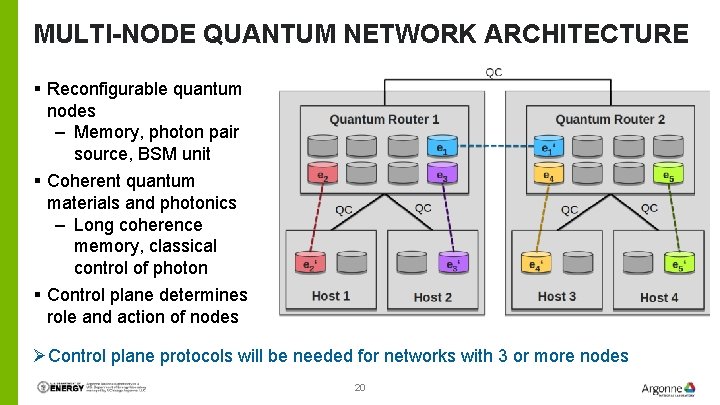
MULTI-NODE QUANTUM NETWORK ARCHITECTURE § Reconfigurable quantum nodes – Memory, photon pair source, BSM unit § Coherent quantum materials and photonics – Long coherence memory, classical control of photon § Control plane determines role and action of nodes ØControl plane protocols will be needed for networks with 3 or more nodes 20