Shakespearean Drama Frequently used techniques Play Story acted
- Slides: 20
Shakespearean Drama Frequently used techniques
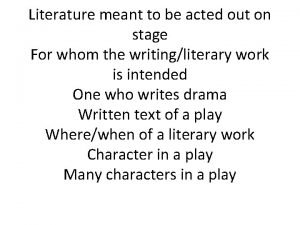
Play Story acted out live, using dialogue and action Shakespearean drama’s have a five act structure with a crisis in Act III that determines the course of the play and whether it the events are tragic or comic.
Tragedy Play that presents serious and important actions, ends unhappily for main character Tragic hero-a character, usually of high birth, neither totally good nor totally evil, whose downfall (peripeteia) is brought about by some weakness or error in judgment (hamartia). Additionally, the hero must recognize or discover something about herself/himself, changing from a state of ignorance to knowledge (anagnorisis).
Comedy A play that ends happily, main character gets what he wants
Dialogue Conversation between characters
Monologue Long speech by a character to others onstage
Soliloquy Speech made by a character alone onstage, speaks to himself or audience
Aside A short speech to another character or audience others don’t hear onstage
Stage Directions Tell actors where to move and how to speak lines Implied stage directions occur where no direct statement of action is made, but are implicit in the lines of dialogue.
Props Items that are portable and actors use onstage
Foil Character whose personality or attitude is in sharp contrast to another
Blank Verse A form of poetry that uses unrhymed lines of iambic pentameter Typically used by high status characters or by low status characters for comic effect. Low status characters typically speak in prose
Iambic Pentameter Lines of 5 unstressed syllables
Allusion Reference to something outside the work that the reader is expected to know
Crisis or Turning Point Moment when a choice made by main characters determine the direction of the action: upward to a happy ending (comedy) or downward to tragedy
Archaic Words that have disappeared from common use You (formal) vs. Thou (familiar) Use the side notes to help with these because definitions and explanations are often provided
Prologue A speech often spoken in verse delivered to an audience at the beginning of a play by an actor to introduce the subject matter
Epilogue A speech often spoken in verse delivered to an audience at the end of a play by an actor
Antithesis is the opposition of words against each other. Shakespeare new that drama must be beset with conflict. Just like good opposed evil Shakespeare’s language was often set against itself. This can be seen in Hamlet’s “To be, or not to be” (III. i. 56).
Pun Pun: Shakespeare loved wordplay, especially puns. And he used them to show a characters wit and intellect. Hamlet uses them more than any other character. From “nay I am too much i’ the sun” (I. ii. 67) when mocking the connection he has with his uncle.