Sh Ualikhanov Kokshetau State University City Kokshetau Country

- Slides: 10
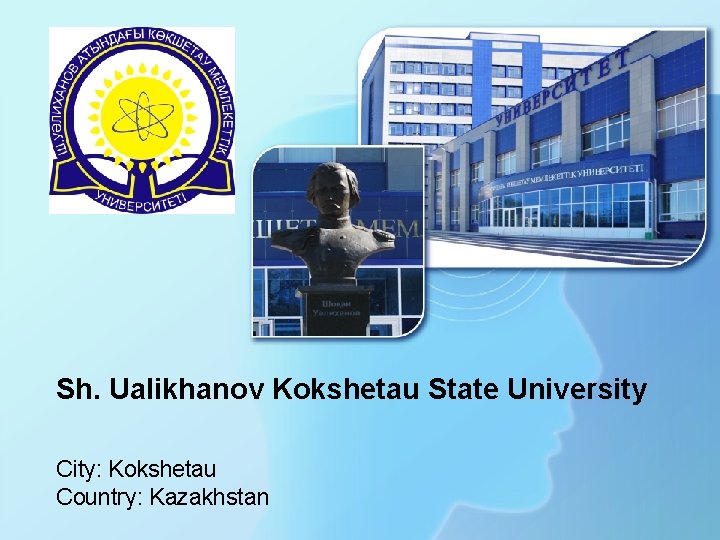
Sh. Ualikhanov Kokshetau State University City: Kokshetau Country: Kazakhstan
Agenda 1. Credit system used at the institution 2. Alignment (or lack of) with the Bologna Process 3. Use (or lack) of) ECTS 4. Administration structure supporting student mobility 5. Student mobility process 6. Credit transfer process 7. Grade conversion process
Credit system used at the institution KAZAKHSTAN CREDIT TRANSFER SYSTEM BASED ON ECTS For the provision of academic mobility of students and recognition of educational programmes it is necessary to transfer Kazakhstan credits to ECTS credits. In KSU the transfer is carried out by dividing the ECTS credits in the conversion factor depending on 1 ECTS credit for each discipline in the range of 1. 5 to 1. 8 ACADEMIC MOBILITY OF CREDIT TRANSFER IN KAZAKHSTAN BASED ON ECTS University develops and approves the procedure of credit transfer based on ECTS, which is the main document on the use of ECTS in university. The outcome document confirming student’s mobility programme is a transcript.
Alignment (or lack of) with the Bologna Process • • The main principles of the Bologna Declaration have been implemented at the Sh. Ualikhanov KSU. Credit Technology has been implemented. A full transition to a three-level training of specialists has been carried out: 1. Bachelor 2. Master 3. Doctor Ph. D Academic mobility of students and lecturers is carried out. Educational programs are aligned with European standards. ECTS credits are being reloaded. Joint educational programs are being implemented. In Sh. Ualikhanov KSU, ECTS coordinators for the university and faculties are appointed.
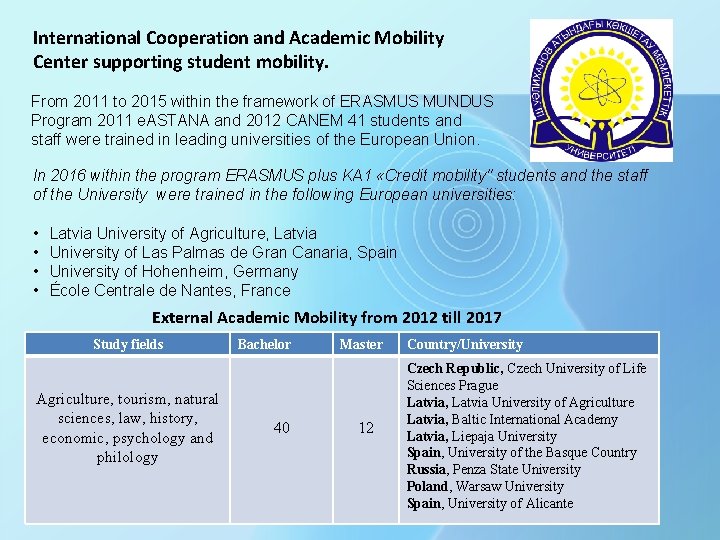
International Cooperation and Academic Mobility Center supporting student mobility. From 2011 to 2015 within the framework of ERASMUS MUNDUS Program 2011 e. ASTANA and 2012 CANEM 41 students and staff were trained in leading universities of the European Union. In 2016 within the program ERASMUS plus KA 1 «Credit mobility" students and the staff of the University were trained in the following European universities: • • Latvia University of Agriculture, Latvia University of Las Palmas de Gran Canaria, Spain University of Hohenheim, Germany École Centrale de Nantes, France External Academic Mobility from 2012 till 2017 Study fields Agriculture, tourism, natural sciences, law, history, economic, psychology and philology Bachelor 40 Master 12 Country/University Czech Republic, Czech University of Life Sciences Prague Latvia, Latvia University of Agriculture Latvia, Baltic International Academy Latvia, Liepaja University Spain, University of the Basque Country Russia, Penza State University Poland, Warsaw University Spain, University of Alicante
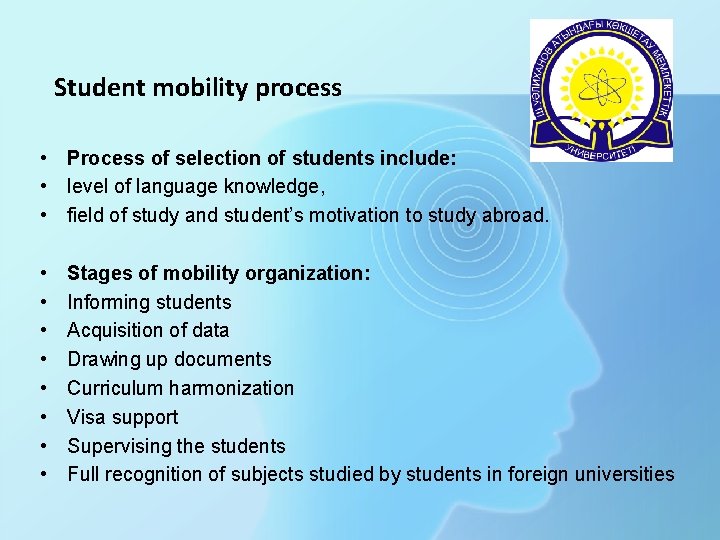
Student mobility process • Process of selection of students include: • level of language knowledge, • field of study and student’s motivation to study abroad. • • Stages of mobility organization: Informing students Acquisition of data Drawing up documents Curriculum harmonization Visa support Supervising the students Full recognition of subjects studied by students in foreign universities
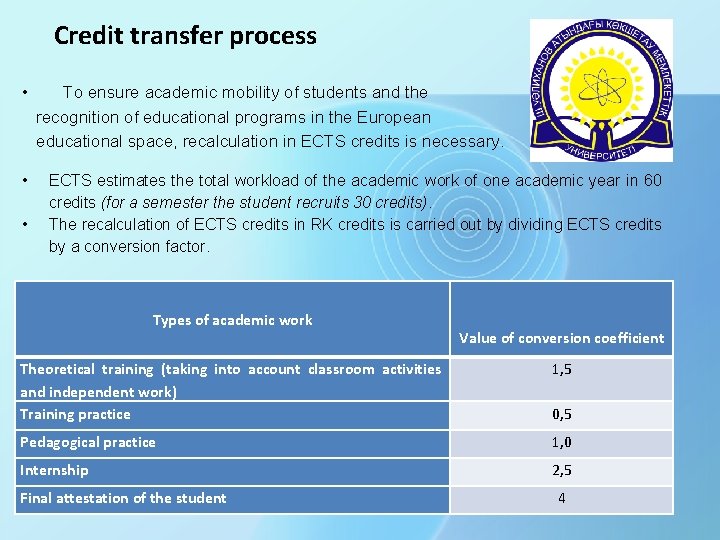
Credit transfer process • • • To ensure academic mobility of students and the recognition of educational programs in the European educational space, recalculation in ECTS credits is necessary. ECTS estimates the total workload of the academic work of one academic year in 60 credits (for a semester the student recruits 30 credits). The recalculation of ECTS credits in RK credits is carried out by dividing ECTS credits by a conversion factor. Types of academic work Value of conversion coefficient Theoretical training (taking into account classroom activities and independent work) Training practice 1, 5 Pedagogical practice 1, 0 Internship 2, 5 Final attestation of the student 0, 5 4
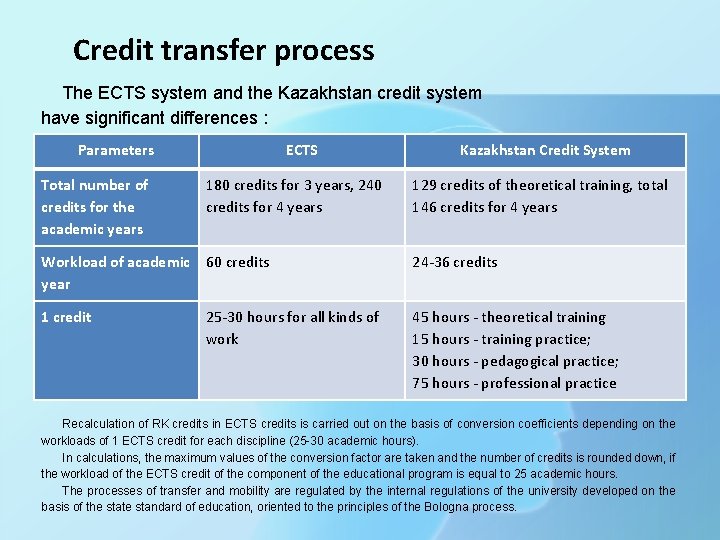
Credit transfer process The ECTS system and the Kazakhstan credit system have significant differences : Parameters Total number of credits for the academic years ECTS 180 credits for 3 years, 240 credits for 4 years Kazakhstan Credit System 129 credits of theoretical training, total 146 credits for 4 years Workload of academic 60 credits year 24 -36 credits 1 credit 45 hours - theoretical training 15 hours - training practice; 30 hours - pedagogical practice; 75 hours - professional practice 25 -30 hours for all kinds of work Recalculation of RK credits in ECTS credits is carried out on the basis of conversion coefficients depending on the workloads of 1 ECTS credit for each discipline (25 -30 academic hours). In calculations, the maximum values of the conversion factor are taken and the number of credits is rounded down, if the workload of the ECTS credit of the component of the educational program is equal to 25 academic hours. The processes of transfer and mobility are regulated by the internal regulations of the university developed on the basis of the state standard of education, oriented to the principles of the Bologna process.
Grade conversion process The grading system in Kazakhstan The Grade by Letter System The Number Equivalent Value by the Percentage: Traditional grading A 4, 0 95 -100 Excellent A- 3, 67 90 -94 Excellent B+ 3, 33 85 -89 Good B 3, 0 80 -84 Good B- 2, 67 75 -79 Good C+ 2, 33 70 -74 Satisfactory C 2, 0 65 -69 Satisfactory C- 1, 67 60 -64 Satisfactory D+ 1, 33 55 -59 Satisfactory D 1, 0 50 -54 Satisfactory F 0 0 -49 Fail
Thank you for attention!