Sequences LO 28022021 I can recognise and extend
- Slides: 23
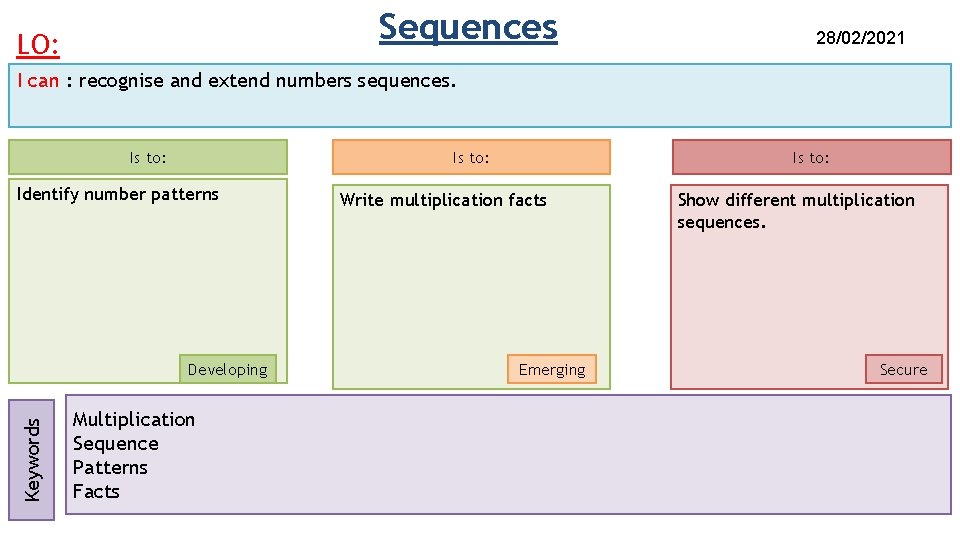
Sequences LO: 28/02/2021 I can : recognise and extend numbers sequences. Is to: Identify number patterns Keywords Developing Multiplication Sequence Patterns Facts Is to: Write multiplication facts Emerging Show different multiplication sequences. Secure
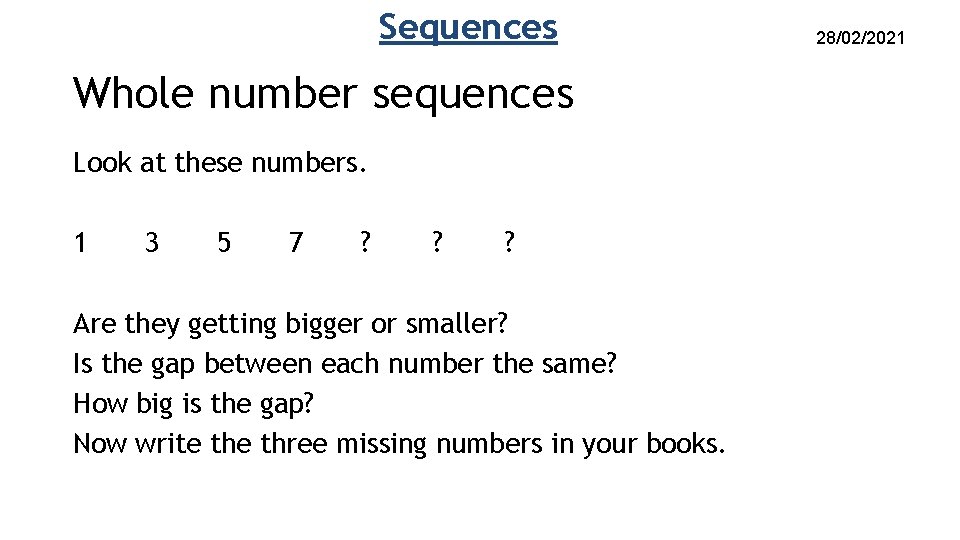
Sequences Whole number sequences Look at these numbers. 1 3 5 7 ? ? ? Are they getting bigger or smaller? Is the gap between each number the same? How big is the gap? Now write three missing numbers in your books. 28/02/2021
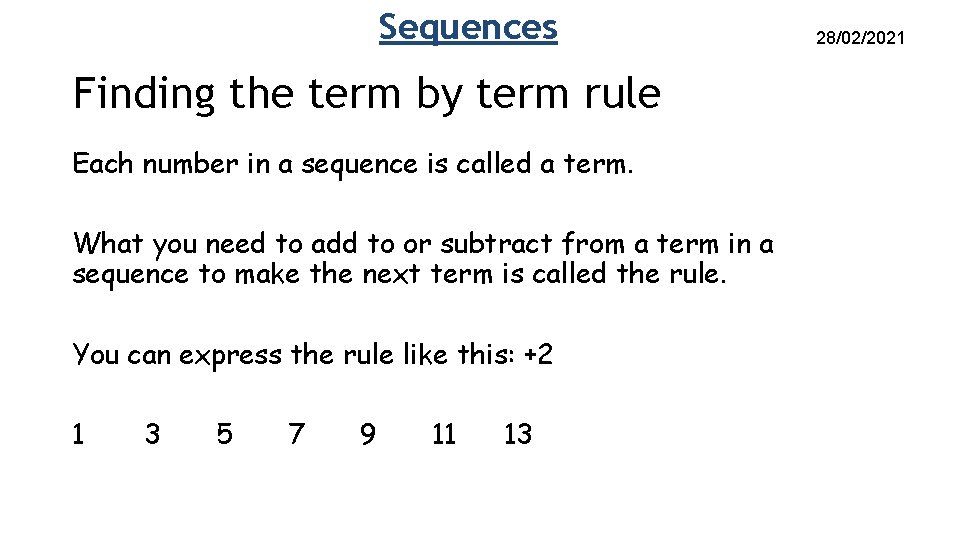
Sequences Finding the term by term rule Each number in a sequence is called a term. What you need to add to or subtract from a term in a sequence to make the next term is called the rule. You can express the rule like this: +2 1 3 5 7 9 11 13 28/02/2021
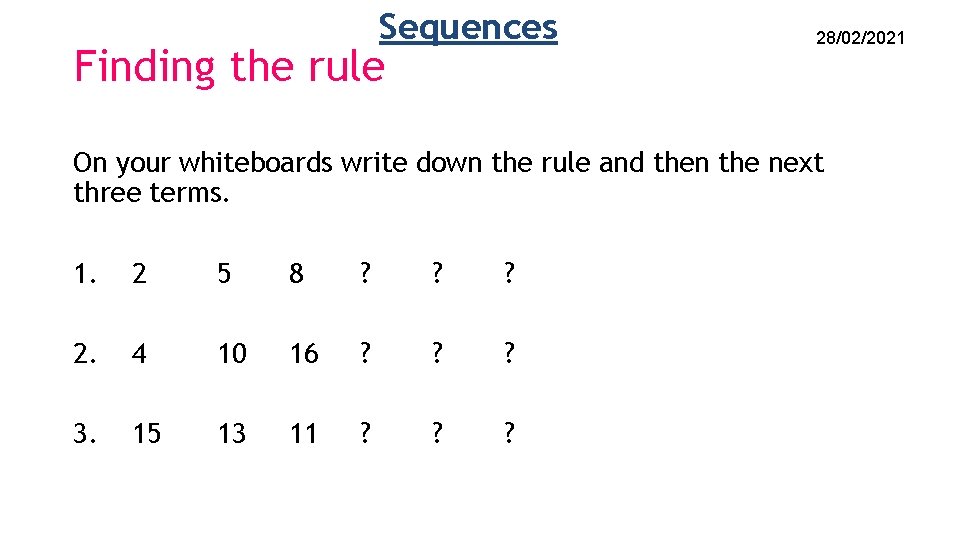
Sequences Finding the rule 28/02/2021 On your whiteboards write down the rule and then the next three terms. 1. 2 5 8 ? ? ? 2. 4 10 16 ? ? ? 3. 15 13 11 ? ? ?
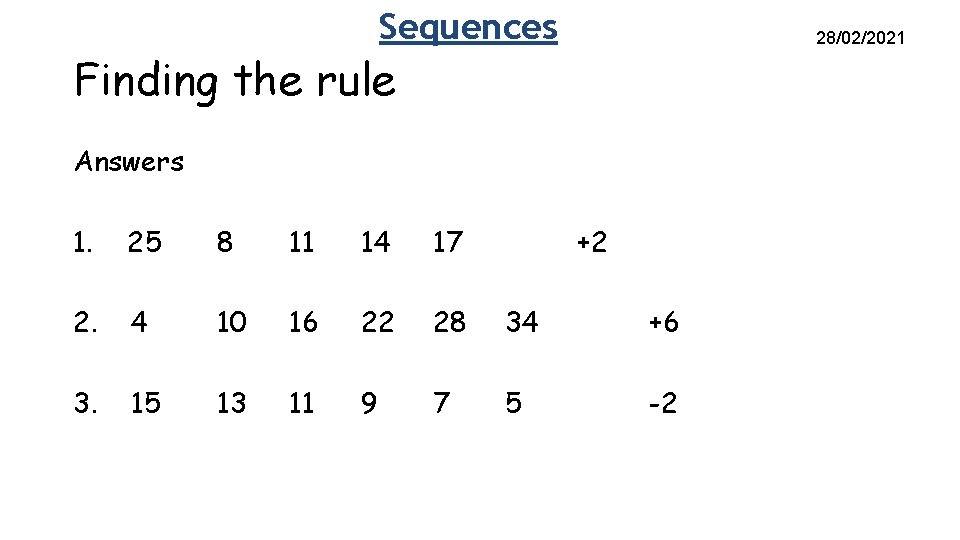
Sequences 28/02/2021 Finding the rule Answers 1. 25 8 11 14 17 2. 4 10 16 22 28 34 +6 3. 15 13 11 9 7 5 -2 +2
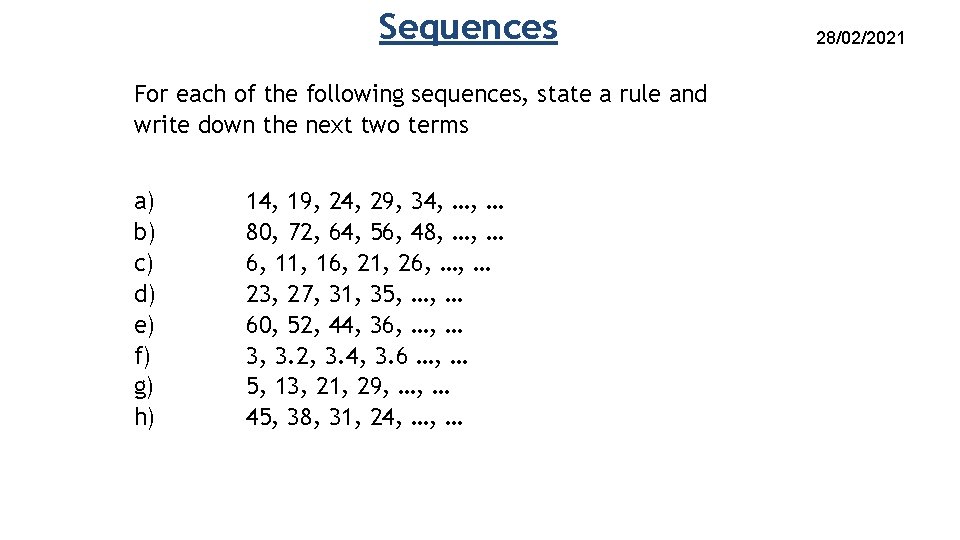
Sequences For each of the following sequences, state a rule and write down the next two terms a) b) c) d) e) f) g) h) 14, 19, 24, 29, 34, …, … 80, 72, 64, 56, 48, …, … 6, 11, 16, 21, 26, …, … 23, 27, 31, 35, …, … 60, 52, 44, 36, …, … 3, 3. 2, 3. 4, 3. 6 …, … 5, 13, 21, 29, …, … 45, 38, 31, 24, …, … 28/02/2021
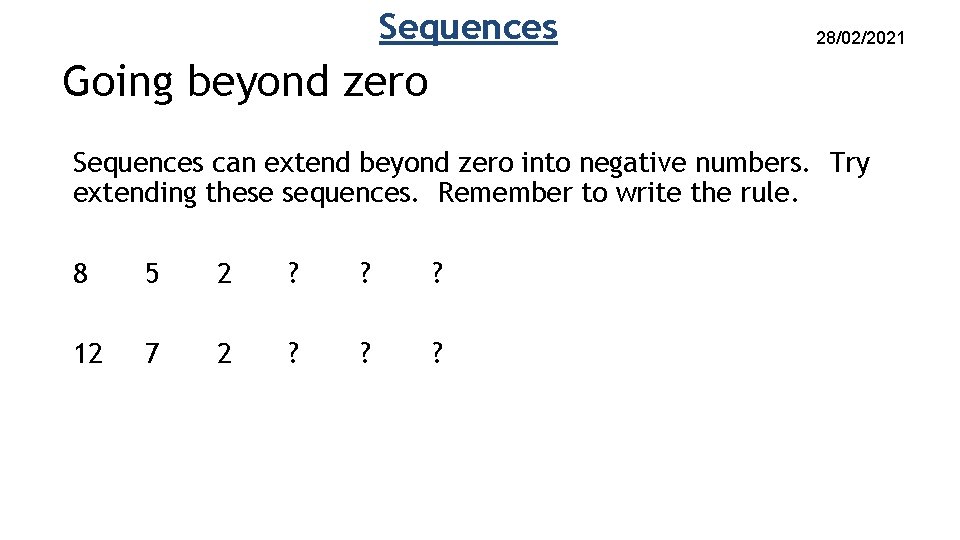
Sequences 28/02/2021 Going beyond zero Sequences can extend beyond zero into negative numbers. Try extending these sequences. Remember to write the rule. 8 5 2 ? ? ? 12 7 2 ? ? ?
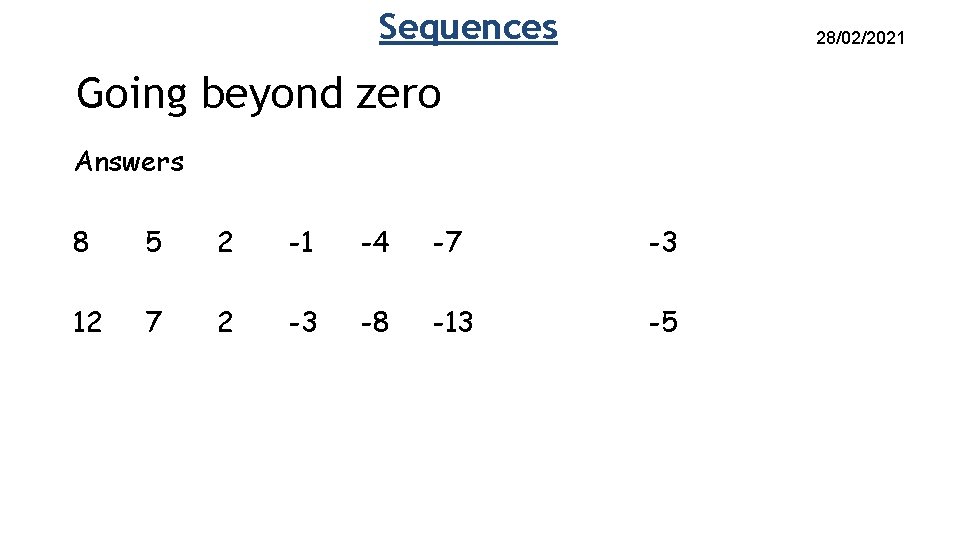
Sequences 28/02/2021 Going beyond zero Answers 8 5 2 -1 -4 -7 -3 12 7 2 -3 -8 -13 -5
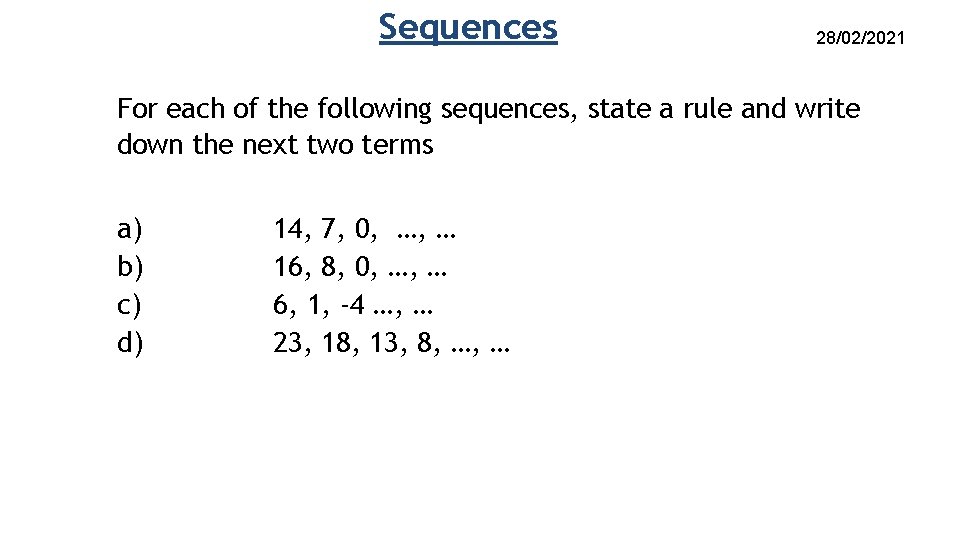
Sequences 28/02/2021 For each of the following sequences, state a rule and write down the next two terms a) b) c) d) 14, 7, 0, …, … 16, 8, 0, …, … 6, 1, -4 …, … 23, 18, 13, 8, …, …
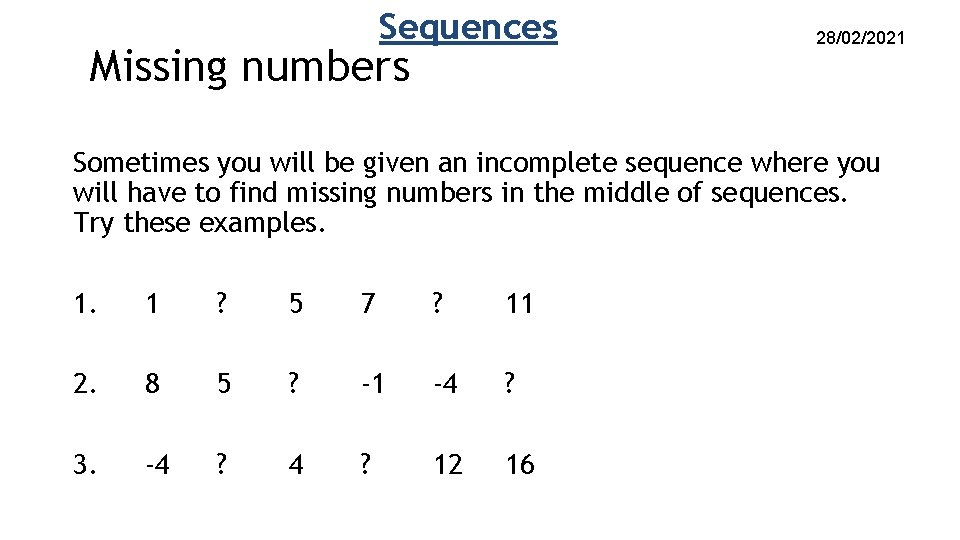
Sequences Missing numbers 28/02/2021 Sometimes you will be given an incomplete sequence where you will have to find missing numbers in the middle of sequences. Try these examples. 1 ? 5 7 ? 11 2. 8 5 ? -1 -4 ? 3. -4 ? 12 16
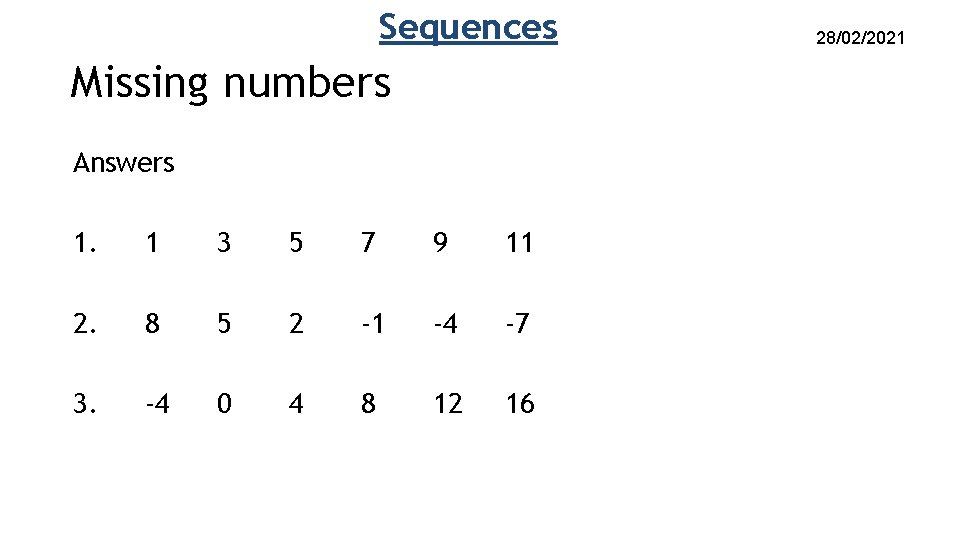
Sequences Missing numbers Answers 1. 1 3 5 7 9 11 2. 8 5 2 -1 -4 -7 3. -4 0 4 8 12 16 28/02/2021
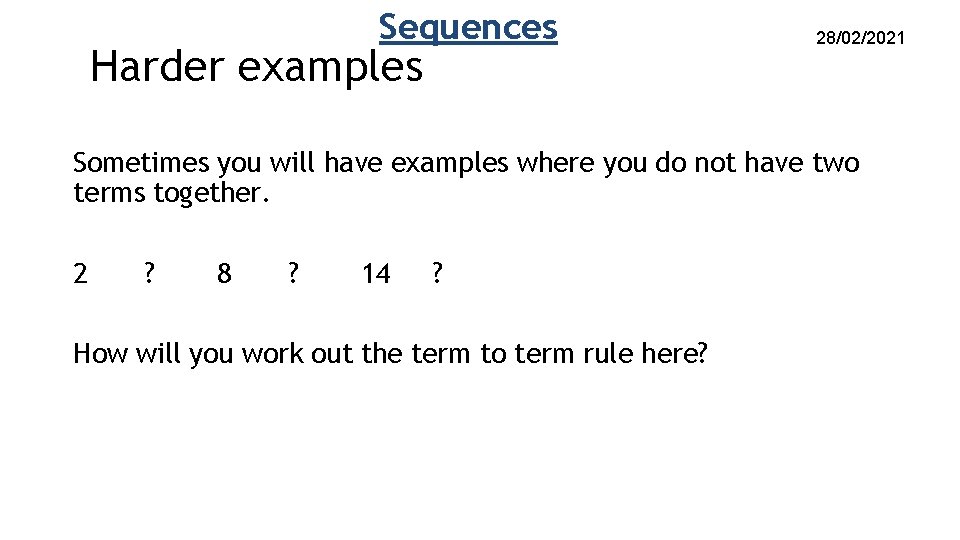
Sequences Harder examples 28/02/2021 Sometimes you will have examples where you do not have two terms together. 2 ? 8 ? 14 ? How will you work out the term to term rule here?
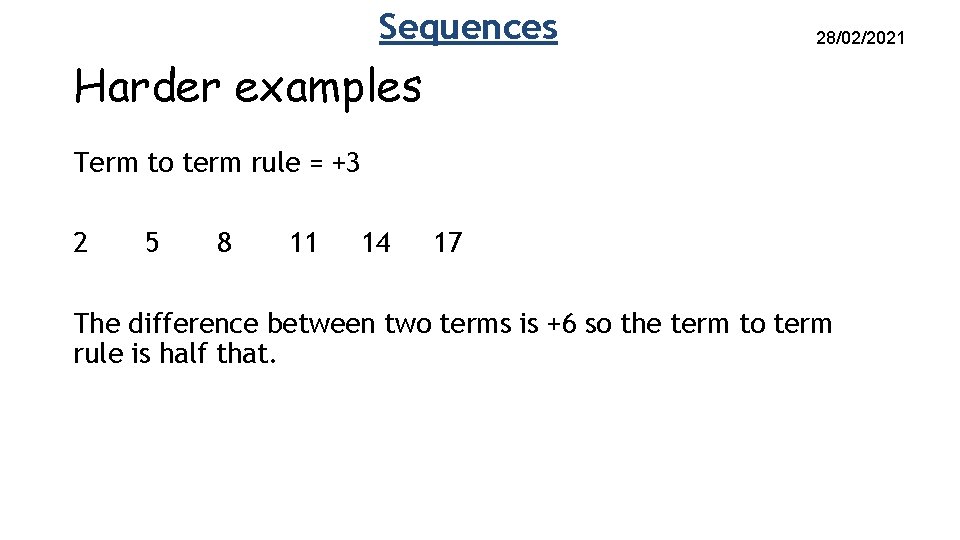
Sequences 28/02/2021 Harder examples Term to term rule = +3 2 5 8 11 14 17 The difference between two terms is +6 so the term to term rule is half that.
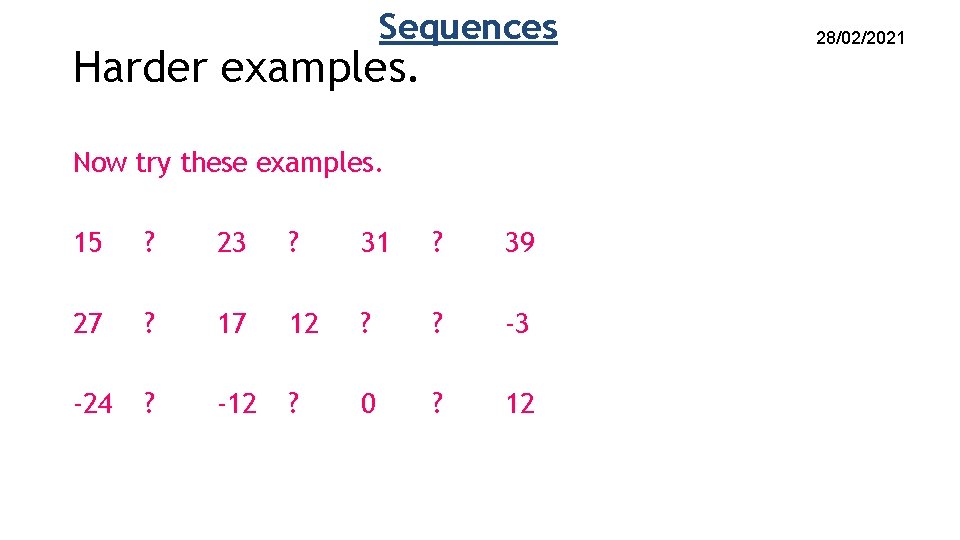
Sequences Harder examples. Now try these examples. 15 ? 23 ? 31 ? 39 27 ? 17 12 ? ? -3 -24 ? -12 ? 0 ? 12 28/02/2021
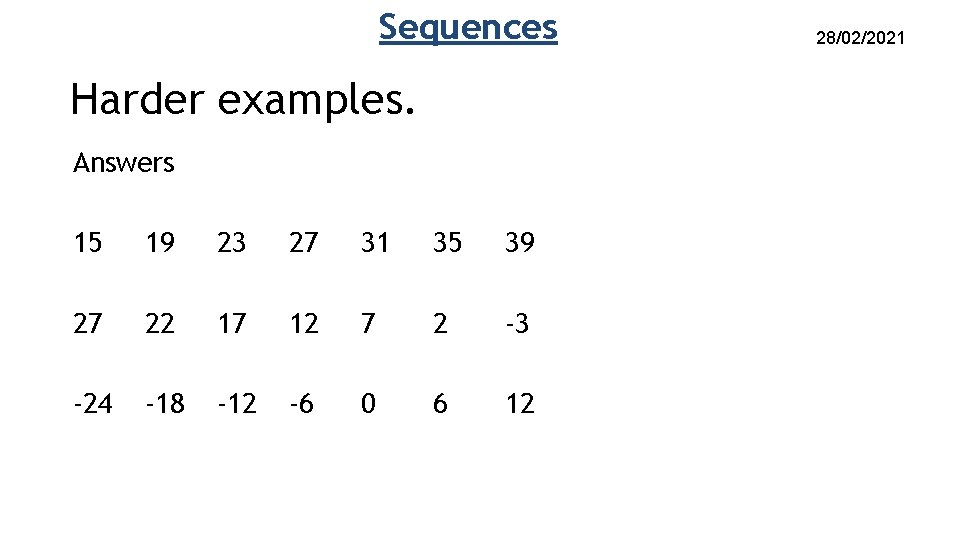
Sequences Harder examples. Answers 15 19 23 27 31 35 39 27 22 17 12 7 2 -3 -24 -18 -12 -6 0 6 12 28/02/2021
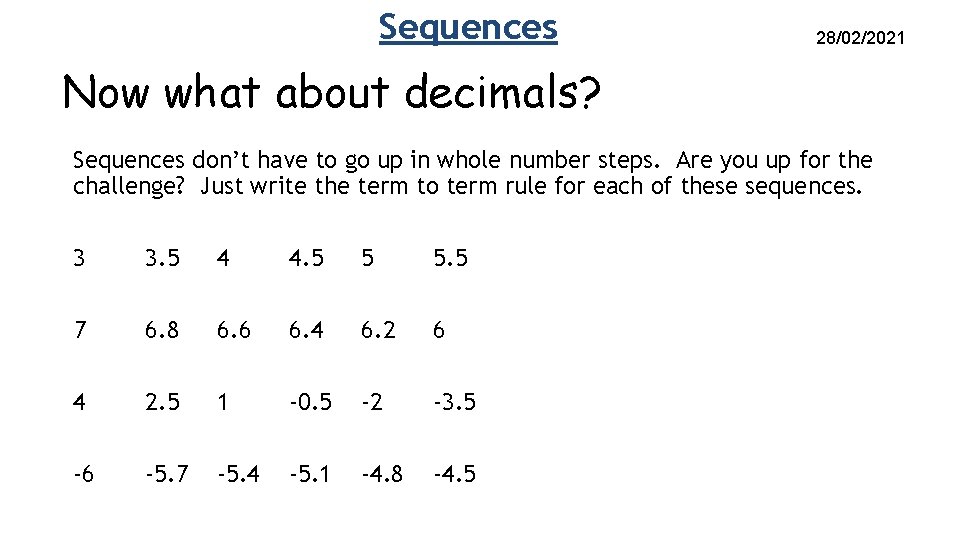
Sequences 28/02/2021 Now what about decimals? Sequences don’t have to go up in whole number steps. Are you up for the challenge? Just write the term to term rule for each of these sequences. 3 3. 5 4 4. 5 5 5. 5 7 6. 8 6. 6 6. 4 6. 2 6 4 2. 5 1 -0. 5 -2 -3. 5 -6 -5. 7 -5. 4 -5. 1 -4. 8 -4. 5
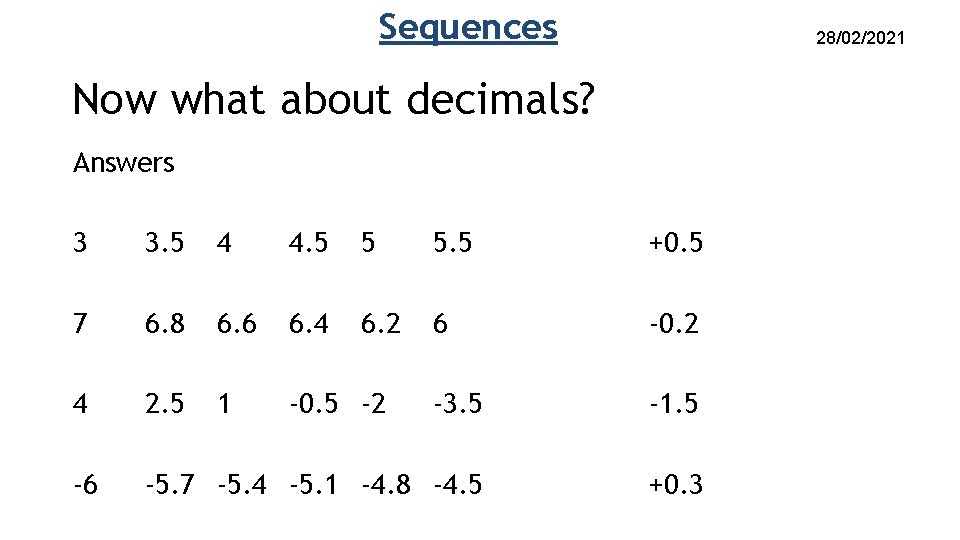
Sequences 28/02/2021 Now what about decimals? Answers 3 3. 5 4 4. 5 5 5. 5 +0. 5 7 6. 8 6. 6 6. 4 6. 2 6 -0. 2 4 2. 5 1 -0. 5 -2 -3. 5 -1. 5 -6 -5. 7 -5. 4 -5. 1 -4. 8 -4. 5 +0. 3
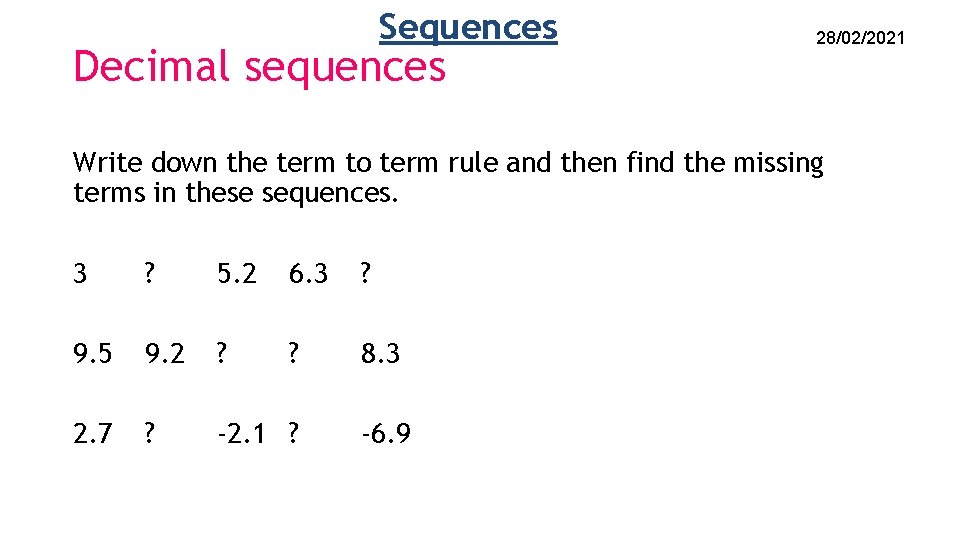
Sequences Decimal sequences 28/02/2021 Write down the term to term rule and then find the missing terms in these sequences. 3 ? 5. 2 6. 3 ? 9. 5 9. 2 ? ? 8. 3 2. 7 ? -2. 1 ? -6. 9
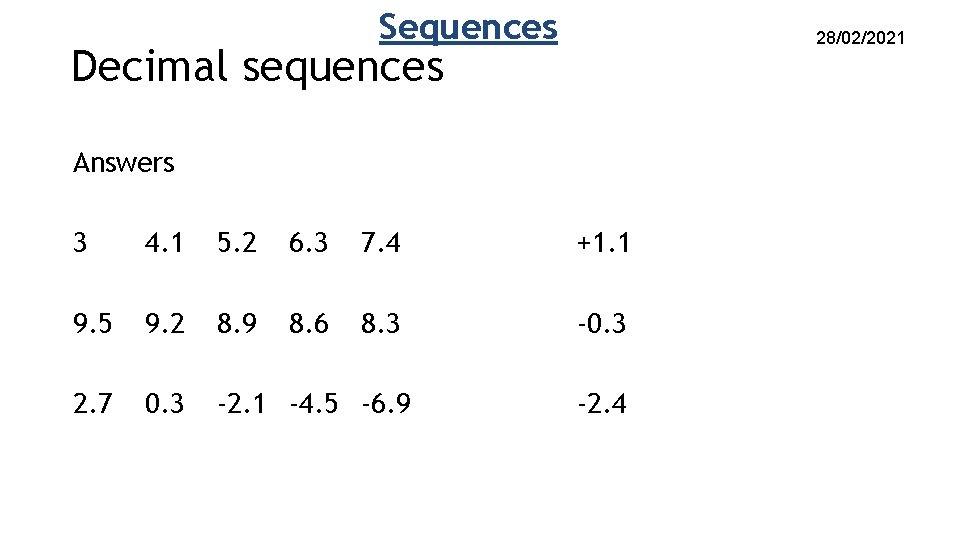
Sequences 28/02/2021 Decimal sequences Answers 3 4. 1 5. 2 6. 3 7. 4 +1. 1 9. 5 9. 2 8. 9 8. 6 8. 3 -0. 3 2. 7 0. 3 -2. 1 -4. 5 -6. 9 -2. 4
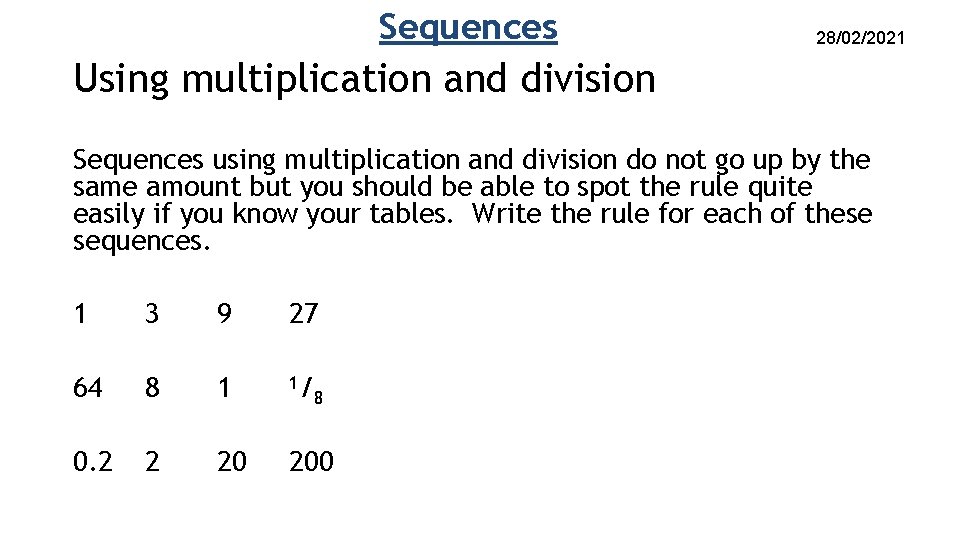
Sequences 28/02/2021 Using multiplication and division Sequences using multiplication and division do not go up by the same amount but you should be able to spot the rule quite easily if you know your tables. Write the rule for each of these sequences. 1 3 9 27 64 8 1 1/ 0. 2 2 20 200 8
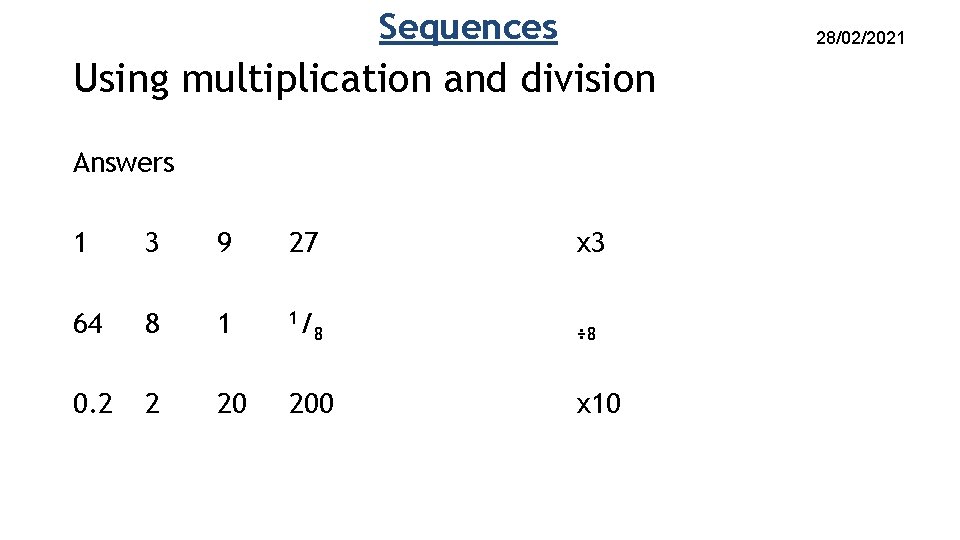
Sequences 28/02/2021 Using multiplication and division Answers 1 3 9 27 x 3 64 8 1 1/ ÷ 8 0. 2 2 20 200 8 x 10
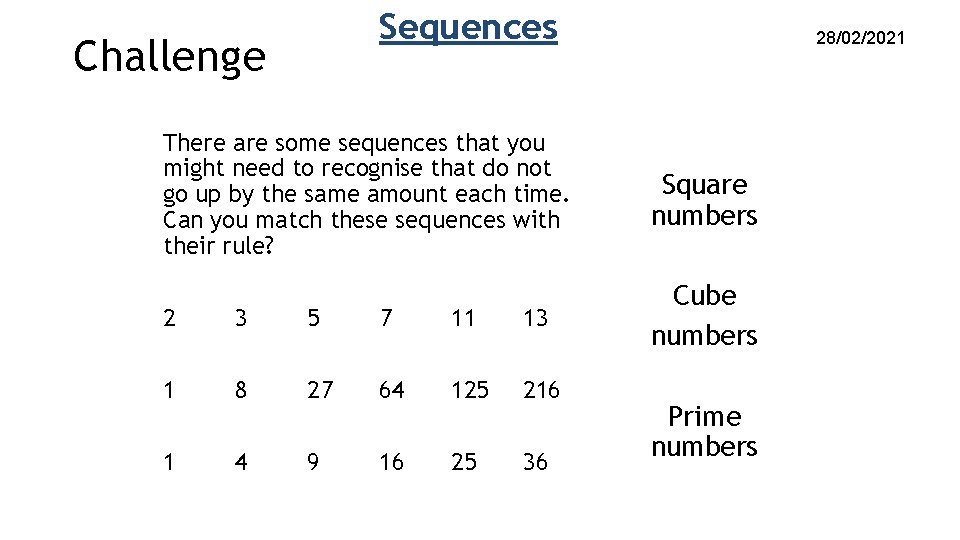
Sequences Challenge 28/02/2021 There are some sequences that you might need to recognise that do not go up by the same amount each time. Can you match these sequences with their rule? Square numbers 2 3 5 7 11 13 Cube numbers 1 8 27 64 125 216 1 4 9 16 25 36 Prime numbers
Plenary Sequences 28/02/2021 You have been finding the rule and extending sequences. Can you find missing terms in sequences? Can you create a sequence once you know the rule? Ask your partner to write out a sequence following your rule. Do you both get the same sequence? How might you make a more complicated sequence?