SENIOR PROJECT PHYSICAL THERAPY INTERNSHIP PRESENTATION ON HIP

- Slides: 11
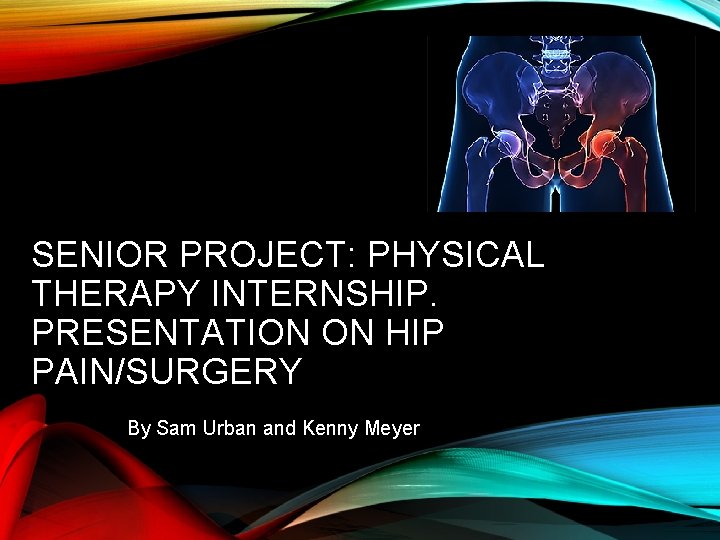
SENIOR PROJECT: PHYSICAL THERAPY INTERNSHIP. PRESENTATION ON HIP PAIN/SURGERY By Sam Urban and Kenny Meyer
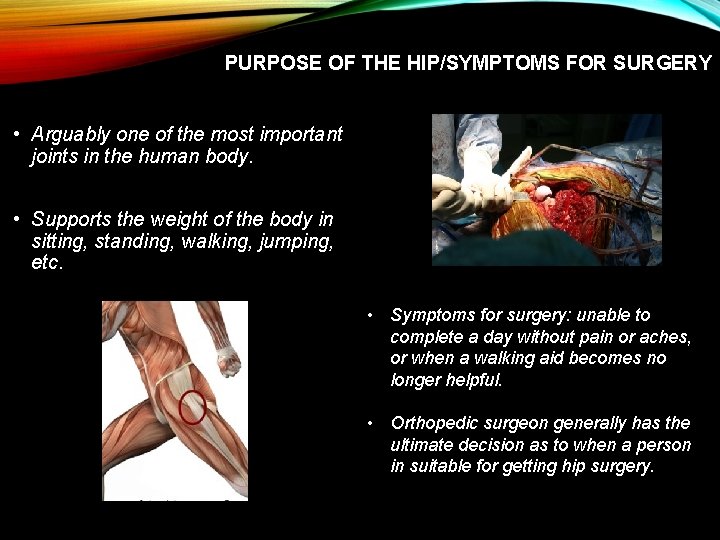
PURPOSE OF THE HIP/SYMPTOMS FOR SURGERY • Arguably one of the most important joints in the human body. • Supports the weight of the body in sitting, standing, walking, jumping, etc. • Symptoms for surgery: unable to complete a day without pain or aches, or when a walking aid becomes no longer helpful. • Orthopedic surgeon generally has the ultimate decision as to when a person in suitable for getting hip surgery.
PREOPERATIVE CARE/ARRANGEMENTS • One to two months out: • set up a date for the actual surgery • set up a date with primary care physician to discuss risks associated with surgery • One month out: • will receive a letter stating required appointments including anesthesia, and preoperative education classes • Two weeks out: • will stop taking certain medications • One week out: • instructed to stop taking all aspirin or other non-steroidal antiinflammatory drugs • One to three days out: • confirm surgery appointments
OLD METHOD VS. NEW MINIMALLY INVASIVE METHOD Old: • An 8 -10 in. cut along the side of the hip to move muscles connected to top of thighbone ball portion of the joint is removed by cutting the thighbone. • An artificial joint is attached to the thighbone the new ball part of the thighbone is then inserted into the socket part of the hip. • Last step is reattaching the muscles and closes the incision. New: • One to two cuts from 2 to 5 inches long in order to move muscles connected to top of thighbone. • Ball portion of the joint is removed by cutting the thighbone. • An artificial joint is attached to the thighbone. • The new ball part of the thighbone is then inserted into the socket part of the hip. • Last step is reattaching the muscles and closes the incision.
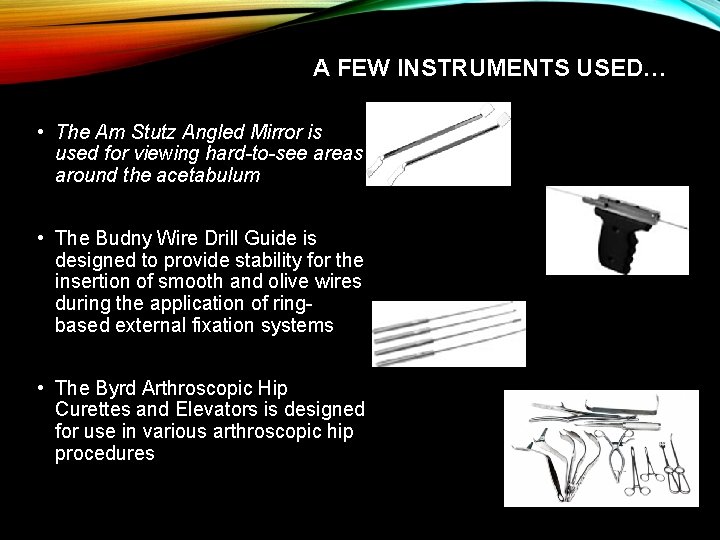
A FEW INSTRUMENTS USED… • The Am Stutz Angled Mirror is used for viewing hard-to-see areas around the acetabulum • The Budny Wire Drill Guide is designed to provide stability for the insertion of smooth and olive wires during the application of ringbased external fixation systems • The Byrd Arthroscopic Hip Curettes and Elevators is designed for use in various arthroscopic hip procedures
POSTOPERATIVE CARE SEDATION IT’S TIME FOR SURGERY! During the intake process the patient receives pain relief medications to alleviate the pain; this medication can be administered by IV and pill form. The patient will struggle greatly with any and all movements; patient needs assistance with every movement. Activities such as going to the bathroom and showering are assisted. They will walk up and down a hallway a couple times a day with a walker to keep blood flowing in their body. The patient is in hospital care for only up to a week (typically 4 -5 days) after surgery before they transition to home care.
POSTOPERATIVE CARE SEDATION • Home care: patient now has more independency to take medications on their own, and do their in bed PT exercises 3 times a day(ankle pumps, quad and glute sets) • Patient is still 0 -10% weight bearing so will need assistance from family or occupational nurses with using the bathroom and shower. • Occupational therapist visits weekly to show patient exercises, as well as how to properly perform a handful of daily tasks
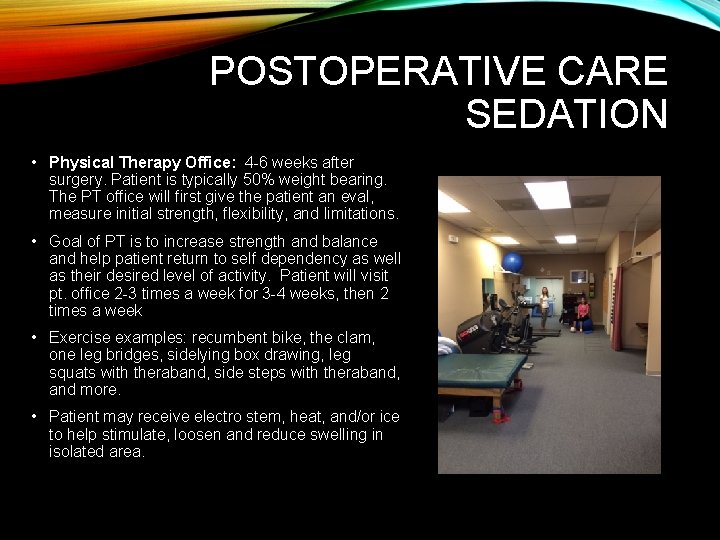
POSTOPERATIVE CARE SEDATION • Physical Therapy Office: 4 -6 weeks after surgery. Patient is typically 50% weight bearing. The PT office will first give the patient an eval, measure initial strength, flexibility, and limitations. • Goal of PT is to increase strength and balance and help patient return to self dependency as well as their desired level of activity. Patient will visit pt. office 2 -3 times a week for 3 -4 weeks, then 2 times a week • Exercise examples: recumbent bike, the clam, one leg bridges, sidelying box drawing, leg squats with theraband, side steps with theraband, and more. • Patient may receive electro stem, heat, and/or ice to help stimulate, loosen and reduce swelling in isolated area.
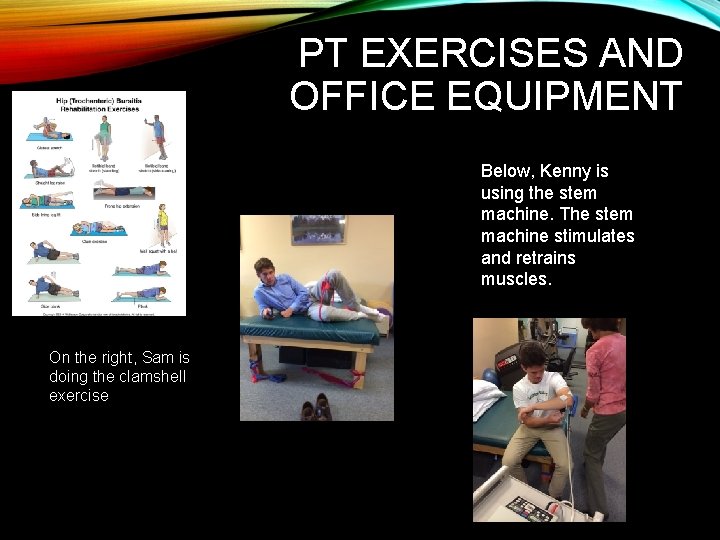
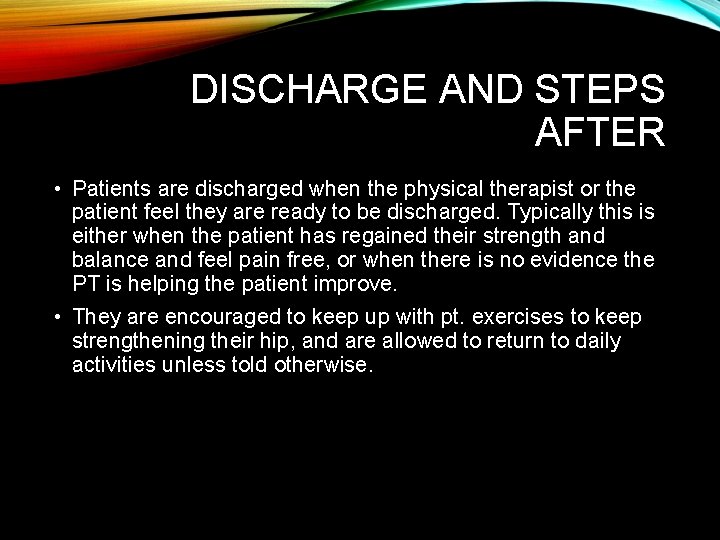
PT EXERCISES AND OFFICE EQUIPMENT Below, Kenny is using the stem machine. The stem machine stimulates and retrains muscles. On the right, Sam is doing the clamshell exercise
DISCHARGE AND STEPS AFTER • Patients are discharged when the physical therapist or the patient feel they are ready to be discharged. Typically this is either when the patient has regained their strength and balance and feel pain free, or when there is no evidence the PT is helping the patient improve. • They are encouraged to keep up with pt. exercises to keep strengthening their hip, and are allowed to return to daily activities unless told otherwise.
FINAL THOUGHTS ON PT • Physical therapy has a huge impact on a patients life and their recovery. It is the only successful and sure way of recovering after injury or surgery. • The past 3 weeks have been an amazing opportunity to experience a Physical Therapy setting first hand; We learned exercises and worked with patients, guided/assisted them with their exercises, sat in on Eval’s of first time patients, learned some anatomy of the body, and learned how to properly put stem pads on, and use the stem machine. We have learned more in the past 3 weeks than we have in the past 18 years. We would like to thank Ms. Lindsay Simmons, Todd, Teresa, and everyone else who helped us, taught us, and allowed us to have this incredible experience for our senior project!