Semaphore synchronization primitive 4 Test And Set are
- Slides: 15
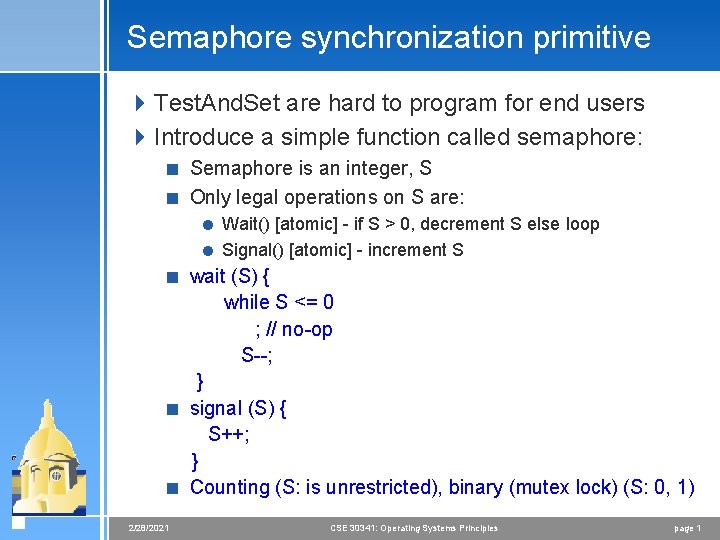
Semaphore synchronization primitive 4 Test. And. Set are hard to program for end users 4 Introduce a simple function called semaphore: < Semaphore is an integer, S < Only legal operations on S are: = Wait() [atomic] - if S > 0, decrement S else loop = Signal() [atomic] - increment S < wait (S) { while S <= 0 ; // no-op S--; } < signal (S) { S++; } < Counting (S: is unrestricted), binary (mutex lock) (S: 0, 1) 2/28/2021 CSE 30341: Operating Systems Principles page 1
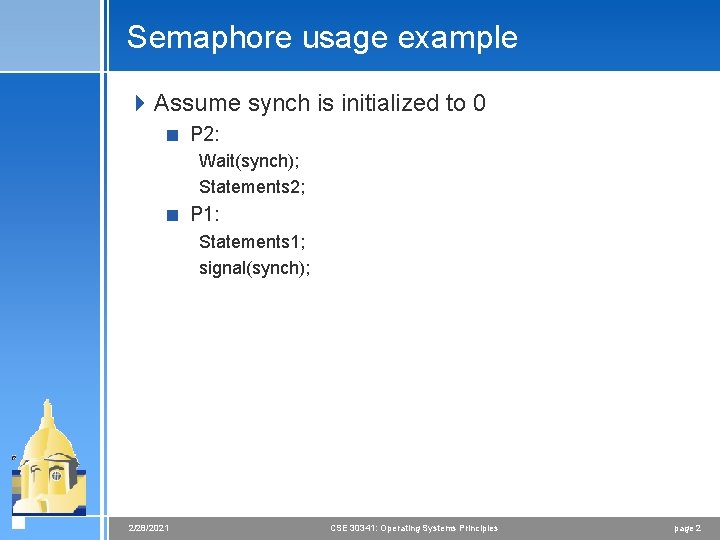
Semaphore usage example 4 Assume synch is initialized to 0 < P 2: Wait(synch); Statements 2; < P 1: Statements 1; signal(synch); 2/28/2021 CSE 30341: Operating Systems Principles page 2
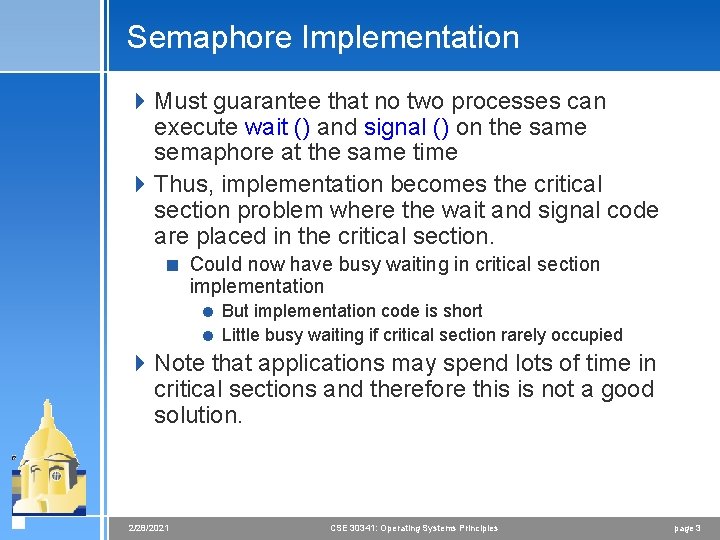
Semaphore Implementation 4 Must guarantee that no two processes can execute wait () and signal () on the same semaphore at the same time 4 Thus, implementation becomes the critical section problem where the wait and signal code are placed in the critical section. < Could now have busy waiting in critical section implementation = But implementation code is short = Little busy waiting if critical section rarely occupied 4 Note that applications may spend lots of time in critical sections and therefore this is not a good solution. 2/28/2021 CSE 30341: Operating Systems Principles page 3
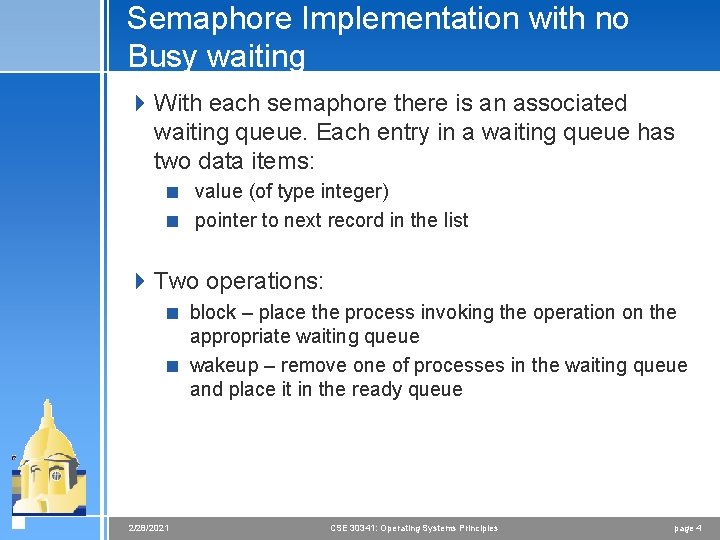
Semaphore Implementation with no Busy waiting 4 With each semaphore there is an associated waiting queue. Each entry in a waiting queue has two data items: < value (of type integer) < pointer to next record in the list 4 Two operations: < block – place the process invoking the operation on the appropriate waiting queue < wakeup – remove one of processes in the waiting queue and place it in the ready queue 2/28/2021 CSE 30341: Operating Systems Principles page 4
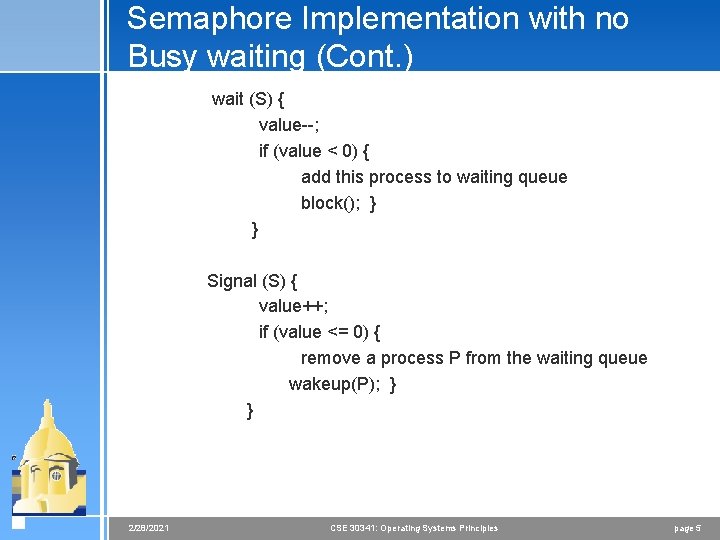
Semaphore Implementation with no Busy waiting (Cont. ) wait (S) { value--; if (value < 0) { add this process to waiting queue block(); } } Signal (S) { value++; if (value <= 0) { remove a process P from the waiting queue wakeup(P); } } 2/28/2021 CSE 30341: Operating Systems Principles page 5
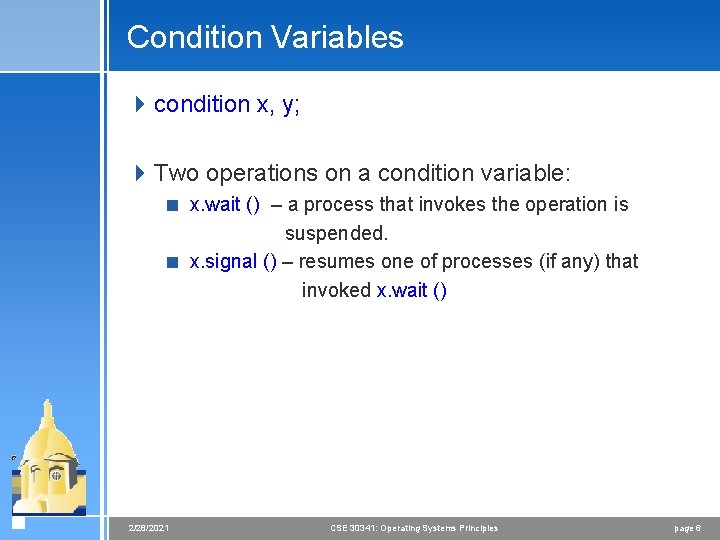
Condition Variables 4 condition x, y; 4 Two operations on a condition variable: < x. wait () – a process that invokes the operation is suspended. < x. signal () – resumes one of processes (if any) that invoked x. wait () 2/28/2021 CSE 30341: Operating Systems Principles page 6
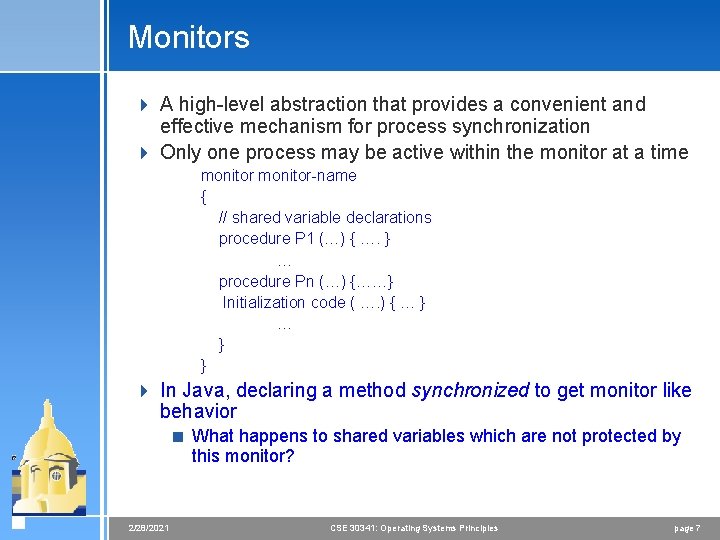
Monitors 4 A high-level abstraction that provides a convenient and effective mechanism for process synchronization 4 Only one process may be active within the monitor at a time monitor-name { // shared variable declarations procedure P 1 (…) { …. } … procedure Pn (…) {……} Initialization code ( …. ) { … } } 4 In Java, declaring a method synchronized to get monitor like behavior < What happens to shared variables which are not protected by this monitor? 2/28/2021 CSE 30341: Operating Systems Principles page 7
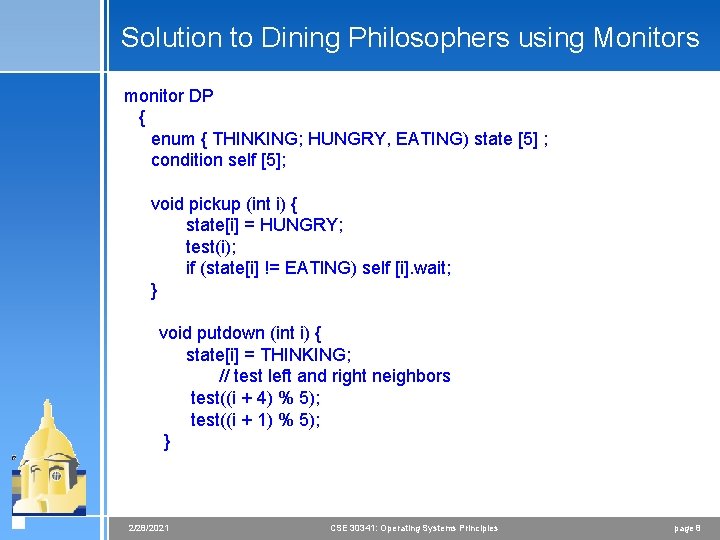
Solution to Dining Philosophers using Monitors monitor DP { enum { THINKING; HUNGRY, EATING) state [5] ; condition self [5]; void pickup (int i) { state[i] = HUNGRY; test(i); if (state[i] != EATING) self [i]. wait; } void putdown (int i) { state[i] = THINKING; // test left and right neighbors test((i + 4) % 5); test((i + 1) % 5); } 2/28/2021 CSE 30341: Operating Systems Principles page 8
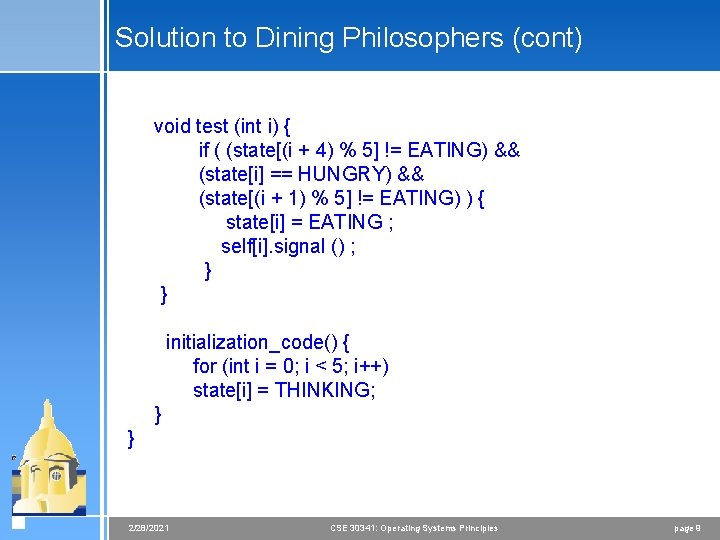
Solution to Dining Philosophers (cont) void test (int i) { if ( (state[(i + 4) % 5] != EATING) && (state[i] == HUNGRY) && (state[(i + 1) % 5] != EATING) ) { state[i] = EATING ; self[i]. signal () ; } } initialization_code() { for (int i = 0; i < 5; i++) state[i] = THINKING; } } 2/28/2021 CSE 30341: Operating Systems Principles page 9
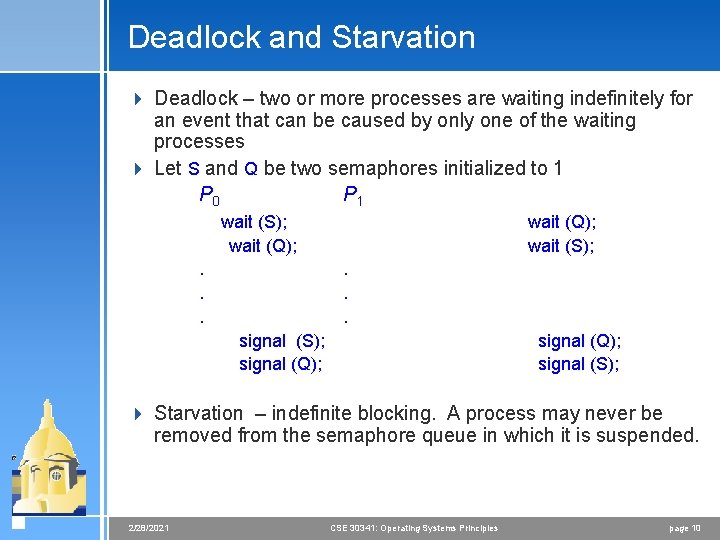
Deadlock and Starvation 4 Deadlock – two or more processes are waiting indefinitely for an event that can be caused by only one of the waiting processes 4 Let S and Q be two semaphores initialized to 1 P 0 P 1 wait (S); wait (Q); . . . wait (Q); wait (S); . . . signal (S); signal (Q); signal (S); 4 Starvation – indefinite blocking. A process may never be removed from the semaphore queue in which it is suspended. 2/28/2021 CSE 30341: Operating Systems Principles page 10
Synchronization Examples 4 Solaris 4 Windows XP 4 Linux 4 Pthreads 2/28/2021 CSE 30341: Operating Systems Principles page 11
Solaris Synchronization 4 Implements a variety of locks to support multitasking, multithreading (including real-time threads), and multiprocessing 4 Uses adaptive mutexes for efficiency when protecting data from short code segments 4 Uses condition variables and readers-writers locks when longer sections of code need access to data 4 Uses turnstiles to order the list of threads waiting to acquire either an adaptive mutex or reader-writer lock 2/28/2021 CSE 30341: Operating Systems Principles page 12
Windows XP Synchronization 4 Uses interrupt masks to protect access to global resources on uniprocessor systems 4 Uses spinlocks on multiprocessor systems 4 Also provides dispatcher objects which may act as either mutexes and semaphores 4 Dispatcher objects may also provide events < An event acts much like a condition variable 2/28/2021 CSE 30341: Operating Systems Principles page 13
Linux Synchronization 4 Linux: < disables interrupts to implement short critical sections 4 Linux provides: < semaphores < spin locks 2/28/2021 CSE 30341: Operating Systems Principles page 14
Pthreads Synchronization 4 Pthreads API is OS-independent 4 It provides: < mutex locks < condition variables 4 Non-portable extensions include: < read-write locks < spin locks 2/28/2021 CSE 30341: Operating Systems Principles page 15