Security Analysis and Portfolio Management Theory Method and

- Slides: 4
Security Analysis and Portfolio Management: Theory, Method and Application* Cheng-Few Lee Distinguished Professor of Finance and Economics, Rutgers University Editor of Review of Quantitative Finance and Accounting and Review of Pacific Basin Financial Market and Policy Email: cflee@business. rutgers. edu *Speech to be delivered at Fe. AT 2019 Annual Conference on May 31, 2019
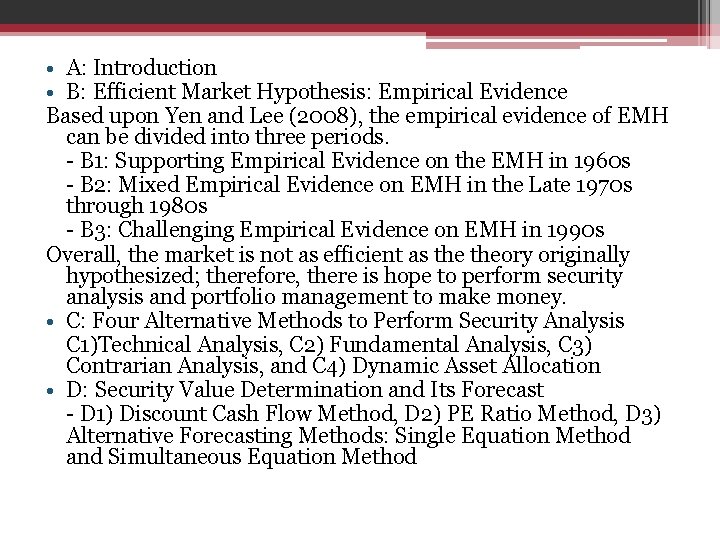
• A: Introduction • B: Efficient Market Hypothesis: Empirical Evidence Based upon Yen and Lee (2008), the empirical evidence of EMH can be divided into three periods. - B 1: Supporting Empirical Evidence on the EMH in 1960 s - B 2: Mixed Empirical Evidence on EMH in the Late 1970 s through 1980 s - B 3: Challenging Empirical Evidence on EMH in 1990 s Overall, the market is not as efficient as theory originally hypothesized; therefore, there is hope to perform security analysis and portfolio management to make money. • C: Four Alternative Methods to Perform Security Analysis C 1)Technical Analysis, C 2) Fundamental Analysis, C 3) Contrarian Analysis, and C 4) Dynamic Asset Allocation • D: Security Value Determination and Its Forecast - D 1) Discount Cash Flow Method, D 2) PE Ratio Method, D 3) Alternative Forecasting Methods: Single Equation Method and Simultaneous Equation Method
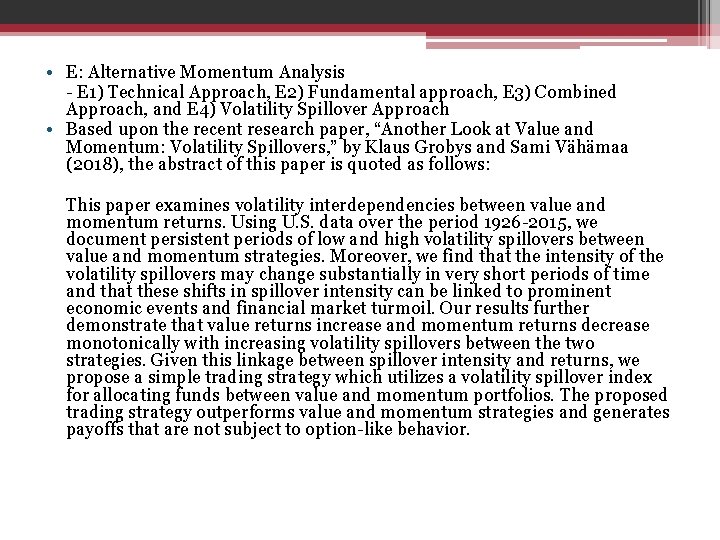
• E: Alternative Momentum Analysis - E 1) Technical Approach, E 2) Fundamental approach, E 3) Combined Approach, and E 4) Volatility Spillover Approach • Based upon the recent research paper, “Another Look at Value and Momentum: Volatility Spillovers, ” by Klaus Grobys and Sami Vähämaa (2018), the abstract of this paper is quoted as follows: This paper examines volatility interdependencies between value and momentum returns. Using U. S. data over the period 1926 -2015, we document persistent periods of low and high volatility spillovers between value and momentum strategies. Moreover, we find that the intensity of the volatility spillovers may change substantially in very short periods of time and that these shifts in spillover intensity can be linked to prominent economic events and financial market turmoil. Our results further demonstrate that value returns increase and momentum returns decrease monotonically with increasing volatility spillovers between the two strategies. Given this linkage between spillover intensity and returns, we propose a simple trading strategy which utilizes a volatility spillover index for allocating funds between value and momentum portfolios. The proposed trading strategy outperforms value and momentum strategies and generates payoffs that are not subject to option-like behavior.
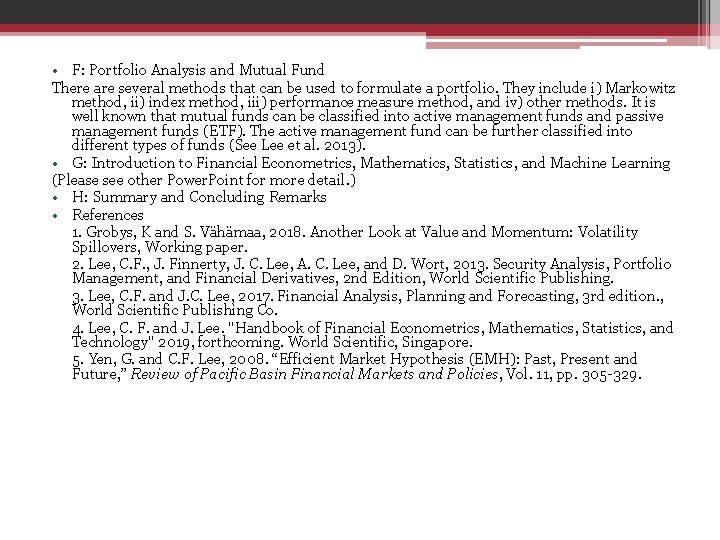
• F: Portfolio Analysis and Mutual Fund There are several methods that can be used to formulate a portfolio. They include i) Markowitz method, ii) index method, iii) performance measure method, and iv) other methods. It is well known that mutual funds can be classified into active management funds and passive management funds (ETF). The active management fund can be further classified into different types of funds (See Lee et al. 2013). • G: Introduction to Financial Econometrics, Mathematics, Statistics, and Machine Learning (Please see other Power. Point for more detail. ) • H: Summary and Concluding Remarks • References 1. Grobys, K and S. Vähämaa, 2018. Another Look at Value and Momentum: Volatility Spillovers, Working paper. 2. Lee, C. F. , J. Finnerty, J. C. Lee, A. C. Lee, and D. Wort, 2013. Security Analysis, Portfolio Management, and Financial Derivatives, 2 nd Edition, World Scientific Publishing. 3. Lee, C. F. and J. C. Lee, 2017. Financial Analysis, Planning and Forecasting, 3 rd edition. , World Scientific Publishing Co. 4. Lee, C. F. and J. Lee. "Handbook of Financial Econometrics, Mathematics, Statistics, and Technology" 2019, forthcoming. World Scientific, Singapore. 5. Yen, G. and C. F. Lee, 2008. “Efficient Market Hypothesis (EMH): Past, Present and Future, ” Review of Pacific Basin Financial Markets and Policies, Vol. 11, pp. 305 -329.