SDN and NFV Security Dr Dijiang Huang Arizona

- Slides: 15
SDN and NFV Security Dr. Dijiang Huang Arizona State University
NFV Security Basics | NFV consists of two main function blocks: - NFV Management and Network Orchestrator (MANO) - NFV Infrastructure (NFVI) | Security compliance using standard authentication, authorization and encryption mechanisms. | NFV security policy enforcement. | Security against Internal and External attacks.
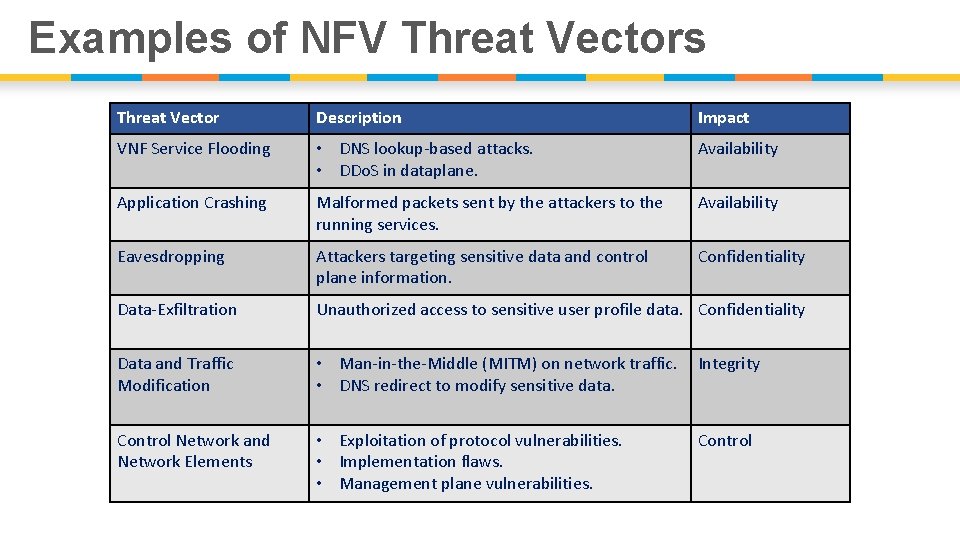
Examples of NFV Threat Vectors Threat Vector Description Impact VNF Service Flooding • DNS lookup-based attacks. • DDo. S in dataplane. Availability Application Crashing Malformed packets sent by the attackers to the running services. Availability Eavesdropping Attackers targeting sensitive data and control plane information. Confidentiality Data-Exfiltration Unauthorized access to sensitive user profile data. Confidentiality Data and Traffic Modification • Man-in-the-Middle (MITM) on network traffic. • DNS redirect to modify sensitive data. Integrity Control Network and Network Elements • Exploitation of protocol vulnerabilities. • Implementation flaws. • Management plane vulnerabilities. Control
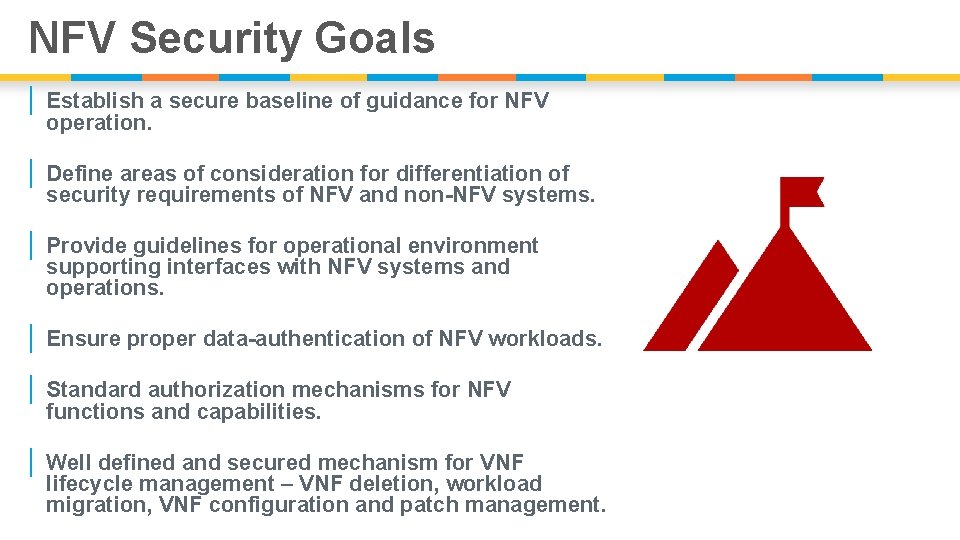
NFV Security Goals | Establish a secure baseline of guidance for NFV operation. | Define areas of consideration for differentiation of security requirements of NFV and non-NFV systems. | Provide guidelines for operational environment supporting interfaces with NFV systems and operations. | Ensure proper data-authentication of NFV workloads. | Standard authorization mechanisms for NFV functions and capabilities. | Well defined and secured mechanism for VNF lifecycle management – VNF deletion, workload migration, VNF configuration and patch management.
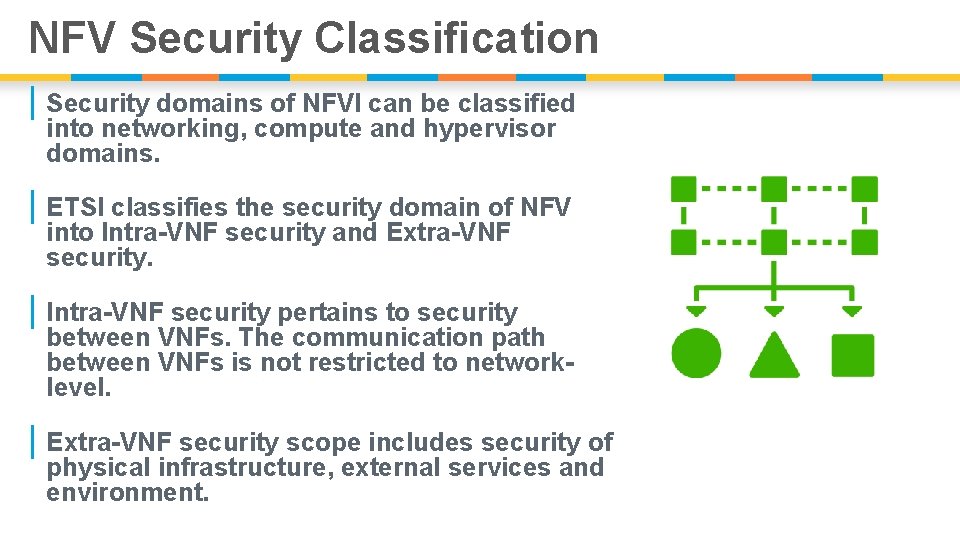
NFV Security Classification | Security domains of NFVI can be classified into networking, compute and hypervisor domains. | ETSI classifies the security domain of NFV into Intra-VNF security and Extra-VNF security. | Intra-VNF security pertains to security between VNFs. The communication path between VNFs is not restricted to networklevel. | Extra-VNF security scope includes security of physical infrastructure, external services and environment.
Intra-NFV Security Characteristics | Secured orchestration for and between VNFs. | Security mechanism in the Intra-VNF communication and attack-resilience. | Service Chaining capabilities should be enforced if available. | Security and virtual appliances need to be configured as part of traffic flow. | Flows between VNFs are often not through layer 3 firewall or any other security enforcement point.
Extra-NFV Security Characteristics | NFV deployment spans across several regulatory and jurisdiction domains. | Extra-VNF security should have ability to administer cross-border and domain requirements. | Multiple SLA and Qo. S requirements across regulatory domains should be satisfiable. | Authentication, authorization, and accounting across NFV domains, humans and system entities should be enforced.
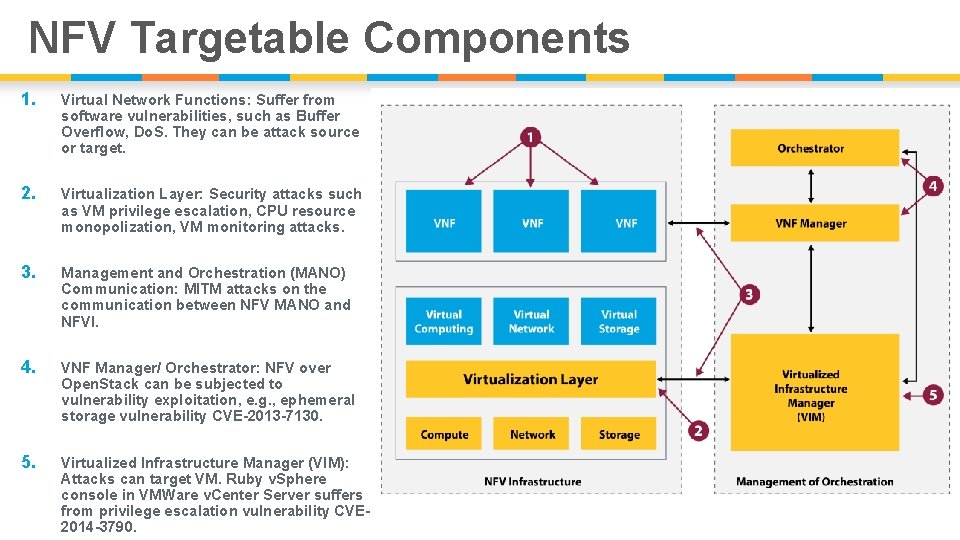
NFV Targetable Components 1. Virtual Network Functions: Suffer from software vulnerabilities, such as Buffer Overflow, Do. S. They can be attack source or target. 2. Virtualization Layer: Security attacks such as VM privilege escalation, CPU resource monopolization, VM monitoring attacks. 3. Management and Orchestration (MANO) Communication: MITM attacks on the communication between NFV MANO and NFVI. 4. VNF Manager/ Orchestrator: NFV over Open. Stack can be subjected to vulnerability exploitation, e. g. , ephemeral storage vulnerability CVE-2013 -7130. 5. Virtualized Infrastructure Manager (VIM): Attacks can target VM. Ruby v. Sphere console in VMWare v. Center Server suffers from privilege escalation vulnerability CVE 2014 -3790.
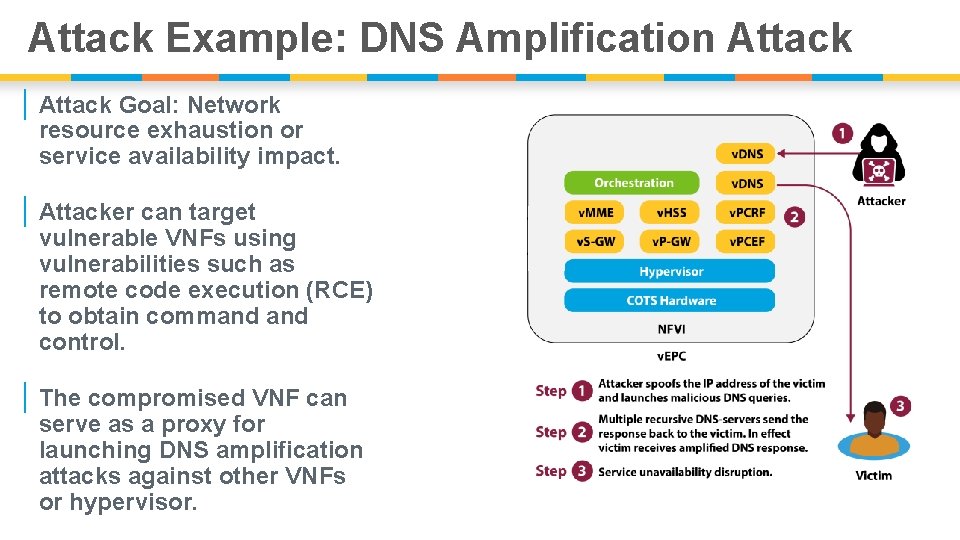
Attack Example: DNS Amplification Attack | Attack Goal: Network resource exhaustion or service availability impact. | Attacker can target vulnerable VNFs using vulnerabilities such as remote code execution (RCE) to obtain command control. | The compromised VNF can serve as a proxy for launching DNS amplification attacks against other VNFs or hypervisor.
NFV Attack Countermeasures | Topology verification and enforcement - Different levels: segments, end-to-end, physical, logical - Data plane: intra-host and inter-host - Control and management plane: within MANO, between MANO and virtualized infrastructure, hardware, and VNFs
NFV Attack Countermeasures | Virtualization platform security - Boot Integrity Protection: Secure Boot. - Prevents boot code tampering. - Trusted boot can be integrated with VNF manager to provide VNF launch and installation phase validation.
NFV Attack Countermeasures | Network and I/O Security - Fine-grained network boundary definition. - Efficient Qo. S scheme to prioritize critical tasks in case of high workload demand. - Fine-grained network segmentation. - Resource isolation 1. Physical segregation of hardware resources 2. VNF rate-limiting 3. Resource distribution between competing demands.
NFV Attack Countermeasures | Authentication, Authorization and Accounting (AAA) - AAA spans across infrastructure layer and network function layer. Authentication: Unauthenticated disclosure of user information. Authorization: Physical privilege escalation by wrapping unrelated identities. Accounting: Lack of accounting at different network infrastructure layers can allow attacker to oversubscribe NFVI resources. Authentication of VNF images. Authentication of users accessing NFV MANO function blocks. Updates to authorized users and managers in suspended/offline images. API authorization between function blocks. Real-time monitoring, logging and reporting. Full line-rate traffic acquisition, classification and per-subscriber/user/application accounting
NFV Attack Countermeasures | Dynamic state management and integrity protection - Dynamic State Management – Secure VM suspend, updating ACLs for suspended VMs, secured live migration. - Dynamic Integrity Management – VNF encryption and secured cryptographic keys storage. - Proper analysis of VNF keys and passwords in an event of crash and consequent crash events.
Wrap-Up