Scottish Texts The Eight Marker The Final Question

- Slides: 8
Scottish Texts The Eight Marker
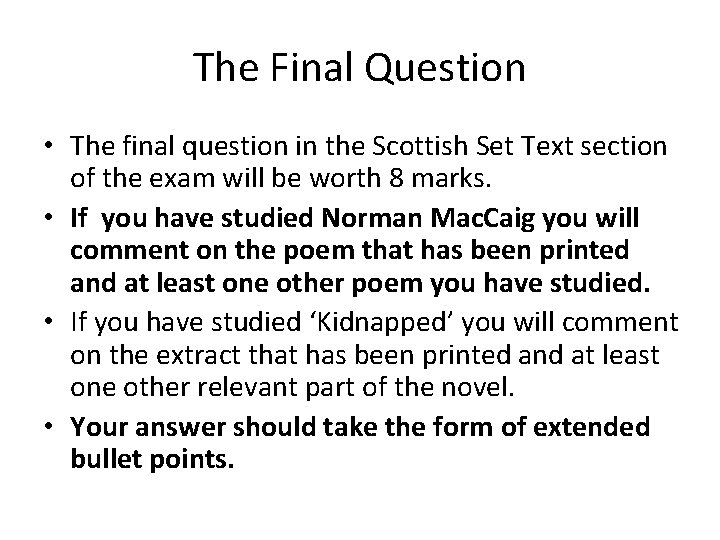
The Final Question • The final question in the Scottish Set Text section of the exam will be worth 8 marks. • If you have studied Norman Mac. Caig you will comment on the poem that has been printed and at least one other poem you have studied. • If you have studied ‘Kidnapped’ you will comment on the extract that has been printed and at least one other relevant part of the novel. • Your answer should take the form of extended bullet points.
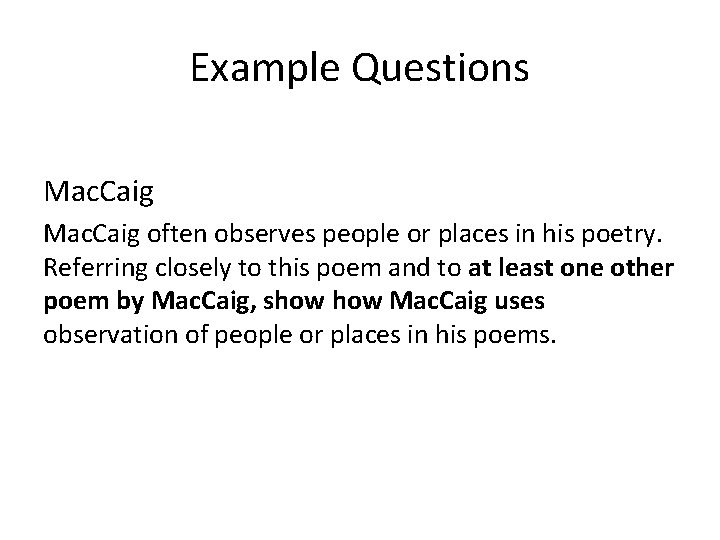
Example Questions Mac. Caig often observes people or places in his poetry. Referring closely to this poem and to at least one other poem by Mac. Caig, show Mac. Caig uses observation of people or places in his poems.
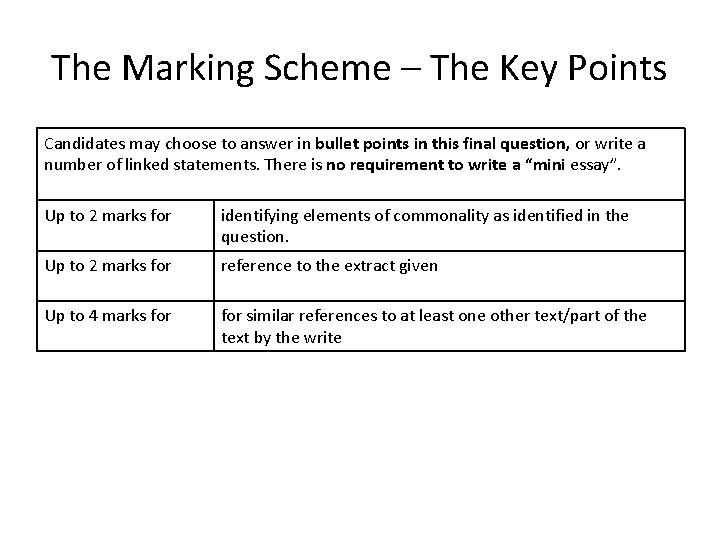
The Marking Scheme – The Key Points Candidates may choose to answer in bullet points in this final question, or write a number of linked statements. There is no requirement to write a “mini essay”. Up to 2 marks for identifying elements of commonality as identified in the question. Up to 2 marks for reference to the extract given Up to 4 marks for similar references to at least one other text/part of the text by the write
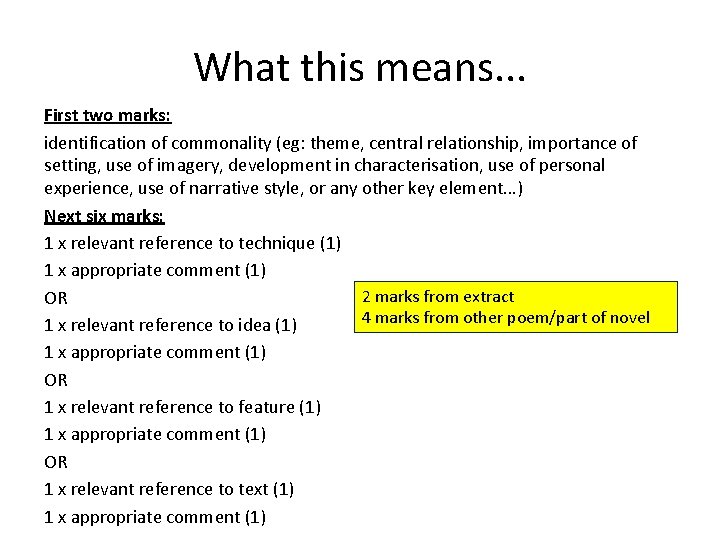
What this means. . . First two marks: identification of commonality (eg: theme, central relationship, importance of setting, use of imagery, development in characterisation, use of personal experience, use of narrative style, or any other key element…) Next six marks: 1 x relevant reference to technique (1) 1 x appropriate comment (1) 2 marks from extract OR 4 marks from other poem/part of novel 1 x relevant reference to idea (1) 1 x appropriate comment (1) OR 1 x relevant reference to feature (1) 1 x appropriate comment (1) OR 1 x relevant reference to text (1) 1 x appropriate comment (1)
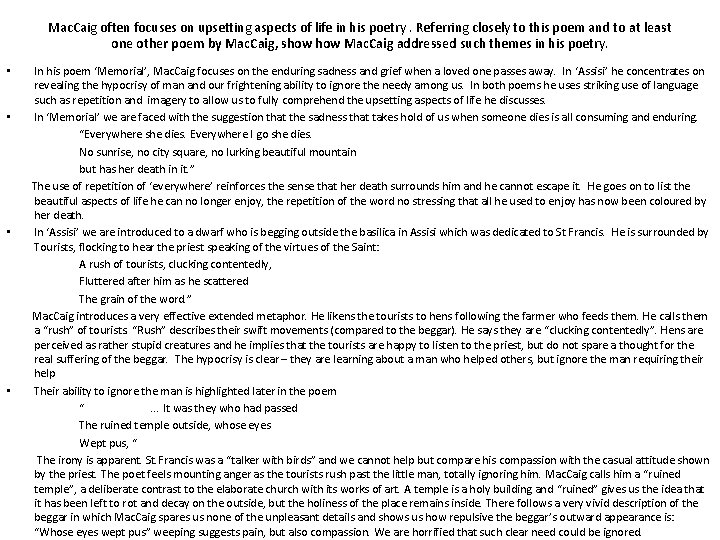
Mac. Caig often focuses on upsetting aspects of life in his poetry. Referring closely to this poem and to at least one other poem by Mac. Caig, show Mac. Caig addressed such themes in his poetry. • • In his poem ‘Memorial’, Mac. Caig focuses on the enduring sadness and grief when a loved one passes away. In ‘Assisi’ he concentrates on revealing the hypocrisy of man and our frightening ability to ignore the needy among us. In both poems he uses striking use of language such as repetition and imagery to allow us to fully comprehend the upsetting aspects of life he discusses. In ‘Memorial’ we are faced with the suggestion that the sadness that takes hold of us when someone dies is all consuming and enduring. “Everywhere she dies. Everywhere I go she dies. No sunrise, no city square, no lurking beautiful mountain but has her death in it. ” The use of repetition of ‘everywhere’ reinforces the sense that her death surrounds him and he cannot escape it. He goes on to list the beautiful aspects of life he can no longer enjoy, the repetition of the word no stressing that all he used to enjoy has now been coloured by her death. In ‘Assisi’ we are introduced to a dwarf who is begging outside the basilica in Assisi which was dedicated to St Francis. He is surrounded by Tourists, flocking to hear the priest speaking of the virtues of the Saint: A rush of tourists, clucking contentedly, Fluttered after him as he scattered The grain of the word. ” Mac. Caig introduces a very effective extended metaphor. He likens the tourists to hens following the farmer who feeds them. He calls them a “rush” of tourists. “Rush” describes their swift movements (compared to the beggar). He says they are “clucking contentedly”. Hens are perceived as rather stupid creatures and he implies that the tourists are happy to listen to the priest, but do not spare a thought for the real suffering of the beggar. The hypocrisy is clear – they are learning about a man who helped others, but ignore the man requiring their help Their ability to ignore the man is highlighted later in the poem “. . . It was they who had passed The ruined temple outside, whose eyes Wept pus, “ The irony is apparent. St. Francis was a “talker with birds” and we cannot help but compare his compassion with the casual attitude shown by the priest. The poet feels mounting anger as the tourists rush past the little man, totally ignoring him. Mac. Caig calls him a “ruined temple”, a deliberate contrast to the elaborate church with its works of art. A temple is a holy building and “ruined” gives us the idea that it has been left to rot and decay on the outside, but the holiness of the place remains inside. There follows a very vivid description of the beggar in which Mac. Caig spares us none of the unpleasant details and shows us how repulsive the beggar’s outward appearance is: “Whose eyes wept pus” weeping suggests pain, but also compassion. We are horrified that such clear need could be ignored.
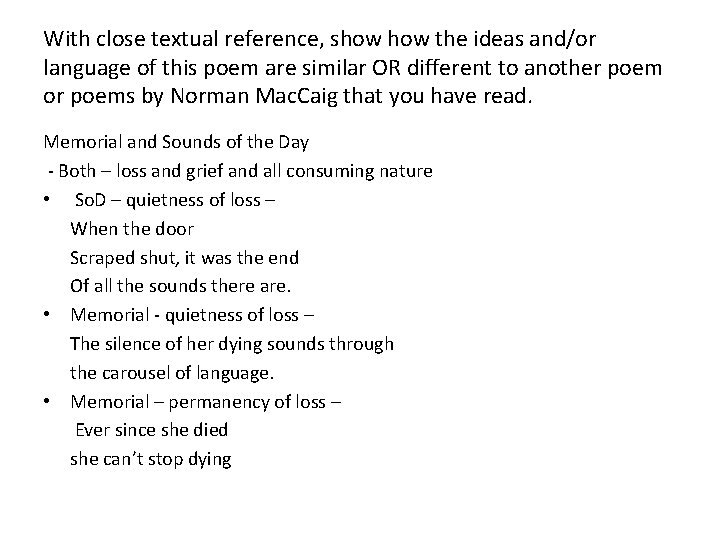
With close textual reference, show the ideas and/or language of this poem are similar OR different to another poem or poems by Norman Mac. Caig that you have read. Memorial and Sounds of the Day - Both – loss and grief and all consuming nature • So. D – quietness of loss – When the door Scraped shut, it was the end Of all the sounds there are. • Memorial - quietness of loss – The silence of her dying sounds through the carousel of language. • Memorial – permanency of loss – Ever since she died she can’t stop dying
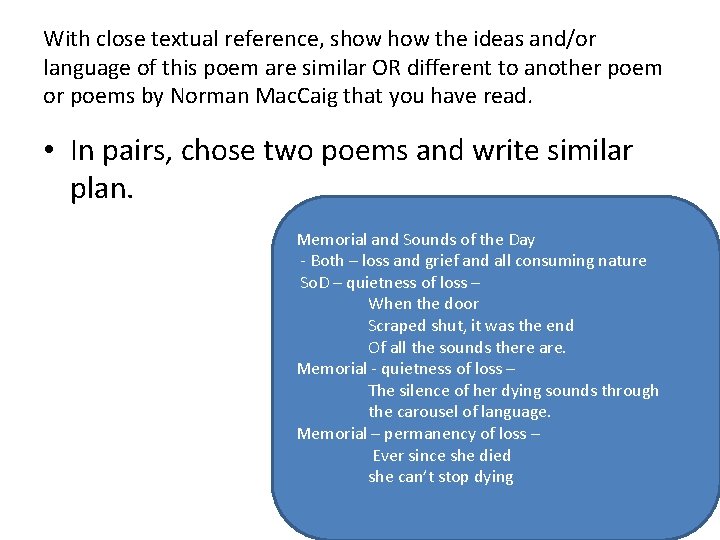
With close textual reference, show the ideas and/or language of this poem are similar OR different to another poem or poems by Norman Mac. Caig that you have read. • In pairs, chose two poems and write similar plan. Memorial and Sounds of the Day - Both – loss and grief and all consuming nature So. D – quietness of loss – When the door Scraped shut, it was the end Of all the sounds there are. Memorial - quietness of loss – The silence of her dying sounds through the carousel of language. Memorial – permanency of loss – Ever since she died she can’t stop dying