SchoolAge Childrens Other Intellectual Needs SCHOOL PREPARATION Entering

- Slides: 13
School-Age Children's Other Intellectual Needs
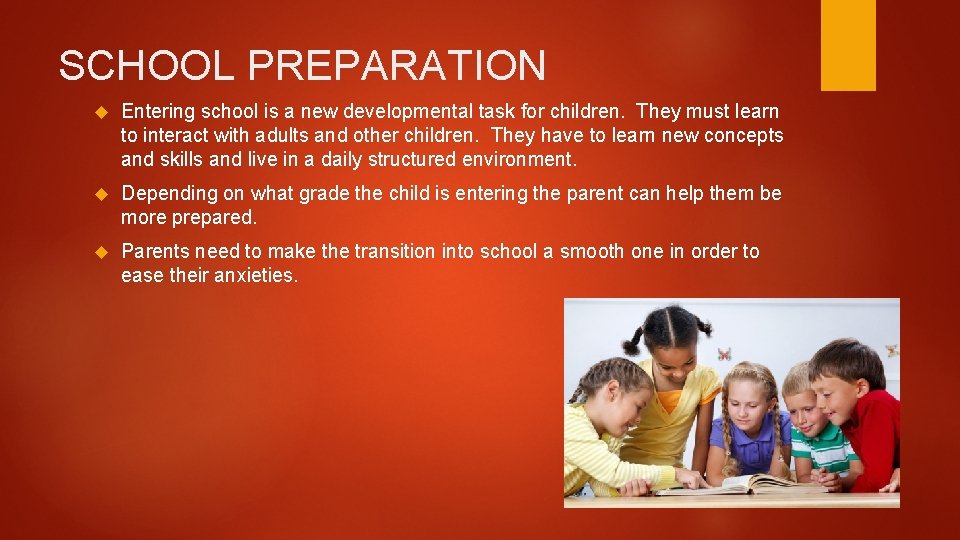
SCHOOL PREPARATION Entering school is a new developmental task for children. They must learn to interact with adults and other children. They have to learn new concepts and skills and live in a daily structured environment. Depending on what grade the child is entering the parent can help them be more prepared. Parents need to make the transition into school a smooth one in order to ease their anxieties.
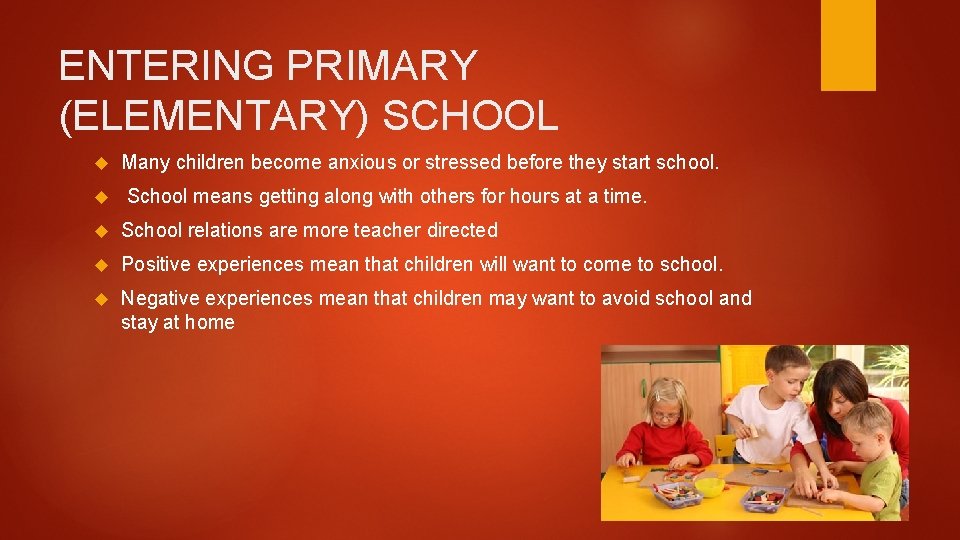
ENTERING PRIMARY (ELEMENTARY) SCHOOL Many children become anxious or stressed before they start school. School means getting along with others for hours at a time. School relations are more teacher directed Positive experiences mean that children will want to come to school. Negative experiences mean that children may want to avoid school and stay at home
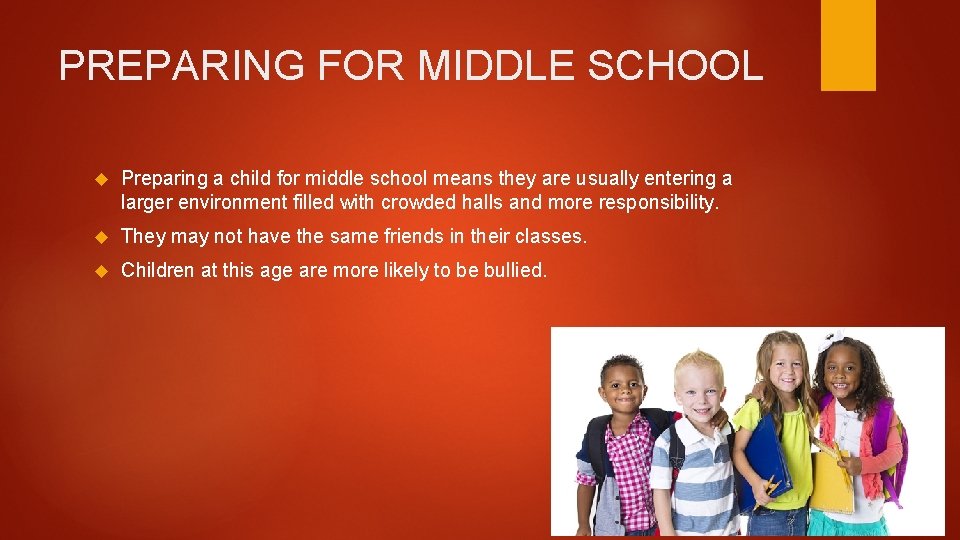
PREPARING FOR MIDDLE SCHOOL Preparing a child for middle school means they are usually entering a larger environment filled with crowded halls and more responsibility. They may not have the same friends in their classes. Children at this age are more likely to be bullied.
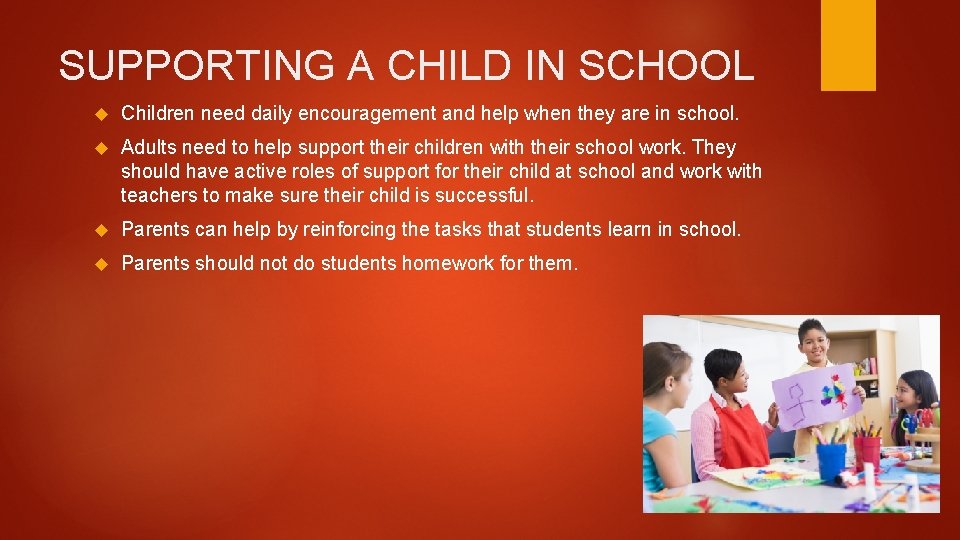
SUPPORTING A CHILD IN SCHOOL Children need daily encouragement and help when they are in school. Adults need to help support their children with their school work. They should have active roles of support for their child at school and work with teachers to make sure their child is successful. Parents can help by reinforcing the tasks that students learn in school. Parents should not do students homework for them.
SUPPORTING A CHILD IN SCHOOL By around age 9 children should be able to use executive functions which are skills used to manage themselves and their resources to reach a goal. Executive functions are necessary for success in life and school. Some of the most common executive functions are: short-term memory, the ability to filter thoughts and feelings, and the ability to adjust to changing demands. A child with weak executive functions is easy to spot, they lose their papers, have a hard time finishing a task, procrastinate and drag out decision making.
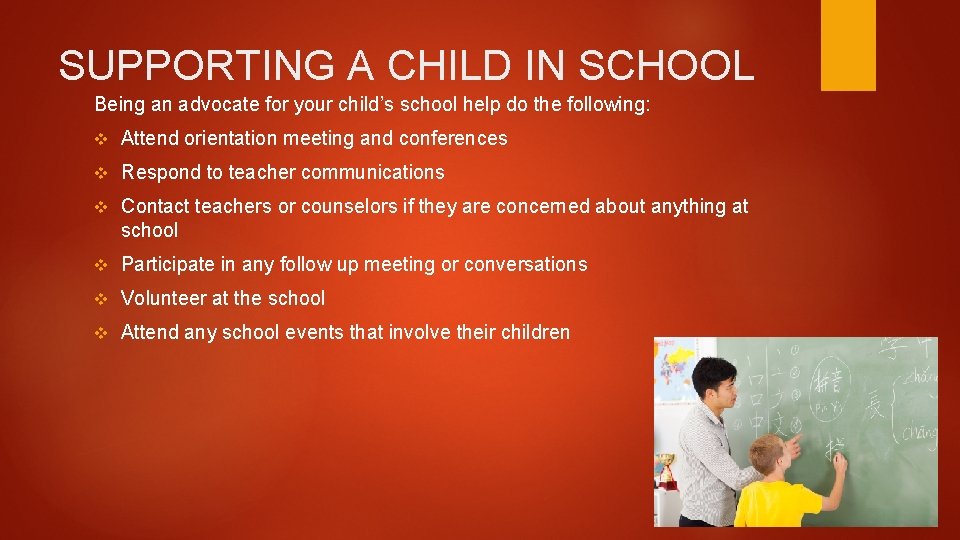
SUPPORTING A CHILD IN SCHOOL Being an advocate for your child’s school help do the following: v Attend orientation meeting and conferences v Respond to teacher communications v Contact teachers or counselors if they are concerned about anything at school v Participate in any follow up meeting or conversations v Volunteer at the school v Attend any school events that involve their children
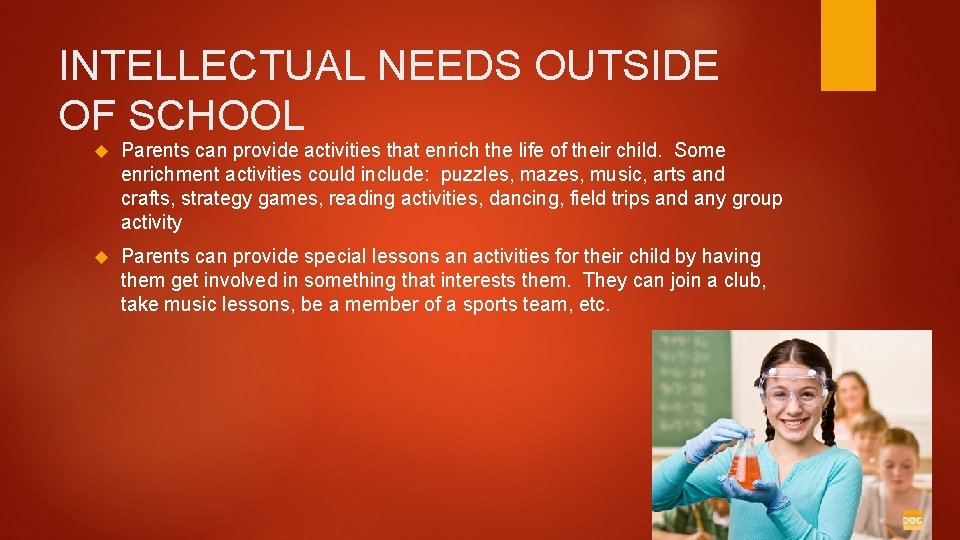
INTELLECTUAL NEEDS OUTSIDE OF SCHOOL Parents can provide activities that enrich the life of their child. Some enrichment activities could include: puzzles, mazes, music, arts and crafts, strategy games, reading activities, dancing, field trips and any group activity Parents can provide special lessons an activities for their child by having them get involved in something that interests them. They can join a club, take music lessons, be a member of a sports team, etc.
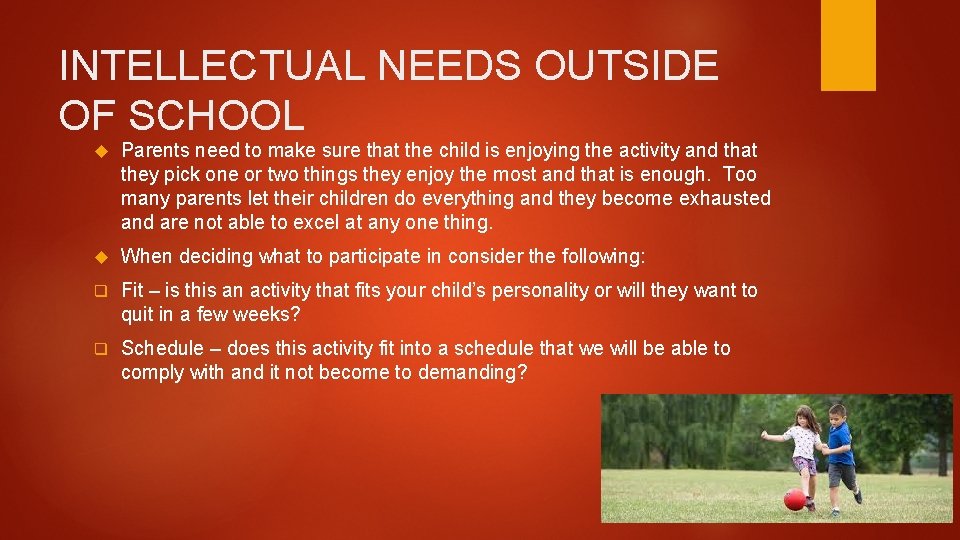
INTELLECTUAL NEEDS OUTSIDE OF SCHOOL Parents need to make sure that the child is enjoying the activity and that they pick one or two things they enjoy the most and that is enough. Too many parents let their children do everything and they become exhausted and are not able to excel at any one thing. When deciding what to participate in consider the following: q Fit – is this an activity that fits your child’s personality or will they want to quit in a few weeks? q Schedule – does this activity fit into a schedule that we will be able to comply with and it not become to demanding?
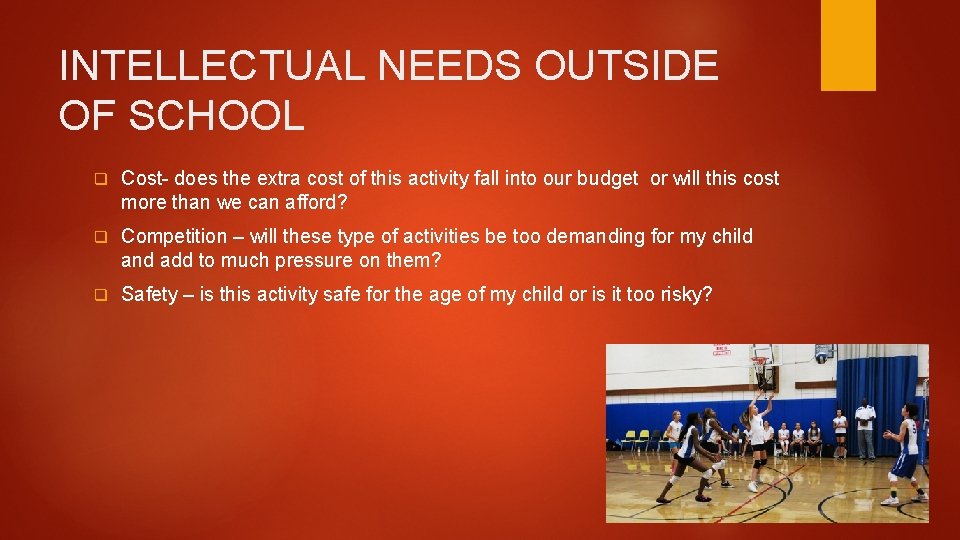
INTELLECTUAL NEEDS OUTSIDE OF SCHOOL q Cost- does the extra cost of this activity fall into our budget or will this cost more than we can afford? q Competition – will these type of activities be too demanding for my child and add to much pressure on them? q Safety – is this activity safe for the age of my child or is it too risky?
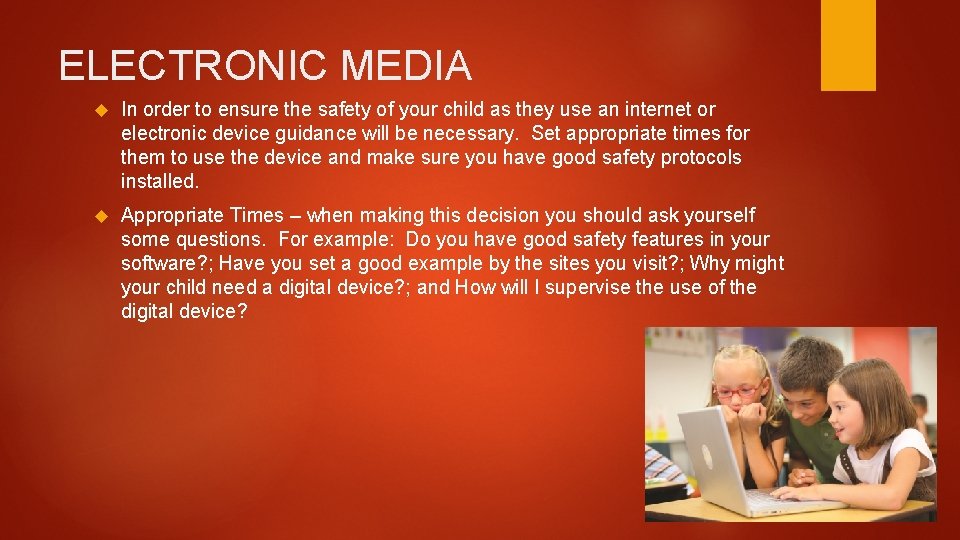
ELECTRONIC MEDIA In order to ensure the safety of your child as they use an internet or electronic device guidance will be necessary. Set appropriate times for them to use the device and make sure you have good safety protocols installed. Appropriate Times – when making this decision you should ask yourself some questions. For example: Do you have good safety features in your software? ; Have you set a good example by the sites you visit? ; Why might your child need a digital device? ; and How will I supervise the use of the digital device?
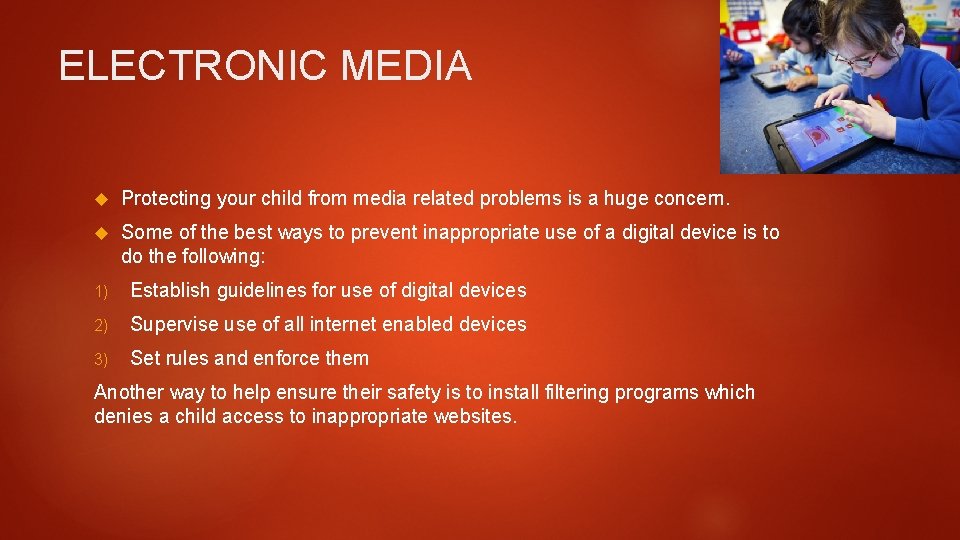
ELECTRONIC MEDIA Protecting your child from media related problems is a huge concern. Some of the best ways to prevent inappropriate use of a digital device is to do the following: 1) Establish guidelines for use of digital devices 2) Supervise use of all internet enabled devices 3) Set rules and enforce them Another way to help ensure their safety is to install filtering programs which denies a child access to inappropriate websites.
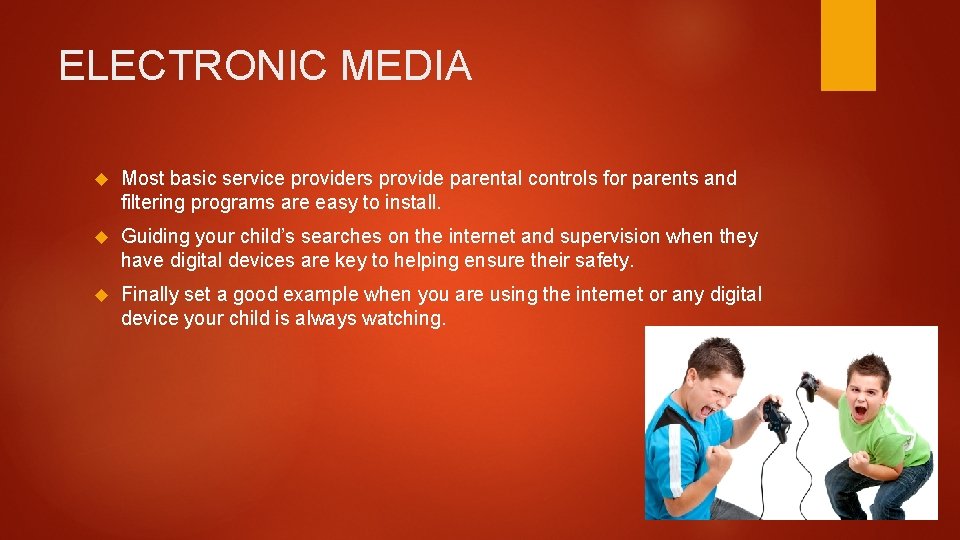
ELECTRONIC MEDIA Most basic service providers provide parental controls for parents and filtering programs are easy to install. Guiding your child’s searches on the internet and supervision when they have digital devices are key to helping ensure their safety. Finally set a good example when you are using the internet or any digital device your child is always watching.