Scheduler Activations CS 5204 Operating Systems 1 Concurrency
- Slides: 16
Scheduler Activations CS 5204 – Operating Systems 1
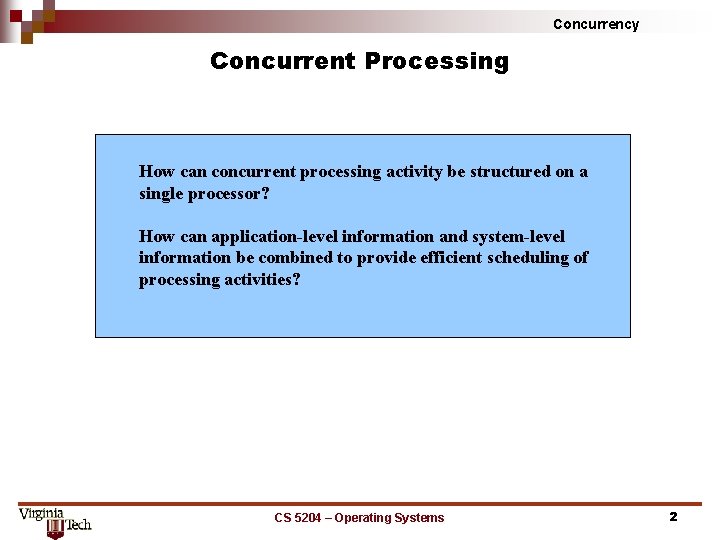
Concurrency Concurrent Processing How can concurrent processing activity be structured on a single processor? How can application-level information and system-level information be combined to provide efficient scheduling of processing activities? CS 5204 – Operating Systems 2
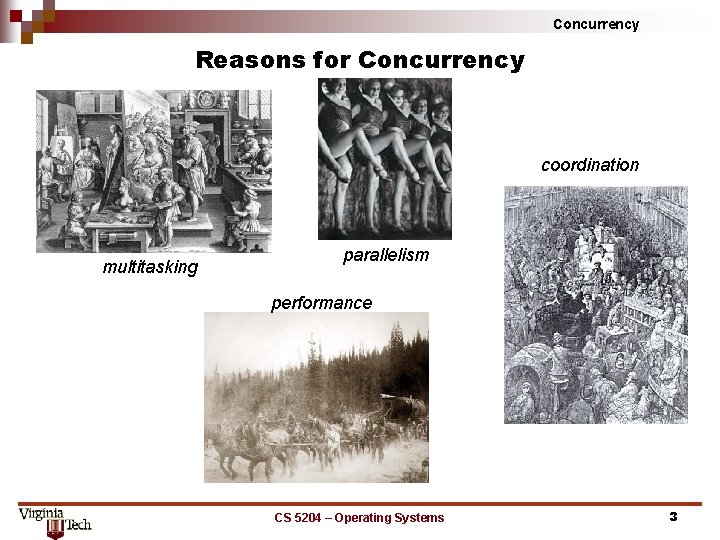
Concurrency Reasons for Concurrency coordination multitasking parallelism performance CS 5204 – Operating Systems 3
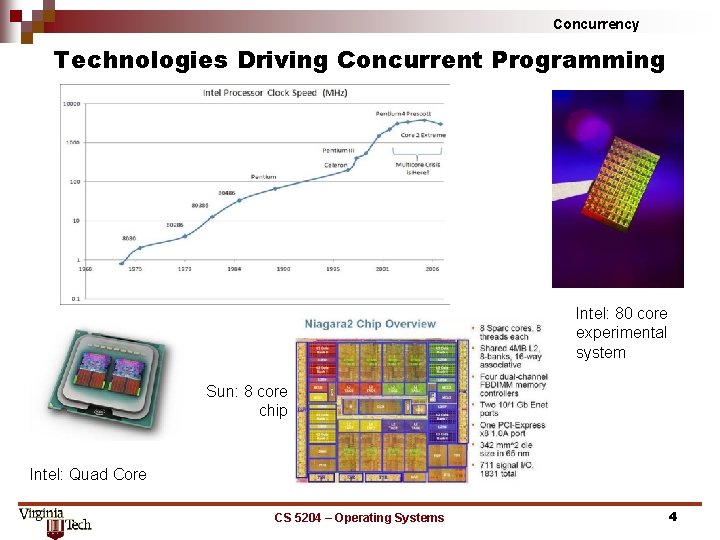
Concurrency Technologies Driving Concurrent Programming Intel: 80 core experimental system Sun: 8 core chip Intel: Quad Core CS 5204 – Operating Systems 4
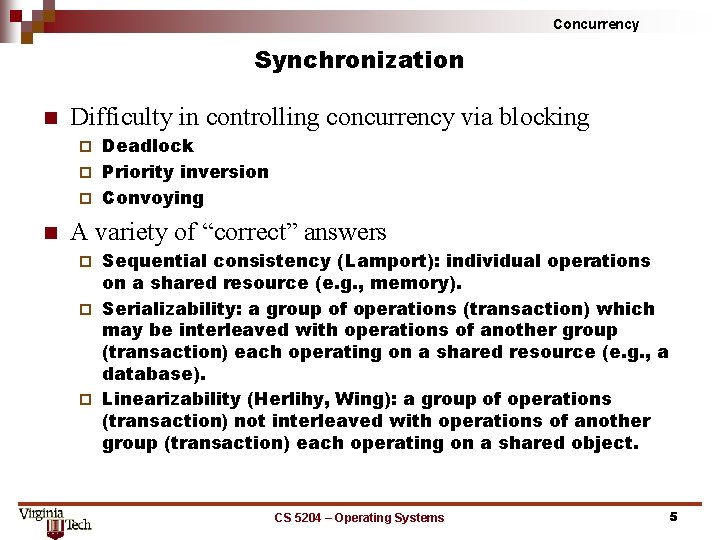
Concurrency Synchronization n Difficulty in controlling concurrency via blocking Deadlock ¨ Priority inversion ¨ Convoying ¨ n A variety of “correct” answers Sequential consistency (Lamport): individual operations on a shared resource (e. g. , memory). ¨ Serializability: a group of operations (transaction) which may be interleaved with operations of another group (transaction) each operating on a shared resource (e. g. , a database). ¨ Linearizability (Herlihy, Wing): a group of operations (transaction) not interleaved with operations of another group (transaction) each operating on a shared object. ¨ CS 5204 – Operating Systems 5
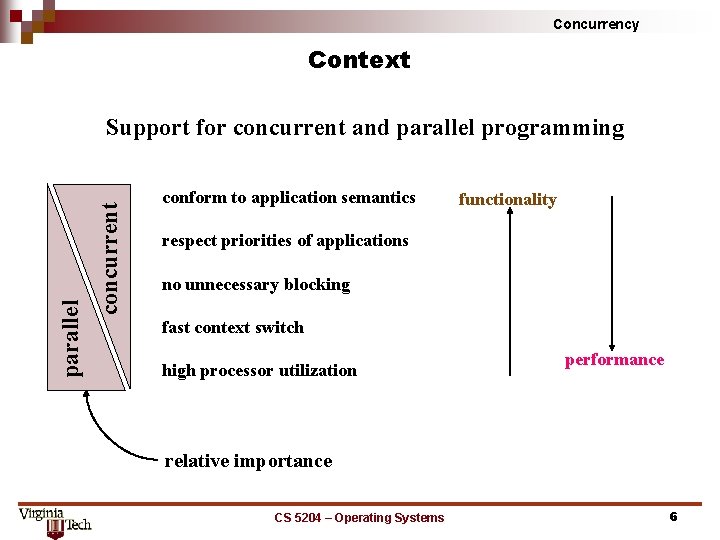
Concurrency Context concurrent parallel Support for concurrent and parallel programming conform to application semantics functionality respect priorities of applications no unnecessary blocking fast context switch high processor utilization performance relative importance CS 5204 – Operating Systems 6
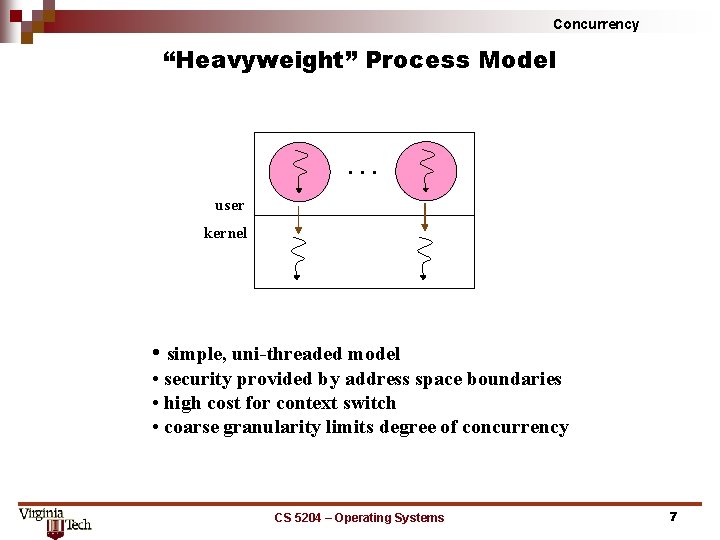
Concurrency “Heavyweight” Process Model . . . user kernel • simple, uni-threaded model • security provided by address space boundaries • high cost for context switch • coarse granularity limits degree of concurrency CS 5204 – Operating Systems 7
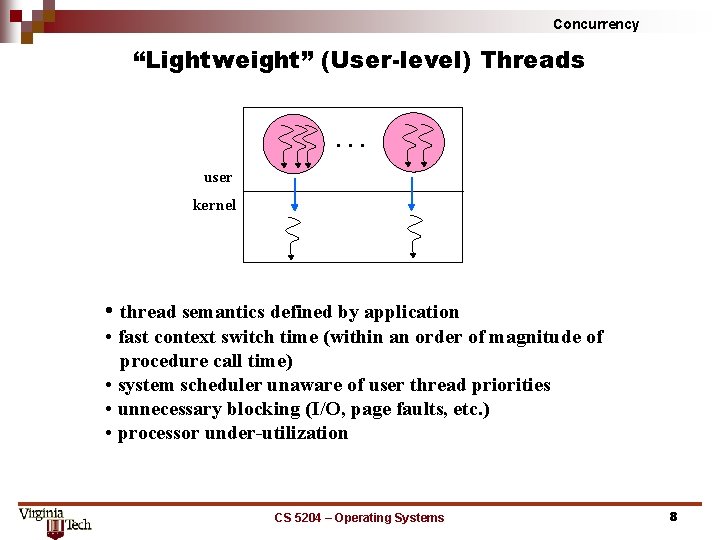
Concurrency “Lightweight” (User-level) Threads. . . user kernel • thread semantics defined by application • fast context switch time (within an order of magnitude of procedure call time) • system scheduler unaware of user thread priorities • unnecessary blocking (I/O, page faults, etc. ) • processor under-utilization CS 5204 – Operating Systems 8
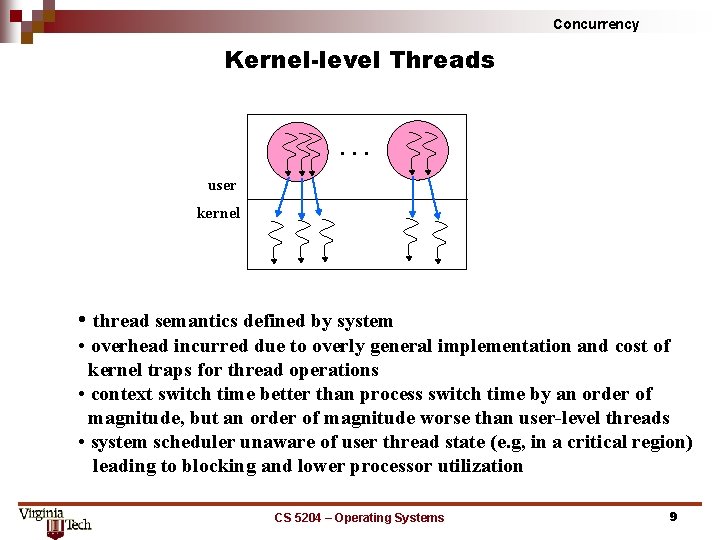
Concurrency Kernel-level Threads. . . user kernel • thread semantics defined by system • overhead incurred due to overly general implementation and cost of kernel traps for thread operations • context switch time better than process switch time by an order of magnitude, but an order of magnitude worse than user-level threads • system scheduler unaware of user thread state (e. g, in a critical region) leading to blocking and lower processor utilization CS 5204 – Operating Systems 9
Concurrency Problem n n Application has knowledge of the user-level thread state but has little knowledge of or influence over critical kernel-level events (by design! to achieve the virtual machine abstraction) Kernel has inadequate knowledge of user-level thread state to make optimal scheduling decisions Solution: a mechanism that facilitates exchange of information between user-level and kernel-level mechanisms. A general system design problem: communicating information and control across layer boundaries while preserving the inherent advantages of layering, abstraction, and virtualization. CS 5204 – Operating Systems 10
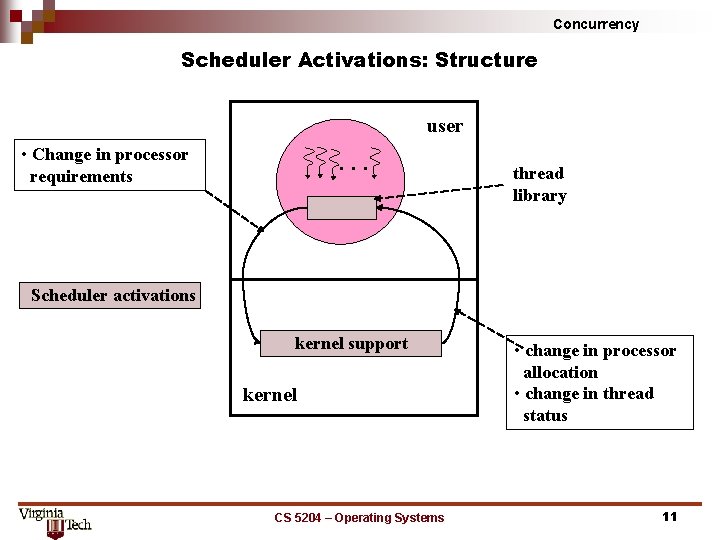
Concurrency Scheduler Activations: Structure user • Change in processor requirements . . . thread library Scheduler activations kernel support kernel CS 5204 – Operating Systems • change in processor allocation • change in thread status 11
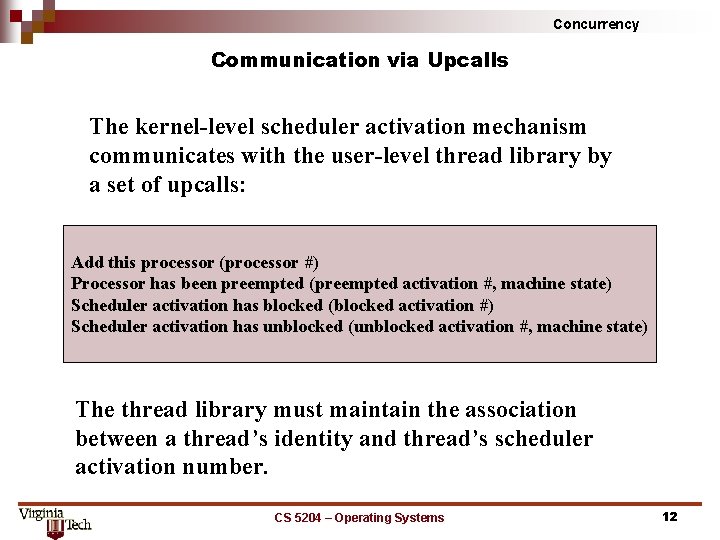
Concurrency Communication via Upcalls The kernel-level scheduler activation mechanism communicates with the user-level thread library by a set of upcalls: Add this processor (processor #) Processor has been preempted (preempted activation #, machine state) Scheduler activation has blocked (blocked activation #) Scheduler activation has unblocked (unblocked activation #, machine state) The thread library must maintain the association between a thread’s identity and thread’s scheduler activation number. CS 5204 – Operating Systems 12
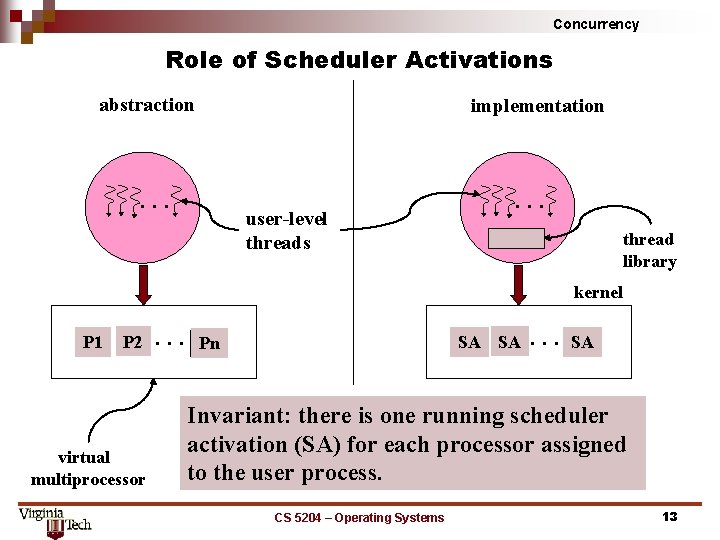
Concurrency Role of Scheduler Activations abstraction implementation . . . user-level threads . . . thread library kernel P 1 P 2 virtual multiprocessor . . . SA SA Pn . . . SA Invariant: there is one running scheduler activation (SA) for each processor assigned to the user process. CS 5204 – Operating Systems 13
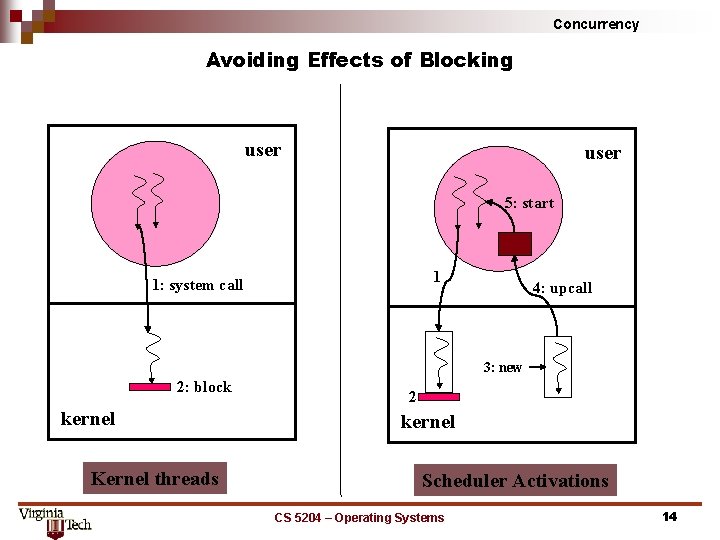
Concurrency Avoiding Effects of Blocking user 5: start 1 1: system call 4: upcall 3: new 2: block kernel Kernel threads 2 kernel Scheduler Activations CS 5204 – Operating Systems 14
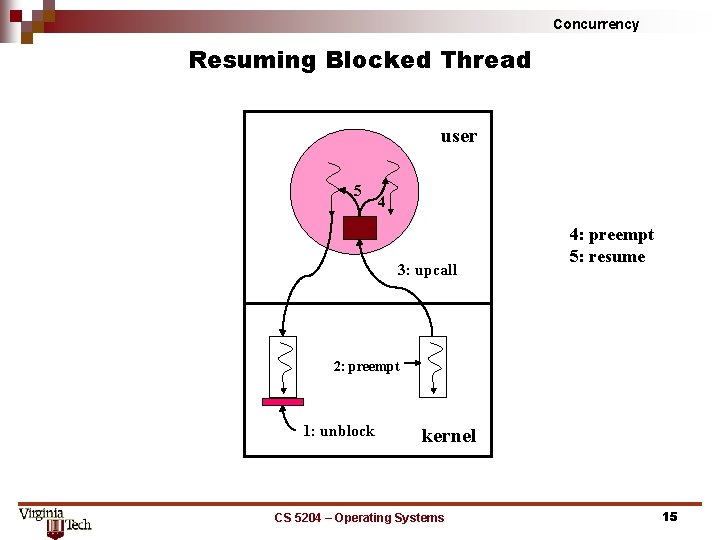
Concurrency Resuming Blocked Thread user 5 4 3: upcall 4: preempt 5: resume 2: preempt 1: unblock kernel CS 5204 – Operating Systems 15
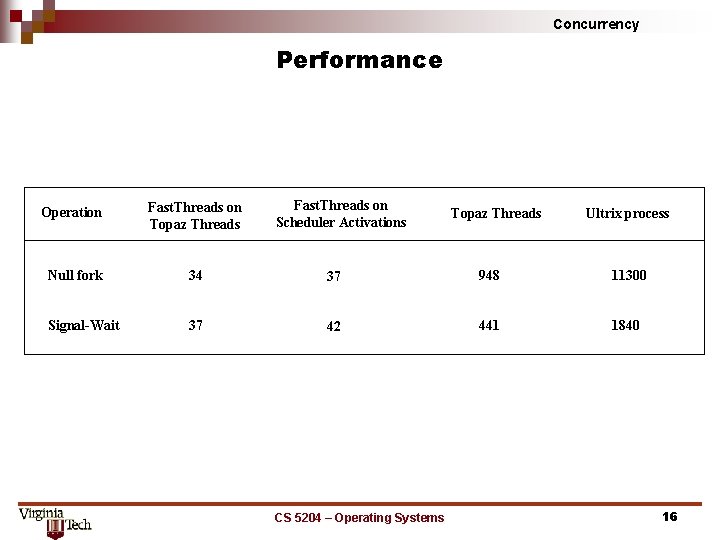
Concurrency Performance Fast. Threads on Scheduler Activations Operation Fast. Threads on Topaz Threads Null fork 34 37 948 11300 Signal-Wait 37 42 441 1840 CS 5204 – Operating Systems Topaz Threads Ultrix process 16