Review Introduction l Define Evaluation l How do
- Slides: 22
Review: Introduction l Define Evaluation l How do formal/informal evaluation differ? l What are two uses of evaluation in education? l What are the pros/cons of using an external evaluator?
Alternative Approaches to Evaluation Dr. Suzan Ayers Western Michigan University (courtesy of Dr. Mary Schutten)
Alternative Approaches l Stakeholders: individuals and groups who have a direct interest in, and may be affected by, evaluation; should be involved early, actively & continuously l Program: activities that are provided on a continuing basis; typically what is evaluated l There a variety of alternative, often conflicting, views of what evaluation is and how it should be carried out
Why so many alternatives? l The way one views evaluation directly impacts the type of activities/methods used l Origins of alternative models stem from differences in: l Philosophical & ideological beliefs l Methodological preferences l Practical choices
Philosophical & Ideological Beliefs l Epistemologies (philosophies of knowing) l Objectivism (social science base of empiricism; replicate) l Subjectivism (experientially-based; tacit knowledge) l Pros/Cons l of each? Principles for assigning value (parallel obj/subj) l Utilitarian: focus on group gains (avg scores); greatest good for the greatest number l Intuitionist-pluralist: value is individually-determined l l Room for both or are these dichotomous? Philosophical purists are rare (impractical? ) l Choose the methods right for THAT evaluation l Understand assumptions/limitations of different approaches
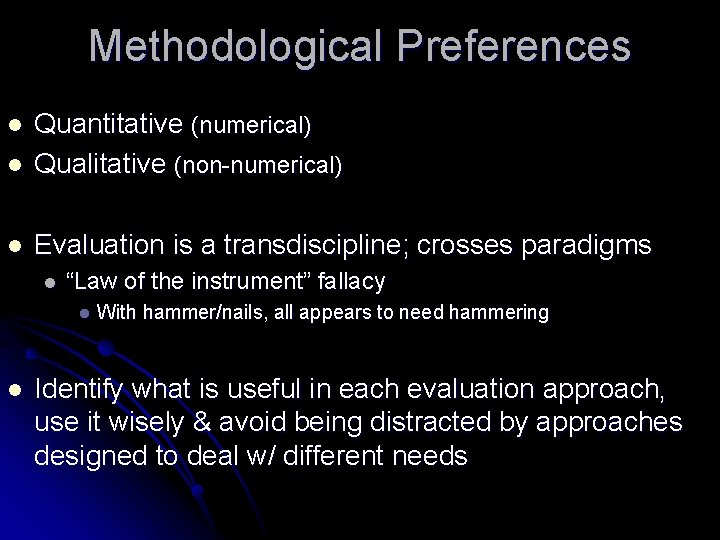
Methodological Preferences l Quantitative (numerical) Qualitative (non-numerical) l Evaluation is a transdiscipline; crosses paradigms l l “Law of the instrument” fallacy l l With hammer/nails, all appears to need hammering Identify what is useful in each evaluation approach, use it wisely & avoid being distracted by approaches designed to deal w/ different needs
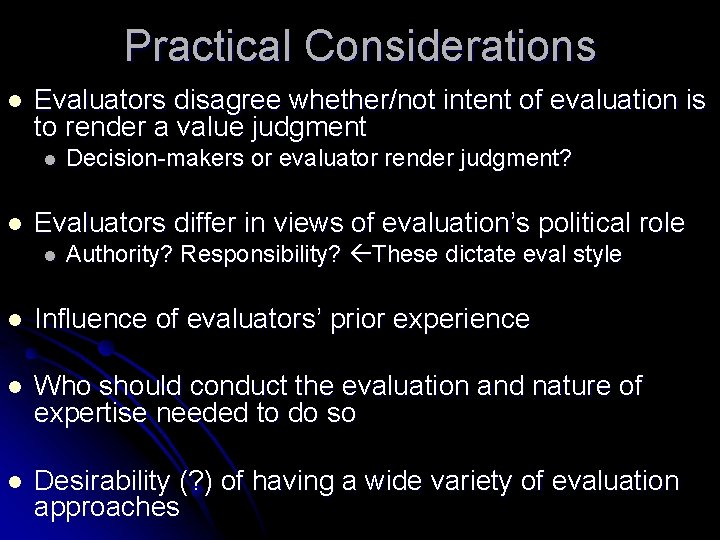
Practical Considerations l Evaluators disagree whether/not intent of evaluation is to render a value judgment l l Decision-makers or evaluator render judgment? Evaluators differ in views of evaluation’s political role l Authority? Responsibility? These dictate eval style l Influence of evaluators’ prior experience l Who should conduct the evaluation and nature of expertise needed to do so l Desirability (? ) of having a wide variety of evaluation approaches
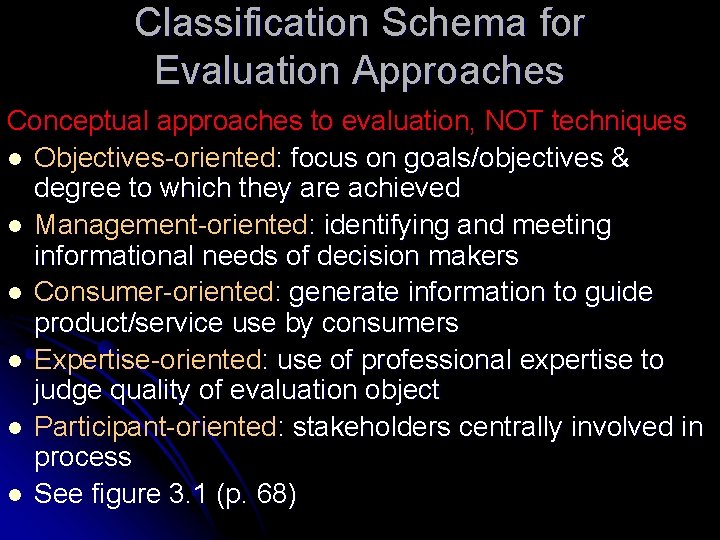
Classification Schema for Evaluation Approaches Conceptual approaches to evaluation, NOT techniques l Objectives-oriented: focus on goals/objectives & degree to which they are achieved l Management-oriented: identifying and meeting informational needs of decision makers l Consumer-oriented: generate information to guide product/service use by consumers l Expertise-oriented: use of professional expertise to judge quality of evaluation object l Participant-oriented: stakeholders centrally involved in process l See figure 3. 1 (p. 68)
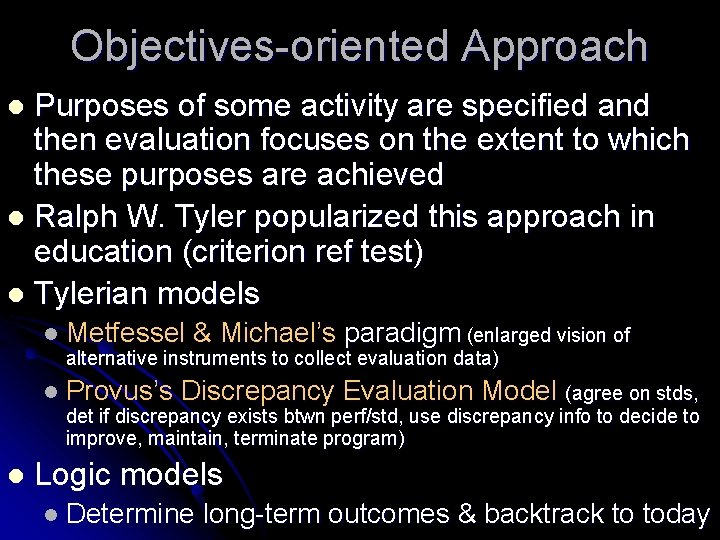
Objectives-oriented Approach Purposes of some activity are specified and then evaluation focuses on the extent to which these purposes are achieved l Ralph W. Tyler popularized this approach in education (criterion ref test) l Tylerian models l l Metfessel & Michael’s paradigm (enlarged vision of alternative instruments to collect evaluation data) l Provus’s Discrepancy Evaluation Model (agree on stds, det if discrepancy exists btwn perf/std, use discrepancy info to decide to improve, maintain, terminate program) l Logic models l Determine long-term outcomes & backtrack to today
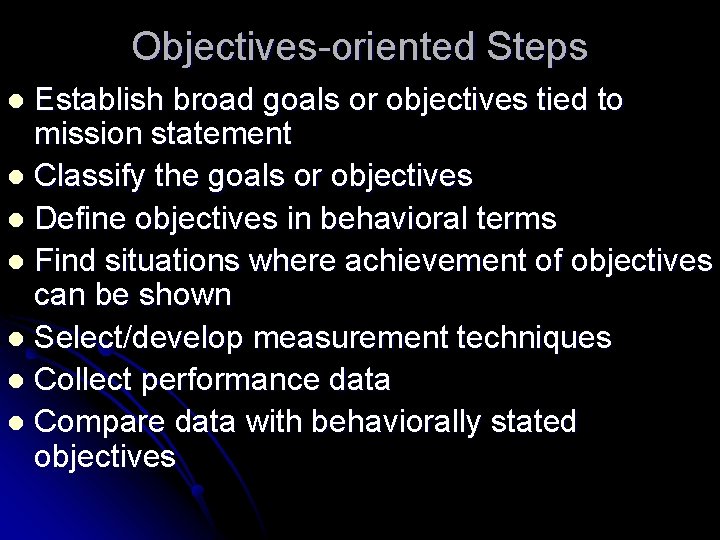
Objectives-oriented Steps Establish broad goals or objectives tied to mission statement l Classify the goals or objectives l Define objectives in behavioral terms l Find situations where achievement of objectives can be shown l Select/develop measurement techniques l Collect performance data l Compare data with behaviorally stated objectives l
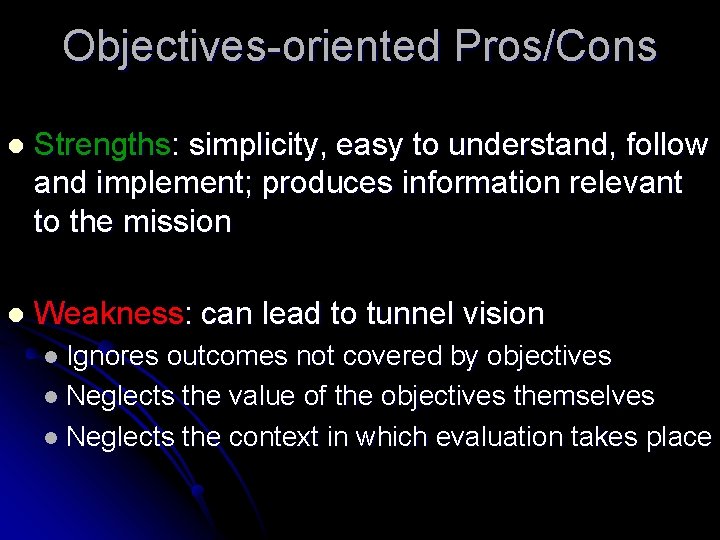
Objectives-oriented Pros/Cons l Strengths: simplicity, easy to understand, follow and implement; produces information relevant to the mission l Weakness: can lead to tunnel vision l Ignores outcomes not covered by objectives l Neglects the value of the objectives themselves l Neglects the context in which evaluation takes place
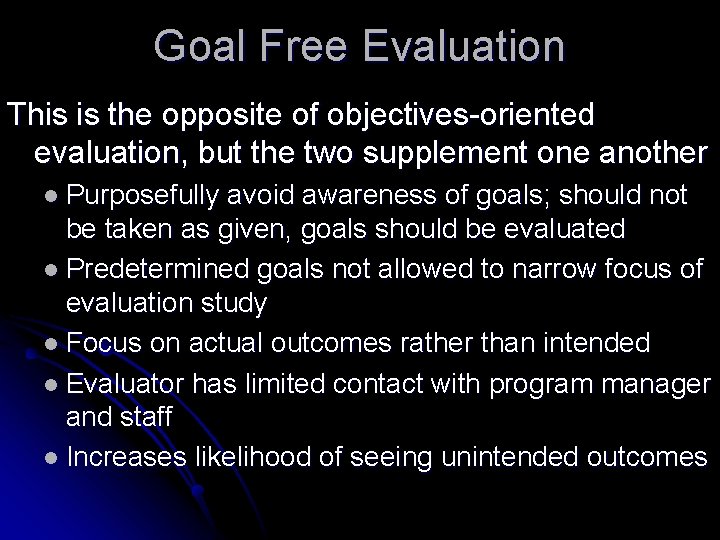
Goal Free Evaluation This is the opposite of objectives-oriented evaluation, but the two supplement one another l Purposefully avoid awareness of goals; should not be taken as given, goals should be evaluated l Predetermined goals not allowed to narrow focus of evaluation study l Focus on actual outcomes rather than intended l Evaluator has limited contact with program manager and staff l Increases likelihood of seeing unintended outcomes
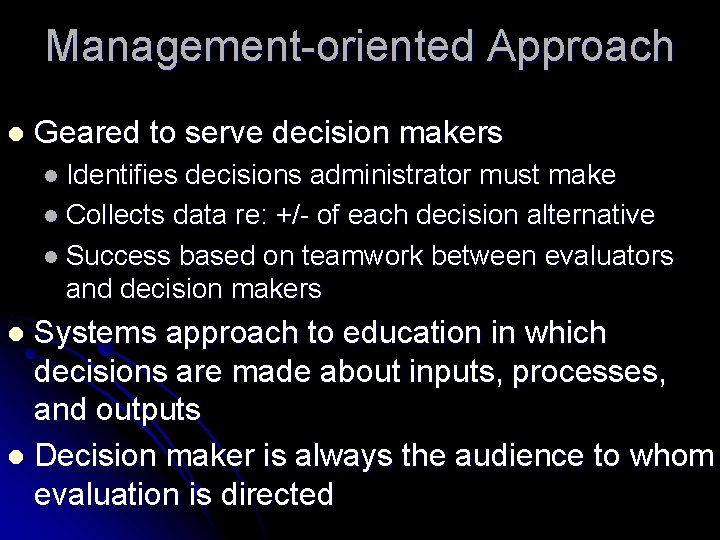
Management-oriented Approach l Geared to serve decision makers l Identifies decisions administrator must make l Collects data re: +/- of each decision alternative l Success based on teamwork between evaluators and decision makers Systems approach to education in which decisions are made about inputs, processes, and outputs l Decision maker is always the audience to whom evaluation is directed l
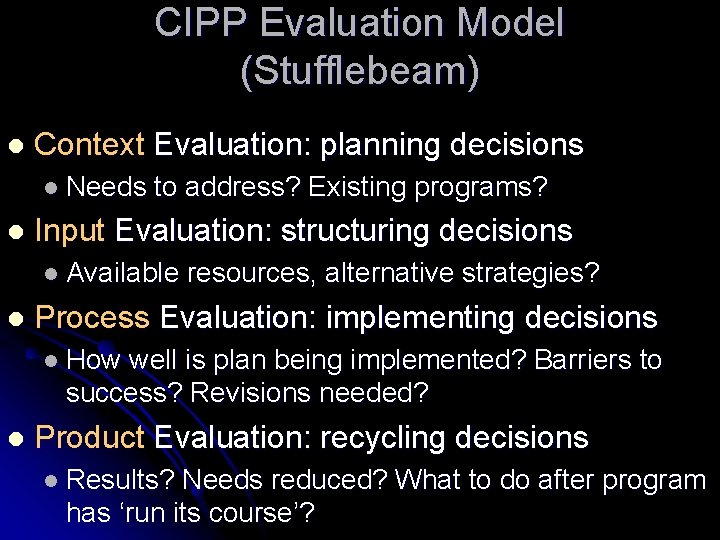
CIPP Evaluation Model (Stufflebeam) l Context Evaluation: planning decisions l Needs l to address? Existing programs? Input Evaluation: structuring decisions l Available l resources, alternative strategies? Process Evaluation: implementing decisions l How well is plan being implemented? Barriers to success? Revisions needed? l Product Evaluation: recycling decisions l Results? Needs reduced? What to do after program has ‘run its course’?
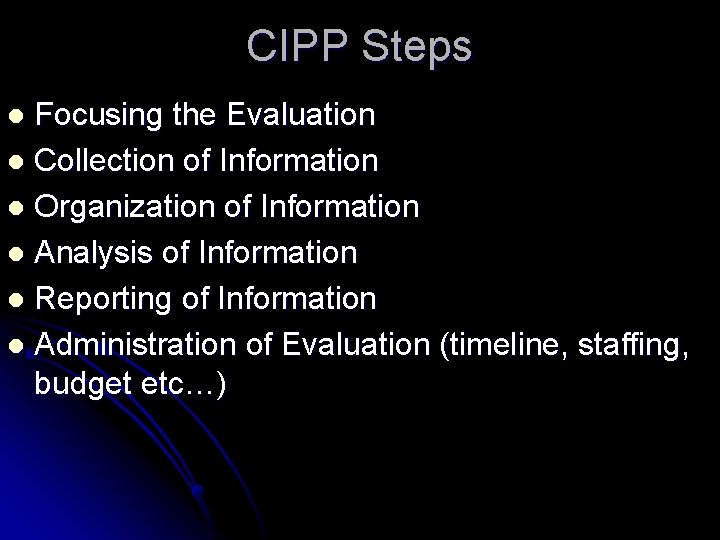
CIPP Steps Focusing the Evaluation l Collection of Information l Organization of Information l Analysis of Information l Reporting of Information l Administration of Evaluation (timeline, staffing, budget etc…) l
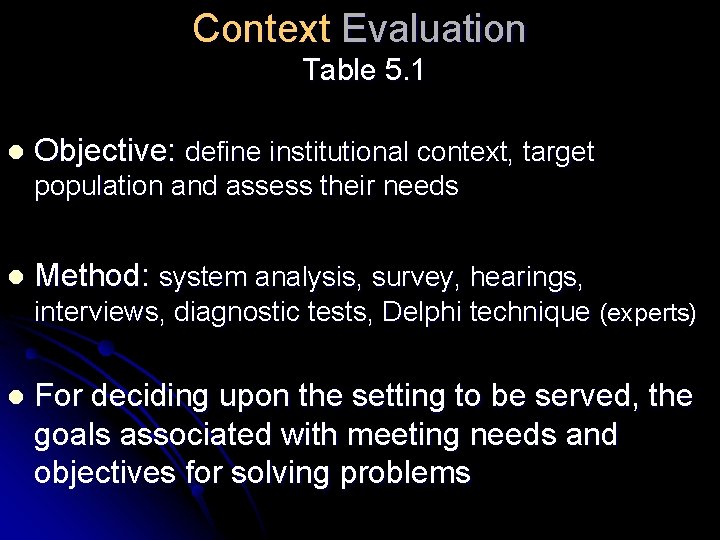
Context Evaluation Table 5. 1 l Objective: define institutional context, target population and assess their needs l Method: system analysis, survey, hearings, interviews, diagnostic tests, Delphi technique (experts) l For deciding upon the setting to be served, the goals associated with meeting needs and objectives for solving problems
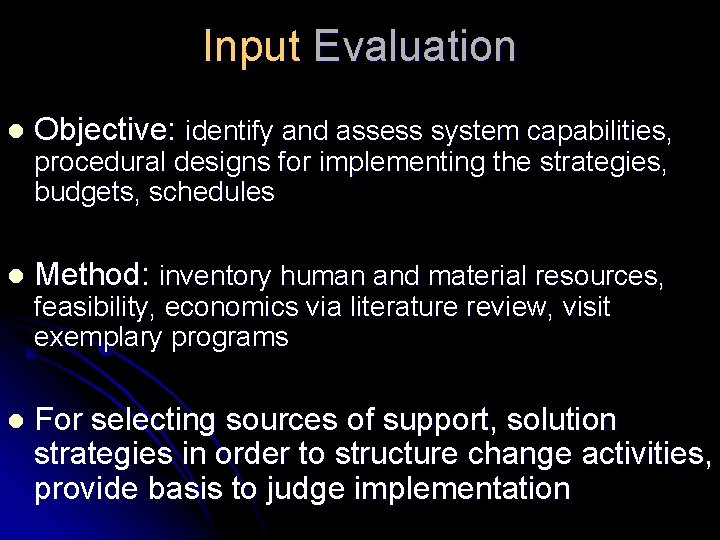
Input Evaluation l Objective: identify and assess system capabilities, l Method: inventory human and material resources, l For selecting sources of support, solution strategies in order to structure change activities, provide basis to judge implementation procedural designs for implementing the strategies, budgets, schedules feasibility, economics via literature review, visit exemplary programs
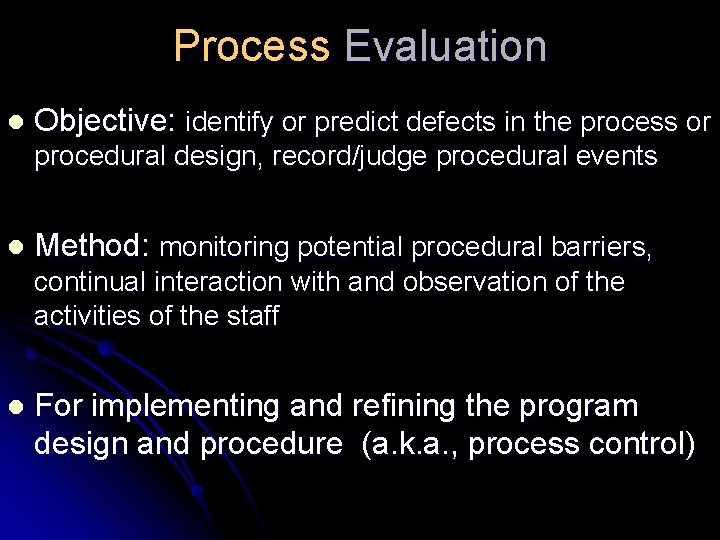
Process Evaluation l Objective: identify or predict defects in the process or procedural design, record/judge procedural events l Method: monitoring potential procedural barriers, continual interaction with and observation of the activities of the staff l For implementing and refining the program design and procedure (a. k. a. , process control)
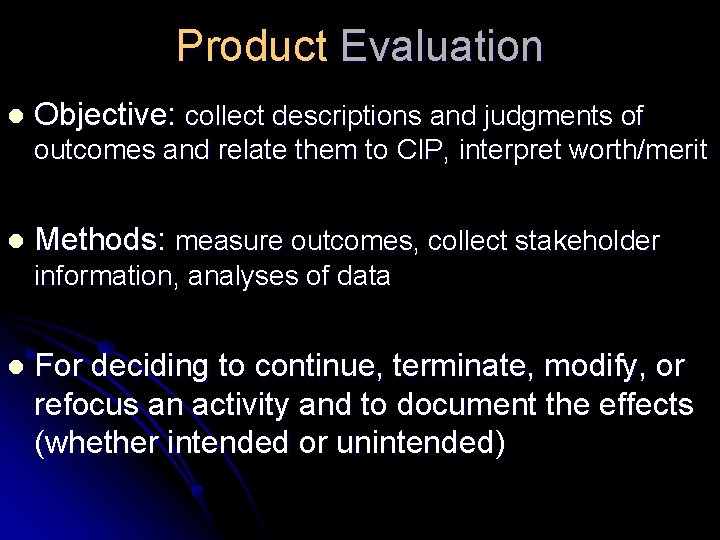
Product Evaluation l Objective: collect descriptions and judgments of outcomes and relate them to CIP, interpret worth/merit l Methods: measure outcomes, collect stakeholder information, analyses of data l For deciding to continue, terminate, modify, or refocus an activity and to document the effects (whether intended or unintended)
Uses of Management-oriented Approaches to Evaluation l CIPP has been used in school districts, state and federal government agencies l Useful guide for program improvement l Accountability l Figure 5. 1 (p. 94) l Formative and summative aspects of CIPP
Management-oriented Pros/Cons l Strengths: appealing to many who like rational, orderly approaches, gives focus to the evaluation, allows formative and summative evaluation l Weaknessws: preference given to top management, can be costly and complex, assumes important decisions can be identified in advance of the evaluation
REVIEW/Qs Why are there so many alternative approaches to evaluation? l What two conceptual approaches to evaluation did we discuss tonight? What are their +/-? l Which, if either, of these approaches do you think will work for your evaluation object? l l Identify your most likely evaluation object