Regents Review Constitutional Principles Elastic Clause l Definition


- Slides: 18
Regents Review Constitutional Principles
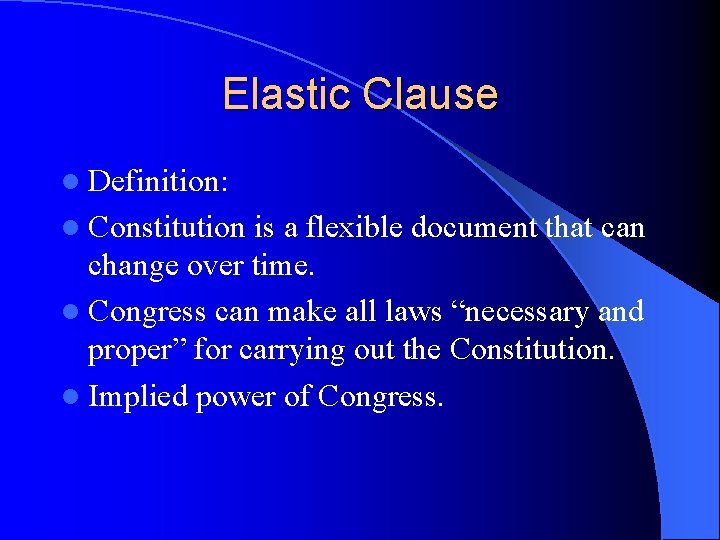
Elastic Clause l Definition: l Constitution is a flexible document that can change over time. l Congress can make all laws “necessary and proper” for carrying out the Constitution. l Implied power of Congress.
Elastic Clause l Example: Louisiana Purchase l 1803 - Jefferson can double the size of the U. S. with the Louisiana Purchase. l Supporting the purchase meant adopting a loose interpretation of the Constitution. l Did President have the right to buy the land? Constitution gave him the right to make treaties.
Elastic Clause- Louisiana Purchase l 1803 - Senate agreed. l Purchase from France for 15 million dollars. l Doubled the size of the U. S. l Gained the Mississippi River. l Lewis and Clark expedition.
Separation of Powers l Definition: l Enlightenment idea- Montesquieu l Government is divided among legislative, executive and judicial branches. l Make sure no single branch can dominate government. l Each branch gets its power from the Constitution.
Separation of Powers: Example l l l Legislature- makes laws. Declare war Override a veto Approve Presidential appointments. Approve treaties. Impeach. l l l Executive- enforces laws and treaties. Veto laws Commander in chief Appoints judges Makes treaties.
Separation of Powers (continued) l Judicial- explains and interprets the laws. l Settles disputes between state and Federal government. l Settles disputes involving foreign ambassadors.
Federalism l Definition: l Articles of Confederation gave too much power to the state governments. l Federalism divides power between the state and Federal government.
Federalism: Example l l l Delegated- powers given to the Federal government. Maintain army & navy Declare war Coin money Regulate trade Make all laws “necessary and proper” l l l Reserved- Powers granted to state governments. Education & schools Marriage and professional licenses. Motor vehicles Regulate businesses within a state.
Federalism- continued l Concurrent- powers shared by both the state and Federal government. l Enforce laws l Taxes l Build roads l Establish courts
Judicial Review l Definition: l Example of the “unwritten” Constitution. l Right of Federal courts to review a law and declare the law unconstitutional. l Supreme Court has the final determination.
Judicial Review- Example l Marbury v. Madison l Presidential election of 1800 Jefferson defeats Adams. l Election decided Feb. 1801. Jefferson did not take office until March 1801. l Adams and the Federalist controlled Congress passed Judiciary Act- creating a number of new courts.
Judicial Review- Marbury v. Madison (continued) l March 2 nd Adams appointed 42 Federalists to these courts. l Following day Senate approved the appointments. l One of the judges was William Marbury appointed Justice of the Peace in the District of Colombia. l At noon, Adams left office, Jefferson inaugurated.
Marbury v. Madison (continued) l Marbury’s commission was signed by Adams and Marshall (Secretary of State at the time). l Marshall had been appointed Chief Justice. l Jefferson voided 25 of the 42 commissions including Marbury because they had not been delivered by the days end.
Marbury v. Madison (continued) l Jefferson ordered Madison (new Secretary of State) not to deliver the commissions. l Marbury sues Madison. l Decision: February 1803 - Marshall declares the Judiciary Act unconstitutional.
Checks and Balances l Definition: l Enlightenment idea- Montesquieu l Gives each branch a way to check/control the other branch. l Prevents one branch from having too much power.
Checks and Balances: Example l. A bill becoming a law: l Bill introduced into the House or Senate. l Needs majority vote. l Must go through same process in other house. l Bill goes to President. l He signs it- bill becomes a LAW.
Checks and Balances: Example (continued) l President vetoes- bill goes back to Congress. l Congress can override with 2/3 rd vote and bill becomes a LAW. l Supreme Court can interpret the law and declare the law unconstitutional (Judicial Review).