Real Estate and Land Use From DW Ch




- Slides: 12
Real Estate and Land Use From DW – Ch 1 © Allen C. Goodman, 2000
Linkages • Real estate is a useful linkage to land use theory and actual land usage. • Demand for real estate (use of space) comes from occupiers of space. They are willing to rent the use of space. • For firms, space is a factor of production. • For households space is a commodity • Supply of real estate comes from the construction sector and depends on the price of those assets relative to the cost of replacing or constructing them.
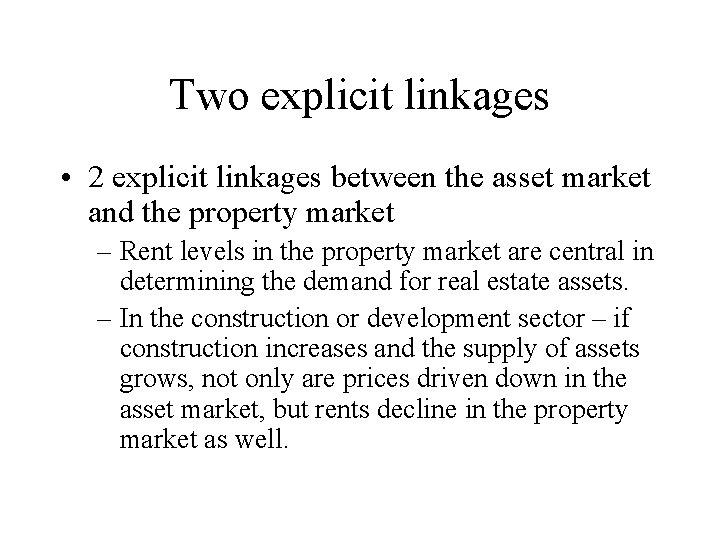
Two explicit linkages • 2 explicit linkages between the asset market and the property market – Rent levels in the property market are central in determining the demand for real estate assets. – In the construction or development sector – if construction increases and the supply of assets grows, not only are prices driven down in the asset market, but rents decline in the property market as well.
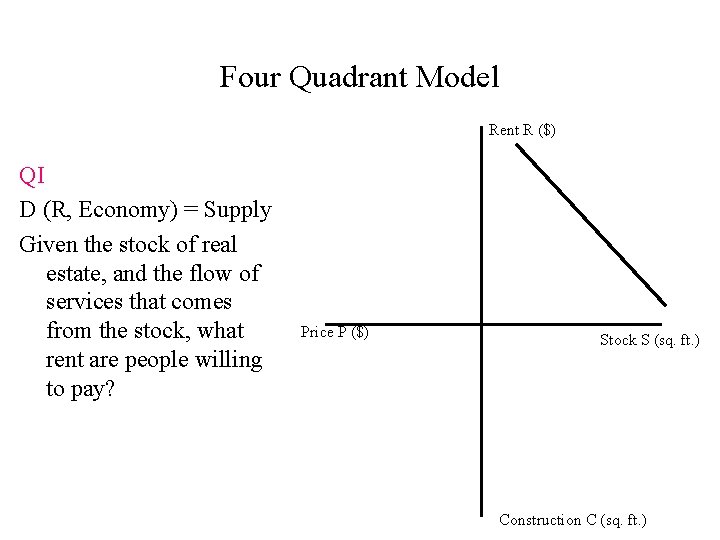
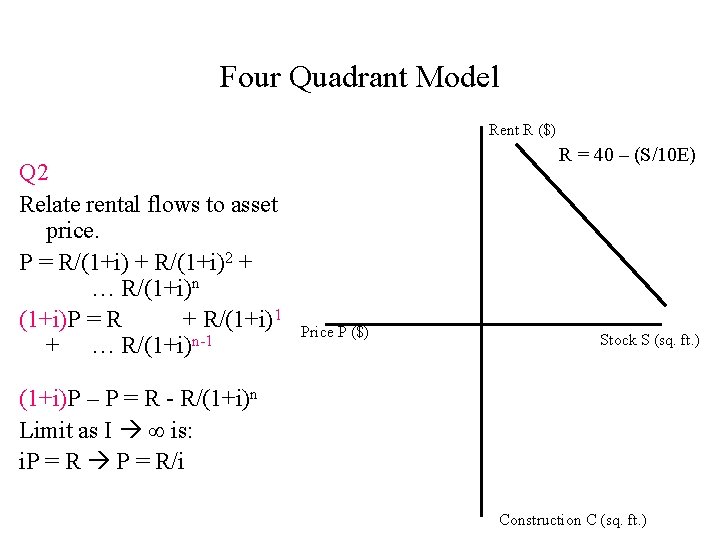
Four Quadrant Model Rent R ($) QI D (R, Economy) = Supply Given the stock of real estate, and the flow of services that comes from the stock, what rent are people willing to pay? Price P ($) Stock S (sq. ft. ) Construction C (sq. ft. )
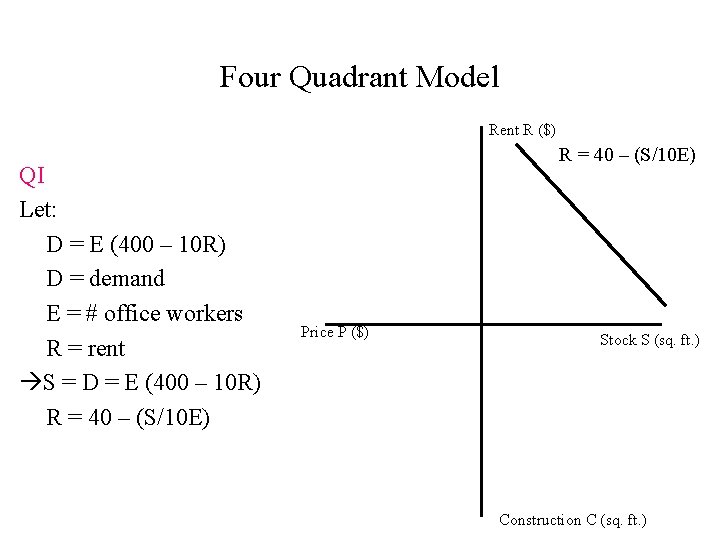
Four Quadrant Model Rent R ($) QI Let: D = E (400 – 10 R) D = demand E = # office workers R = rent S = D = E (400 – 10 R) R = 40 – (S/10 E) Price P ($) Stock S (sq. ft. ) Construction C (sq. ft. )
Four Quadrant Model Rent R ($) Q 2 Relate rental flows to asset price. P = R/(1+i) + R/(1+i)2 + … R/(1+i)n (1+i)P = R/(1+i) + R/(1+i)1 + … R/(1+i)n-1 R = 40 – (S/10 E) Price P ($) Stock S (sq. ft. ) (1+i)P – P = R - R/(1+i)n Limit as I is: i. P = R/i Construction C (sq. ft. )
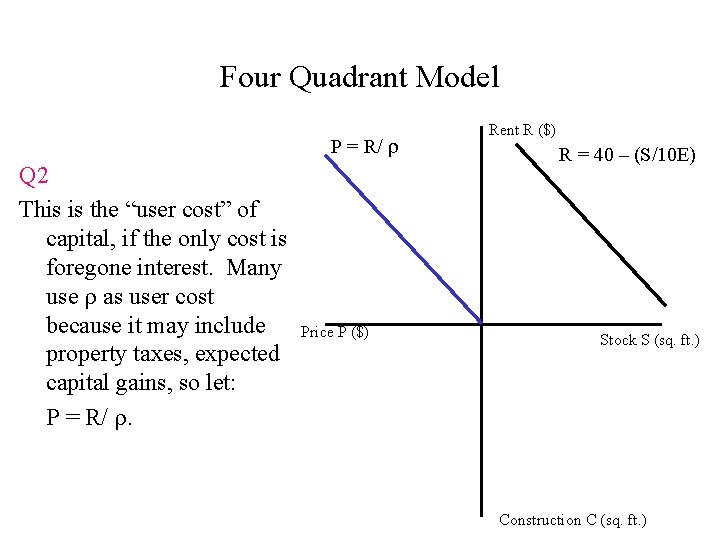
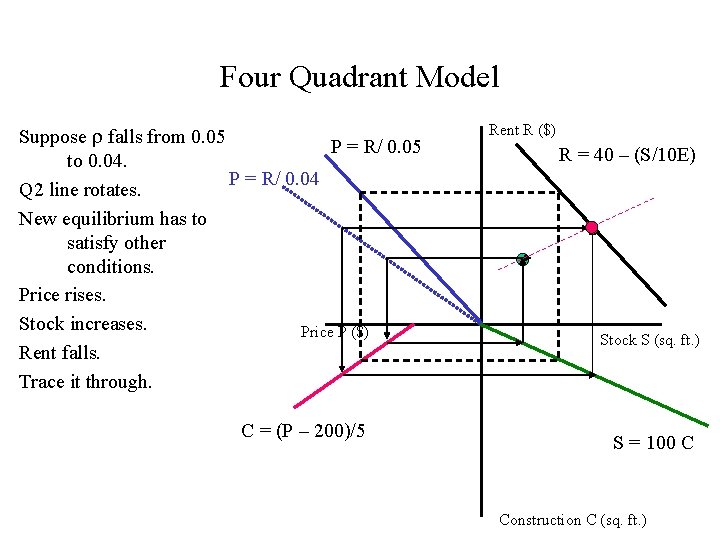
Four Quadrant Model P = R/ Q 2 This is the “user cost” of capital, if the only cost is foregone interest. Many use as user cost because it may include property taxes, expected capital gains, so let: P = R/ . Price P ($) Rent R ($) R = 40 – (S/10 E) Stock S (sq. ft. ) Construction C (sq. ft. )
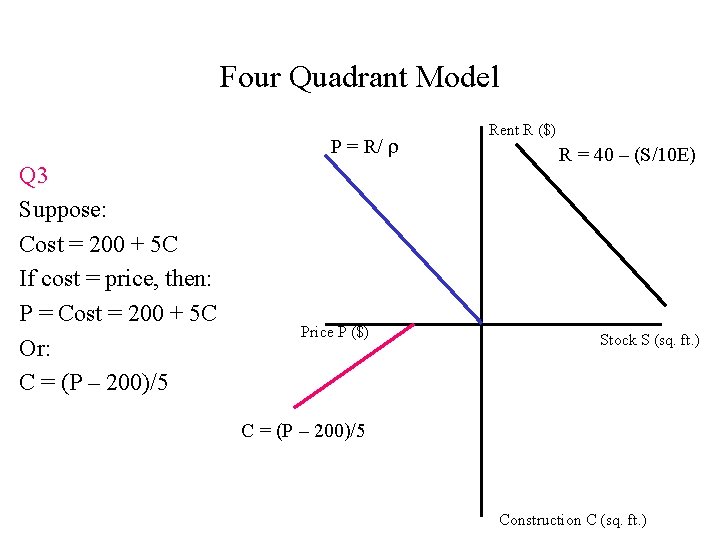
Four Quadrant Model P = R/ Q 3 Real estate construction. Presumably some minimum cost. Eq’m occurs at the point that replacement cost = real estate prices. Why? Lower C excess profits Higher C unprofitable Price P ($) Rent R ($) R = 40 – (S/10 E) Stock S (sq. ft. ) Construction C (sq. ft. )
Four Quadrant Model P = R/ Q 3 Suppose: Cost = 200 + 5 C If cost = price, then: P = Cost = 200 + 5 C Or: C = (P – 200)/5 Price P ($) Rent R ($) R = 40 – (S/10 E) Stock S (sq. ft. ) C = (P – 200)/5 Construction C (sq. ft. )
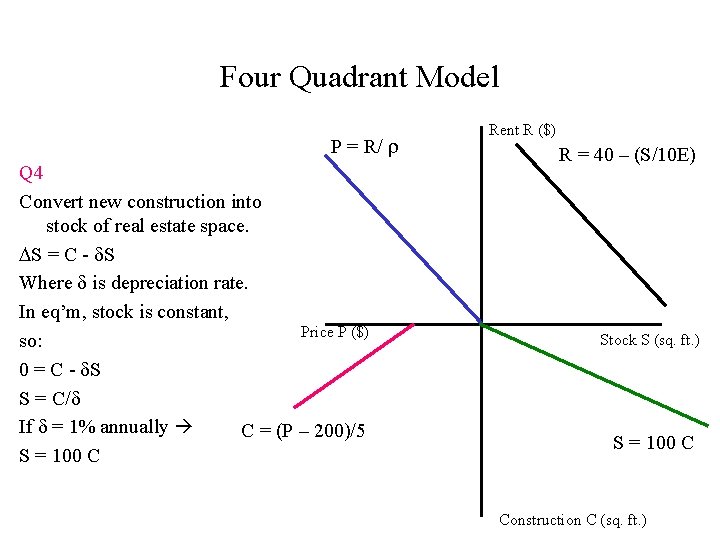
Four Quadrant Model P = R/ Q 4 Convert new construction into stock of real estate space. S = C - S Where is depreciation rate. In eq’m, stock is constant, Price P ($) so: 0 = C - S S = C/ If = 1% annually C = (P – 200)/5 S = 100 C Rent R ($) R = 40 – (S/10 E) Stock S (sq. ft. ) S = 100 C Construction C (sq. ft. )
Four Quadrant Model Rent R ($) P = R/ 0. 05 (1) (2) (3) R = 40 – (S/10 E) C = (P – 200)/5 S = 100 C, and (4) S = [E/(i. E +2)][800 – 4000 i] 320 If E = 10 m; i = 0. 5, Price P ($) S = 240 sq. ft. /worker 1. 24 m sq. ft. of C/yr. 2. Rents = $16/sq. ft. C = (P – 200)/5 3. P = $320/sq. ft. R = 40 – (S/10 E) 16 240 Stock S (sq. ft. ) 24 S = 100 C Construction C (sq. ft. )
Four Quadrant Model Suppose falls from 0. 05 P = R/ 0. 05 to 0. 04. P = R/ 0. 04 Q 2 line rotates. New equilibrium has to satisfy other conditions. Price rises. Stock increases. Price P ($) Rent falls. Trace it through. C = (P – 200)/5 Rent R ($) R = 40 – (S/10 E) Stock S (sq. ft. ) S = 100 C Construction C (sq. ft. )